
Do Air Source Heat Pumps Work in Winter? UK Guide 2026
Check Your Eligibility for Boiler Upgrade Scheme (BUS)
Complete your details below to check your eligibility.
Thank you
We've received your details and will be in touch shortly.

Quick answer: do air source heat pumps work in winter?
Yes. Air source heat pumps continue extracting heat from outdoor air below 0°C. Many modern models operate well below typical UK winter temperatures, although exact operating limits and heating outputs vary by model.
Cold weather reduces efficiency because the heat pump must lift heat from a colder source to the temperature needed indoors. Energy Systems Catapult’s final UK heat-pump research found a median whole-system COP of 2.57 at 0°C and 2.30 at -5°C across monitored air source systems. The systems were still producing substantially more heat than the electrical energy they consumed.
Do Air Source Heat Pumps Work in Winter? UK Cold-Weather Guide
Yes. A correctly designed air source heat pump can heat a UK home throughout winter, including during sub-zero weather. As temperatures fall, the system does not suddenly stop working. Instead, the home needs more heat while the heat pump usually becomes less efficient.
That distinction matters. A unit may still operate at -5°C, yet a poorly sized system, small radiators or unnecessarily high flow temperatures can make the home harder or more expensive to heat. This guide explains winter performance, defrost cycles and the checks that matter before installation.
Considering a heat pump? Compare property-specific options rather than relying on a headline kW rating. Compare free quotes for your home
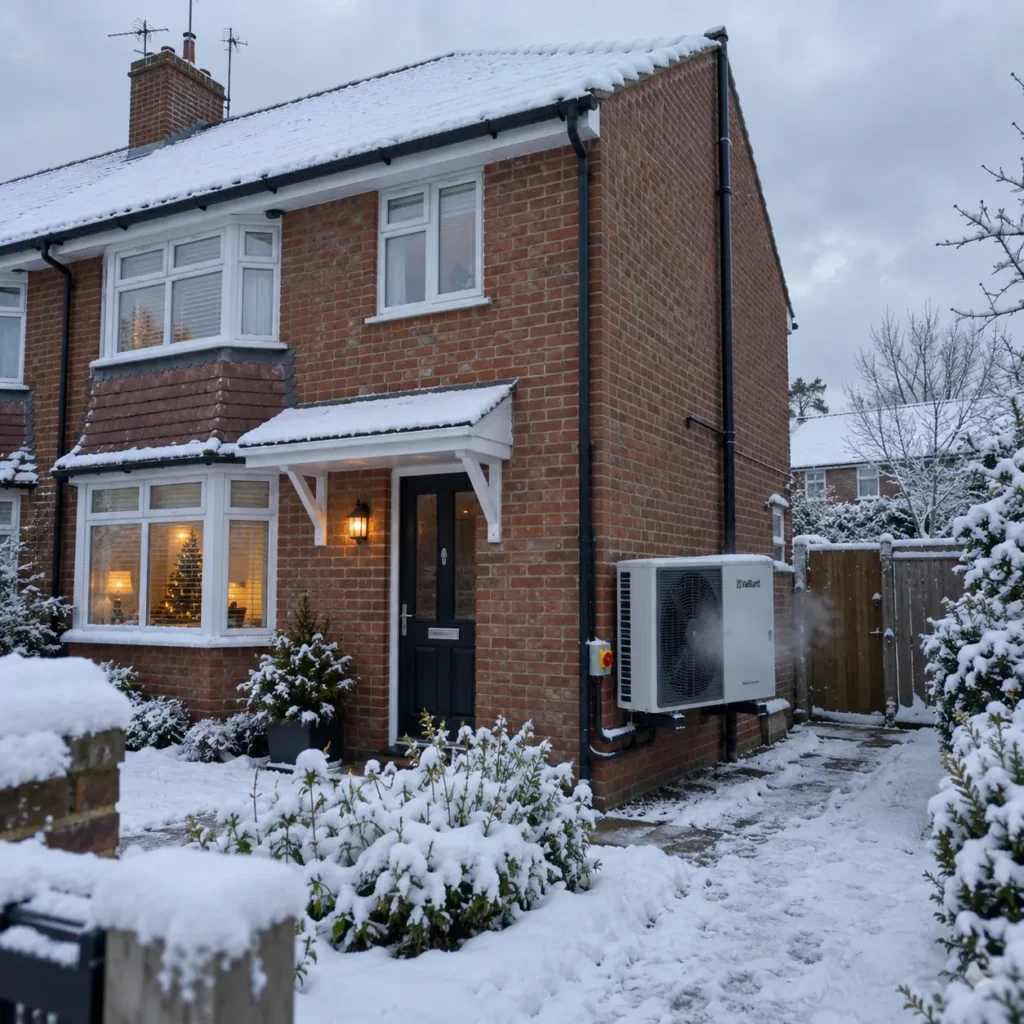
Air source heat pump winter performance at a glance
| Outdoor condition | What normally happens | Homeowner takeaway |
|---|---|---|
| Mild winter weather | High efficiency and lower heat demand | Lower flow temperatures may be possible |
| Around 0°C | Efficiency falls as heat demand rises | Normal winter operation |
| Around -5°C | Lower COP and possible defrost cycles | Correct sizing becomes critical |
| Colder conditions | Output depends heavily on the model | Check manufacturer low-temperature capacity data |
Do air source heat pumps work below freezing?
Yes. Reaching 0°C does not make an air source heat pump stop. There is still thermal energy in cold air, and the refrigerant circuit can collect and upgrade that energy for heating.
Energy Saving Trust’s current heat-pump guidance notes that heat pumps can perform down to around -15°C or lower. However, the useful buying figure is not a generic minimum operating temperature. It is the heat output your proposed unit can deliver at the winter temperature used to design your system.
A heat pump can technically run at a very low temperature but still be too small for a particular property. That is why cold-weather capacity matters more than a marketing claim about the lowest operating temperature.
For the wider relationship between outdoor, flow and room temperatures, see the air source heat pump temperature guide.
How does a heat pump find heat in cold air?
The refrigeration cycle works the same way in January as it does in October. A fan moves outdoor air across an evaporator containing refrigerant. The refrigerant absorbs heat and evaporates. A compressor raises its pressure and temperature, then a condenser transfers that heat into the home’s heating water.
The colder the outdoor air and the hotter the water required indoors, the harder the compressor must work. That is why lower-temperature radiators or underfloor heating can help efficiency.
Visual suggestion: A simple four-stage diagram showing the evaporator, compressor, condenser and expansion valve, with a winter outdoor temperature shown beside the evaporator.
How much does efficiency fall in cold weather?
COP, or Coefficient of Performance, shows how much useful heat a system produces for each unit of electricity at a given operating point. A COP of 3 means about 3kWh of heat for 1kWh of electricity.
The Department for Energy Security and Net Zero-funded Electrification of Heat project recorded these median whole-system COP figures for air source heat pumps:
| Outside temperature | Median whole-system COP |
|---|---|
| 0°C | 2.57 |
| -1°C | 2.50 |
| -3°C | 2.37 |
| -5°C | 2.30 |
| -6°C | 2.32 |
On each property’s coldest analysed day, the report found a median whole-system COP of 2.27, with a mean outdoor temperature of -4.15°C.
These figures are not a prediction for every home. They cover many properties and systems. However, they show that cold weather reduced performance without eliminating the heat pump’s efficiency advantage over direct electric heating.
For the wider annual picture, see the air source heat pump efficiency guide.
Visual suggestion: Turn the Catapult temperature/COP figures into a simple line graph. Clearly label them as monitored whole-system median figures rather than manufacturer test data.
What is a heat pump defrost cycle?
Frost on the outdoor coil is normal in cold, damp weather. As the evaporator extracts heat, its surface can fall below 0°C and moisture can freeze on it.
A modern heat pump detects this and automatically starts a defrost cycle. It briefly redirects heat to clear the coil, protecting airflow and heat transfer. You may notice the fan stop, water draining beneath the unit, visible vapour or a short pause in space heating.
A brief defrost is not a fault. Persistent heavy ice that will not clear, blocked drainage, recurring fault codes or a noticeable loss of heating performance should be investigated. Manufacturer cold-weather guidance also describes automatic defrosting as a normal response to cold, humid conditions.
Visual suggestion: Side-by-side photographs labelled “normal temporary frost” and “persistent ice requiring investigation”.
Why winter output matters as much as winter efficiency
Your home loses more heat as the outdoor temperature falls. At the same time, a heat pump may provide less capacity or need more electricity than it does in mild weather.
A good design therefore starts with a room-by-room heat-loss calculation. MCS heat-load guidance says this should consider building fabric, room dimensions, air-change rates, desired internal temperatures and the lowest external winter temperature.
Ask the installer to show your calculated design heat loss and the proposed heat pump’s output at that same temperature. Avoid selections based only on floor area, bedroom count or the nominal model name.
For more detail, see what size air source heat pump do I need?
Radiators and flow temperature in winter
Heat pumps generally operate more efficiently when the water sent to radiators is cooler. However, the radiators must still release enough heat to each room on a cold day.
Larger radiators can provide more heat at a lower water temperature because they have more surface area. Underfloor heating can work well for the same reason. This does not mean every radiator needs replacing; each emitter should be checked against the room’s calculated heat loss.
If a quote predicts strong efficiency at 35°C flow temperature but your radiators need 50°C to keep the house warm, that estimate does not reflect the system you will actually use.
See heat pump radiators for a fuller explanation.
Does insulation affect winter performance?
Insulation reduces the building’s heat loss. A home that loses less heat needs less output from the heat pump and may stay comfortable at lower flow temperatures.
Poor insulation does not automatically make a heat pump impossible. Energy Systems Catapult’s demonstration project installed heat pumps across a broad range of property types and ages; 68% of participating properties were built before 1980.
The key question is whether the complete heating system can meet the property’s calculated demand. Fabric improvements should therefore form part of the heat-loss and comfort assessment rather than act as a blanket pass-or-fail test.
How to run an air source heat pump efficiently in winter
Heat pumps usually work best when maintaining a fairly steady indoor temperature rather than repeatedly reheating a cold property.
Energy Saving Trust recommends using the heating curve, or weather compensation, so the system adjusts its heating-water temperature as outdoor conditions change. It also advises running heat pumps for longer periods and using the lowest practical flow temperature that still keeps the home comfortable.
In practice, keep the outdoor unit free from leaves and obstructions, allow defrost water to drain and avoid large thermostat setbacks unless your system has been designed for them. Do not increase the flow temperature simply because heat-pump radiators feel cooler than radiators connected to a traditional boiler.
When winter behaviour may indicate a problem
Longer run times, warm rather than very hot radiators, light frost and occasional defrost cycles can all be normal.
Thick ice that remains after defrost, recurring fault codes, frozen drainage, rooms that never reach their design temperature or frequent direct-electric backup during ordinary winter conditions deserve investigation.
Possible causes include undersizing, insufficient radiator output, poor weather-compensation settings, restricted hydraulic flow or a fault. The right response is diagnosis rather than simply increasing every temperature setting.
Is an air source heat pump suitable for your home in winter?
The most useful question is not simply, “Will a heat pump work in winter?” It is: “Will this proposed heat pump, at this flow temperature, cover my home’s heat loss on a cold day?”
Before accepting a quote, ask for the room-by-room heat-loss calculation, design outdoor temperature, design flow temperature, radiator outputs and the heat pump’s published capacity at those conditions. Also ask when any immersion or backup heater is expected to operate.
Eligible installations in England and Wales currently receive £7,500 towards an air-to-water heat pump through the Boiler Upgrade Scheme. Qualifying off-gas-grid properties replacing oil or LPG can currently receive £9,000, with that uplift available until 31 March 2027. Check the current GOV.UK Boiler Upgrade Scheme rules before relying on grant figures.
CTA: If you are comparing systems, ask each installer to show how their proposed heat pump performs at your property’s winter design temperature—not just its nominal headline output.
Get Your Free Air Source Heat Pump Quote
Find the right air source heat pump solution for your home. Tell us a few details and our team will help you explore suitable options at a competitive price.
Quick to complete. No obligation.
Get your quote
Enter your details below and one of our team will get back to you.
Frequently asked questions
Find clear answers to common questions about air source heat pump performance in winter, including operation below zero, efficiency, defrost cycles, radiators, insulation, hot water, cold-weather electricity use and system design.
Yes. Energy Systems Catapult recorded a median whole-system COP of 2.30 at -5°C across its monitored air source heat pumps. Actual performance varies between homes and systems.
No. Freezing point is not an operating cut-off. A suitable heat pump continues extracting heat from outdoor air below zero.
Many models can, but the operating range is model-specific. More importantly, check how much heating capacity the model retains at that temperature.
Yes, some systems are designed to operate at -15°C or lower. Energy Saving Trust notes that modern heat pumps can perform at these temperatures, although additional heating may sometimes be used if output becomes insufficient.
The heat pump must move heat across a larger temperature difference. Your home also loses heat faster in colder weather, increasing the total heating demand.
Heat pumps generally work efficiently when maintaining a steady temperature for extended periods rather than repeatedly reheating a cold house. Energy Saving Trust recommends longer operating periods and appropriate heating-curve settings.
That can be normal. Heat pumps often use lower flow temperatures than boilers and provide gentler heat for longer periods.
Not necessarily. Each radiator should be assessed against the room's heat loss at the proposed flow temperature. Some existing radiators may already be large enough.
It removes frost from the outdoor heat exchanger so air can continue flowing freely across the coil. Defrosting happens automatically.
Often, yes. Visible vapour can appear while frost melts during a defrost cycle. Persistent ice or fault codes are more concerning than temporary vapour.
It temporarily reduces efficiency because energy is used to clear the outdoor coil. However, defrosting is necessary to maintain efficient heat transfer.
There is no universal timetable. Frequency depends on outdoor temperature, humidity, the heat pump and its operating conditions. Cold, damp weather can produce more frost than dry cold weather.
Potentially, yes. Poor insulation increases heat loss, so the heat pump and radiators need sufficient capacity. Improving insulation can reduce heat demand and make lower flow temperatures easier to achieve.
Yes. An air-to-water heat pump can provide both space heating and stored domestic hot water. Hot-water production normally requires higher temperatures and can therefore operate less efficiently than space heating.
A properly designed system should be sized around the chosen indoor design temperatures. The heat-loss calculation must account for both the target room temperature and local winter outdoor conditions.
Yes, provided the system is designed using an appropriate local outdoor design temperature and has enough cold-weather output. Climate should form part of the heat-loss and equipment-selection process.
Usually, yes. Heat demand increases while COP generally falls, so electricity consumption can rise even when the system is working normally.
Ask for the design heat loss, design outdoor temperature, design flow temperature, cold-weather heat-pump capacity, proposed radiator outputs and expected use of any backup heating.
Conclusion
Air source heat pumps do work in winter. They do not suddenly stop at freezing point, and real UK monitoring shows that systems can continue delivering substantially more heat than the electricity they consume even around -5°C.
The winter questions that matter are capacity, flow temperature, radiator output, defrost behaviour and the home’s heat loss. A system designed around those conditions can provide steady heating through a UK winter.
Before deciding, compare the cold-weather figures behind each quote rather than looking only at the nominal heat-pump size.


