
How to Hide an Air Source Heat Pump Safely | UK Guide
Check Your Eligibility for Boiler Upgrade Scheme (BUS)
Complete your details below to check your eligibility.
Thank you
We've received your details and will be in touch shortly.

Quick Answer: Can You Hide an Air Source Heat Pump?
Yes. You can conceal an air source heat pump with an open screen, landscaping or a properly engineered enclosure, provided you do not obstruct manufacturer-required airflow, drainage, refrigerant safety zones or service access. Never assume a decorative box is suitable simply because the heat pump fits inside it. Clearances vary by model and by side of the unit. For example, Vaillant publishes different minimum gaps around its aroTHERM plus, including substantially more space in some directions than others. A solid barrier can also affect noise calculations, so it should ideally form part of the installation design rather than being added later without checking.
How to Hide an Air Source Heat Pump Safely: Screens, Covers and Garden Ideas
Yes, you can hide an air source heat pump, but you should not simply box it in. The outdoor unit needs a steady flow of air through its heat exchanger, plus clear space for servicing, drainage and safe operation. Energy Saving Trust specifically notes that an outdoor heat-pump unit needs space around it to maintain good airflow.
The safest approach is usually to make the heat pump less visible rather than fully enclose it. Open slatted screens, carefully positioned fencing, planting set well back from the unit or a purpose-designed acoustic enclosure can all work. However, the exact clearances must come from the manufacturer’s instructions for your particular model.
This guide explains how to hide an air source heat pump safely, which ideas work best, what to avoid and how UK planning and noise rules affect screening.
Considering a heat pump? Compare heat-pump quotes through Get Free Quote before settling on the outdoor-unit position. The easiest time to reduce its visual impact is during the design stage.
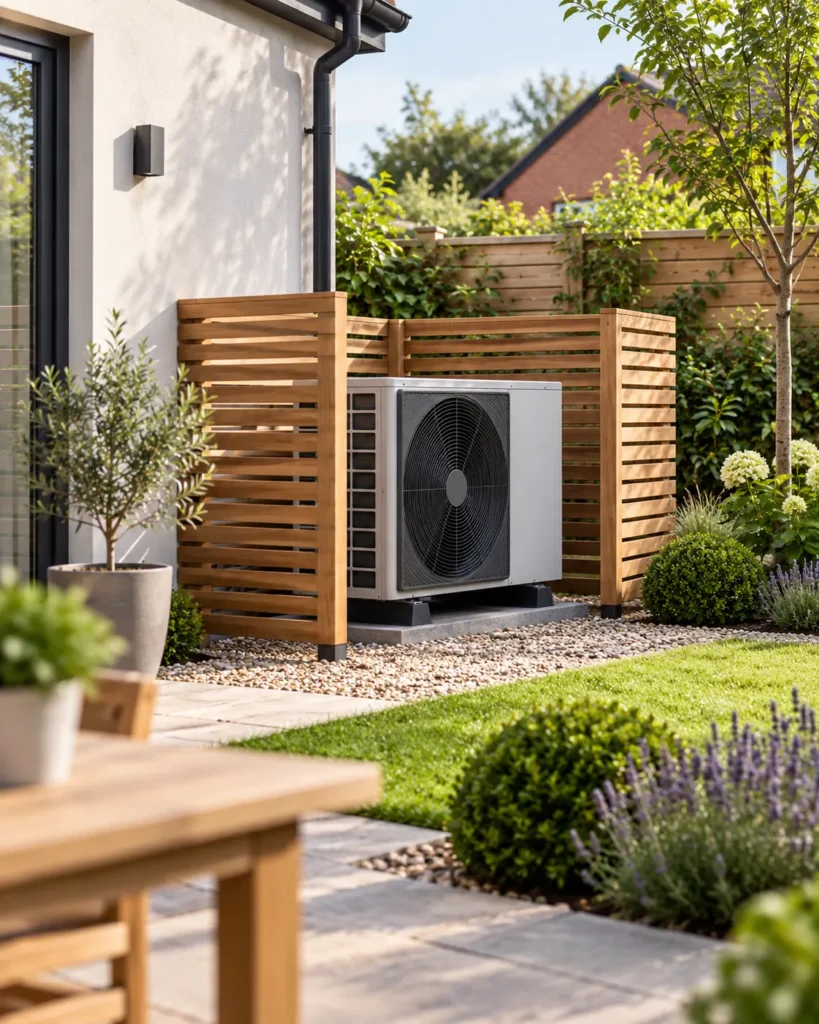
Can an Air Source Heat Pump Be Hidden Safely?
Yes, if “hidden” means visually screened rather than sealed inside a tight box.
An air source heat pump works by moving outdoor air across a heat exchanger. Its fan therefore needs an unobstructed route for air to enter and leave the unit. MCS guidance says air source heat pumps need careful siting to maintain adequate airflow and control unacceptable sound transmission.
Do not rely on a universal rule such as “leave 300 mm all round”. Manufacturer requirements vary significantly.
For example, Vaillant’s current aroTHERM plus literature specifies different minimum distances on different sides of the unit. Some installations also have refrigerant-related safety zones around doors, windows, drains, ignition sources or other openings.
The basic principle is simple: the screen must fit around the heat pump’s operating requirements, not the other way around.
For a deeper look at the positioning rules, see the air source heat pump location guide.
Best Ways to Hide an Air Source Heat Pump
1. Use an Open Slatted Screen
A timber or metal slatted screen is often the most straightforward solution.
It can break the direct sightline from a patio, window or seating area while leaving the outdoor unit open to moving air. Vaillant itself identifies privacy screens and suitably specified custom enclosures as possible ways to disguise a heat pump, while stressing the need to preserve airflow and servicing access.
Keep any screen outside every manufacturer-specified clearance. The slats should not sit directly against either the air intake or fan discharge.
A hinged or removable section can also make future servicing easier.
2. Use Planting — but Keep It Under Control
Shrubs, ornamental grasses and planting beds can soften the appearance of an outdoor heat-pump unit without creating a hard enclosure.
However, plants grow.
A shrub that sits safely away from the heat pump when first planted could reach the heat exchanger or service area after several growing seasons. Fallen leaves can also collect around the unit.
Use plants as a distant visual screen, rather than creating a dense living wall immediately around the heat pump. Keep vegetation trimmed and maintain a clear route for servicing.
3. Hide the View Rather Than the Heat Pump
Sometimes the safest solution is to screen the heat pump from the place where you actually see it.
For example, a short garden screen positioned between the heat pump and your patio may hide most of the unit from view while leaving several feet of open air around the equipment.
This can be much better technically than building a close-fitting three-sided box.
It also gives you more freedom to integrate the screen into fencing, planting or an existing garden design.
4. Consider a Purpose-Designed Acoustic Enclosure
If noise as well as appearance concerns you, a specialist acoustic enclosure may be appropriate.
Unlike an ordinary timber box, these products use engineered air passages and acoustic materials so that ventilation can continue while sound is controlled.
Professional design matters. Adding solid boards around a heat pump can alter both airflow and sound reflections.
If your proposed installation is still at the design stage, the air source heat pump installation guide explains the other siting and commissioning checks that should happen before work starts.
Which Heat-Pump Hiding Method Works Best?
| Method | Visual effect | Airflow risk | Maintenance access | Best use |
|---|---|---|---|---|
| Open slatted screen | High | Low if correctly positioned | Good | Most gardens |
| Planting set back | Medium–high | Low if maintained | Good | Soft landscaping |
| Distant garden screen | High from one viewpoint | Usually low | Very good | Patios and seating areas |
| Close decorative box | High | Potentially high | Often poor | Only with specific approval |
| Engineered acoustic enclosure | High | Controlled by design | Designed in | Noise-sensitive locations |
For most homes, the lowest-risk approach is a screen that interrupts the main sightline while leaving generous open space around the heat pump.
How Much Space Should You Leave Around a Heat Pump Cover?
There is no single UK clearance that applies to every air source heat pump.
Your installer should use the exact installation manual for the selected unit.
For example, Vaillant’s aroTHERM plus documentation lists minimum clearances including 100 mm in one direction and 1,000 mm in another, with other distances between 200 mm and 600 mm depending on the side and operating arrangement.
Those numbers should not be copied to another manufacturer’s heat pump. They simply demonstrate why generic enclosure dimensions can be misleading.
Your proposed screening also needs to preserve space for:
- removing service panels;
- cleaning and inspecting the heat exchanger;
- pipework and electrical work;
- safe condensate and defrost-water drainage;
- any refrigerant safety zone;
- leaves, snow and future plant growth;
- unobstructed intake and discharge airflow.
If space is particularly tight, see the dedicated air source heat pump space requirements guide before choosing an enclosure.
Can a Screen Reduce Air Source Heat Pump Noise?
Sometimes, but a visual screen is not automatically an acoustic screen.
The MCS planning calculation allows specific corrections for qualifying solid barriers between an air source heat pump and a neighbouring assessment position. Depending on how completely the barrier blocks the relevant line of sight, the method can apply a defined noise reduction.
However, this does not mean that putting up any fence will solve a noise issue.
Height, position, solidity and geometry all matter. Nearby walls can also reflect sound.
If neighbour noise is a concern, ask the installer to assess the proposed barrier as part of the MCS calculation rather than adding one after commissioning and assuming it will help.
Does Hiding a Heat Pump Affect Planning Permission?
Potentially.
Planning rules vary across England, Wales, Scotland and Northern Ireland. A fence, permanent enclosure or other structure can also have planning implications separate from those applying to the heat pump.
In England, an air source heat pump can qualify as permitted development if all relevant requirements are satisfied. Current rules include compliance with MCS 020a and, for houses, a maximum outdoor compressor-unit volume of 1.5 cubic metres. The former restriction requiring the unit to remain at least one metre from the property boundary was removed in May 2025. Restrictions still apply to certain roof positions, listed buildings and designated locations.
You can check the detailed implications in the air source heat pump planning permission guide.
Wales changed its domestic air-source heat-pump permitted-development rules on 1 June 2026. Current Welsh guidance requires MCS 020(a) compliance and includes separate conditions covering the number of units and visual impact.
Scotland and Northern Ireland have separate planning systems. If your property is listed, within a conservation area, leasehold or otherwise restricted, check the applicable rules before installing permanent screening.
What Should You Avoid When Hiding an Air Source Heat Pump?
Avoid anything that treats the outdoor unit like a boiler that can simply be placed inside a cupboard.
Do not wrap the heat pump, place a close-fitting solid lid over it, pack planting around the heat exchanger or build a tight shed-style enclosure without approval from the manufacturer or installer.
You should also avoid screens that prevent engineers reaching service panels or that discharge air into a narrow corner where it can recirculate.
Be cautious with homemade “soundproof” boxes. Controlling noise while still moving the required volume of air is an acoustic and ventilation problem, not simply a matter of adding heavy material.
Most importantly, do not choose a poor heat-pump position first and assume landscaping will solve it afterwards. Location affects airflow, noise, drainage, pipe runs, maintenance and appearance simultaneously.
How to Plan Concealment Before Installation
If you have not installed the heat pump yet, discuss its appearance during the survey rather than after commissioning.
Ask the installer to show you the proposed footprint, clearances and sightlines before approving the position.
A sensible sequence is:
- Identify technically suitable locations.
- Check manufacturer clearances and refrigerant safety zones.
- Complete the required noise assessment.
- Confirm drainage and servicing access.
- Decide which views of the heat pump you most want to hide.
- Design screening outside the required operating space.
- Confirm that the screening does not conflict with manufacturer requirements.
This turns concealment into part of the installation rather than an improvised garden project afterwards.
Get Your Free Air Source Heat Pump Quote
Find the right air source heat pump solution for your home. Tell us a few details and our team will help you explore suitable options at a competitive price.
Quick to complete. No obligation.
Get your quote
Enter your details below and one of our team will get back to you.
Frequently asked questions
Find clear answers to common questions about hiding and screening air source heat pumps, including covers, fences, planting, enclosures, sheds, airflow, noise, clearances, winter protection, planning and installer considerations.
Usually not with an ordinary solid cover. The outdoor unit requires continuous airflow, so complete enclosure can interfere with its operation. Any full enclosure should be purpose-designed and approved for the specific heat pump.
Yes, provided the screen remains outside the manufacturer's required clearances and does not restrict the intake, discharge airflow or maintenance access.
Potentially. The distance and design matter because the fan needs space to discharge air freely. Check the exact manufacturer's clearance before installing the fence.
Yes. Planting can soften the visual impact if shrubs and grasses remain far enough away to preserve airflow and service access. Regular trimming is important.
A conventional enclosed shed is generally unsuitable because it restricts air movement. A specially designed open or ventilated structure may work if the manufacturer permits it.
They can. A cover that restricts airflow or allows cold discharged air to return to the intake may reduce performance.
There is no universal distance. Use the minimum obstruction clearances stated in the installation manual for the exact heat-pump model.
A correctly positioned solid barrier can sometimes reduce sound reaching a neighbour, and qualifying barriers can be accounted for within the MCS calculation. However, barrier design needs proper assessment.
It can. Poorly positioned hard surfaces may reflect sound or change the way noise propagates, particularly in narrow or enclosed locations.
Do not alter the factory casing without checking the manufacturer's instructions and warranty terms. Painting ventilation openings, coils or other functional parts could cause problems.
A bin-store-style screen may work visually, but it must be designed around the heat pump's required airflow and service clearances rather than copied directly from a normal bin store.
Not necessarily. Leaving the top open can often make airflow and servicing simpler. Heat pumps are designed as outdoor equipment, so weather protection is not automatically a reason to add a roof.
Do not cover an operating heat pump with a solid winter cover. Air source heat pumps are designed to work outdoors during cold weather and need airflow while operating.
Possibly. The answer depends on the screen's height, location, property and planning jurisdiction. Heat-pump permitted-development rights do not automatically mean every separate fence or enclosure is permitted.
For many homes, an open screen located outside the manufacturer's clearances is a practical option. Planting or a screen positioned further away can reduce visual impact with even less airflow risk.
Yes. Raise it during the survey. The installer can then consider sightlines, airflow, noise, drainage and maintenance when choosing the outdoor-unit position.
Conclusion
You can hide an air source heat pump, but the best solutions disguise it without smothering it.
An open slatted screen, planting kept well back or a garden screen positioned further away will often reduce the visual impact with less risk than a close-fitting decorative box. Where noise is also a problem, consider a properly engineered acoustic solution and include it in the acoustic assessment.
The deciding document is always the installation guidance for your exact heat-pump model. Preserve airflow, drainage, safety zones and servicing access first. Then design the screening around those limits.
Before agreeing an installation, compare quotes and ask each installer to show exactly where the outdoor unit and any proposed screening will sit.


