
Can You Put a Fence Around an Air Source Heat Pump?
Check Your Eligibility for Boiler Upgrade Scheme (BUS)
Complete your details below to check your eligibility.
Thank you
We've received your details and will be in touch shortly.

Quick Answer: Can You Put a Fence Around an Air Source Heat Pump?
Yes. A fence or screen can be installed around an air source heat pump if it preserves the manufacturer’s required airflow clearances, keeps the fan discharge unobstructed and leaves enough room for servicing and drainage.
Do not completely box the heat pump into a tight enclosure.
For noise control, MCS 020a distinguishes between solid barriers and open fencing. A gap-free solid fence may receive an acoustic barrier allowance in the permitted-development noise calculation, while slatted fencing, vegetation and fences with gaps are treated as having no acoustic barrier effect. The final layout should therefore be checked against both the heat pump manufacturer’s installation manual and the applicable MCS noise assessment.
Can You Put a Fence Around an Air Source Heat Pump?
Yes, you can put a fence around an air source heat pump, but the design needs care. A heat pump must move a large volume of outdoor air through its heat exchanger. Put a solid fence too close to the unit and you can restrict that airflow, encourage cold discharged air to circulate back through the heat pump and make servicing harder.
A well-designed screen can still work. The important questions are how far it sits from the heat pump, whether it obstructs the air inlet or fan discharge, whether an engineer can access the unit and whether the fence changes the installation’s noise assessment.
There is also an important distinction between a decorative screen and an acoustic barrier. An open or slatted fence may be better for airflow, but under the current MCS 020a noise calculation it does not count as an acoustic barrier. A qualifying solid fence can reduce the calculated sound reaching a neighbour, provided it meets specific construction and line-of-sight requirements.
If you are still deciding where the outdoor unit should go, read our guide to choosing the right air source heat pump location before designing screening around it.
Considering a heat pump? You can also compare home-improvement quotes with Get Free Quote before committing to a system or outdoor-unit position.
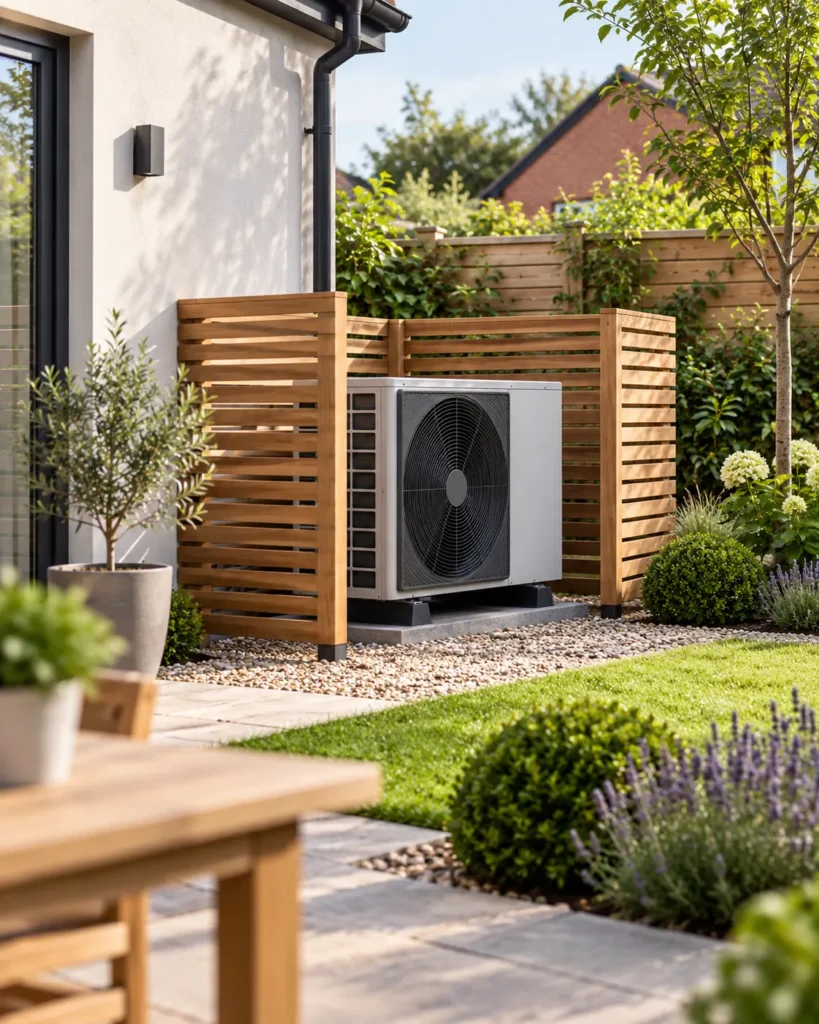
Fence Options at a Glance
| Fence or screen | Airflow | MCS acoustic barrier? | Main consideration |
|---|---|---|---|
| Open/slatted screen | Usually easier to maintain | No | Good for appearance, but does not receive MCS barrier attenuation |
| Solid timber fence | More likely to restrict airflow | Potentially | Must satisfy MCS construction rules and heat-pump clearances |
| Brick/masonry wall | Can obstruct or redirect airflow | Potentially | Position, reflections and service access matter |
| Purpose-designed enclosure | Design dependent | Design dependent | Use a system engineered for the exact heat pump and airflow requirement |
Can a Fence Affect Air Source Heat Pump Performance?
Yes. The outdoor unit needs to draw outdoor air across its heat exchanger and discharge that air again without creating excessive resistance.
If a fence sits too close to the inlet or directly in front of the fan, discharged air can accumulate around the unit instead of escaping freely. The heat pump may then draw some of that colder air back through the heat exchanger.
This is one reason a universal rule such as “leave 500mm around every heat pump” is unreliable. Different outdoor units have different air paths and clearance requirements.
Daikin, for example, gives general consumer guidance suggesting approximately 30–50cm around the sides and one metre in front of the fan, while warning that fences, plants and walls placed too close can restrict airflow. Those figures are useful as an example, not a rule for every manufacturer. Always follow the installation manual for the actual model.
If appearance is the main issue rather than noise, our guide to how to hide an air source heat pump covers other screening approaches.
Solid Fence or Slatted Screen?
This is where the design becomes a compromise.
A widely spaced slatted screen can disguise the outdoor unit while leaving significant open area for air movement. However, it will normally provide little benefit under the MCS permitted-development noise calculation.
A solid fence can have a much greater acoustic effect. Unfortunately, that same solid surface can make airflow more difficult if it is placed too close to the fan.
Therefore, a fence intended to reduce noise should not simply be added after installation wherever it happens to fit. It should form part of the heat-pump siting and acoustic design.
Research from the University of Salford also illustrates why “a wooden fence will make the heat pump quiet” is too simplistic. A field study found that a roughly 15mm wooden fence provided limited attenuation of some low-frequency tonal sound. Actual acoustic performance depends on construction, frequency and geometry.
How Does MCS 020a Treat a Fence Around a Heat Pump?
This is particularly important for installations relying on permitted development.
The current MCS 020a standard uses a 37 dB LAeq,5mins permitted-development noise limit at defined assessment positions outside neighbouring habitable-room doors or windows. The calculation considers the heat pump’s sound power, distance, nearby reflective surfaces and qualifying barriers.
MCS defines two relevant solid barrier types.
A Type 1 barrier can be a solid brick or masonry wall, or a solid fence at least 18mm thick. It should have no cracks or gaps and must extend at least one metre horizontally beyond both edges of the heat pump.
A Type 2 barrier is a solid fence under 18mm thick, again without cracks or gaps and extending at least one metre beyond either edge.
Open fences, fences with gaps and vegetation receive no barrier allowance.
The benefit then depends on line of sight. Under MCS 020a, a qualifying Type 1 barrier can provide a 10dB correction where the assessment position has no view of the heat pump, or 5dB with the specified partial-view condition. Type 2 receives 5dB or 2.5dB respectively. Full line of sight receives no barrier attenuation.
That does not mean homeowners should place a thick solid fence tightly around the machine. The acoustic calculation and the airflow design both have to work.
How Far Should a Fence Be From an Air Source Heat Pump?
There is no reliable universal distance.
The correct clearance comes from the manufacturer’s instructions for your exact unit. Pay particular attention to the front fan-discharge distance because this can be much greater than the minimum gap behind or beside some models.
You also need enough room for an engineer to remove access panels, clean the heat exchanger and replace components. Get Free Quote’s existing location guidance similarly warns that fences and permanent garden structures should not encroach on required service space.
Some modern heat pumps use refrigerants such as R290 propane, for which manufacturers may also specify safety or protective zones around openings, drains and ignition sources. Vaillant’s aroTHERM plus guidance, for example, sets model-specific protective areas and minimum clearances rather than one generic distance.
Therefore, check the manual before buying or building the fence.
Can a Fence Reduce Air Source Heat Pump Noise?
Potentially, yes.
A suitably positioned solid barrier can interrupt the direct sound path between the heat pump and a neighbouring window. That is why MCS 020a includes barrier attenuation in its calculation.
However, barriers can also alter how sound reflects around the installation. MCS treats sufficiently large surfaces close to the heat pump as potential reflective surfaces, and an installation surrounded by too many qualifying surfaces will not meet the MCS 020a method.
This means a narrow three-sided box made from solid fencing is not automatically a good acoustic solution.
Where noise is your main concern, review our dedicated guide to air source heat pump noise and ask the installer to rerun the MCS calculation with the proposed barrier included.
Does Planning Permission Affect Heat-Pump Fencing?
Heat-pump planning rules vary across the UK.
In England, the former rule requiring the heat pump itself to remain at least one metre from the property boundary was removed in May 2025. Current permitted-development guidance instead includes MCS 020a compliance alongside other limits and conditions. For houses, the current outdoor compressor-unit volume limit is 1.5m³.
Wales updated its domestic heat-pump permitted-development rules from 1 June 2026 and now also requires MCS 020a compliance. Scotland operates its own permitted-development framework.
A fence can have planning implications of its own depending on its height, location, designated-land status and local restrictions. If the property is listed, in a conservation area or subject to an Article 4 direction, check before building permanent screening.
For a wider explanation, see our guide to air source heat pump planning permission.
How to Design a Fence Around an Air Source Heat Pump
Start with the heat pump rather than the fence.
First, obtain the outdoor-unit installation manual. Mark the minimum clearances for the air inlet, discharge side and maintenance panels.
Next, decide what the fence needs to achieve. A decorative screen and an acoustic barrier have different design requirements.
Then check the fan direction. Do not position a solid panel immediately in the path of discharged air unless the manufacturer specifically permits that arrangement.
Allow for servicing. An engineer should not have to dismantle permanent landscaping simply to open the heat-pump casing.
Also consider defrost water. Air source heat pumps periodically melt frost from their outdoor coil in cold, damp conditions. Water needs to drain safely rather than pooling beneath the unit or freezing across a path.
Finally, have the completed arrangement checked acoustically if the fence forms part of the permitted-development noise strategy.
Fence Designs to Avoid
Avoid building a tight timber box around all four sides of the heat pump. Likewise, do not place decorative panels directly against the fan grille.
Dense planting immediately around the unit can create similar access and airflow problems, while vegetation does not qualify as an MCS acoustic barrier.
A roofed enclosure or garden shed should not be assumed suitable either. Outdoor heat pumps are designed around specific airflow conditions. Any full enclosure should be purpose-designed for the appliance rather than improvised.
If you have already installed screening and notice the heat pump behaving differently afterwards — for example, longer running, unusual icing or noticeably stronger recirculation around the unit — ask an installer to check the clearances and airflow.
Get Your Free Air Source Heat Pump Quote
Find the right air source heat pump solution for your home. Tell us a few details and our team will help you explore suitable options at a competitive price.
Quick to complete. No obligation.
Get your quote
Enter your details below and one of our team will get back to you.
Frequently asked questions
Find clear answers to common questions about hiding and screening air source heat pumps, including covers, fences, planting, enclosures, sheds, airflow, noise, clearances, winter protection, planning and installer considerations.
Usually not with an ordinary solid cover. The outdoor unit requires continuous airflow, so complete enclosure can interfere with its operation. Any full enclosure should be purpose-designed and approved for the specific heat pump.
Yes, provided the screen remains outside the manufacturer's required clearances and does not restrict the intake, discharge airflow or maintenance access.
Potentially. The distance and design matter because the fan needs space to discharge air freely. Check the exact manufacturer's clearance before installing the fence.
Yes. Planting can soften the visual impact if shrubs and grasses remain far enough away to preserve airflow and service access. Regular trimming is important.
A conventional enclosed shed is generally unsuitable because it restricts air movement. A specially designed open or ventilated structure may work if the manufacturer permits it.
They can. A cover that restricts airflow or allows cold discharged air to return to the intake may reduce performance.
There is no universal distance. Use the minimum obstruction clearances stated in the installation manual for the exact heat-pump model.
A correctly positioned solid barrier can sometimes reduce sound reaching a neighbour, and qualifying barriers can be accounted for within the MCS calculation. However, barrier design needs proper assessment.
It can. Poorly positioned hard surfaces may reflect sound or change the way noise propagates, particularly in narrow or enclosed locations.
Do not alter the factory casing without checking the manufacturer's instructions and warranty terms. Painting ventilation openings, coils or other functional parts could cause problems.
A bin-store-style screen may work visually, but it must be designed around the heat pump's required airflow and service clearances rather than copied directly from a normal bin store.
Not necessarily. Leaving the top open can often make airflow and servicing simpler. Heat pumps are designed as outdoor equipment, so weather protection is not automatically a reason to add a roof.
Do not cover an operating heat pump with a solid winter cover. Air source heat pumps are designed to work outdoors during cold weather and need airflow while operating.
Possibly. The answer depends on the screen's height, location, property and planning jurisdiction. Heat-pump permitted-development rights do not automatically mean every separate fence or enclosure is permitted.
For many homes, an open screen located outside the manufacturer's clearances is a practical option. Planting or a screen positioned further away can reduce visual impact with even less airflow risk.
Yes. Raise it during the survey. The installer can then consider sightlines, airflow, noise, drainage and maintenance when choosing the outdoor-unit position.
Conclusion: Should You Put a Fence Around Your Heat Pump?
A fence around an air source heat pump can work well, but the safest approach is to design it around the machine rather than trying to hide the machine afterwards.
For visual screening, a well-spaced open design often makes airflow easier to protect. For acoustic screening, a solid barrier may provide a measurable benefit, but only when its construction and position satisfy the noise assessment without compromising airflow or servicing.
There is no universal “safe fence distance”. Use the exact manufacturer’s installation instructions, keep the discharge air path clear and have any noise-control barrier considered within the MCS calculation.
If you are choosing a heat pump now, ask every installer to show the proposed outdoor-unit position and clearances before accepting the quotation. That makes it much easier to plan screening which looks good without reducing performance.


