
Can an Air Source Heat Pump Go in a Garage? UK Guide
Check Your Eligibility for Boiler Upgrade Scheme (BUS)
Complete your details below to check your eligibility.
Thank you
We've received your details and will be in touch shortly.

Quick answer: can you put an air source heat pump in a garage?
A standard air source heat pump outdoor unit should not usually go inside an enclosed garage. Most residential outdoor units depend on unrestricted outdoor airflow and require model-specific clearances around the air inlet and discharge. Some manufacturers explicitly specify outdoor installation only.
A garage can, however, be an excellent location for indoor equipment such as the hot-water cylinder, hydraulic module, pumps and controls, provided the equipment is suitable for the expected garage temperature and protected against frost where necessary.
Alternatively, the outdoor heat pump may be positioned beside the garage or on a suitable flat garage roof, subject to structural, airflow, noise, servicing, drainage and planning checks.
Can an Air Source Heat Pump Go in a Garage? UK Guide
Yes, a garage can form part of an air source heat pump installation, but the standard outdoor unit should not normally be installed inside a closed garage.
An air source heat pump needs a continuous supply of outdoor air. Its fan draws air across the evaporator, extracts heat and then discharges colder air. Put a conventional outdoor unit in an enclosed garage and that cold air can recirculate, restricting the supply of useful outdoor air and affecting performance.
However, other parts of an air-to-water system can often go in a garage. These may include the hot-water cylinder, indoor hydraulic unit, buffer vessel and controls. You may also be able to position the outdoor unit beside the garage or, in suitable circumstances, on a flat garage roof.
The key is knowing which equipment belongs indoors and which needs unrestricted access to outdoor air.
Planning a heat pump installation? Compare free heat-pump quotes with Get Free Quote and ask for the proposed position of every major component to be shown before you commit.
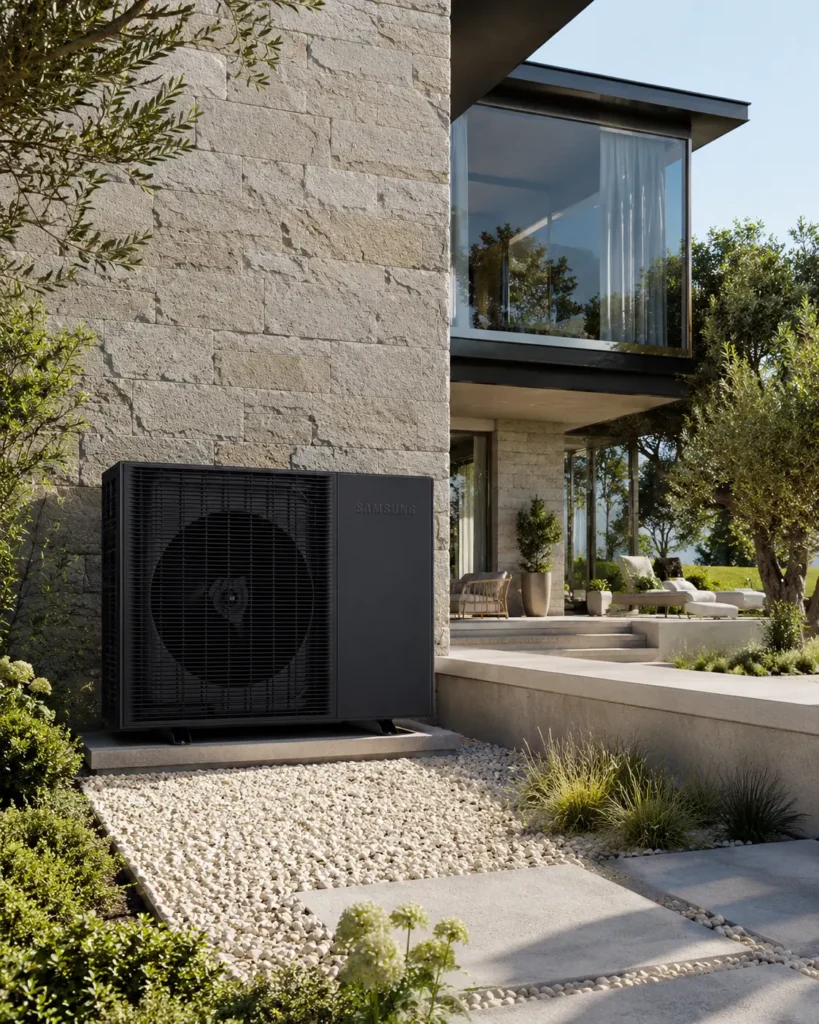
Which parts of an air source heat pump can go in a garage?
First, distinguish the outdoor heat-pump unit from the equipment that sits inside the property.
| Component | Normal garage suitability | Main consideration |
|---|---|---|
| Outdoor monobloc unit | Usually unsuitable inside | Requires free outdoor airflow |
| Split-system outdoor unit | Usually unsuitable inside | Still designed to exchange heat with outdoor air |
| Indoor hydraulic unit | Often suitable | Check permitted ambient temperature |
| Hot-water cylinder | Often suitable | Heat loss, pipe insulation and frost protection |
| Buffer vessel and pumps | Often suitable | Protect water-filled equipment from freezing |
| Outdoor unit on flat garage roof | Sometimes suitable | Structure, access, airflow, noise and planning |
If you want a concise explanation of the refrigeration cycle and what each component does, see our guide to how air source heat pumps work.
Why the outdoor unit normally needs to stay outside
It has to move a large volume of outdoor air
An air source heat pump uses an evaporator and refrigerant to absorb energy from outdoor air. A compressor then raises the refrigerant’s pressure and temperature so the captured heat can be transferred into the heating system.
That process depends on airflow.
For example, the Vaillant aroTHERM plus installation instructions state that its outdoor unit uses outdoor air as the heat source, discharged air must be able to flow away freely and the product is intended only for outdoor installation.
Inside an ordinary garage, the heat pump would gradually cool the surrounding air. If the colder discharge air returns to the intake, the unit is effectively trying to extract heat from air it has already cooled.
That is very different from operating outdoors, where fresh ambient air continually replaces the discharged air.
Opening the garage door is not a proper design solution
Keeping the garage door open does not automatically make an indoor installation suitable. Neither does cutting a few vents into the wall.
The required inlet area, outlet route, separation of incoming and discharged air and clearances all depend on the heat-pump design. Manufacturers can also specify servicing spaces and refrigerant-related safety zones.
A purpose-designed ducted installation may exist for specialist equipment, but you should not convert a conventional outdoor unit into one unless the manufacturer explicitly permits that configuration.
For most homes, an outdoor position is far simpler and more reliable.
Can the indoor unit and cylinder go in an unheated garage?
Often, yes.
Some manufacturers specifically identify garages as potential locations for indoor heat-pump equipment. Consumer guidance from Which? also notes that a hot-water cylinder can be installed in a garage or outbuilding when internal space is limited, although putting it in an unheated area can increase heat losses.
There are three practical checks.
Temperature and frost protection
Check the minimum ambient temperature allowed for the chosen indoor unit. Water-filled components, valves and pipework also need protection from freezing.
Do not assume that every garage stays warm enough simply because it is attached to the house.
Pipe insulation
Warm pipework running through a cold garage loses heat. Good insulation and sensible pipe routes help minimise that loss.
Cylinder standing losses matter too. Heat escaping from a cylinder inside the heated home contributes some warmth to the house. Heat released into a detached, cold garage is largely lost.
Service access
Allow enough room to reach filters, valves, pumps, controls and removable panels.
A technically suitable garage becomes a poor plant room if equipment disappears behind shelving, bicycles or stored boxes.
Better locations for a heat pump around a garage
Instead of installing the outdoor unit inside the garage, use the garage to make an outdoor installation more convenient.
Outside the garage wall
Positioning the heat pump directly outside a garage can work well. Pipework has only a short distance to travel before reaching the indoor equipment.
The manufacturer’s exact clearances still apply. There is no universal rule such as leaving one metre around every heat pump.
Our wider air source heat pump location guide explains airflow, drainage, boundaries and neighbouring windows in more detail. Existing Get Free Quote guidance also warns against normal enclosed garages unless an appropriate air path has specifically been engineered.
On a flat garage roof
A flat garage roof can sometimes provide an effective outdoor location.
Energy Saving Trust documents a UK installation where an outdoor heat-pump unit was installed on a garage roof after the roof was assessed to confirm it was structurally suitable. See the Energy Saving Trust garage-roof case study.
However, roof strength is only one consideration. Safe maintenance access, vibration, wind exposure, drainage and noise also need checking.
Beside or behind the garage
A ground-mounted unit beside the garage may keep it away from primary living areas without compromising airflow.
Avoid turning the space between the garage and house into a tight acoustic enclosure. Nearby walls can reflect sound and may also interfere with intake or discharge airflow.
Does garage positioning affect heat-pump noise?
It can.
Moving the unit towards a garage may increase the distance from bedrooms or neighbouring windows, which can help. However, surrounding walls can also reflect sound.
The current MCS 020a planning standard uses a permitted-development noise limit of 37 dB LAeq,5mins at relevant neighbouring assessment positions. Its calculation considers factors including distance, barriers and reflective surfaces.
MCS 020a specifically states that surfaces within one metre can count as reflecting surfaces and that a heat pump surrounded by more than three qualifying reflective surfaces will not meet its method.
So hiding a heat pump in a small recess between the house and garage may create a new problem rather than solve one.
Will putting the indoor equipment in a garage reduce efficiency?
Potentially, but not necessarily enough to make the garage unsuitable.
The main losses come from the cylinder and warm pipework being outside the home’s heated envelope. Good insulation, short pipe runs and suitable equipment can limit these losses.
A garage may still be preferable to sacrificing an airing cupboard or utility-room space inside the home.
The decision should therefore compare practicality and calculated heat loss, rather than treating garages as automatically good or bad.
Do you need planning permission for a heat pump on a garage?
The answer depends on where you live and exactly where the unit is installed.
In England, an air source heat pump can often qualify as permitted development if all relevant conditions are satisfied. The Planning Portal’s current air source heat pump guidance says these rights can cover equipment within a home’s curtilage, including installation on another building within that curtilage.
For houses, the current English rules allow an outdoor compressor unit up to 1.5m³ under the permitted-development provisions. A unit on a flat roof must be at least one metre from the external roof edge, while installation on a pitched roof does not fall within this permitted-development right.
Listed buildings, scheduled monuments and some conservation-area or highway-facing locations have additional restrictions.
For a deeper planning overview, see our air source heat pump planning permission guide.
Wales, Scotland and Northern Ireland operate separate planning systems. Wales updated its domestic heat-pump permitted-development rules on 1 June 2026, so UK homeowners should check the rules for their own nation rather than applying English requirements universally.
How to decide whether your garage can be used
Ask the surveyor to show exactly where the outdoor unit, cylinder, hydraulic equipment and connecting pipework will go.
The design should confirm manufacturer clearances, airflow, garage winter temperatures, frost protection, pipe insulation, drainage, service access, acoustic compliance and planning requirements.
It should also compare the garage arrangement with at least one realistic alternative. A position that hides the equipment is not automatically the position that gives the best long-term performance.
A proper heat pump survey should resolve these questions before installation begins.
Get Your Free Air Source Heat Pump Quote
Find the right air source heat pump solution for your home. Tell us a few details and our team will help you explore suitable options at a competitive price.
Quick to complete. No obligation.
Get your quote
Enter your details below and one of our team will get back to you.
Frequently asked questions
Find clear answers to common questions about air source heat pumps and garages, including outdoor-unit location, cylinders, indoor equipment, garage roofs, ventilation, airflow, monobloc and split systems, planning, noise and practical layouts.
Usually not. Conventional outdoor units require unrestricted outdoor airflow, and many models are specifically approved for outdoor installation only. Always follow the manufacturer's instructions.
Yes, in many installations. However, cylinder and pipework heat losses can be greater in an unheated garage, so insulation and frost protection need consideration.
Often yes, provided the chosen unit is approved for the garage's expected ambient temperature and has adequate servicing space. Some manufacturers specifically identify garages as suitable locations.
Potentially. The roof must be structurally suitable and the design needs safe access, drainage, airflow, vibration control, noise assessment and planning compliance.
That is not a reliable substitute for a manufacturer-approved installation. Heat-pump performance should not depend on somebody remembering to leave a garage door open.
Only if the exact heat-pump model supports such an installation and the ventilation or ductwork has been professionally designed. Ordinary wall vents do not automatically provide sufficient airflow.
It extracts heat from air passing across its evaporator. Continuous airflow replaces the air that has already been cooled by the heat-extraction process.
An outdoor unit operating inside an enclosed garage would remove heat from the garage air and discharge colder air into the same space. That is one reason normal outdoor units should not simply be moved indoors.
A conventional residential monobloc designed for outdoor installation normally should not. Check the installation manual for the exact product.
Normally not simply because it is a split system. The outdoor section still requires access to outdoor air and must comply with its installation instructions.
It can be excellent for cylinders and other indoor plant because it saves space inside the home. The garage temperature, pipework, frost risk and service access must still be assessed.
Not necessarily. Many domestic installations qualify as permitted development, but rules differ across the UK and depend on the property and proposed position.
Possibly, but narrow spaces can restrict airflow and increase reflected noise. MCS 020a explicitly accounts for nearby reflective surfaces.
It can slightly increase heat loss compared with keeping the cylinder inside the heated envelope. The actual effect depends on cylinder insulation, garage temperature and pipework design.
A common practical arrangement is the outdoor unit immediately outside the garage with the cylinder and suitable indoor components inside. This keeps the heat pump in free air while allowing short, accessible pipe routes.
Conclusion
A garage can be extremely useful in an air source heat pump installation, but a normal enclosed garage is usually the wrong location for the outdoor heat-pump unit.
The outdoor unit needs a continuous supply of ambient air and sufficient space for colder discharge air to escape without recirculating. Positioning it outside the garage, beside it or on a suitable flat garage roof is normally a better approach.
Meanwhile, a hot-water cylinder, hydraulic module, pumps and controls can often live inside the garage if the equipment suits the temperature, frost protection is adequate and pipework is properly insulated.
The best arrangement is therefore not simply “inside or outside”. It is a component-by-component design based on the chosen heat pump, property layout and manufacturer requirements.


