
Heat Pump Hot Water Cylinder: Do You Need One? | UK Guide
Check Your Eligibility for Boiler Upgrade Scheme (BUS)
Complete your details below to check your eligibility.
Thank you
We've received your details and will be in touch shortly.

Quick Answer: Does a Heat Pump Need a Hot Water Cylinder?
A standard air-to-water heat pump normally needs a hot water cylinder if it supplies showers, baths and hot taps. Heat pumps usually heat stored water rather than producing it instantly like a combi boiler.
The cylinder must also suit heat-pump operation. It needs enough capacity for the household and a heat exchanger capable of transferring heat effectively at the lower temperatures typically used by heat pumps. An existing cylinder can sometimes be retained, but its heat exchanger, insulation, condition and capacity should first be checked.
If the heat pump provides space heating only, another hot-water system can be used instead.
Considering a heat pump? Compare heat-pump options and request a free quote based on your property rather than relying on generic system sizes.
ce heat pump for a two-bedroom UK house may cost around £8,000 to £12,500 before grants.
If you qualify for the standard £7,500 Boiler Upgrade Scheme grant, your contribution could fall to around £500 to £5,000.
In addition, some installers offer £0 customer-contribution deals for suitable smaller homes when the complete installation can be delivered within the available grant funding.
However, the price can rise if you need several new radiators, a new hot-water cylinder, electrical upgrades or major pipework changes.
Therefore, the best way to establish your true cost is through a property survey and room-by-room heat-loss calculation.
Does an Air Source Heat Pump Need a Hot Water Cylinder?
Usually, yes. If an air-to-water heat pump will provide hot water for your taps, showers and baths, it will normally need a hot water cylinder. Unlike a combi boiler, a standard heat pump does not heat domestic hot water instantly when you open a tap. Instead, it heats water more gradually and stores it ready for use. Energy Saving Trust confirms that a standard air source heat pump does not provide hot water on demand like a combi boiler.
Not every air source heat pump needs a cylinder. Air-to-air systems usually heat rooms rather than domestic water, while an air-to-water heat pump can be configured for space heating with a separate appliance providing hot water.
This guide explains when a heat pump hot water cylinder is needed, whether an existing cylinder can work, how sizing is calculated and what to consider if space is limited.
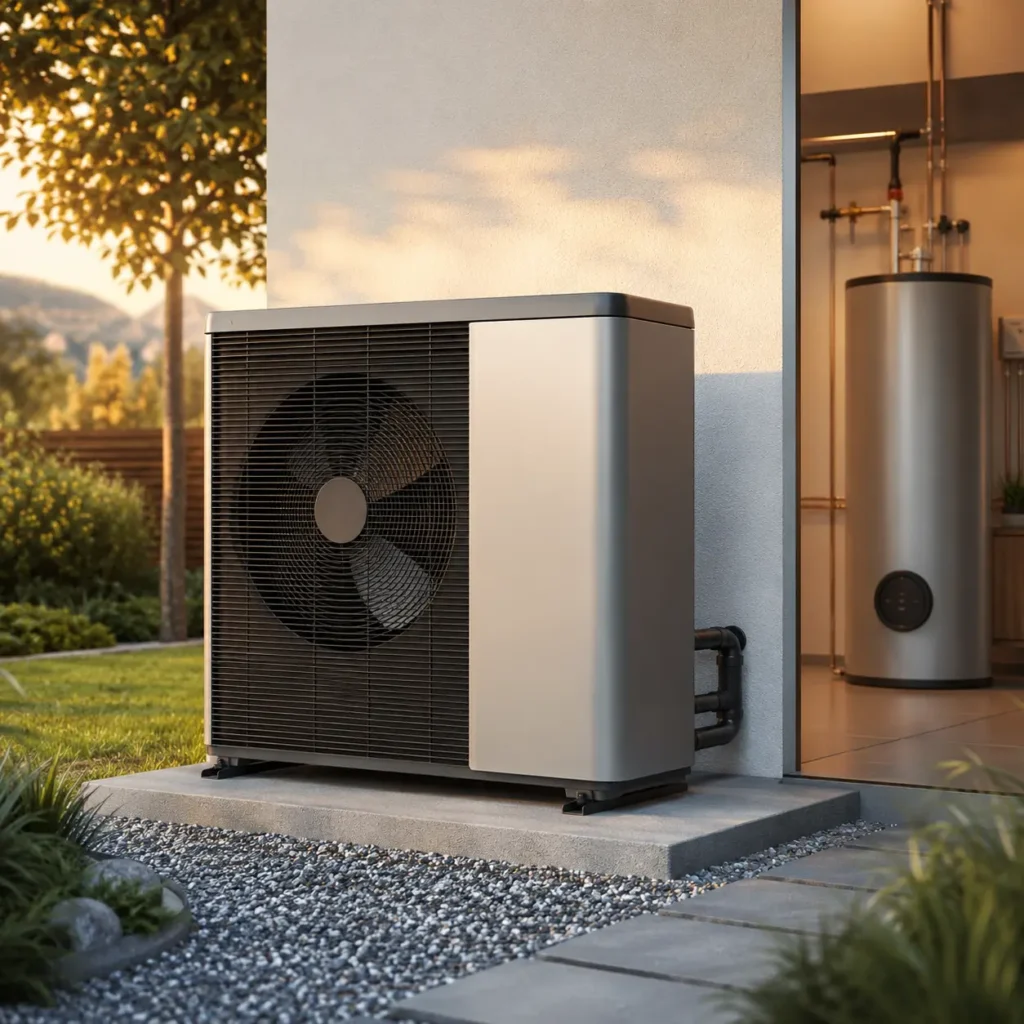
Does Every Air Source Heat Pump Need a Hot Water Cylinder?
No. It depends on how the system will provide your heating and hot water.
| System arrangement | Cylinder needed? | Domestic hot water |
|---|---|---|
| Air-to-water heat pump for heating and hot water | Usually yes | Stored water heated by the heat pump |
| Air-to-water heat pump for space heating only | Not necessarily | Separate water-heating system |
| Air-to-air heat pump | Usually no for the heat-pump system | Separate hot-water system normally required |
| Hybrid arrangement | Depends on design | Heat pump and/or another appliance |
For most UK homeowners replacing a boiler with an air-to-water system, a cylinder is the normal arrangement. Energy Saving Trust also lists heat batteries and some other arrangements as potential alternatives where cylinder space is difficult.
For the wider technical explanation, see our guide to how air source heat pumps work.
Why Do Heat Pumps Use Stored Hot Water?
A combi boiler can deliver a large amount of heat quickly when somebody opens a hot tap. A heat pump behaves differently. It is designed to transfer heat steadily and efficiently, usually with lower heating-water temperatures than a conventional boiler.
For domestic hot water, an air-to-water system normally diverts heated system water through a heat exchanger inside the cylinder. This transfers heat into the stored water that later supplies your taps, shower and bath.
The cylinder therefore acts as a reserve for short periods of high demand. For example, it can provide enough stored hot water for several morning showers even though the heat pump itself is not producing that water instantaneously.
This difference matters most when replacing a combi boiler. Your existing heating system may have no stored hot water at all, so finding space for the cylinder becomes part of the heat-pump design.
What Is Different About a Heat Pump Hot Water Cylinder?
The heat exchanger is one of the most important differences.
The current MCS Heat Pump Design Standard, MIS 3005-D:2025 Issue 2.0, says the cylinder heat exchanger should follow the heat-pump or cylinder manufacturer’s recommendations. It specifically notes that heat-pump domestic hot-water heat exchangers tend to require a greater surface area than those used with combustion boilers because heat-pump flow temperatures are typically lower. MCS Heat Pump Design Standard
A suitable heat pump cylinder therefore needs:
- enough stored water for the household;
- a heat exchanger suited to the selected heat pump;
- effective insulation;
- compatible controls and safety components;
- a sensible recovery time after heavy hot-water use.
A bigger cylinder is not automatically better. Oversizing takes additional space and can increase standing heat losses, while undersizing can leave a household short of hot water.
For more detail on the relationship between water temperature and system performance, read our air source heat pump temperature guide.
Can You Use Your Existing Hot Water Cylinder?
Sometimes.
An existing cylinder should be assessed rather than automatically replaced. MCS allows for an existing domestic hot-water cylinder to be used, but requires consideration of its insulation, mechanical integrity and size.
An installer should therefore check:
- cylinder capacity;
- heat-exchanger performance;
- insulation and standing heat loss;
- physical condition and corrosion;
- compatibility with the selected heat pump;
- expected hot-water recovery.
The Centre for Sustainable Energy notes that an existing cylinder may need replacing with a heat-pump-ready model. A larger heating coil can transfer heat more effectively when the heat source operates at lower temperatures. Centre for Sustainable Energy heat-pump guidance
Ask the installer to explain why your existing cylinder can or cannot be retained rather than accepting a blanket rule.
What Size Heat Pump Hot Water Cylinder Do You Need?
There is no universal cylinder capacity for a two-, three- or four-bedroom home.
Current MCS guidance starts the domestic hot-water calculation at 45 litres × N, where N is whichever is greater: the number of bedrooms plus one, or the number of known occupants.
| Example home | MCS value for N | Calculated daily hot-water demand |
|---|---|---|
| 1 bedroom | 2 | 90 litres |
| 2 bedrooms | 3 | 135 litres |
| 3 bedrooms | 4 | 180 litres |
| 4 bedrooms | 5 | 225 litres |
| 5 bedrooms | 6 | 270 litres |
Importantly, these figures are design hot-water demand, not an instruction to install a cylinder of exactly that size. MCS says cylinder selection should consider both the calculated demand and the proposed heat pump’s heating capacity.
Real households also differ significantly. The survey should consider occupancy, baths versus showers, shower flow rates, overlapping use, target water temperature and expected reheat time.
Where Can a Heat Pump Cylinder Go?
Common locations include an airing cupboard, utility room or another suitable internal cupboard.
Energy Saving Trust says a hot-water cylinder can usually fit in a cupboard measuring at least around 80 cm × 80 cm, although the required height, access and clearances depend on the actual cylinder. Energy Saving Trust air source heat-pump guidance
A loft or garage can sometimes be considered. However, physical space is only part of the assessment. Structural loading, frost protection, pipe runs, heat loss, servicing access and safety discharge arrangements also matter.
If you currently have a combi boiler, include cylinder space in the survey from the start. Our guide to whether your home is suitable for a heat pump covers the other checks that should happen alongside it.
How Quickly Does a Heat Pump Cylinder Reheat?
There is no single reheat time that applies to every installation.
Recovery depends on cylinder volume, starting temperature, target temperature, heat-pump output, heat-exchanger performance and the control strategy.
Many air-to-water systems give domestic hot water temporary priority. When the cylinder needs reheating, the system can direct heat to the cylinder before returning to space heating.
Ask your installer for the expected recovery time based on the proposed equipment. Cylinder selection should be based on hot-water demand and heat-pump capacity rather than guesswork.
What Temperature Does a Heat Pump Cylinder Run At?
Domestic hot water generally requires higher temperatures than space heating, which means heat-pump efficiency can be lower while heating the cylinder.
Current MCS rules require a heat pump serving a domestic hot-water cylinder to be capable of a flow temperature of at least 55°C at design conditions. This does not mean your radiators need to operate at 55°C continuously.
Stored hot-water systems must also incorporate a way to control bacterial growth, including legionella risk. MCS does not prescribe one universal method; the correct strategy depends on the system design.
Some installations use periodic higher-temperature cycles. Depending on the heat pump, these can be achieved by the compressor itself, an immersion heater or another designed method.
What If You Do Not Have Space for a Cylinder?
Limited space can change the design, but it does not automatically rule out a heat pump.
Possible solutions include a different cylinder location, a compact or integrated indoor unit, a suitable heat battery, an air-to-water heat pump used for space heating only, or an air-to-air system with separate domestic hot-water provision.
Each has different implications for cost, efficiency and convenience.
Funding can also affect the decision. As of September 2026, Ofgem states that fossil-fuel hybrid heat-pump systems are not eligible for the Boiler Upgrade Scheme in England and Wales. Ofgem Boiler Upgrade Scheme guidance
How Much Can the Cylinder Add to Installation Cost?
Cost depends on cylinder capacity, specification, pipework and where it needs to be installed.
The Centre for Sustainable Energy uses approximately £1,500 as an example cost for replacing an existing cylinder with a heat-pump-ready model. Existing Get Free Quote cost research gives a broader indicative supplied-and-fitted range of around £900–£2,000.
These are guide figures rather than quotations. Additional pipework, valves, electrical connections, carpentry or making-good can change the final cost.
See our guide to the hidden costs of heat pump installation for the other items worth checking.
What Should You Check Before Accepting a Heat Pump Quote?
Before signing a contract, make sure the proposed design answers five practical questions:
- Why is a cylinder required? Confirm whether the heat pump is providing both space heating and domestic hot water.
- Why this particular cylinder? Ask for the make, model, capacity and heat-exchanger specification.
- How was it sized? Ask what occupancy and hot-water demand the installer assumed.
- Where will it go? Confirm its dimensions, access requirements, pipework and any associated building work.
- What happens after heavy hot-water use? Ask how the cylinder reheats and approximately how long recovery should take.
If you already own a cylinder, ask for a written explanation of whether it can be retained and what that choice means for system performance.
Get Your Free Air Source Heat Pump Quote
Find the right air source heat pump solution for your home. Tell us a few details and our team will help you explore suitable options at a competitive price.
Quick to complete. No obligation.
Get your quote
Enter your details below and one of our team will get back to you.
Frequently asked questions
Find clear answers to common questions about air source heat pumps and hot-water cylinders, including cylinder sizing, combi-boiler replacement, existing-cylinder reuse, hot-water temperatures, immersion heaters, loft and garage locations, space constraints and Boiler Upgrade Scheme support.
No. Air-to-water systems normally need a cylinder when they provide domestic hot water. Air-to-air systems usually require separate water heating.
Yes. A heat pump can provide space heating while another appliance supplies domestic hot water. However, a conventional air-to-water system providing both usually stores hot water in a cylinder.
Yes, but the hot-water arrangement normally changes. A combi boiler heats water on demand, whereas an air-to-water heat pump usually heats stored water in a cylinder.
Potentially. Its heat exchanger, insulation, condition, size and compatibility should be checked before reuse. MCS includes provisions for retaining suitable existing cylinders.
It depends on household demand and heat-pump output. MCS starts with a calculation of 45 litres × N, where N is the greater of bedrooms plus one or known occupants, but this is not automatically the cylinder capacity.
It can be, but household habits matter. Several long showers, a large bath or simultaneous demand can justify greater capacity. The system should be sized from calculated demand rather than family size alone.
Not necessarily in every property. However, heat-pump cylinders commonly use larger heat-exchanger surfaces because the primary water temperature is usually lower.
There is no fixed time. Cylinder volume, water temperature, heat-pump output and heat-exchanger performance all affect recovery.
The correct setting is system-specific. MCS requires a heat pump serving a domestic hot-water cylinder to be capable of at least 55°C flow at design conditions, while bacterial-risk controls must also be incorporated.
You can if the cylinder is undersized or demand greatly exceeds the design assumption. A properly sized cylinder should accommodate the household's expected hot-water use.
Not necessarily. Some systems use an immersion heater for backup or certain higher-temperature cycles, while heat pumps capable of higher temperatures may handle more of this themselves.
No. A hot-water cylinder stores domestic water for taps and showers. A buffer vessel forms part of the heating circuit and performs a different hydraulic or energy-storage role.
Possibly, but the structure, access, frost protection, safety discharge and pipework must all be suitable. It should be assessed as part of the system design.
Potentially. Insulation, frost risk, pipe heat loss, access and manufacturer requirements need to be considered.
Alternative locations, compact systems, suitable heat batteries, space-heating-only heat pumps or air-to-air systems with separate water heating may be worth investigating. Energy Saving Trust specifically identifies heat batteries and other hot-water arrangements as alternatives where cylinder space is difficult.
Usually not. Most air-to-air systems provide room heating and potentially cooling, so another system must provide domestic hot water.
No. The Boiler Upgrade Scheme provides an upfront contribution towards an eligible heat-pump installation rather than a separate grant for individual components.
No. It should first be assessed. Replacement makes sense where the existing unit is unsuitable, poorly insulated, damaged, incorrectly sized or unable to transfer heat effectively from the proposed heat pump.
Conclusion
For most UK homes using an air-to-water heat pump for both central heating and domestic hot water, a heat pump hot water cylinder is part of the normal system.
The more useful question is whether the proposed cylinder suits the heat pump and your household. It needs sufficient usable hot water, effective heat transfer, reasonable recovery performance and a practical location.
An existing cylinder may be reusable, but its heat exchanger, insulation, capacity and condition need checking. If you currently have a combi boiler, cylinder space should be considered early because this can be one of the biggest physical changes to your heating system.
A property-specific survey should identify the proposed cylinder model, capacity and location before you commit. Compare complete system designs rather than judging quotations on the heat-pump unit alone.
Ready to explore your options? Compare properly surveyed heat-pump quotations and make sure each installer is pricing the same cylinder, heating system and associated work.


