
Flat Roof Solar Panel Installation UK: Costs & Rules
Check Your Eligibility for Boiler Upgrade Scheme (BUS)
Complete your details below to check your eligibility.
Thank you
We've received your details and will be in touch shortly.

Quick answer: can you install solar panels on a flat roof?
Yes. Solar PV panels can be installed on most suitable flat roofs using purpose-designed mounting systems. The panels are commonly raised at a shallow angle rather than laid directly against the roof.
A flat-roof installation may use weighted ballast, mechanical fixings or a combination of both. Before installation, the roof should be assessed for its condition, structural capacity, waterproofing, drainage, shading and exposure to wind.
Flat roofs can work particularly well because the installer has greater freedom to choose the panel orientation and layout. However, the best design depends on the individual building rather than a standard angle or mounting method.
Want to compare suitable solar options for your property? Get a free home-energy quote without committing to an installation.
Flat Roof Solar Panel Installation: UK Costs, Mounting & Planning Rules
Solar panels can be installed successfully on many flat roofs. In fact, a flat roof can give an installer more control over the direction, angle and layout of the panels than a fixed pitched roof.
However, flat roof solar panel installation needs more design work than simply placing panels on the roof. The installer must consider structural loading, wind uplift, waterproofing, drainage, panel spacing and planning restrictions.
This guide explains how flat-roof solar mounting works, which systems are available, how much an installation may cost and what UK homeowners should check before accepting a quote.
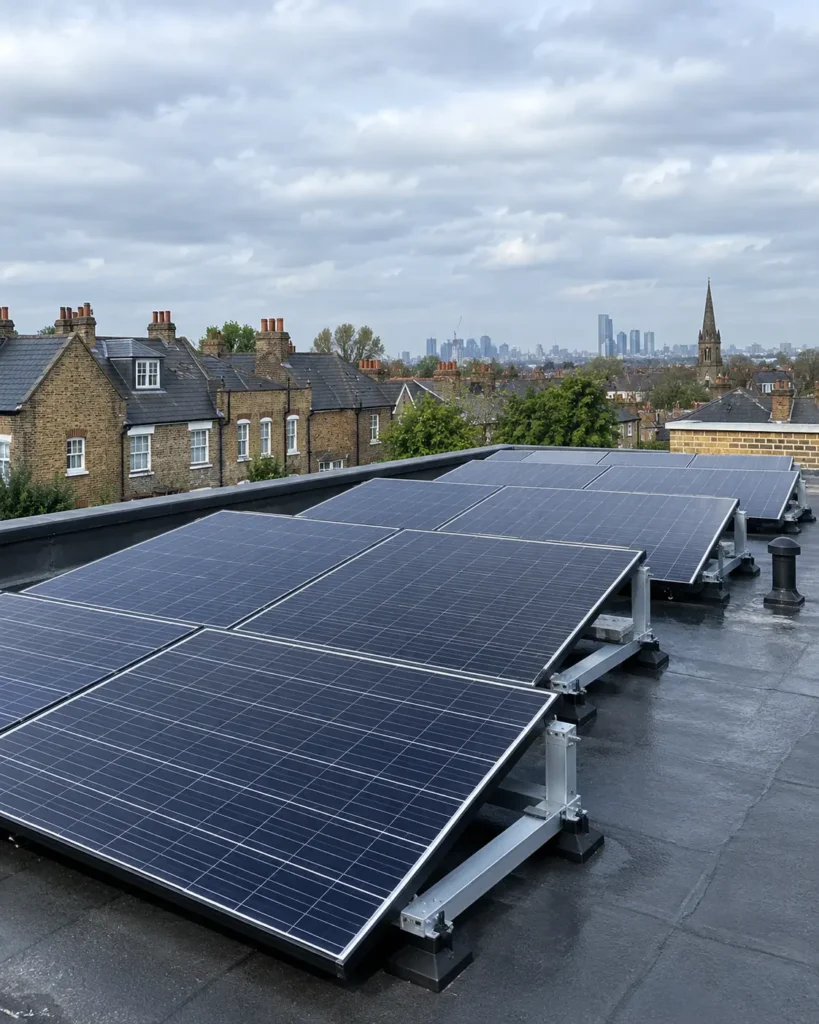
Can you put solar panels on a flat roof?
In many cases, yes.
The Energy Saving Trust confirms that solar panels can be installed on flat roofs. The basic solar technology is exactly the same as on a pitched roof: photovoltaic cells generate direct-current electricity from daylight, and an inverter converts it into alternating current that your home can use. Solar panels continue generating electricity on cloudy days, although output varies with available sunlight.
The important difference is the mounting structure.
Instead of following an existing roof pitch, the installer can position panels on frames. This allows the system designer to choose an angle and orientation that balance electricity generation with available roof space, wind exposure and shading between rows.
Flat roof vs pitched roof solar
| Factor | Flat roof | Pitched roof |
|---|---|---|
| Panel angle | Created by mounting frame | Mainly determined by roof |
| Orientation | More design flexibility | Mainly determined by roof direction |
| Mounting | Ballasted, mechanically fixed or hybrid | Usually fixed to roof structure |
| Main structural concern | Panels, frames and possible ballast | Fixing loads and roof condition |
| Row shading | Must be considered carefully | Usually less relevant |
| Maintenance access | Can often be designed into layout | Depends on roof access |
Neither roof type is automatically better. The useful comparison is the expected annual generation from the proposed design.
How does flat roof solar panel mounting work?
There are two main approaches.
Ballasted solar panel mounting
A ballasted system uses calculated weight to hold the mounting frame in position rather than relying entirely on penetrations through the roof covering.
One advantage is that the waterproof membrane may not need to be pierced. This can make ballasted mounting attractive for felt, bitumen and membrane roofs.
However, “no roof penetration” does not mean “no structural implications”. The roof must safely carry the solar panels, mounting structure and required ballast.
Wind forces also vary across a roof. Areas near corners and edges can experience greater uplift, so ballast requirements and panel positions should come from a proper system design rather than guesswork.
Mechanically fixed systems
A mechanically fixed system anchors the solar mounting structure into a suitable part of the building.
This may reduce the amount of ballast required and can be useful where the roof has limited spare load capacity. However, penetrations through the roof need correctly designed weatherproofing.
The fixing method must also be compatible with the roof covering and any existing roofing warranty.
Some systems combine mechanical fixing with aerodynamic mounting design and limited ballast.
Roof strength, waterproofing and drainage
The condition of the roof should be checked before panels are fitted.
A concrete flat roof, lightweight timber extension and steel-framed commercial roof have very different structural characteristics. Depending on the building and proposed mounting loads, additional structural calculations or an engineer’s assessment may be required.
Waterproofing matters just as much.
Mounting feet should use suitable protective layers, while panels, ballast and cables must not obstruct rainwater outlets or drainage routes. The design should also leave enough access for roof inspections and maintenance.
If the roof covering is approaching the end of its service life, replacing it before installing solar can make financial sense. Otherwise, the panels may have to be removed and reinstalled when the roof is renewed. The Energy Saving Trust specifically identifies renewal of the roof covering as one factor that can affect installation cost.
If repairs are already needed, compare your options through the Get Free Quote roofing service before adding the solar array.
What angle should solar panels be on a flat roof?
There is no universal best angle.
Purpose-designed flat-roof systems frequently use relatively shallow angles. For example, K2’s current UK Dome 6 system uses a 10-degree inclination, while related variants are available at other shallow angles. Its design documentation also specifies roof-edge clearances and different approaches to ballast and anchoring.
Why not simply tilt the panels more steeply?
A higher angle may improve the performance of an individual south-facing panel in some circumstances. However, it can also increase wind loading and require larger gaps between rows to prevent one row shading another.
A shallower layout may therefore fit more generating capacity into the available roof area.
East-west arrays are another option. They can make efficient use of roof space and spread generation more evenly across the morning and afternoon.
The installer should model the annual electricity generation in kWh for the proposed layout rather than focusing only on the number of panels.
Cleaning is also relevant. The Energy Saving Trust says UK rainfall will generally clean panels adequately where they are tilted by at least 15 degrees, although local conditions may make occasional cleaning necessary.
Do you need planning permission for solar panels on a flat roof?
Often not, but the rules depend on where in the UK the property is located.
England
For domestic properties in England, flat-roof solar can normally fall within permitted development when the relevant conditions are met. Current guidance applies a key limit of 0.6 metres above the flat roof for domestic panels. Additional restrictions can affect listed buildings, conservation areas and properties where permitted development rights have been removed.
Wales and Scotland
Do not assume the English dimensions apply throughout Britain.
Welsh Government guidance currently states that domestic flat-roof panels cannot be within one metre of the external roof edge or protrude more than one metre above the roof plane.
Scottish guidance permits domestic solar under its own rules, including a one-metre projection restriction and additional controls for listed buildings and conservation areas.
Northern Ireland operates under a separate planning system.
Planning limits should also not be confused with mounting-system requirements. A manufacturer or structural design may require a greater setback from the roof edge for wind-loading reasons even where planning rules would permit another position.
How much does flat roof solar panel installation cost?
The Energy Saving Trust currently estimates that an average domestic solar PV system costs around £7,600. Its current benchmark is based on a typical domestic installation of roughly 4.5kWp.
A flat roof installation may cost more than a straightforward pitched-roof system if it requires:
- specialist mounting equipment or additional ballast
- structural calculations
- membrane protection
- difficult lifting or roof access
- roof repairs before installation
- more complex cable routes.
Conversely, easy access and a simple, unobstructed roof can reduce installation complexity.
There is therefore no reliable fixed “flat roof premium”. The sensible approach is to compare itemised proposals for the same system size and specification.
Qualifying solar installations in UK residential accommodation are currently zero-rated for VAT until 31 March 2027. HMRC states that the reduced VAT rate is scheduled to apply again from 1 April 2027 unless the rules change.
Payback depends on installation cost, system output, your electricity tariff, how much solar electricity you use yourself and what you receive for exported power.
In Great Britain, eligible generators can receive export payments through the Smart Export Guarantee. Individual SEG suppliers determine their rates and contract terms, so export income should not be treated as a single guaranteed figure.
How to choose the right flat roof solar system
1. Check the roof before designing the array
Confirm its age, construction, waterproofing condition, drainage and available load capacity.
2. Ask for a proper roof layout
The proposal should show panel positions, orientation, tilt, spacing, rooflights, vents, outlets and maintenance routes.
3. Compare predicted generation
Ask each installer for expected annual generation in kWh and the assumptions used in the calculation.
4. Understand how the array stays on the roof
The installer should explain whether the proposed system is ballasted, mechanically fixed or a hybrid, and how wind loading has been addressed.
5. Protect the roof warranty
If the roof membrane is still under warranty, establish whether the mounting method or protective materials need approval from the roofing manufacturer.
6. Compare the whole solar specification
Panel wattage alone tells you very little about installation quality. Compare the inverter, mounting system, monitoring, warranties, predicted output and electrical design.
You can use the solar panel quote comparison service to compare installation options rather than relying on one proposal.
7. Think about future electricity use
A battery, heat pump or electric vehicle can change how much solar electricity you use on site.
For example, an EV owner who can charge during daylight hours may be able to consume more of their own generation. If an electric car is part of your plans, compare compatible options through the EV charger quote service as part of the wider energy design.
What should a flat roof solar quote include?
A useful quotation should identify the panel and inverter models, system capacity in kWp, mounting system, panel angle, layout and estimated annual generation.
It should also explain any structural assessment, ballast or mechanical fixings, roof-protection measures, scaffolding or lifting requirements, electrical works, monitoring and warranty arrangements.
For an MCS-certified installation, the relevant solar PV installation standard is MIS 3002. The current 2026 standard covers the supply, design, installation, commissioning and related requirements for qualifying PV systems.
Compare the complete scope rather than the lowest headline price. A cheaper quote can become poor value if important structural, waterproofing or electrical work has simply been omitted.
Get Your Free Air Source Heat Pump Quote
Find the right air source heat pump solution for your home. Tell us a few details and our team will help you explore suitable options at a competitive price.
Quick to complete. No obligation.
Get your quote
Enter your details below and one of our team will get back to you.
Frequently asked questions
Find clear answers to common questions comparing air source and ground source heat pumps, including efficiency, installation and running costs, winter performance, noise, land requirements and borehole depth.
Not every roof is suitable. The roof needs adequate structural capacity, suitable waterproofing, sufficient usable space and acceptable shading. Older or lightweight roofs may require structural assessment before a system can be specified.
They can be mounted at very low or zero inclination with certain specialist systems, but installers commonly use a raised angle. Tilting can assist drainage, generation and natural cleaning, although the optimum arrangement depends on the roof.
There is no single best angle. Many commercial mounting systems use shallow angles around 10–15 degrees, but orientation, wind loading, row spacing, roof area and planning restrictions all affect the final design.
Often they fall within permitted development, but the dimensional limits and restrictions differ between England, Wales, Scotland and Northern Ireland. Listed buildings, conservation areas and properties without normal permitted development rights need additional checks.
A correctly designed system should protect the roof. Ballasted systems can avoid penetrations, while mechanically fixed systems require properly detailed waterproof connections. Poor installation, unsuitable protective layers or blocked drainage can create problems.
It varies significantly. The total includes panels, frames and potentially substantial ballast. Wind calculations can also change the ballast requirement across different areas of the same roof, so the load must be calculated for the actual installation.
Not always, but one may be required where the existing structure, available load capacity or proposed ballast cannot be confirmed adequately by the installer.
Often, yes. Mounting systems are available for several common flat-roof coverings. The installer should confirm compatibility with the exact membrane and check any roofing warranty conditions before installation.
Potentially. The same checks apply: structural capacity, waterproofing, shading, electrical cable routing, available space and relevant planning requirements.
Not inherently. A well-designed flat-roof system can perform strongly because the installer can choose the array orientation and angle. Actual output depends on location, shading, panel layout and the amount of capacity that fits on the roof.
Professional mounting systems are designed using wind-load calculations. They use ballast, structural fixings or both. Wind pressure and suction vary with building height, location and position on the roof.
Usually not frequently. Energy Saving Trust guidance says UK rainfall generally cleans panels effectively at inclinations of 15 degrees or more. Shallower panels or sites exposed to dust, leaves and birds may need occasional cleaning.
It depends on the goal. A south-facing layout can provide strong output per panel, while an east-west layout may fit more panels into the available area and spread generation across more of the day. Compare modelled annual kWh for both designs.
A battery can increase the amount of solar electricity you use yourself, but its financial value depends on the battery price, electricity tariffs, your consumption pattern and available generation. Ask for separate solar-only and solar-plus-battery calculations.
Energy Saving Trust recommends obtaining quotations from MCS-certified installers. MCS certification also provides recognised technical and consumer-protection standards for qualifying installations.
Conclusion
A flat roof can be an excellent location for solar panels when the array is designed around the building.
The biggest decisions are not simply which panels to buy. They are whether the roof can support the proposed system, how the mounting method protects the waterproof covering, how wind loads are controlled and whether the layout provides strong annual generation without unnecessary shading.
Before committing, compare several itemised proposals and ask each installer to explain the roof loading, mounting system, generation forecast and warranty implications.
For help comparing suitable options for your property, contact Get Free Quote.


