
Solar Panels for Farms UK: 2026 Cost & Payback Guide
Check Your Eligibility for Boiler Upgrade Scheme (BUS)
Complete your details below to check your eligibility.
Thank you
We've received your details and will be in touch shortly.

Quick answer: are solar panels worth it for UK farms?
For many farms, yes. Solar is most attractive where the business has consistent daytime electricity demand and suitable roof space, because every kilowatt-hour used directly on site can replace electricity that would otherwise be bought from the grid. Exporting surplus electricity can add revenue, but self-consumption is normally the stronger value driver.
A farm solar project should be sized around actual demand rather than roof area alone. Roof condition, structural loading, three-phase supply, DNO export limits, seasonal demand, battery economics and tax treatment can all affect the result. In 2026, current commercial market guides commonly put mid-sized rooftop installations at roughly £750–£1,100 per kWp, depending on size and complexity. Only a site survey and detailed quotation can establish a reliable price.
Solar Panels for Farms UK: Costs, Payback, Planning and Practical Advice for 2026
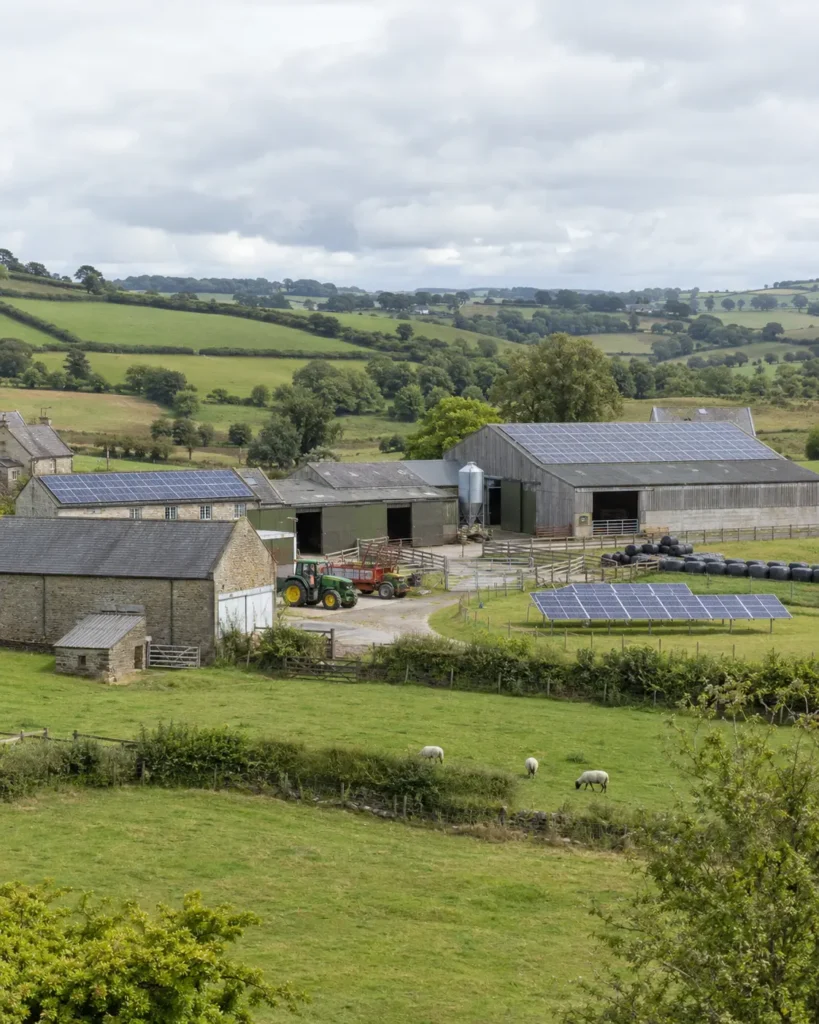
Solar panels can work particularly well on UK farms because agricultural businesses often combine large roof areas with substantial daytime electricity use. Dairy parlours, poultry sheds, grain stores, workshops, cold stores, irrigation systems and packing facilities can all consume power while solar PV is generating.
The key question is not simply how many panels fit on a barn. It is how much solar electricity the farm can use on site, whether the roof and electrical infrastructure are suitable, what export capacity the local network allows and how the investment fits the farm’s cash flow.
This guide covers typical 2026 costs, system sizing, batteries, grid connection, planning, tax treatment and the checks to make before comparing quotations.
Compare farm solar quotes: Start with recent electricity bills or half-hourly meter data, your postcode and details of the available roofs or land. Get Free Quote can help you compare suitable solar quotations without obligation.
Farm solar at a glance
| Farm situation | Solar fit | Main factor to check |
|---|---|---|
| Dairy, poultry, horticulture or cold storage | Often strong | High daytime or continuous electricity demand |
| Grain drying and seasonal processing | Potentially strong | Match generation with seasonal load |
| Large barns with modest electricity use | Mixed | Avoid oversizing solely because roof space exists |
| Farm with a constrained grid connection | Site-specific | DNO export limit and reinforcement |
| Farm considering batteries | Site-specific | Whether stored energy will be used often enough |
Why solar panels can suit farms
The economics of farm solar are driven by self-consumption. If a dairy parlour, ventilation system or cold store uses electricity during daylight hours, solar can supply part of that demand directly and reduce grid imports.
That is why two farms with identical arrays can achieve different returns. A farm using most of its generation on site may achieve a stronger financial result than one exporting most of its output.
Future demand matters too. Planned refrigeration, irrigation pumps, heat pumps or vehicle charging can change the optimum system size. The existing Get Free Quote solar panel guide explains the core quotation checks—system size, generation assumptions, equipment, warranties and DNO responsibilities—which also matter on agricultural projects.
How much do solar panels for farms cost in the UK?
Commercial solar prices vary by project size and site complexity. Current 2026 market guides commonly place mid-sized commercial rooftop systems at roughly £750–£1,100 per kWp, while larger straightforward installations can achieve a lower cost per kWp.
As a broad budgeting example, a 100 kWp system may fall around £80,000–£105,000 before VAT and tax relief. A 250 kWp system may be around £175,000–£225,000. These are indicative market ranges, not quotations.
Costs can rise where a project needs roof strengthening, asbestos management, long cable runs, switchgear upgrades, scaffolding, trenching, export-control equipment or network reinforcement.
What determines payback?
Simple payback depends mainly on installed cost, annual generation, self-consumption, avoided import price, export income, maintenance, finance and tax relief.
Be cautious with proposals that promise a fixed payback without showing those assumptions. A robust model should let you test what happens if electricity prices, generation or self-consumption are lower than expected.
How should a farm solar system be sized?
Start with electricity data, not panel count. For larger farms, half-hourly meter data is more useful than an annual bill because it shows when electricity is consumed.
An installer should compare the farm’s demand profile with expected solar generation across the year. This helps identify a sensible array size and whether a battery is likely to add value.
A poultry unit with steady ventilation loads will use solar differently from an arable farm whose largest electrical demand occurs during harvest and grain drying. A larger array is not automatically better: once daytime generation regularly exceeds on-site demand, extra capacity depends more heavily on export income and grid capacity.
Roof-mounted or ground-mounted solar?
Roof-mounted solar is often the first option because farms may have substantial barn and shed roof area without sacrificing productive land. However, the building must be structurally suitable and have enough remaining roof life to justify a long-term solar asset.
If a roof needs major work first, compare that scope separately using Get Free Quote’s roofing quote guidance.
Ground-mounted solar can provide better orientation, easier maintenance and greater scale, but planning, land use, grid connection and ecology become more significant.
In England, permitted development rights can apply to solar PV on non-domestic roofs, subject to conditions. Under Part 14 Class J, qualifying rooftop solar can fall within permitted development up to 1 MW, but restrictions apply, including on listed buildings and scheduled monuments, while prior approval may be required in some circumstances. Confirm the exact position with the local planning authority before work starts.
Do farm solar panels need a battery?
Not necessarily. A battery is most useful when the farm regularly generates surplus solar during the day and can use that stored electricity later.
Farms with high daytime demand may already consume much of their solar directly. Conversely, evening milking, refrigeration, overnight ventilation or time-of-use tariffs can strengthen the battery case.
Ask for two financial models: solar-only and solar-plus-battery. Compare usable capacity, power rating, cycle assumptions, efficiency, warranty, degradation and replacement cost.
Grid connection and export payments
Grid connection should be investigated early. Energy Networks Association guidance separates smaller generator connections under G98 from other projects under G99, and the connection process generally becomes more involved as generating capacity increases. Read the Energy Networks Association distributed-generation connection guidance
A Distribution Network Operator may permit full export, impose an export limit or require reinforcement. That can materially change project economics, so a quotation should not assume unrestricted export without evidence.
For eligible installations in Great Britain, the Smart Export Guarantee (SEG) can pay for surplus renewable electricity exported to the grid. Ofgem states that eligible solar PV installations can participate up to 5 MW, subject to the scheme’s eligibility and metering requirements. Export tariff rates and contract terms vary between suppliers. Check Ofgem’s Smart Export Guarantee guidance
Tax relief and farm solar grants
Solar panels are treated as special-rate plant and machinery for capital-allowance purposes. Qualifying expenditure can potentially use the Annual Investment Allowance (AIA), which is currently £1 million. Other capital allowances can apply where AIA is unavailable or not used.
Tax treatment depends on the farm’s legal structure, taxable profits and other capital expenditure. Ask the farm’s accountant to model the actual tax effect rather than assuming a headline percentage saving.
Grant availability changes frequently. The previous Improving Farm Productivity grant round in England included rooftop solar PV, batteries, inverters and certain grid-connection costs, but that round is closed. As of September 2026, GOV.UK also lists FETF 2026 and Capital Grants 2026 application windows as closed. Check current funding for farmers on GOV.UK before building any grant into the business case.
How to compare farm solar quotations
A credible proposal should make its assumptions easy to audit.
| Check | What the quote should show |
|---|---|
| System design | kWp, panel count, layout, inverter capacity and predicted generation |
| Energy model | Self-consumption, export and tariff assumptions |
| Roof | Structural survey, roof condition and exclusions |
| Electrical work | Cabling, switchgear, protection and point of connection |
| Grid | DNO route, export limit and reinforcement responsibility |
| Battery | Usable capacity, power rating, efficiency, cycles and warranty |
| Commercials | Installed price, VAT basis, finance assumptions and exclusions |
| Handover | Commissioning documents, monitoring, warranties and maintenance |
Compare scope as well as headline price. A cheap quote can become expensive if grid work, access, roof repairs or switchgear are excluded.
If the farm is also planning vehicle electrification, consider how that future load could interact with solar and review Get Free Quote’s EV charger guidance. For project-specific questions, contact Get Free Quote before comparing proposals.
Get Your Free Air Source Heat Pump Quote
Find the right air source heat pump solution for your home. Tell us a few details and our team will help you explore suitable options at a competitive price.
Quick to complete. No obligation.
Get your quote
Enter your details below and one of our team will get back to you.
Frequently asked questions
Find clear answers to common questions comparing air source and ground source heat pumps, including efficiency, installation and running costs, winter performance, noise, land requirements and borehole depth.
They can be. Farms with substantial daytime electricity consumption usually have the strongest case because more solar power can be used directly on site rather than exported.
As a broad 2026 market guide, commercial rooftop solar commonly falls around £750–£1,100 per kWp, although roof condition, access, electrical work and grid requirements can move the price significantly.
There is no standard number. The array should be sized from the farm’s electricity demand, available roof or land area, expected solar generation and permitted grid export.
There is no universal payback period. It depends on capital cost, electricity prices, self-consumption, export income, financing, generation and tax treatment. Ask installers to provide their assumptions rather than relying on one headline figure.
Yes, provided the roof is suitable. Structural loading, roof condition, remaining lifespan, orientation, shading, fire safety and access all need to be considered.
Potentially, but asbestos requires specialist assessment and management. Do not assume panels can simply be fixed through an existing asbestos-containing roof. Any remedial or replacement work should be planned before the solar installation.
It depends on the project and UK nation. In England, qualifying non-domestic rooftop systems can benefit from permitted development rights subject to conditions. Larger, ground-mounted, listed-building and sensitive-site projects can require planning permission or prior approval.
Potentially. However, planning, land classification, visual impact, ecology, access and grid connection need to be considered. Ground-mounted projects should be assessed separately from straightforward rooftop installations.
It can be where significant daytime solar would otherwise be exported and the farm has useful evening or overnight loads. Compare solar-only and solar-plus-battery models before deciding.
Yes, subject to its network connection and export arrangements. The DNO may approve full export, restrict export or require additional network work.
Eligible solar PV installations in Great Britain can use the SEG, subject to the scheme requirements. Ofgem states that qualifying technologies can participate up to 5 MW.
Do not assume a grant is currently available. The previous Improving Farm Productivity solar PV round is closed, and GOV.UK showed both FETF 2026 and Capital Grants 2026 application windows as closed in September 2026. Funding can change, so check current guidance.
Potentially. HMRC treats solar panels as special-rate plant and machinery, while qualifying expenditure may be eligible for AIA within the applicable limit. The actual benefit depends on the farm’s circumstances and should be confirmed with an accountant.
Yes. Solar PV works from daylight, not heat, so it still generates during winter. However, shorter days and lower solar irradiation mean output is normally lower than in spring and summer.
Solar PV has relatively few moving parts, but commercial systems still need monitoring and periodic inspection. Check panels, mounting, cabling, inverters and electrical protection, and investigate unexpected drops in generation promptly.
Is solar right for your farm?
Solar panels for farms in the UK can be a strong investment where electricity demand, roof or land suitability and grid capacity align. Farms with consistent daytime loads generally have the clearest route to high self-consumption, while seasonal farms need more careful modelling.
Gather at least 12 months of bills, half-hourly data if available, roof dimensions, roof age, supply details and planned future electrical loads. Then compare complete, site-specific proposals rather than relying on a generic payback figure.
A well-sized system should be designed around how the farm actually uses energy—not simply around how many panels fit on the roof.
Next step: Compare site-specific solar options through Get Free Quote before deciding. The strongest quotation should explain the system design, expected generation, self-consumption, grid arrangements, exclusions and financial assumptions clearly.


