
How Are Solar Panels Installed? UK Step-by-Step Guide
Check Your Eligibility for Boiler Upgrade Scheme (BUS)
Complete your details below to check your eligibility.
Thank you
We've received your details and will be in touch shortly.

Quick Answer: How Are Solar Panels Installed?
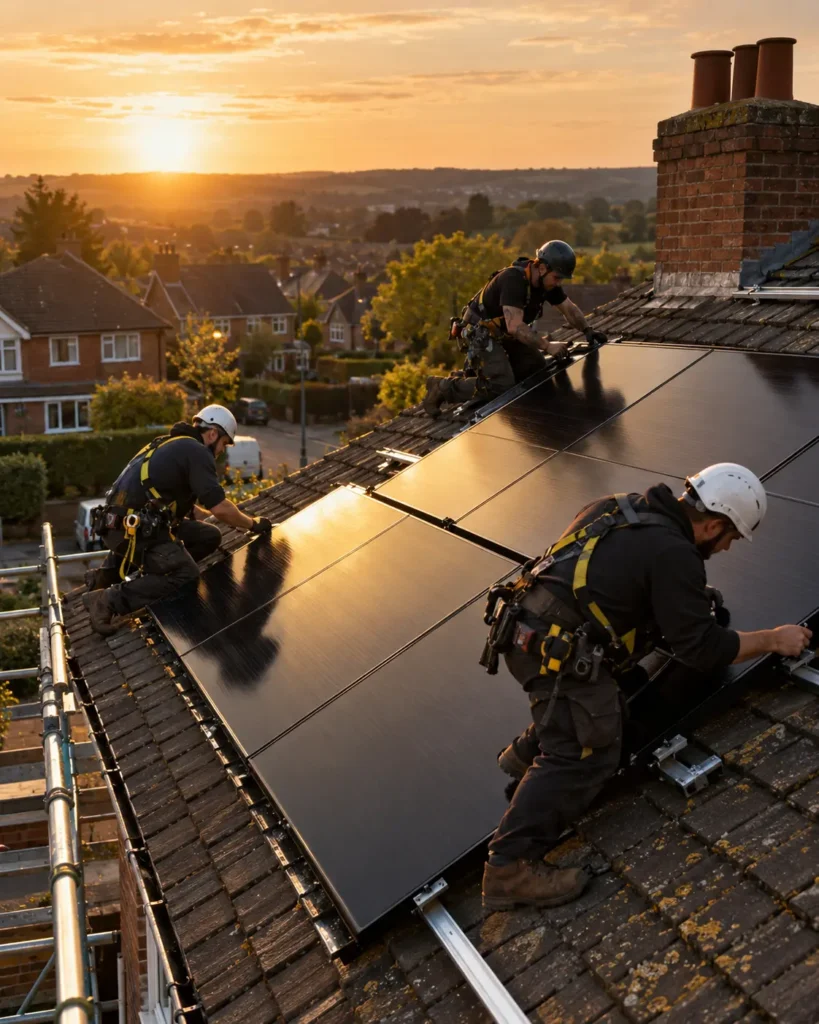
Solar panels are normally installed by first surveying the property and designing an array around the roof’s size, orientation, shading and structural condition. Scaffolding or another suitable access system is then erected. On a tiled pitched roof, installers typically lift selected tiles, attach brackets to the roof structure and fit aluminium mounting rails. The panels are clamped onto these rails.
Electrical cables connect the panels to an inverter, which converts their direct-current electricity into alternating current for the home. The system is then connected to the electrical installation, inspected, tested and commissioned. A typical domestic installation itself can often be completed in around one or two days, although complex roofs or additional electrical work can take longer.
How Are Solar Panels Installed? UK Step-by-Step Guide
Solar panels are installed through a combination of roof work, electrical installation and system commissioning. For a typical UK home, the process starts with a survey and system design. Installers then provide safe roof access, fit a mounting system, secure the solar panels, run electrical cabling to an inverter and connect the system to your home’s electricity supply.
A professional installation involves more than simply attaching panels to roof tiles. The installer must consider roof strength, weatherproofing, wind loads, electrical safety, grid-connection requirements and the position of equipment such as the inverter and optional battery. Current MCS standards require solar PV systems to be designed, installed, tested and commissioned against defined technical requirements.
This guide explains the process from the initial survey to final handover, including what happens on your roof and inside your home.
If you are still comparing options, start with Get Free Quote or review what should be included when you compare solar panel installation quotes.
Solar Panel Installation at a Glance
| Stage | What normally happens | What the homeowner should check |
|---|---|---|
| Survey and design | Roof, shading, electrics and proposed equipment assessed | Final array layout and system size |
| Permissions and network checks | Planning, Building Regulations and DNO requirements reviewed | Who handles each requirement |
| Roof access | Scaffolding or another safe access system installed | Whether access is included in the quote |
| Mounting | Brackets and rails secured to the roof structure | Roof condition and weatherproofing |
| Panels | PV modules positioned and clamped to rails | Panel layout matches the design |
| Electrical work | Cabling, inverter and protection equipment installed | Inverter and cable locations |
| Commissioning | System inspected, tested and switched on | Certificates, warranties and monitoring |
1. What Happens Before Solar Panels Are Installed?
A proper installation begins with the survey rather than the scaffolding.
The installer needs to establish how many panels will fit and where they should go. Important factors include roof direction, pitch, shading, chimneys, roof windows and the electricity your household uses.
Energy Saving Trust advises that shading can materially affect solar generation. Trees, neighbouring buildings and chimneys therefore need to be considered when the array is designed.
The physical roof also needs checking. Current MCS requirements state that a suitably competent person should confirm that a pitched roof can withstand the loads introduced by the PV installation. Unusual or distressed roof structures may require a structural engineer.
If tiles, slates, underlay or roof timbers already need significant work, addressing that before installing panels can avoid paying to remove and reinstall the array later. You can separately compare roofing quotes if remedial work is identified.
The electrical survey
The installer will also inspect your electricity supply, consumer unit and proposed cable routes.
They should decide where the inverter will go and whether other equipment is required. If you are adding a battery, that needs to be incorporated into the electrical design rather than treated as an afterthought.
Future electricity demand can matter too. For example, households planning an EV charger installation or considering an air source heat pump may want the solar design considered alongside those future loads.
2. Planning Permission, Building Regulations and Grid Checks
Many residential rooftop solar installations can proceed without a conventional planning application, but the rules vary across the UK and special restrictions can apply.
In England, permitted-development rules for domestic solar were updated on 27 August 2026, with transitional provisions running for 12 months. Listed buildings, scheduled monuments, conservation areas and unusual installations can require additional consideration. Check the current Planning Portal guidance for roof-mounted solar before relying on a general rule.
Building Regulations are separate from planning permission. Planning Portal states that roof strength normally needs to be demonstrated and electrical work also falls within Building Regulations requirements.
What are G98 and G99?
A grid-connected solar system also interacts with your local Distribution Network Operator, or DNO.
The current MCS solar standard requires installers to follow the applicable grid-connection procedure. G98 covers qualifying generation up to and including 16 amps per phase, while G99 applies above that threshold. Battery storage and existing generation can affect which route applies because the combined AC output may need to be considered.
Your quotation should state who is responsible for the DNO application or notification.
3. Scaffolding and Safe Roof Access
For most pitched domestic roofs, installers use scaffolding to create a safe working platform.
Solar panels are large, awkward objects that must be moved and positioned at height. MCS highlights the combination of fall risks, manual handling and electrical hazards involved in PV work.
Scaffolding may therefore appear several days before the solar team arrives and remain temporarily after installation.
Ground-mounted systems and some flat roofs use different access arrangements.
4. How Are Solar Panels Fixed to a Pitched Roof?
On a conventional tiled roof, installers normally locate suitable structural fixing positions beneath the tiles.
Selected tiles are lifted or temporarily removed. Roof hooks or brackets are then secured to the supporting structure. Aluminium rails attach to these brackets and create the framework that carries the panels.
The exact mounting method depends on the roof covering. Slate, clay tile, concrete tile, metal and other materials require appropriate components and detailing.
MCS guidance is particularly concerned with avoiding damage to roof coverings. It also requires installers to maintain the building’s weather-tightness and structural integrity. Tiles or slates may need appropriate notching or flashing so they sit correctly around the mounting components.
Correct installation should therefore transfer loads into the roof structure rather than simply resting the solar array on fragile tiles.
What about flat roofs?
Flat roofs commonly use angled mounting frames.
Some systems are mechanically fixed, while others use ballast to resist wind forces without penetrating the roof covering. Ballasted installations can add significant weight, so MCS requires the structural loading to be considered and specifies structural-engineer involvement for applicable systems.
5. How Are the Solar Panels Attached?
Once the mounting rails or frames are aligned, installers lift the panels into position.
Specialist clamps secure each module to the mounting system. The installer follows the mounting manufacturer’s specified fixing positions and spacing rather than simply placing clamps wherever convenient.
Panels are electrically connected as the array is assembled.
Traditional installations often connect panels into one or more DC strings. Other designs may use power optimisers or microinverters.
Cable management matters. Connectors and cables should be secured appropriately and protected from long-term water exposure, abrasion and unnecessary movement. MCS specifically requires PV connectors to remain protected against water ingress over the system’s lifetime.
6. What Does the Solar Inverter Do?
Standard solar panels produce direct-current, or DC, electricity.
Most UK household appliances and the electricity network use alternating current, or AC. The solar inverter converts the panels’ DC output into compatible AC electricity.
With a conventional string-inverter system, DC cables run from the roof array to the inverter. Depending on the property and system design, the inverter may be located in a garage, utility area or another suitable position.
The installer also fits the required isolation, protection and electrical equipment.
Systems using microinverters work differently because conversion takes place at individual panels or small groups of panels. However, the system still needs an appropriately designed AC connection to the home’s electrical installation.
7. How Do Solar Panels Connect to the House?
After conversion to AC, solar electricity feeds into your home’s electrical system.
When the panels are generating electricity, appliances can consume that power directly. If generation exceeds household demand and no battery stores the surplus, electricity can be exported to the grid.
Your installer may need to turn off the home’s electricity temporarily while carrying out the final connection.
Electrical work must comply with the applicable safety requirements. Part P of the Building Regulations covers electrical installations associated with dwellings in England, including rooftop photovoltaic equipment.
8. Testing and Commissioning
The system should not simply be connected and left running.
MCS requires commissioning through a documented procedure to confirm that the installation is safe, meets the relevant requirements and operates correctly. Inspection and testing can include polarity, insulation resistance, earthing where applicable, isolator operation and inverter checks.
The installer should also configure any monitoring platform and explain how you can see what the system is generating.
If you intend to receive payments for exported electricity, Ofgem’s Smart Export Guarantee guidance explains how eligible generators can apply for export tariffs. Requirements vary between suppliers.
9. How Long Does Solar Panel Installation Take?
Energy Saving Trust says a typical rooftop solar installation usually takes around one to two days, although more complicated systems can take longer.
That does not mean the entire project takes two days.
Surveys, design work, equipment ordering, scaffolding, DNO approval where required and final paperwork can extend the overall timetable. Weather and unexpected roof or electrical problems can also cause delays.
10. What Should You Receive After Installation?
Before considering the job complete, check that you understand the system and have the relevant documentation.
Depending on the installation, your handover pack may include electrical certificates, system drawings, equipment datasheets, warranties, commissioning records, DNO paperwork, monitoring instructions and an MCS certificate where applicable.
MCS’s current installation standard includes formal verification and handover documentation covering installed components, system rating, estimated performance and test records.
Keep these documents. They can be useful for warranty claims, future electrical work, house sales and export-tariff applications.
Get Your Free Air Source Heat Pump Quote
Find the right air source heat pump solution for your home. Tell us a few details and our team will help you explore suitable options at a competitive price.
Quick to complete. No obligation.
Get your quote
Enter your details below and one of our team will get back to you.
Frequently asked questions
Find clear answers to common questions comparing air source and ground source heat pumps, including efficiency, installation and running costs, winter performance, noise, land requirements and borehole depth.
A typical domestic rooftop system can often be installed in one or two days. Complex roofs, batteries, electrical upgrades or difficult access may extend this.
Scaffolding is commonly used on pitched roofs because installers need a safe platform for moving panels and completing roof work at height.
Selected tiles are often lifted temporarily so mounting brackets can be attached to the underlying roof structure. They are then replaced or appropriately detailed around the bracket.
A correctly designed installation should maintain the roof's structural integrity and weather-tightness. Existing roof defects or poor mounting work can create problems, so roof condition should be checked first.
Often not, but planning rules vary by nation, property and location. Listed buildings, conservation areas and unusual installations require particular attention.
Yes, relevant Building Regulations can apply to structural and electrical aspects of the installation.
The panels generate DC electricity. An inverter normally converts this into AC electricity before it connects to the home's electrical installation.
Usually only temporarily while electricians carry out the final connection and relevant electrical work.
The location depends on the design and manufacturer's requirements. Installers consider cable length, ventilation, temperature, accessibility and protection from unsuitable conditions.
Yes. Flat-roof systems often use angled frames that are mechanically fixed or ballasted. Structural loading and waterproofing need careful assessment.
Yes. Solar and battery storage are frequently designed together. The electrical arrangement, battery location and combined grid-export capability need to be considered.
Grid-connected systems need to follow the relevant DNO process. The route depends on system capacity and other generation or storage installed at the property.
MCS certification is widely used for UK domestic installations and may be important for documentation and some export-tariff requirements. Check your intended tariff's current conditions before proceeding.
If substantial roof work is likely during the life of the solar system, doing it first can avoid the future cost of removing and reinstalling panels.
Expect appropriate electrical and commissioning documents, equipment and warranty information, operating instructions and applicable MCS and DNO documentation.
Some physical work can technically be undertaken outside a conventional turnkey installation, but rooftop safety, Building Regulations, electrical certification, grid connection and MCS/export requirements make DIY considerably more complicated. Check all requirements before buying equipment.
Conclusion: What Does a Good Solar Installation Look Like?
Solar-panel installation is a structured engineering process rather than simply a roofing job.
A good installation starts with an accurate survey. The roof must safely support the system, mounting components must remain secure and weather-tight, electrical equipment must be properly designed and the completed installation must be inspected and tested.
For homeowners, the most useful step is to compare proposals on the complete installation scope. Look beyond the panel price and check the mounting system, scaffolding, electrical work, DNO responsibilities, warranties, commissioning and documentation.
Once those details are clear, you can compare complete solar installation quotations rather than headline prices alone.


