
Solar Panels on a Flat Roof UK: 2026 Guide
Check Your Eligibility for Boiler Upgrade Scheme (BUS)
Complete your details below to check your eligibility.
Thank you
We've received your details and will be in touch shortly.

Quick Answer: Can You Put Solar Panels on a Flat Roof in the UK?
Yes. Solar panels can be installed on a flat roof in the UK. A flat roof can offer useful design flexibility because the installer can choose the panel angle and orientation rather than accept an existing roof pitch.
The main challenge is the mounting system. Panels may be held down with ballast or mechanically fixed to the roof structure, depending on structural capacity, wind loads and waterproofing. The current MCS installation standard treats roofs below 10° as flat roofs and requires a qualified structural engineer to be consulted for ballasted systems. Planning rules also differ across England, Wales, Scotland and Northern Ireland, so the final layout must be checked against the rules where the property is located.
Solar Panels on a Flat Roof UK: Installation, Costs, Planning & Performance
Solar panels can work very well on a flat roof in the UK, but the design differs from a typical pitched-roof installation. Instead of fixing panels parallel to an existing slope, installers use a mounting system that sets the angle and manages wind, drainage and roof protection.
The key questions are whether the roof can carry the extra load, whether ballast or mechanical fixings suit the structure, how the array affects waterproofing, what planning rules apply and how much electricity the layout should generate.
This guide explains those points so homeowners, landlords and businesses can compare designs and quotes with more confidence.
Thinking about solar? Get Free Quote can help you compare renewable-energy options and quotations from UK providers.
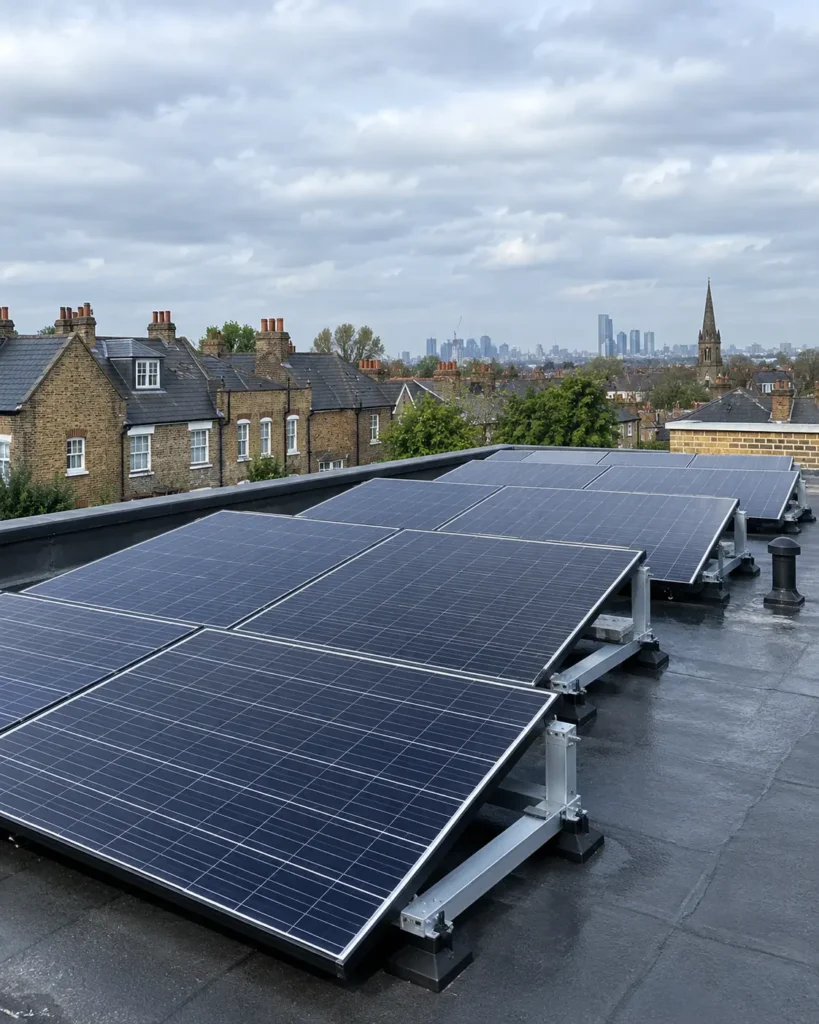
Can You Put Solar Panels on a Flat Roof?
Yes. Energy Saving Trust’s solar installation guidance confirms that solar panels can be installed on flat roofs. A flat roof can actually give the designer more freedom because the array is not locked to one existing slope or direction.
However, the mounting frame, modules and any ballast add load to the roof. Wind can also try to lift or slide the array. The design therefore has to protect the roof covering, preserve drainage and avoid imposing loads the structure cannot safely support.
Check the roof condition before finalising the PV design. If the waterproof covering is ageing or already needs attention, dealing with this first can avoid removing and reinstalling solar equipment later. Energy Saving Trust also lists roof-covering renewal as a factor affecting installation cost.
If repairs or replacement may be necessary, compare your options through Get Free Quote’s roofing quote service before the solar array goes on.
Flat-Roof Solar Mounting Options
| Method | Main advantage | Main consideration |
|---|---|---|
| Ballasted | Can avoid penetrating the waterproof layer | Roof capacity, wind loading and ballast weight |
| Mechanically fixed | Can reduce reliance on heavy ballast | Fixing strength and weatherproofing |
| East-west low-angle layout | Can use roof area efficiently and spread generation through the day | Self-shading, wind and layout modelling |
Ballasted systems use weight to resist movement rather than relying entirely on penetrations through the roof covering. However, “no penetrations” does not mean “no engineering”.
The current MCS installation standard MIS 3002 requires wind calculations, a compatible protection or slip layer and consultation with a qualified structural engineer to confirm that a roof can withstand the solar PV system and proposed ballast.
Mechanically fixed systems transfer loads into the structure. MCS also sets requirements around assessing solid roof decks and the resistance of fixings. The mounting and waterproofing details therefore need to work together.
Structural Loading and Waterproofing
Flat-roof solar is a structural and waterproofing project as well as an electrical installation.
An engineer may need to consider load distribution, localised loads, wind uplift, sliding forces and existing roof loads rather than simply adding up the total weight of the panels.
MCS defines a flat roof for these installation requirements as a roof with a pitch below 10°. For ballasted arrays, its 2026 standard states that a qualified structural engineer must be consulted to ensure the roof can withstand both the PV system and its ballast.
The waterproofing system matters as well. Mounting components and protection layers must be compatible with the roof covering. Drainage outlets should remain accessible, while the array layout should retain practical access for future inspection and maintenance.
If your roof covering has a manufacturer or installer warranty, confirm how the proposed solar system affects it before work begins.
What Angle Should Solar Panels Be on a Flat Roof?
There is no single best angle for every UK flat roof.
A steeper south-facing panel may capture more solar energy under some conditions, but it also presents a larger surface to the wind. Steeper rows normally need more separation to control self-shading.
For this reason, many specialist flat-roof systems use relatively shallow mounting angles. The exact angle should come from the system design rather than a generic rule.
East-west arrays are another option. Opposing rows can make efficient use of available space while spreading electricity production across more of the day.
The right design should be judged by expected annual energy production, not angle alone. The European Commission’s PVGIS tool can model PV generation using location, module slope and orientation, and can calculate an optimum fixed slope and azimuth for annual energy output.
For a household, the layout with the highest theoretical annual generation is not necessarily the only useful option. Matching generation to when you consume electricity can also matter.
That is particularly relevant if you use a solar-compatible EV charger or are comparing electricity demand through an air source heat pump running-cost calculation.
Planning Permission for Flat-Roof Solar Panels in the UK
Planning rules are devolved, so limits differ between UK nations. The rules can also change for listed buildings, conservation areas, World Heritage Sites and properties where permitted-development rights have been restricted.
| Nation | Key flat-roof planning point |
|---|---|
| England | For domestic permitted development, solar equipment on a flat roof can generally be no more than 0.6m above the highest part of the roof, excluding a chimney. Extra controls apply in some designated areas. |
| Wales | Welsh Government guidance says flat-roof panels cannot be within 1m of the external roof edge or protrude more than 1m above the roof plane. |
| Scotland | On a dwelling, Class 6HA generally limits projection to 1m from the roof plane or other relevant surface, subject to restrictions including listed buildings and conservation areas. |
| Northern Ireland | Northern Ireland operates its own planning and permitted-development regime. Check the current council and Department for Infrastructure requirements rather than assuming an English, Welsh or Scottish limit applies. |
Because mounting frames raise the panels above a flat roof, planning limits can directly affect the design and possible tilt.
For primary sources, see the relevant England permitted-development provisions, Welsh Government solar guidance and Scottish Government householder guidance.
Where there is any doubt, confirm the proposal with the relevant local planning authority before ordering equipment.
How Much Do Solar Panels on a Flat Roof Cost?
Energy Saving Trust currently gives around £7,600 as an indicative cost for a typical 4.5kWp domestic solar PV system. This is a general home solar figure, not a specific flat-roof quotation.
Flat-roof installations can cost more where they require additional mounting equipment, structural work or more complex installation. Energy Saving Trust specifically notes that flat-roof installations can be more complex because additional mounting may be needed and the roof must support the extra weight.
Compare itemised quotes rather than headline totals. Relevant costs can include:
- Solar panels and inverter
- Flat-roof mounting system
- Ballast or mechanical fixings
- Structural assessment
- Access equipment or scaffolding
- Electrical installation
- Monitoring equipment
- Roof repairs or waterproofing work
A survey is needed for reliable property-specific pricing.
Will Flat-Roof Solar Panels Generate Less Electricity?
Not necessarily.
Output depends on location, shading, usable roof area, module performance, tilt, orientation and system losses. A flat roof gives the designer some freedom to optimise several of these factors.
An east-west arrangement, for example, can sometimes accommodate a different number of panels or provide a broader daily production profile than a conventional south-facing row layout. The best option therefore depends on the complete array, not simply the direction of one panel.
PVGIS can estimate monthly and annual output using solar radiation, temperature, wind and module characteristics.
Ask every installer for an annual generation estimate in kWh, together with the assumptions behind it. Compare that expected generation with your own electricity-use pattern.
Eligible solar generators in Great Britain may also be able to receive payments for surplus electricity through the Smart Export Guarantee. Suppliers set their own tariff terms and rates.
How to Decide Whether Your Flat Roof Is Suitable
- Check the structure. Confirm whether the roof can safely support the array, mounting equipment and any ballast.
- Check the roof covering. Review its condition, age, warranty and likely remaining service life.
- Review wind exposure. Building height, location and position on the roof influence wind forces.
- Measure genuinely usable area. Allow for rooflights, vents, outlets, drainage, shading and maintenance access rather than using the total roof dimensions.
- Check planning constraints. Apply the correct rules for your UK nation and any protected status affecting the building.
- Model the proposed layout. Compare practical orientations and consider self-shading as well as predicted annual kWh generation.
- Compare itemised quotations. Make sure structural, roofing and performance assumptions appear in writing.
What Should a Flat-Roof Solar Quote Include?
A good quotation should identify the exact mounting system and explain whether the design is ballasted, mechanically fixed or uses another approved approach.
It should state who is responsible for structural verification and protecting the waterproofing. Where ballast is involved, the design should make the calculated loading clear.
Ask for the proposed panel angle, array drawing, predicted annual generation and key modelling assumptions. Electrical equipment, monitoring, warranties and relevant DNO responsibilities should also be explained.
Energy Saving Trust recommends obtaining quotes from MCS-certified installers.
Get Your Free Air Source Heat Pump Quote
Find the right air source heat pump solution for your home. Tell us a few details and our team will help you explore suitable options at a competitive price.
Quick to complete. No obligation.
Get your quote
Enter your details below and one of our team will get back to you.
Frequently asked questions
Find clear answers to common questions comparing air source and ground source heat pumps, including efficiency, installation and running costs, winter performance, noise, land requirements and borehole depth.
Yes. Solar PV can be installed on a UK flat roof. The main additional considerations are mounting, structural loads, wind resistance, waterproofing and planning.
There is no universal best angle. The optimum depends on location, orientation, wind exposure, available area and row spacing. PVGIS can model different slopes and calculate an optimum fixed angle for annual generation.
They are normally installed at an angle rather than simply laid flat. Tilting affects solar exposure, drainage, wind loading and the spacing needed between panel rows.
Neither is automatically better. A ballasted system can reduce roof penetrations but adds weight. Mechanical fixing can reduce ballast but requires suitable structural attachment and careful waterproofing.
For a ballasted system installed under the current MCS standard, a qualified structural engineer must be consulted to ensure the roof can withstand the PV and ballast loads.
They can if the mounting method or installation conflicts with the waterproofing provider’s conditions. Check any existing roof warranty before installation and record who is responsible for making good the waterproof layer.
Often they can fall within permitted-development rights, but the conditions differ between England, Wales, Scotland and Northern Ireland. Listed buildings, conservation areas and other designated locations can have additional requirements.
For domestic permitted development, the equipment can generally be no more than 0.6m above the highest part of the roof, excluding a chimney.
Welsh Government guidance says panels on a domestic flat roof cannot be within 1m of the external roof edge or protrude more than 1m above the roof plane.
For a dwelling, Scotland’s Class 6HA permitted-development rules generally prevent solar equipment from projecting more than 1m from the roof plane or other specified surfaces. Other restrictions apply to listed buildings and some protected locations.
Northern Ireland has a separate planning system and permitted-development rules. Check the current local council and Department for Infrastructure requirements for the property rather than applying rules from Great Britain.
They can. Energy Saving Trust notes that flat roofs can involve greater complexity because extra mounting equipment may be required and the roof needs to support the additional load.
Not automatically. The result depends on the complete system design, including shading, orientation, tilt, panel quantity and usable roof area. Flat roofs also give designers freedom to choose the orientation.
Yes. East-west configurations are a recognised flat-roof design option. Whether they are suitable depends on roof dimensions, wind calculations, row geometry and the required generation profile.
An eligible installation in Great Britain may qualify for payments under the Smart Export Guarantee. Suppliers determine their tariff rates and terms, while the installation must meet the scheme’s eligibility requirements.
Conclusion: Are Solar Panels Worth Considering on a Flat Roof?
A flat roof does not rule out solar panels. In some properties, it can provide valuable freedom over orientation and layout.
However, the array needs to be designed as part of the building rather than treated as equipment simply placed on the roof. Structural capacity, wind loading, waterproofing, planning restrictions, drainage, shading and realistic energy modelling all matter.
Ballasted systems can reduce the need for roof penetrations, while mechanically fixed systems can reduce reliance on ballast. Neither approach is automatically right for every property.
Before committing, make sure the quotation explains how the array will be supported, how the roof will remain weather-tight and how much electricity the proposed layout is expected to generate.
Ready to compare your options? Use Get Free Quote’s solar panel quote comparison service and ask each provider to state its flat-roof mounting, structural and generation assumptions in writing.


