
Do Solar Panels Work on Flat Roofs? UK Guide 2026
Check Your Eligibility for Boiler Upgrade Scheme (BUS)
Complete your details below to check your eligibility.
Thank you
We've received your details and will be in touch shortly.

Quick answer: do solar panels work on flat roofs?
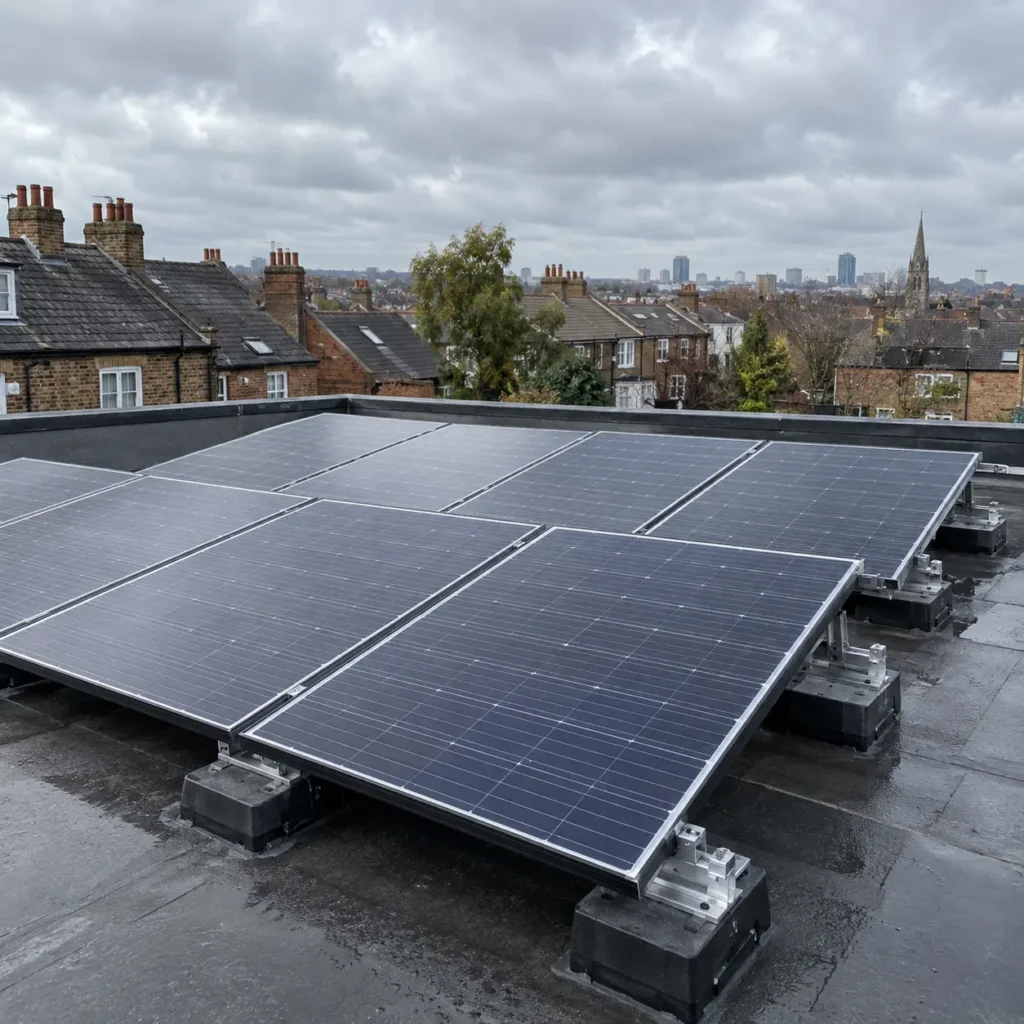
Yes. Solar panels generate electricity on flat roofs just as they do on pitched roofs. In most installations, however, the panels are not laid completely flat. They sit on a mounting system that gives them a shallow tilt, which can improve solar exposure, help rainwater drain and reduce dirt build-up.
The main design issues are structural strength, wind loading, waterproofing and row spacing. Ballasted systems avoid drilling through the roof membrane but add weight. Mechanically fixed systems can reduce ballast but create roof penetrations that must be properly weatherproofed. A flat-roof solar survey should assess these factors before the system is specified. The Energy Saving Trust specifically confirms that solar panels can be installed on flat roofs and notes that many systems use ballast to avoid disturbing the roof covering.
Do Solar Panels Work on Flat Roofs? UK Guide 2026
Yes. Solar panels can work very well on flat roofs in the UK, provided the system is designed for the roof rather than treated like a standard pitched-roof installation.
The photovoltaic (PV) panels work in exactly the same way. The difference is the mounting. On a flat roof, installers normally use a frame to create a useful tilt, control wind loading and keep the array secure without compromising the waterproof covering.
For homeowners, the key questions are whether the structure can safely carry the system, how it will be secured, whether rows will shade each other, and whether the proposed height meets planning rules.
Thinking about solar for a flat roof? Start with a property-specific survey before comparing final quotes. It should cover roof condition, structural loading, mounting, shading, orientation and access. You can compare solar options through Get Free Quote.
Flat-roof solar at a glance
| Question | Typical answer | What matters most |
|---|---|---|
| Do panels work on a flat roof? | Yes | Correct design and mounting |
| Should panels lie completely flat? | Usually no | Tilt, drainage and soiling |
| Can mounting avoid roof penetrations? | Often | Ballast and structural capacity |
| Can a flat roof outperform a poor pitched roof? | Yes | Orientation and shading |
| Is planning permission always required? | No | Nation, property type and dimensions |
| Is a survey important? | Yes | Structure, membrane, wind and access |
Do flat-roof solar panels generate less electricity?
Not automatically.
Solar output depends on the light reaching the panels, orientation, tilt, shading, temperature and system losses. A flat roof gives the designer more freedom because the panels are not forced to follow the roof’s direction.
That can help if the main roof faces east, west or north. A flat-roof array may face south, or use an east-west layout to spread generation across more of the day.
The Energy Saving Trust’s solar panel guidance says an unshaded south-facing roof is ideal and that east- or west-facing systems tend to generate around 15–20% less energy than an equivalent system facing directly south. Energy Saving Trust
That does not make east-west layouts a poor choice. On a constrained flat roof, fitting more panels at a shallower east-west angle can make better use of the available space.
The useful comparison is the predicted annual generation for the proposed layout, not whether the underlying roof is flat.
What angle should solar panels be on a flat roof?
Flat-roof panels are normally tilted rather than placed horizontally.
A shallow angle helps rainwater run off and can improve exposure to sunlight. It also keeps the array lower, reduces wind pressure and lets rows sit closer together.
There is no single best angle for every UK property. A steeper south-facing array may increase output from each panel, but it creates longer shadows and needs more row spacing. A lower-angle east-west arrangement may fit more modules into the same area.
See the Get Free Quote guide to flat-roof solar panel angles for the design detail. The installer should model the actual orientation, angle and shading rather than quote one universal “optimum” angle.
How are solar panels mounted on a flat roof?
The two main approaches are ballasted and mechanically fixed mounting.
| Mounting method | How it works | Main advantage | Main consideration |
|---|---|---|---|
| Ballasted | Weighted frame sits on the roof | Usually avoids penetrating the waterproof membrane | Adds permanent load |
| Mechanically fixed | Mounts connect into the deck or structure | Can reduce ballast | Penetrations must be properly sealed |
Ballasted systems are common because they can preserve the roof membrane. However, the design still has to resist wind uplift and sliding while distributing loads safely.
The current MCS Solar PV Installation Standard, MIS 3002:2025 Issue 2.0 defines a flat roof as one with an angle below 10°. For ballasted systems, it states that a qualified structural engineer must be consulted to confirm that the roof can withstand the imposed load from the solar PV system and proposed ballast. MCS Certified
For a closer look at both methods, see the flat-roof solar panel mounting guide.
Can a flat roof take the weight of solar panels?
Sometimes, but this must be checked rather than assumed.
The roof has to carry the panels, mounting equipment, ballast where used, and the effects of wind. Existing construction matters: timber joists, concrete decks, roof spans, parapets, roof height and local exposure can all change the design.
This is especially important on domestic extensions and garages, where the roof may not have been designed for substantial extra permanent load.
For ballasted systems covered by the current MCS installation standard, structural engineering input is specifically required. MCS Certified Planning Portal guidance also says the existing roof’s ability to carry solar-panel loads needs to be checked and proven. Planning Portal
A proper solar panel installation survey should establish the roof build-up, condition and loading requirements before the final design is agreed.
Will solar panels damage a flat roof?
They should not when the mounting system is compatible with the roof and properly installed.
The main risk is compromising the waterproof covering. Ballasted systems can avoid penetrations, but protection layers must be compatible with the membrane. Mechanically fixed systems pass through the roof covering, so every penetration needs suitable weatherproofing. MCS specifically requires a compatible protection or slip layer for ballasted flat-roof installations. MCS Certified
Roof age also matters. Solar panels may remain in service for decades. If the membrane is ageing or near replacement, renewing it first can be more economical than removing and reinstalling the array later. The Energy Saving Trust also advises considering roof-covering renewal where necessary before panels are fitted. Energy Saving Trust
Do you need planning permission for solar panels on a flat roof?
Often not, but the rules vary across the UK.
In England, domestic solar PV on a flat roof can fall within permitted development if the relevant conditions are met. Current Planning Portal guidance says the highest part of the equipment cannot be more than 600mm above the highest part of the flat roof, excluding chimneys. The domestic solar rules were updated again on 27 August 2026, but this 600mm flat-roof limit remains in the current guidance. Extra controls apply in some protected locations and to listed-building settings. Planning Portal
Wales has different limits. Welsh Government guidance says flat-roof panels on a house cannot sit within one metre of the external roof edge or protrude more than one metre above the roof plane. GOV.WALES
Scotland has its own permitted-development framework; current Scottish Government guidance allows domestic solar subject to specific restrictions, including a one-metre projection limit. Scottish Government Northern Ireland advises householders to check with their council planning office, particularly for listed buildings and conservation areas. nidirect
Always confirm the rules that apply to the property before installation.
Do solar panels on flat roofs cost more?
They can, because the mounting and structural design may be more involved.
The Energy Saving Trust currently gives around £7,600 as a typical cost for a domestic 4.5kWp solar PV system. That is a broad benchmark, not a flat-roof quotation. Flat-roof projects may add cost for specialist mounting, structural calculations, ballast handling, roof repairs or access. Energy Saving Trust
Use the flat-roof solar panel cost guide as a starting point, but compare written quotations based on the same system size, mounting method, warranties and structural scope.
How to check whether your flat roof is suitable
- Check the roof covering. Confirm its age, condition, material and remaining life.
- Confirm the structure. Establish how the roof is built and whether it can support the proposed loads.
- Model shading. Include parapets, chimneys, trees, buildings and row-to-row shading.
- Choose the layout. Compare south-facing and east-west arrangements.
- Check wind design. The mounting system must suit the property’s location, height and exposure.
- Check planning. Use the rules for the relevant UK nation and property type.
- Plan maintenance access. Leave access for inspection, cleaning and future roof work.
- Compare predicted generation. Ask for the annual estimate for the actual design.
Get Your Free Air Source Heat Pump Quote
Find the right air source heat pump solution for your home. Tell us a few details and our team will help you explore suitable options at a competitive price.
Quick to complete. No obligation.
Get your quote
Enter your details below and one of our team will get back to you.
Frequently asked questions
Find clear answers to common questions comparing air source and ground source heat pumps, including efficiency, installation and running costs, winter performance, noise, land requirements and borehole depth.
They can generate electricity when horizontal, but installers normally give them some tilt. A tilt improves drainage, helps reduce dirt build-up and may improve annual generation.
There is no universal best angle. The installer must balance annual yield, row shading, wind loading, roof space and planning-height limits. Shallow angles are common on flat roofs for these reasons.
Yes. Solar PV needs daylight rather than hot weather, so it continues generating in winter and in cloudy conditions. Output is lower during shorter, darker winter days. Energy Saving Trust
No. South generally maximises annual generation per panel in the UK, but east-west arrangements can spread production through the day and may fit more panels on a constrained roof.
It depends on the roof and electricity-use pattern. South-facing layouts favour maximum output per panel, while east-west layouts can reduce row spacing and produce a broader morning-to-evening generation profile.
Not always. Permitted-development limits differ between England, Wales, Scotland and Northern Ireland, and extra controls may apply to protected or listed properties. Check the rules for the property's location before installation. Planning Portal
A properly designed system should not. It should distribute loads and use materials compatible with the waterproof membrane. The roof must also be strong enough for the panels and ballast. MCS Certified
There is no safe universal figure. Required ballast depends on the mounting system, roof height, location, exposure, array position and wind-loading calculations.
Potentially. These roofs need the same structural and waterproofing checks as any other flat roof. Lightweight timber roofs deserve particular attention before ballast is added.
There is no fixed schedule. Inspect performance and panel condition periodically. Shallower arrays can retain more dirt than steep pitched-roof panels, so cleaning needs depend on the angle and local environment.
Potentially, yes. The chosen mounting system and any protection layer must be compatible with the specific roof covering, and its warranty conditions should be checked before installation.
Not automatically, but an unsuitable fixing or unauthorised alteration could affect warranty cover. Check the roof manufacturer's or warranty provider's conditions before the work starts.
Usually, yes, provided the electrical system is designed with future storage in mind. Discuss inverter compatibility, available space and electrical requirements at the initial design stage.
They sometimes do because they can require specialist mounting equipment, structural engineering, ballast handling or additional roof work. Obtain a property-specific quotation rather than applying a standard percentage premium.
The current MIS 3002:2025 Issue 2.0 says a qualified structural engineer must be consulted to ensure a roof can withstand the imposed load from a ballasted solar PV system and its proposed ballast.
Are flat-roof solar panels worth considering?
Yes, where the roof is structurally suitable and the array can be mounted without creating unacceptable waterproofing or planning problems.
A flat roof can give the designer useful freedom over orientation and layout. The trade-off is that mounting becomes a more important part of the project, particularly because of wind loading, ballast and membrane protection.
The best next step is to confirm that the roof can support a safe, productive layout. Ask any installer to explain the proposed mounting method, structural checks, predicted annual output, wind-loading assessment and effect on the existing roof warranty before accepting a quotation.


