
Best Solar Panels for Small Roofs UK: 2026 Guide
Check Your Eligibility for Boiler Upgrade Scheme (BUS)
Complete your details below to check your eligibility.
Thank you
We've received your details and will be in touch shortly.

Quick answer: what are the best solar panels for a small UK roof?
For a small roof, look for panels offering high power density and dimensions that work with the available space.
The AIKO Neostar 3P54 is particularly strong because current models reach 500W and up to 25% module efficiency. The Maxeon 7 is another compelling option, especially where its relatively narrow 1,035mm width helps the layout. LONGi’s Hi-MO X10 combines up to 490W with 24% efficiency in its residential format, while REC’s Alpha Pure-RX offers up to 470W, strong long-term output retention and a relatively short panel format. AIKO Website
The important point is that the highest-efficiency panel is not automatically the one that produces the largest complete array on your particular roof.
Best Solar Panels for Small Roofs in the UK: 2026 Guide
A small roof does not rule out a worthwhile solar installation. It simply changes what matters most.
For a space-constrained roof, the priority is not finding the cheapest panel or even the panel with the highest wattage. You need to generate as much useful electricity as possible from the usable roof area. That means comparing efficiency, watts per square metre, physical dimensions, shading performance and the way each panel fits around chimneys, dormers and roof edges.
The Energy Saving Trust says a typical 4.5kWp domestic system may occupy around 20–30m². However, modern high-efficiency residential panels can deliver substantially more power per panel than older modules. Energy Saving Trust solar panel guidance Energy Saving Trust
If your roof can only accommodate four, six or eight panels, choosing the right module can therefore make a significant difference.
For broader help comparing equipment and installation options, see our guide to the best solar panels in the UK for 2026.
Ready to see what will actually fit your roof? You can compare solar panel installation quotes or start with Get Free Quote.
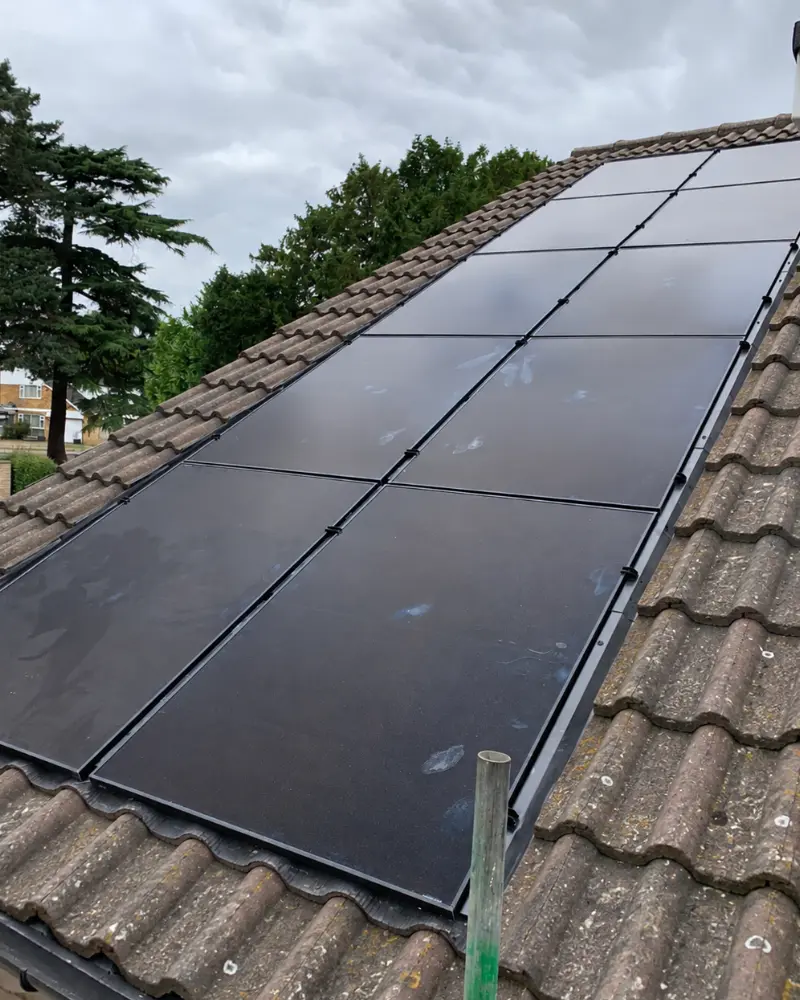
Best solar panels for small roofs compared
| Panel | Current residential specification | Approx. dimensions | Why consider it for a small roof |
|---|---|---|---|
| AIKO Neostar 3P54 | 470–500W; up to 25.0% efficiency | 1,762 × 1,134mm | Very high output per square metre; strong option when total roof area is the constraint |
| Maxeon 7 | Up to 445W; 24.1% efficiency | 1,787 × 1,035mm | Narrow format can help on roofs where panel width limits the layout |
| LONGi Hi-MO X10 | 475–490W; up to 24.0% efficiency | 1,800 × 1,134mm | High output and efficiency with a mainstream residential footprint |
| REC Alpha Pure-RX | Up to 470W; 22.6% efficiency | 1,728 × 1,205mm | Shorter panel with strong long-term performance and useful shade characteristics |
Specifications change, so ask the installer to identify the exact model code on the quotation rather than accepting a brand name alone.
What matters most when roof space is limited?
1. Watts per square metre
Efficiency tells you how much incoming solar energy becomes electricity. For a constrained roof, it is particularly useful because higher efficiency usually means more generating capacity within the same area.
Using current manufacturer power ratings and dimensions, the AIKO 500W format provides roughly 250W of nameplate capacity per square metre. The equivalent figures for the 445W Maxeon 7 and 490W LONGi Hi-MO X10 are about 241W/m² and 240W/m² respectively.
That difference becomes meaningful when only a handful of modules fit.
2. Panel dimensions
Do not compare wattage without checking length and width.
Imagine a roof section that can accommodate three 1,050mm-wide panels but only two 1,134mm-wide panels. A narrower 445W module could create a larger total array than a wider 500W module.
This is why a proper solar panel installation survey matters on small and awkward roofs.
3. Usable roof area
Your roof’s gross dimensions are not the same as usable solar area.
Installers need to account for roof edges, ridges, valleys, windows, chimneys, vents and safe fixing positions. Planning or building constraints can also affect the final arrangement.
The best design therefore starts with an accurate roof layout, not a target number of panels.
Which panel stands out?
AIKO Neostar 3P54: strongest where power density matters most
AIKO’s current Neostar 3P54 range reaches 470–500W and up to 25% efficiency. AIKO also specifies partial-shading optimisation, a -0.26%/°C temperature coefficient and a 30-year performance warranty. AIKO Neostar 3P54 specifications AIKO Website
For a roof where every square metre counts, those figures make it particularly attractive.
However, its 1,134mm width still has to suit the roof. A theoretically more efficient panel is of little benefit if its dimensions mean one fewer module will fit.
Maxeon 7: useful when roof width is the problem
The Maxeon 7 reaches 445W at up to 24.1% efficiency. Its dimensions are approximately 1,787 × 1,035mm, making it noticeably narrower than many current high-output residential panels. SunPower
That can make it valuable on terraced homes or broken roof sections where the limiting measurement is horizontal space.
Maxeon’s current warranty information also lists long warranty coverage, although applicable terms and registration requirements should always be checked for the exact UK installation. Maxeon warranty information Maxeon Solar Technologies
LONGi Hi-MO X10: high output with strong efficiency
The residential LR7-54HVH Hi-MO X10 range reaches 490W and up to 24% efficiency. LONGi specifies a 15-year materials and processing warranty and 30-year linear power warranty for this datasheet. LONGi Solar
It is a sensible comparison point against AIKO when installers can offer the system at a competitive installed price.
REC Alpha Pure-RX: worth considering for awkward conditions
The REC Alpha Pure-RX reaches 470W and 22.6% efficiency. REC quotes 226W/m² power density and at least 92% warranted output in year 25. REC Alpha Pure-RX specifications REC Group
Its four-section panel design is also intended to maintain more production under partial shading.
How much solar can you fit on a small roof?
The following example uses a 500W panel occupying roughly 2m². It shows module footprint only, not the total roof area required.
| Number of panels | 500W array | 400W array | Approx. 500W panel footprint |
|---|---|---|---|
| 4 | 2.0kWp | 1.6kWp | ~8m² |
| 6 | 3.0kWp | 2.4kWp | ~12m² |
| 8 | 4.0kWp | 3.2kWp | ~16m² |
With six panels, moving from 400W to 500W increases nameplate capacity from 2.4kWp to 3.0kWp — 25% more capacity from the same panel count.
Actual annual generation depends on orientation, pitch, location, shading and system losses. For more detail, see our guide to solar panel output in the UK.
What about chimneys, dormers and shade?
A small roof often becomes difficult because the usable area is fragmented rather than simply small.
The Energy Saving Trust notes that trees, buildings and chimneys can reduce generation. It also explains that optimisers can stop one shaded panel from unnecessarily restricting the performance of other panels in suitable system designs. Energy Saving Trust
Optimisers do not create sunlight. Their value is managing mismatch between panels.
Likewise, a mixed portrait-and-landscape layout may sometimes use an awkward roof more effectively. The final arrangement must still follow the panel manufacturer’s mounting requirements.
Orientation also matters. Energy Saving Trust estimates that an east- or west-facing system typically generates around 15–20% less energy than an equivalent directly south-facing system. Energy Saving Trust
How much does a small-roof solar system cost?
Energy Saving Trust currently gives around £7,600 as the cost of a typical 4.5kWp domestic solar installation. Roof access, system size, roof work and equipment specification all affect the price. Energy Saving Trust
A smaller array should not be priced by simply dividing that figure by the number of panels. Scaffolding, electrical work, surveying and inverter installation create fixed costs.
For an accurate comparison, ask for:
- Exact panel make and model.
- Number of panels and total kWp.
- Estimated annual generation.
- Roof layout drawing.
- Shading assumptions.
- Inverter or optimiser specification.
- Product, performance and workmanship warranties.
- Total installed price.
Qualifying residential solar installations currently benefit from 0% VAT until 31 March 2027, after which current legislation provides for the reduced rate to return. HMRC energy-saving materials VAT guidance GOV.UK
Is a small solar system still worth having?
It can be.
A four- or six-panel array will generate less electricity than a large installation, but system value depends on how much of that electricity you use, what electricity would otherwise cost and what you receive for exports.
Surplus electricity from eligible systems can be sold through the Smart Export Guarantee in Great Britain. Ofgem Smart Export Guarantee guidance Ofgem
A battery should not be added automatically. With a small array, an oversized battery may receive relatively little surplus solar energy on many days. Compare solar-only and solar-plus-battery projections before spending more.
Where MCS certification is important to your project or export arrangements, check both the installer and eligible products rather than relying solely on marketing claims. MCS requires certified installers to follow applicable installation standards and use products covered by its scheme requirements. MCS Certified
How to choose solar panels for a small roof
Start with the roof rather than the panel catalogue.
First, measure the usable area. Account for obstacles and roof geometry.
Next, compare several actual layouts. Ask installers to show which modules fit and the resulting total kWp.
Then compare power density. High efficiency becomes particularly valuable when space is the limiting factor.
Check dimensions separately. A narrower or shorter module can outperform a higher-wattage alternative if more panels fit.
Model shading realistically. Ask why optimisers or microinverters are being recommended and what difference they make to predicted annual generation.
Finally, compare whole-system value. Panels, inverter, mounting, monitoring, warranty support and installation price all matter.
Get Your Free Air Source Heat Pump Quote
Find the right air source heat pump solution for your home. Tell us a few details and our team will help you explore suitable options at a competitive price.
Quick to complete. No obligation.
Get your quote
Enter your details below and one of our team will get back to you.
Frequently asked questions
Find clear answers to common questions comparing air source and ground source heat pumps, including efficiency, installation and running costs, winter performance, noise, land requirements and borehole depth.
High-efficiency panels such as the AIKO Neostar 3P54, Maxeon 7, LONGi Hi-MO X10 and REC Alpha Pure-RX are strong options. The best choice depends on which dimensions produce the largest practical array on your roof.
Yes. When roof area limits system size, higher efficiency can provide more generating capacity from each square metre.
Neither should be considered alone. Compare wattage, efficiency and panel dimensions together to determine actual power density and roof fit.
It depends on the usable dimensions and obstacles. Four to eight modern panels can already provide roughly 2–4kWp when using high-output modules.
Potentially. A four-panel 500W array provides 2kWp of nameplate capacity. Financial value depends on generation, electricity use and installation cost.
Six 500W panels provide a 3kWp array. Whether that is enough depends on household electricity consumption and the roof's annual generation potential.
Six panels of around 500W may have a combined panel footprint of roughly 12m². More roof space may be needed for installation clearances and obstacles.
Yes, where suitable fixing positions and clearances are available. However, chimney shading should be included in the generation estimate.
Potentially. Mixed orientations can help use awkward roof areas, provided the manufacturer's mounting instructions and system design allow it.
They can help where individual panels experience different levels of shade. They do not increase the sunlight reaching the roof.
They can be. Energy Saving Trust estimates east- and west-facing systems typically generate around 15–20% less than directly south-facing equivalents. Energy Saving Trust
Often not, but rules and exceptions vary. Listed buildings, conservation areas and other protected locations may require additional checks. Energy Saving Trust
An eligible system can receive export payments in Great Britain if it meets the relevant supplier and certification requirements. Ofgem
Not automatically. Compare expected surplus generation with usable battery capacity and your electricity consumption before deciding.
They are easiest to justify when roof space prevents you from reaching the desired system capacity with lower-efficiency panels.
Conclusion: which solar panel is best for a small UK roof?
For pure power density, the AIKO Neostar 3P54 is one of the strongest current options, reaching 500W and up to 25% efficiency. The Maxeon 7 deserves particular attention where a narrower panel unlocks a better layout, while the LONGi Hi-MO X10 offers another high-efficiency alternative. REC’s Alpha Pure-RX is also worth comparing where long-term output retention and partial-shade behaviour matter.
However, the real objective is not to buy the panel with the largest number on its datasheet.
It is to create the highest-performing complete array that physically fits your usable roof.
Ask installers for a measured roof plan, exact model numbers and comparable annual-generation estimates before deciding.


