
Solar Panels and Roof Replacement UK: 2026 Guide
Check Your Eligibility for Boiler Upgrade Scheme (BUS)
Complete your details below to check your eligibility.
Thank you
We've received your details and will be in touch shortly.

Quick Answer
You do not need a new roof simply because you want solar panels. If the roof is sound and has useful life remaining, solar can normally proceed after a suitable survey. However, if there are widespread covering failures, leaks, deteriorated underlay, structural concerns or a re-roof is already planned, completing that work first can avoid paying to remove and reinstall the array later.
If panels are already fitted, a full re-roof will usually require safe isolation and removal before roofing starts, followed by refitting, testing and recommissioning.
Solar Panels and Roof Replacement: Should You Re-Roof Before Installing Solar?
If you are planning solar panels and your roof is ageing, deal with the roof question before the array goes up. Installing a long-life solar system over tiles, slates, membrane or timbers that may soon need major work can create avoidable cost later.
If you already have solar and need a new roof, the panels can usually be removed, stored and refitted once the roof is weather-tight. This guide explains when roof replacement should come first, likely extra costs, warranty issues and how to coordinate both trades.
Get a Free Quote: Compare solar and home-improvement quotes with Get Free Quote based on a proper property survey, not only photographs or a headline price.
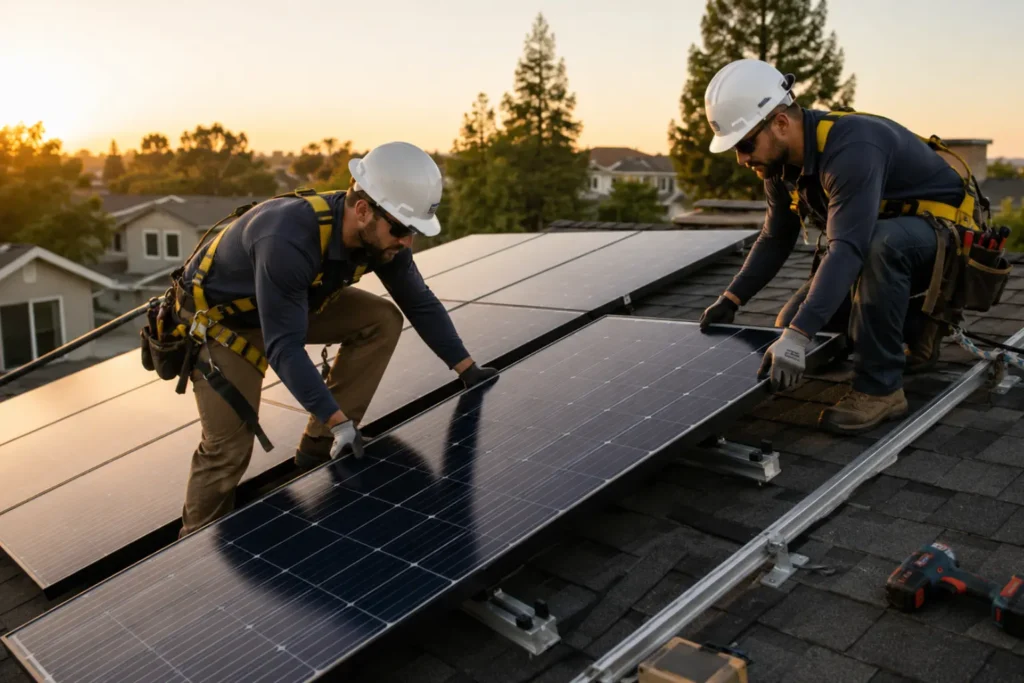
Should You Replace Your Roof Before Installing Solar Panels?
Not automatically. Roof age alone does not decide suitability. Condition, construction, remaining service life and the proposed solar loading matter more.
Energy Saving Trust says an assessor should check that the roof is safe to hold solar panels. Its guidance also notes that renewing a roof covering can sometimes be cheaper in the long run if the covering is unlikely to remain in good condition while solar is attached. Energy Saving Trust See the Energy Saving Trust rooftop solar installation guidance.
Current MCS standard MIS 3002 Issue 6.0 requires an MCS contractor to ensure that the roof structure is checked by a suitably competent person for the loads imposed by solar PV. Where the structure is unusual or there is doubt, the standard says a qualified structural engineer should be consulted. MCS Certified You can review the current MCS Solar PV Installation Standard, MIS 3002 Issue 6.0.
The practical question is therefore: is this roof a sound long-term base for the proposed system?
| Roof situation | Practical next step |
|---|---|
| Sound covering, no leaks, structure satisfactory | Solar can usually proceed after survey |
| Localised broken tiles or flashing defects | Repair first, then install solar |
| Widespread covering or underlay deterioration | Price roof renewal before solar |
| Structural movement, sagging or altered timbers | Obtain competent structural assessment |
| Full roof replacement already planned | Coordinate roofing and solar together |
| Existing solar over a roof needing replacement | Remove, re-roof, refit and recommission |
How Can You Tell Whether the Roof Is Ready for Solar?
A proper solar panel installation survey should look beyond orientation and shading. It should consider the roof structure, covering and how the mounting system will transfer loads.
Warning signs that justify further investigation include persistent leaks, widespread cracked or slipping tiles, failed underlay, rotten battens, visible sagging or damaged rafters.
Do not assume an old roof automatically needs replacing. A competent roofer should identify actual defects and explain whether repair, partial renewal or full replacement is justified.
If the roof is under warranty, check the terms before solar work begins. MIS 3002 says the roof warranty provider should be consulted where a solar installation could affect an existing roof-covering warranty. MCS Certified
What Happens If You Already Have Solar Panels and Need a New Roof?
For a full re-roof, the usual sequence is straightforward. The solar system is safely isolated, then modules and relevant mounting equipment are removed and stored. The roofer completes the new covering and any membrane, batten or structural work. The mounting system and panels are then refitted. Current UK removal-and-refit services and guidance describe this as the normal approach for substantial roof work beneath an array. iHeat
Afterwards, the system should be properly tested rather than merely switched back on. For work carried out within the MCS framework, MIS 3002 requires documented commissioning to confirm that the PV system is safe, correctly installed and operating in accordance with its design. MCS Certified
Can the same solar panels go back on?
Often, yes. Reuse depends on the condition and compatibility of the modules, connectors, cables, inverter and mounting system.
If the array is relatively young and performing well, replacing it purely because the roof is being renewed may offer poor value. If major components are old, damaged or unsuitable for the new roof design, ask for a separate upgrade option so you can compare costs.
How Much Does It Cost to Remove and Reinstall Solar Panels?
There is no official national UK tariff, and current market pricing varies substantially. For example, one 2026 guide quotes roughly £500–£900+ for removal and refitting, while another specialist provider advertises a service from £1,495. Other current guides put typical domestic projects around £1,200–£2,500. These are commercial market examples rather than guaranteed national averages. Going Solar UK
Price depends on panel count, roof height and pitch, access, scaffolding, mounting type, storage, cable condition and replacement parts.
One avoidable cost is duplicated access. If the roofer and solar contractor can share scaffolding and agree the programme in advance, you may avoid paying for separate scaffold visits. Energy Saving Trust likewise notes that solar installation costs can be lower when scaffolding is already in place for roofing work. Energy Saving Trust
Treat online figures as planning allowances. A quotation should state removal, storage, refitting, replacement components, testing, scaffolding and VAT clearly.
If You Need a New Roof and New Solar, Which Comes First?
Complete necessary roof work first, then install the solar array on the finished roof. Both jobs can still be planned as one coordinated project.
A sensible sequence is:
- Roofing and solar surveys.
- Confirm whether repair or full replacement is needed.
- Finalise the roof covering and solar mounting design.
- Agree scaffolding and access.
- Complete roofing work.
- Install the solar system.
- Test, commission and hand over the system.
Energy Saving Trust specifically identifies existing scaffolding for roof repairs or new construction as something that can reduce solar installation costs. Energy Saving Trust
If a roof clearly needs replacement soon, installing solar first usually means additional labour and disruption when the array has to come off again. That same practical concern appears repeatedly in current UK homeowner discussions about ageing roofs and proposed solar installations. Reddit
On-Roof or In-Roof Solar During a Roof Replacement?
A re-roof is a useful time to compare conventional on-roof panels with an in-roof, or integrated, system.
On-roof panels sit above the finished roof covering. In-roof systems replace part of the tile or slate covering and provide a lower-profile appearance.
Compare the complete installed price, drainage and flashing details, fire classification, maintenance access, panel compatibility and warranties. Do not assume in-roof solar is automatically cheaper simply because roof tiles are already being replaced.
For MCS installations, the current standard says systems mounted above or integrated into pitched roofs should use products certified to the relevant MCS 012 requirements, while the overall installation must maintain structural safety and weather-tightness. MCS Certified
Will Roof Replacement Affect Solar Warranties, FIT or Export Payments?
It can. Before work starts, identify the panel, inverter, mounting, workmanship and roof warranties separately. Ask who is responsible for damage while panels are removed and stored, and whether the roof warranty covers the new mounting or flashing details.
If you receive legacy Feed-in Tariff payments, check proposed changes with your FIT licensee before altering system capacity or replacing key generation equipment. The FIT scheme closed to new applicants in 2019, but Ofgem continues to publish guidance for existing generators, including modifications to accredited systems. Ofgem See Ofgem’s guidance for existing Feed-in Tariff generators.
For Smart Export Guarantee customers, keep MCS, DNO, commissioning and export-meter records together. Ofgem states that eligible SEG generators must meet certification and metering requirements. Ofgem
What About VAT and Planning Permission?
Installed solar panels in residential accommodation currently qualify for zero-rate VAT in the UK until 31 March 2027, subject to HMRC rules. However, adding solar does not automatically make a full roof replacement zero-rated. HMRC distinguishes qualifying energy-saving materials from a larger construction job where the energy-saving element is ancillary. GOV.UK See the current HMRC guidance on VAT for energy-saving materials.
Most domestic rooftop solar in England can fall under permitted development, but limits and exceptions apply. Listed buildings, conservation areas and certain other locations or designs may need additional checks. Planning rules also differ across the UK. Planning Portal Check the current Planning Portal solar-panel guidance for England.
What Should You Ask Before Signing a Quote?
The written scope should make clear who removes the panels, who stores them, who provides scaffolding, who supplies new mounting parts if required and who performs final electrical testing.
Also agree what happens if contractors uncover rotten timber, damaged roof coverings, defective cables or failed solar components. Variations should be priced and approved before extra work proceeds.
If you are new to solar, read how solar panels are installed and the solar panel installation process before comparing quotes. If old panels may be replaced at the same time, compare the best solar panels for home use in the UK on warranty, efficiency and long-term support rather than headline wattage alone.
Get Your Free Air Source Heat Pump Quote
Find the right air source heat pump solution for your home. Tell us a few details and our team will help you explore suitable options at a competitive price.
Quick to complete. No obligation.
Get your quote
Enter your details below and one of our team will get back to you.
Frequently asked questions
Find clear answers to common questions comparing air source and ground source heat pumps, including efficiency, installation and running costs, winter performance, noise, land requirements and borehole depth.
No. A roof in good condition can usually support solar without replacement, subject to the required structural and condition checks. MCS Certified
Potentially. Age alone is not a pass-or-fail test. The roof covering, structure, weather-tightness and remaining useful life matter more.
There is no universal age limit. Slate, clay tile, concrete tile and flat-roof coverings age differently, so condition should be assessed rather than relying solely on installation date.
Yes. Existing arrays can generally be isolated, removed and then reinstalled after the roofing work is complete. iHeat
Use a suitably competent solar or electrical contractor familiar with PV systems. For an MCS-certified project, confirm how certification, testing and commissioning will be handled.
Minor work away from the array may sometimes be possible. A full re-roof beneath the panels will normally require the affected array and mounting components to come off first.
There is no fixed national rate. Current commercial examples range from several hundred pounds to £2,500 or more depending on array size, access, scaffolding and complexity. Going Solar UK
Usually, provided they and the associated electrical and mounting components remain serviceable and compatible with the new roof.
Not necessarily. The installer should assess whether existing brackets, rails and fixings remain suitable for the new roof covering and current design.
It can be, particularly where both trades can share scaffolding. Energy Saving Trust identifies existing roofing scaffolding as a potential solar-installation cost saving. Energy Saving Trust
It is worth comparing. In-roof solar can create a lower-profile finish, but compare total price, weatherproofing, maintenance, fire performance and warranty terms against an on-roof system.
It may affect particular warranties if the work does not comply with their terms. Check panel, inverter, workmanship, mounting and roof warranties before work begins.
Ordinary temporary removal does not automatically end FIT accreditation, but modifications to an accredited installation can matter. Check the planned work with your FIT licensee and Ofgem guidance first. Ofgem
Yes, proper testing is prudent. Under MIS 3002, MCS commissioning involves documented checks that the system is safe and operating correctly. MCS Certified
Not for every conventional roof. MIS 3002 requires a suitably competent structural check and calls for a qualified structural engineer where the roof is unusual or there is doubt. MCS Certified
Qualifying installed solar panels currently benefit from 0% VAT until 31 March 2027. The wider roof replacement does not automatically receive the same treatment. GOV.UK
Many domestic installations can fall within permitted development, but restrictions apply. Always check the rules relevant to your UK nation, property and location. Planning Portal
A correctly designed installation should preserve the roof's weather-tightness. Current MCS standards specifically address maintaining weather-tightness and structural integrity.
Conclusion
Solar panels and roof replacement work best when planned around the same roof lifecycle.
A sound roof does not need replacing simply to accept solar. However, if significant roof work is already due, completing it first can prevent avoidable removal costs later. Where panels are already installed, a full re-roof normally means professional removal, storage, refitting and recommissioning.
The next step is a property-specific assessment covering both roof condition and solar design. Compare written scopes and make sure scaffolding, warranties, testing and responsibility between trades are clear before work begins.
Compare Quotes: Get Free Quote can help homeowners compare properly scoped solar and home-improvement quotations before deciding whether to proceed.


