
Solar Panel Installers Birmingham: How to Choose in 2026
Check Your Eligibility for Boiler Upgrade Scheme (BUS)
Complete your details below to check your eligibility.
Thank you
We've received your details and will be in touch shortly.

Quick Answer: How Do You Choose a Solar Panel Installer in Birmingham?
Look for a solar installer that can provide a property-specific survey, realistic generation estimate, clear equipment specification and itemised quotation. For homeowners who want access to Smart Export Guarantee payments, using an appropriately certified installation is particularly important: Ofgem states that installations up to 50kW will normally demonstrate suitable certification through an MCS certificate or equivalent.
Compare installers on system design, projected output, warranties, workmanship protection, scaffolding, electrical work, monitoring, grid-connection paperwork and aftercare — not simply the cheapest headline price.
The strongest proposal should make it easy to understand exactly what you are buying and how the financial assumptions have been calculated.
Solar Panel Installers Birmingham: How to Compare Local Installers in 2026
Choosing between solar panel installers in Birmingham involves more than comparing the price at the bottom of three quotations.
A well-designed solar PV system should reflect your roof, shading, electricity use, future plans and local grid connection requirements. The installer should also explain how the predicted generation figure was calculated and what happens after installation.
For Birmingham homeowners, that makes the quality of the survey and system design just as important as the panel brand.
This guide explains how to compare solar installers, what a professional quotation should contain, which certifications matter and which questions to ask before signing a contract.
For a broader overview of costs, potential savings and Birmingham property suitability, see the existing solar panels in Birmingham guide.
Considering solar? You can also visit Get Free Quote to compare options for your property.
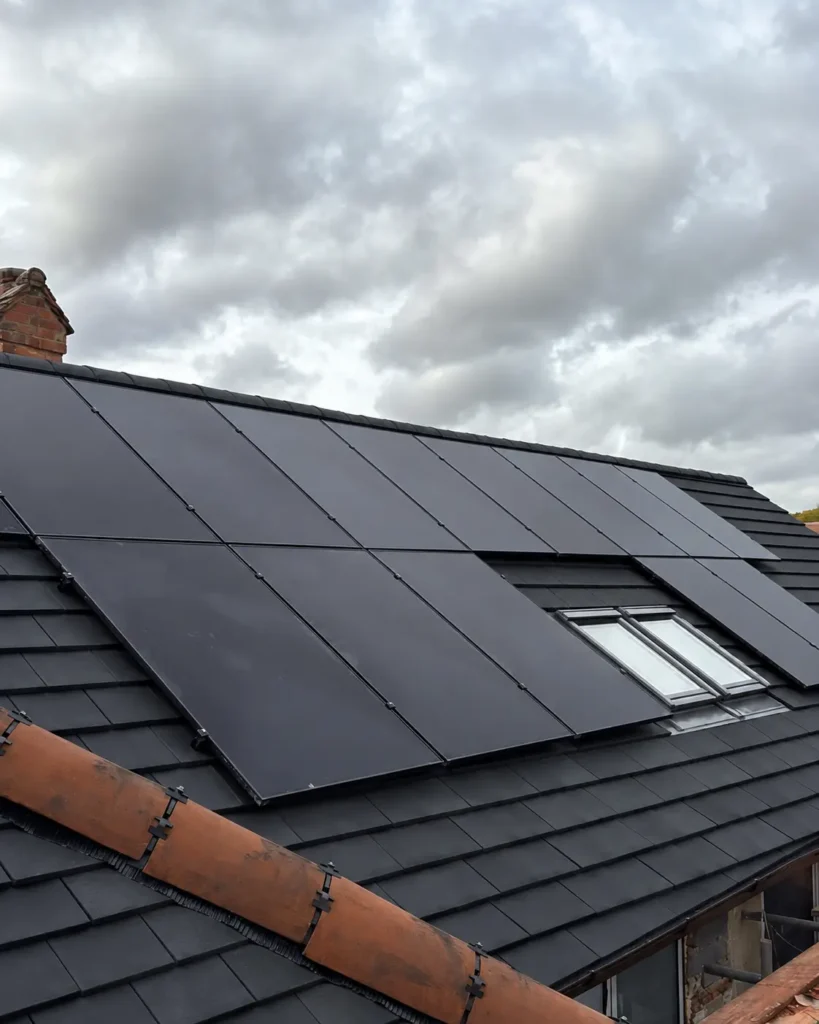
What Should You Compare Between Solar Panel Installers?
Price matters, but two quotations that appear similar can contain very different equipment and levels of service.
| Check | What a strong proposal should show | Why it matters |
|---|---|---|
| Certification | Installer and installation credentials explained clearly | Important for quality assurance and export eligibility |
| System design | Panel quantity, kWp, inverter and layout | Shows what you are actually buying |
| Generation estimate | Annual kWh estimate with shading assumptions | Helps assess likely performance |
| Warranties | Product, performance and workmanship cover | Different warranties protect different things |
| Installation scope | Scaffolding, electrical work and roof mounting | Reduces unexpected extras |
| Grid paperwork | Who handles DNO notification/application | Prevents administrative surprises |
| Aftercare | Monitoring, fault support and warranty process | Important over a system lasting decades |
Avoid comparing quotations solely by the number of panels.
Higher-wattage panels mean two systems can have different numbers of modules but similar total capacity. Compare the proposed capacity in kilowatt peak (kWp) and the expected annual generation in kilowatt-hours (kWh).
Check MCS Certification and Consumer Protection
MCS is the principal UK certification framework for small-scale renewable energy installations.
For solar buyers, it provides a useful way to distinguish between a simple equipment sale and an installation carried out under recognised requirements covering design, installation and commissioning.
Ofgem also identifies MCS certification or an equivalent standard as the usual evidence of suitable certification for smaller installations applying for the Smart Export Guarantee.
Before signing, check the installer rather than relying solely on an MCS logo displayed in marketing material. You can use the official MCS website to verify current information.
Consumer-code membership is another useful check.
For example, RECC requires its members to protect qualifying deposits, advance payments and workmanship warranties against the installer ceasing to trade.
Ask exactly which consumer code, warranty provider and insurance arrangements apply to your contract.
What Should a Solar Panel Quote Include?
A professional quotation should allow you to understand the whole installation without relying on verbal promises.
At minimum, expect to see the proposed panel make and model, number of panels, total system capacity, inverter, mounting arrangement and estimated generation.
Battery storage should have its own make, model and usable capacity where included.
The quotation should also state whether the price covers:
scaffolding and access equipment
roof-mounting components
inverter installation
electrical protection and alterations
monitoring equipment
DNO administration
testing and commissioning
certification
waste removal
warranty registration.
If any of these are excluded, ask what they could cost.
For more detail about the practical stages, see the solar panel installation Birmingham guide.
Look Closely at the Generation Estimate
A predicted annual generation figure should not simply assume perfect conditions.
Shading from neighbouring properties, chimneys, dormers and mature trees can affect output. Roof direction and pitch also influence when and how much electricity the array produces.
Ask the installer to explain the assumptions behind the forecast.
A quotation predicting substantially higher output than competing proposals is not automatically better. It may simply use more optimistic assumptions.
What Should Happen During a Solar Survey?
A good installer needs enough information to design for your property rather than sell a standard package.
The survey should consider usable roof area, orientation, pitch, shading, roof condition and safe access.
The installer should also consider the location of the inverter, consumer unit, electricity meter and potential cable routes.
Building regulations normally apply to rooftop solar installation, including consideration of whether the roof can support the additional load.
If your roof needs substantial repairs soon, it can be more economical to complete that work before fitting solar panels. Otherwise, you may later pay to remove and refit the array.
Planning Rules in Birmingham
Many residential rooftop systems in England can be installed under permitted-development rights, subject to conditions.
The rules were updated on 27 August 2026, with transitional provisions extending to 27 August 2027. Listed buildings, conservation areas and other restricted properties require additional attention.
Your installer should flag obvious planning issues, but the property owner remains responsible for ensuring the necessary permissions are in place.
How Much Do Solar Panels Cost in Birmingham?
There is no single correct Birmingham price.
As a national reference point, Energy Saving Trust currently puts a typical domestic solar PV system at around 4.5kWp and £7,600 installed. Actual quotations vary according to system size, roof access, equipment, electrical work and installation complexity.
For Birmingham-specific cost considerations, see solar panels cost in Birmingham.
Qualifying installations of solar panels in Great Britain are currently zero-rated for VAT until 31 March 2027. Under current rules, the rate is scheduled to return to 5% from 1 April 2027.
Treat prices advertised online as guides rather than guaranteed quotations.
Compare the Same Scope
When comparing three installers, first make sure they have priced approximately the same system.
| Question | Why ask it? |
|---|---|
| What is the total array size in kWp? | Makes capacity easier to compare |
| What annual generation do you predict? | Reveals differences in modelling |
| Is scaffolding included? | Can materially change the final price |
| Which inverter is included? | Inverter specifications and warranties differ |
| Is bird protection included? | Sometimes priced separately |
| Who handles DNO paperwork? | Clarifies responsibility |
| What workmanship warranty applies? | Protects the installation work |
| Are monitoring and setup included? | Helps identify faults after commissioning |
You can use solar panel quotes in Birmingham to compare the quotation process in more detail.
Who Handles DNO and Export Paperwork?
Your installer should explain what happens with the local Distribution Network Operator, or DNO.
Depending on the proposed system, the network process may involve notification or an application before connection. Do not assume that every system can simply be fitted without checking the local network requirements.
Ask the installer who completes this work and whether any potential export limitation has been allowed for in the financial forecast.
After commissioning, you may also want to apply for a Smart Export Guarantee tariff.
The SEG allows eligible small-scale generators to receive payment for qualifying electricity exported to the grid. Your SEG provider does not have to be the same company that supplies your electricity.
Energy Saving Trust also recommends considering possible export limits when estimating savings.
Should You Add a Battery or EV Charger?
A solar battery can increase the amount of generated electricity you use yourself by storing surplus energy for later.
However, that does not mean every Birmingham household should automatically buy one.
Ask for a solar-only quotation and a solar-plus-battery quotation using the same panel array. Compare the additional battery cost with the predicted change in annual savings.
Energy Saving Trust currently estimates typical battery-storage costs at around £5,000–£8,000, although actual prices vary considerably by capacity and specification.
If you already own an electric vehicle, or expect to buy one, tell the installer. Daytime EV charging can increase direct use of solar generation.
Even if you do not buy a battery today, discussing future storage can help the installer design the system with later expansion in mind.
Questions to Ask a Solar Installer Before Signing
Are you currently certified for the solar work you are proposing?
Who will physically carry out the installation?
Do you use subcontractors?
What is the proposed system size in kWp?
What annual generation do you predict?
How have shading losses been calculated?
Which panels and inverter are included?
What warranties apply to each component?
How long is the workmanship warranty?
Is scaffolding included in the quoted price?
Who manages the DNO process?
What documentation will I receive after commissioning?
Can you show a solar-only and solar-plus-battery comparison?
Who handles warranty claims if equipment fails?
What aftercare is available once the system is operating?
Be cautious if an installer cannot explain the assumptions behind projected savings or pushes for an immediate decision before you have compared alternatives.
Get Your Free Air Source Heat Pump Quote
Find the right air source heat pump solution for your home. Tell us a few details and our team will help you explore suitable options at a competitive price.
Quick to complete. No obligation.
Get your quote
Enter your details below and one of our team will get back to you.
Frequently asked questions
Find clear answers to common questions comparing air source and ground source heat pumps, including efficiency, installation and running costs, winter performance, noise, land requirements and borehole depth.
MCS certification is strongly worth checking, particularly if you intend to claim Smart Export Guarantee payments. Ofgem says smaller eligible installations normally demonstrate suitable certification through an MCS certificate or equivalent.
Comparing around three properly itemised quotations is sensible. Make sure each installer is pricing a similar system before comparing the totals.
Energy Saving Trust currently uses around £7,600 as the average cost of a typical 4.5kWp domestic solar PV system. Your Birmingham quotation may be higher or lower.
Kilowatt peak, or kWp, describes the rated maximum output of the solar-panel array under standard test conditions. It is useful when comparing system sizes.
kWp describes the rated size of the solar array. kWh measures electricity generated or consumed over time.
Yes. Solar PV generates electricity from daylight, although output is lower during dull conditions than in strong sunshine.
No. South-facing roofs often produce strong annual generation, but east- and west-facing roofs can also work well. A survey should model your specific property.
Yes. Roof condition, available space, structure, shading and mounting requirements can all influence the design.
Often, but never assume it is. Check whether scaffolding and all other access equipment are explicitly included in the quotation.
Many domestic rooftop systems in England qualify as permitted development, subject to conditions. Additional restrictions can apply to listed buildings, conservation areas and other protected properties.
The Smart Export Guarantee is the scheme under which participating electricity suppliers pay eligible small-scale generators for electricity exported to the grid.
Yes. Ofgem states that your SEG provider does not have to be the company supplying your household electricity.
Often yes, but compatibility depends on the system design and inverter arrangement. Tell the installer in advance if future battery storage is likely.
Not necessarily. Compare system size, equipment quality, generation assumptions, warranties, installation scope and aftercare alongside price.
Your installer should explain the commissioning, certification, electrical, warranty and operating documentation supplied for the completed system.
Most modern panels are designed for long-term operation and commonly carry lengthy product or performance warranties. Check the exact warranty rather than assuming all panels have identical cover.
Check panel, inverter, battery and workmanship warranties separately. They protect different parts of the system and may have different providers and claim procedures.
That depends on your electricity-use pattern and budget. Ask for separate solar-only and solar-plus-battery calculations before deciding.
Final Checklist for Choosing a Birmingham Solar Installer
A strong solar installation starts with a realistic survey and transparent design.
Compare the capacity, projected annual generation and complete installation scope rather than selecting the lowest headline price. Verify certification independently, understand the warranties and confirm who handles grid paperwork and aftercare.
Current national figures can provide a useful benchmark, but your Birmingham property needs its own assessment.
The most useful quotation is therefore not necessarily the cheapest one. It is the proposal that clearly shows what will be installed, what it should generate, what is included and what protection you have if something goes wrong.
Once you have comparable specifications, you can make a much more confident decision.


