
Average Solar Panel Cost UK 2026: Prices & Payback
Check Your Eligibility for Boiler Upgrade Scheme (BUS)
Complete your details below to check your eligibility.
Thank you
We've received your details and will be in touch shortly.

Quick answer: what is the average solar panel cost in the UK?
A typical UK home solar PV system costs around £7,600 installed in 2026, based on current Energy Saving Trust guidance. Its typical domestic system is about 4.5kWp. Smaller 3kWp installations may cost roughly £5,000–£6,500, while larger 5–6kWp systems commonly move towards £7,500–£11,000 depending on the roof and specification.
The final cost normally includes panels, an inverter, mounting equipment, labour and commissioning. Scaffolding may also be included, but homeowners should check the written quotation.
A battery commonly adds around £5,000–£8,000. Qualifying domestic solar installations currently benefit from 0% VAT until 31 March 2027, under current UK rules.
Average Solar Panel Cost UK: 2026 Price Guide
The average solar panel cost in the UK is around £7,600 for a typical domestic system, according to the Energy Saving Trust. Its current benchmark is based on a system of roughly 4.5kWp, which is a common size for UK homes. Energy Saving Trust
However, £7,600 should be treated as a useful starting point rather than a fixed price. A smaller installation may cost around £5,000–£6,500, while larger systems can exceed £10,000. Roof access, scaffolding, panel specification, inverter choice and electrical work can all change the final quotation.
Battery storage is another major consideration. The Energy Saving Trust currently puts typical battery costs at around £5,000–£8,000, although the value of adding storage depends heavily on when your household uses electricity. Energy Saving Trust
This guide explains what solar panels cost in 2026, what should be included in a quotation, how batteries affect the budget and what realistic savings and payback can look like.
Ready to price a system for your own property? You can compare solar panel installation quotes or start from the Get Free Quote homepage.
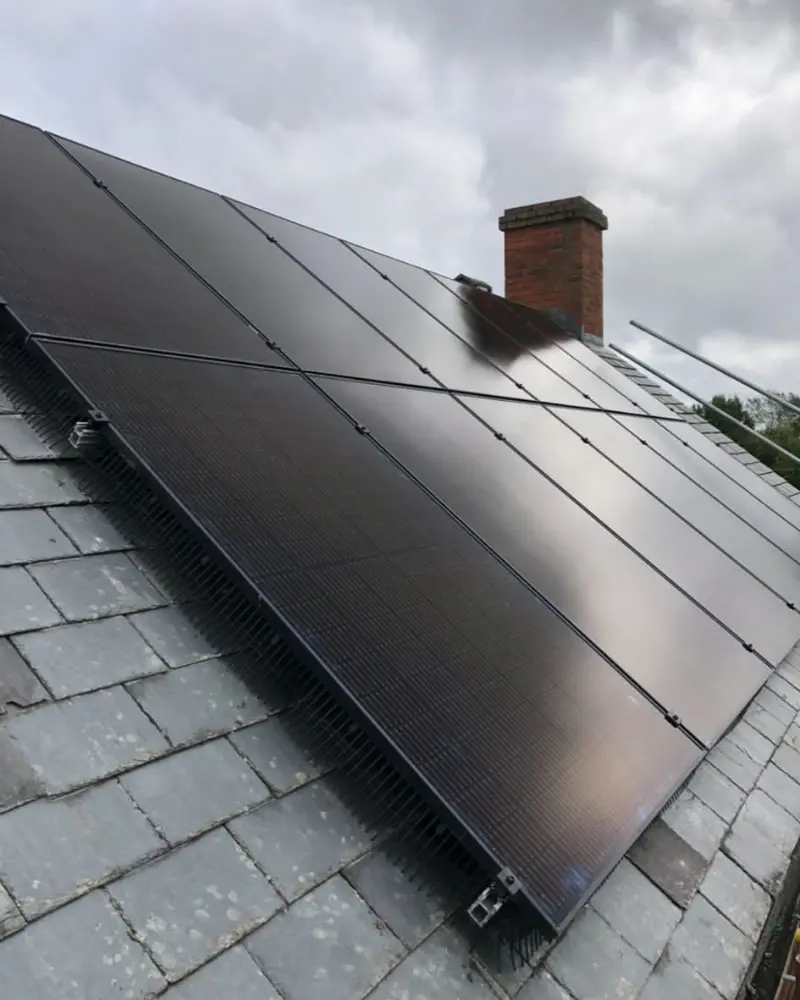
How much do solar panels cost in the UK in 2026?
The Energy Saving Trust currently estimates a typical 4.5kWp domestic system at around £7,600. Current consumer and installer pricing research broadly places standard residential systems in the £5,000–£11,000 range, depending primarily on capacity and installation complexity. Energy Saving Trust
The UK Government also publishes solar PV cost statistics using information from the MCS Installation Database. The latest release covers 2025/26 and was published in May 2026. These data report installed costs per kW and show that system size materially affects the cost per unit of capacity. See the latest UK Government solar PV cost data GOV.UK
| System size | Approx. number of modern panels | Indicative 2026 planning budget | Typical situation |
|---|---|---|---|
| 3kWp | 7–8 | £5,000–£6,500 | Smaller home or limited roof |
| 4kWp | 9–10 | £6,500–£8,000 | Typical family home |
| 4.5kWp | Around 10–12 | Around £7,600 | Energy Saving Trust benchmark |
| 5kWp | 11–13 | £7,500–£9,500 | Higher electricity use |
| 6kWp | 13–15 | £8,500–£11,000 | Larger roof, EV or high demand |
These are planning figures, not quotations. A survey is needed before an installer can price your property accurately.
If panel specification matters to your budget, see the guide to best-value solar panels in the UK before comparing quotes.
What does the solar panel price normally include?
A complete installation costs much more than the panels themselves. You are buying a working electricity-generation system rather than a set of modules.
A normal quotation should cover the solar panels, roof mounting system, inverter, DC and AC cabling, electrical protection, labour, commissioning and monitoring setup. It should also make clear whether scaffolding, DNO paperwork and certification are included.
The inverter is especially important. Solar panels generate direct current, or DC. The inverter converts this into alternating current, or AC, which your home can use.
Check whether your quotation includes every necessary item. A low headline price can become much less competitive if scaffolding, electrical upgrades or certification appear later as extras.
The solar panel installation survey guide explains the property checks that should take place before a final system is agreed.
What affects the cost of solar panels?
System size
More panels generally mean a higher overall price. However, larger systems can cost less per kWp because fixed costs such as scaffolding, travel and paperwork are spread across more generating capacity.
This is why doubling the system size does not necessarily double the installation bill.
Roof access and complexity
A simple pitched roof with easy access is normally cheaper to work on than a property with several roof elevations, dormers or difficult scaffolding requirements.
Flat roofs may require specialist mounting structures and additional structural consideration. Roof repairs can also change the project substantially.
If your roof is approaching the end of its useful life, dealing with that work before the panels are installed can avoid paying to remove and refit the array later.
Panel and inverter specification
High-efficiency or premium panels usually cost more. Whether that premium makes sense depends on the property.
Higher-efficiency panels may offer particular value when roof space is limited. On a large, uncomplicated roof, a less expensive panel can sometimes provide better overall value.
Inverter choice also affects cost. Optimisers and microinverters may help on complex or partially shaded roofs, but they add hardware and should solve a genuine design problem rather than simply increase the specification.
Electrical work
Some homes need extra electrical work before solar can be connected safely. This might include changes to cabling, protection equipment or the consumer unit.
A quotation should identify known electrical work rather than treating it as an unexplained contingency.
How much does a solar battery cost?
Battery storage usually increases the investment substantially. Energy Saving Trust currently estimates £5,000–£8,000 for typical battery storage. Energy Saving Trust
A battery stores surplus solar electricity during the day so you can use it later. That can increase your solar self-consumption, particularly if the property is empty during working hours and electricity demand rises in the evening.
| Option | Indicative cost | Main advantage | Main consideration |
|---|---|---|---|
| Solar only | Around £7,600 for a typical system | Lower upfront cost | More surplus may be exported |
| Battery storage | Around £5,000–£8,000 extra | Use more generated electricity later | Higher capital cost |
| Solar + battery | Often £12,000+ overall | Greater energy flexibility | Compare payback with solar-only quote |
A battery is not automatically the most profitable option. Compare the proposed system both with and without storage and ask the installer to show the assumptions behind each payback calculation.
How much money can solar panels save?
Your return comes from two places: electricity you generate and use instead of buying from the grid, and payments for qualifying surplus electricity you export.
The proportion used inside your home is known as self-consumption. Homes with significant daytime demand can often use a larger share of their solar generation directly.
Your roof also matters. Orientation, pitch, shading and location affect annual production. For a more detailed explanation, see the guide to solar panel output in the UK.
In England, Scotland and Wales, eligible systems can receive export payments through the Smart Export Guarantee (SEG). Ofgem confirms that participating suppliers set their own tariffs, so the payment rate can differ considerably between companies. Read Ofgem’s Smart Export Guarantee guidance Ofgem
This is why a useful savings calculation should show:
- predicted annual generation in kWh;
- estimated household self-consumption;
- expected exported electricity;
- assumed electricity purchase price;
- assumed export rate; and
- any battery losses or replacement assumptions.
Be cautious with a quotation that provides a payback figure without showing these inputs.
How long do solar panels take to pay for themselves?
Current Energy Saving Trust examples for Great Britain give payback periods of roughly 9–12 years, depending on location and household usage. Its July 2026 examples range from nine years in London to as much as 12 years in Stirling under the modelled scenarios. Energy Saving Trust
That does not mean your system will automatically pay back within the same period.
A lower installation price improves payback. So does using more solar electricity yourself, assuming imported electricity costs more than the payment available for exporting the same unit.
Solar panels themselves can last 25 years or more, although the inverter may need replacement earlier. Energy Saving Trust currently suggests an inverter lifespan of around 12 years as a general guide. Energy Saving Trust
The useful comparison is therefore not simply “How much will I save this year?” It is the expected lifetime value after installation, maintenance, equipment replacement and financing costs.
Is there 0% VAT on solar panels?
Yes, qualifying installed solar panels currently benefit from a temporary 0% VAT rate.
HMRC states that the zero rate applies until 31 March 2027. Under current legislation, qualifying installations are scheduled to return to the 5% reduced VAT rate from 1 April 2027. Check HMRC’s current VAT rules for energy-saving materials GOV.UK
That treatment relates to qualifying installations. Do not assume every solar-related purchase or unrelated building job receives the same VAT treatment.
Are there grants for solar panels?
There is no universal UK grant that simply gives every homeowner money towards solar panels.
However, wider energy-efficiency programmes can fund solar for qualifying households. In England, the Warm Homes: Local Grant runs through participating local authorities and targets eligible low-income households in privately owned homes with EPC ratings from D to G. Solar PV is one of the measures that may be installed. Check the Warm Homes: Local Grant information GOV.UK
Funding arrangements differ across England, Scotland, Wales and Northern Ireland. Always check the current scheme available where the property is located before assuming a grant will reduce your quotation.
How to compare solar panel quotes properly
Do not compare quotations on price alone. First make sure each installer is proposing broadly the same job.
Check the system capacity in kWp, panel make and model, inverter specification and predicted annual generation. Then confirm whether scaffolding, electrical work, monitoring, certification and network paperwork are included.
Ask the installer to explain the generation assumptions. An unusually high forecast does not make one system better if it ignores shading or uses unrealistic performance assumptions.
Next, divide the quoted system price by its capacity in kWp. This gives you a rough cost per kWp, which makes differently sized quotations easier to compare.
Get several written quotations rather than relying on one supplier. Energy Saving Trust recommends obtaining at least three and looking for MCS-certified installers. Energy Saving Trust
Finally, ask for solar-only and solar-plus-battery versions where storage is being considered. That makes it much easier to see whether the additional battery investment is justified for your consumption pattern.
Get Your Free Air Source Heat Pump Quote
Find the right air source heat pump solution for your home. Tell us a few details and our team will help you explore suitable options at a competitive price.
Quick to complete. No obligation.
Get your quote
Enter your details below and one of our team will get back to you.
Frequently asked questions
Find clear answers to common questions comparing air source and ground source heat pumps, including efficiency, installation and running costs, winter performance, noise, land requirements and borehole depth.
Energy Saving Trust currently puts a typical 4.5kWp domestic system at around £7,600 installed. Your price can be higher or lower depending on system size and the property. Energy Saving Trust
A reasonable 2026 planning range is approximately £6,500–£8,000 for a standard installation. Complex roofs, premium equipment and extra electrical work can increase the price.
Ten modern panels usually create a system of roughly 4–5kWp, depending on panel wattage. A complete installation will commonly fall somewhere around £6,500–£9,000 rather than simply being ten times the retail price of an individual panel.
Energy Saving Trust currently estimates typical battery storage at around £5,000–£8,000. Energy Saving Trust
Published domestic installation prices normally refer to the complete installed system. However, always confirm whether scaffolding, electrical upgrades, certification and other extras are included.
Qualifying installed solar panels are currently zero-rated until 31 March 2027. Current legislation provides for a return to the 5% reduced rate from 1 April 2027. GOV.UK
There is no universal solar-only grant for every UK household. Eligible households may receive solar through wider programmes such as England's Warm Homes: Local Grant. GOV.UK
Energy Saving Trust's current examples for Great Britain are roughly 9–12 years, although your result depends on price, generation, electricity use and export income. Energy Saving Trust
There is no reliable single UK-wide number. Savings depend mainly on annual generation, how much electricity you use while the panels are producing and your import and export tariffs.
The Smart Export Guarantee allows eligible small-scale generators in Great Britain to receive payments for electricity exported to the grid. Suppliers determine their individual tariff rates. Ofgem
It can be, especially if you export large amounts of solar electricity during the day and buy electricity back in the evening. Compare battery and solar-only projections before deciding.
Usually yes, although inverter choice and system design can affect compatibility. Tell the installer during the initial design if future battery storage is likely.
Yes. Energy Saving Trust says east- and west-facing systems can work, although they tend to produce around 15–20% less energy than an equivalent directly south-facing installation. Energy Saving Trust
They can. Flat roofs often need specialist frames, ballast, spacing and structural checks, which can make the mounting system more complex.
Energy Saving Trust says solar panels should last 25 years or more. Other system components, particularly the inverter, may need replacing earlier. Energy Saving Trust
Yes. Energy Saving Trust recommends comparing at least three installers. Make sure each quotation uses similar assumptions and clearly states the equipment and work included. Energy Saving Trust
Yes, but they are a different product from a professionally installed rooftop array. Plug-in solar became available in Great Britain from August 2026, with Energy Saving Trust reporting systems from roughly £450. Energy Saving Trust
Not necessarily. Compare the complete installed system, expected generation, warranties, inverter, installer support and roof suitability rather than panel price alone.
So, what should you budget for solar panels?
For a typical UK home in 2026, around £7,600 is a sensible headline benchmark for a domestic solar PV installation. Smaller straightforward systems can cost less, while larger arrays, difficult roofs, premium equipment and batteries can push the total well above £10,000.
The cheapest quotation is not automatically the best value. Compare system capacity, realistic generation, equipment, warranties, included work and expected lifetime return.
Before signing a contract, make sure the installer has surveyed the property and provided an itemised written proposal. That is the point at which an online average becomes a useful property-specific price.
Next step: compare properly specified quotations rather than relying on a national average alone.


