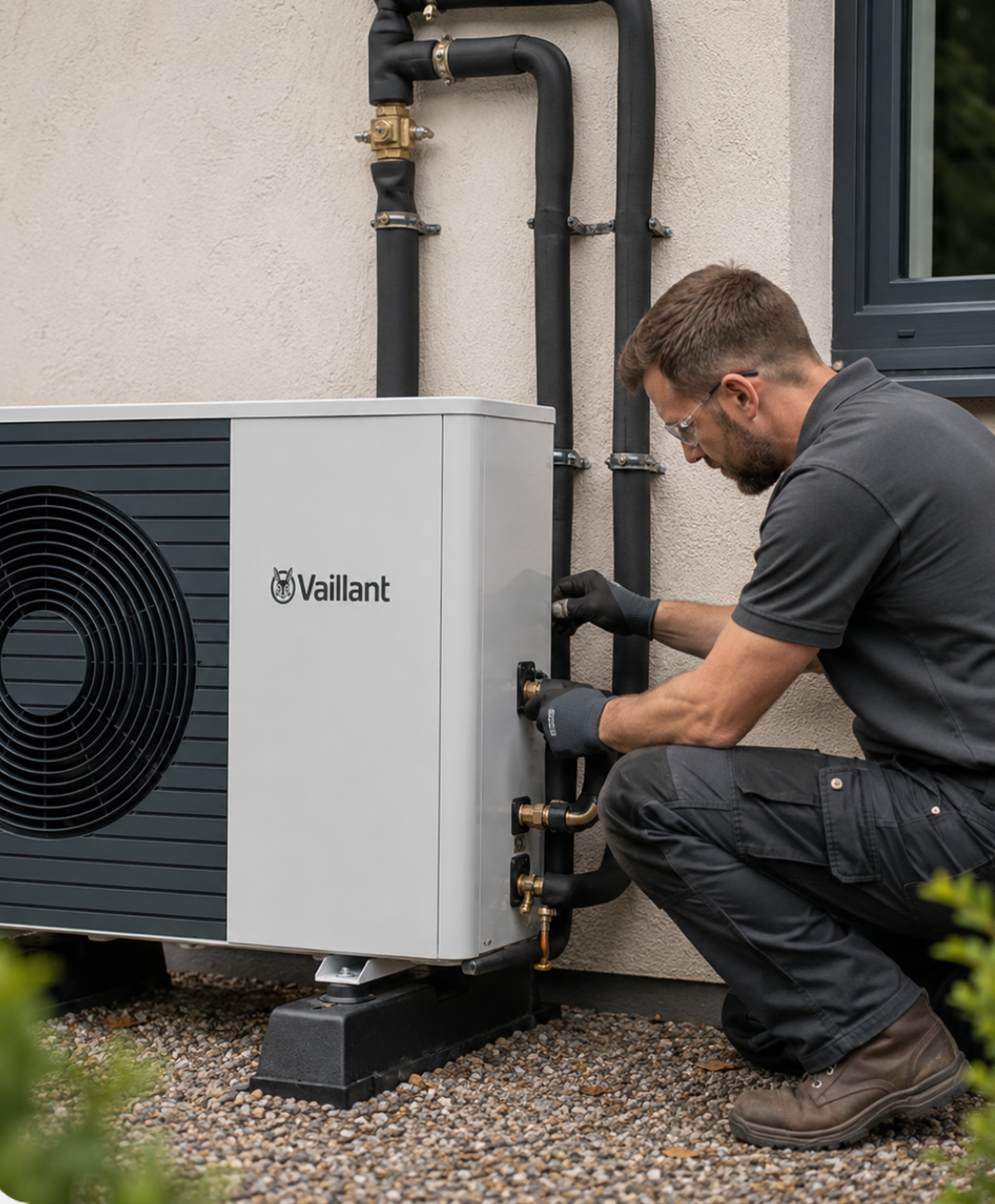
Ducted vs Split Air Conditioning UK: Costs & Best Choice
Check Your Eligibility for Boiler Upgrade Scheme (BUS)
Complete your details below to check your eligibility.
Thank you
We've received your details and will be in touch shortly.

Quick answer:
A split system is usually best for one room or a straightforward retrofit because it costs less to install and needs no large duct runs. For several rooms, a multi-split can connect multiple indoor units to one outdoor unit. Ducted air conditioning suits homes where discreet grilles, multi-room coverage and a clean interior finish justify the extra cost and building work. It needs suitable loft, ceiling or service-void space. Neither layout is automatically more energy efficient: correct sizing, controls, equipment efficiency, duct design and how you use the system matter more.
Ducted vs Split Air Conditioning: Which Is Better for UK Homes?
Choosing between ducted and split air conditioning is mainly a choice between concealed multi-room comfort and simpler room-by-room installation.
For most existing UK homes, a single-split or multi-split system is the more practical and lower-cost option. Ducted air conditioning becomes more attractive when you are renovating, building from new, have usable loft or ceiling voids, and want the indoor equipment almost completely hidden.
The right answer depends on how many rooms you want to heat or cool, how much disruption you will accept, whether independent room control matters and where the outdoor unit can go.
Considering air conditioning for your home? Get Free Quote can help you compare no-obligation quotations and understand what each proposal includes.
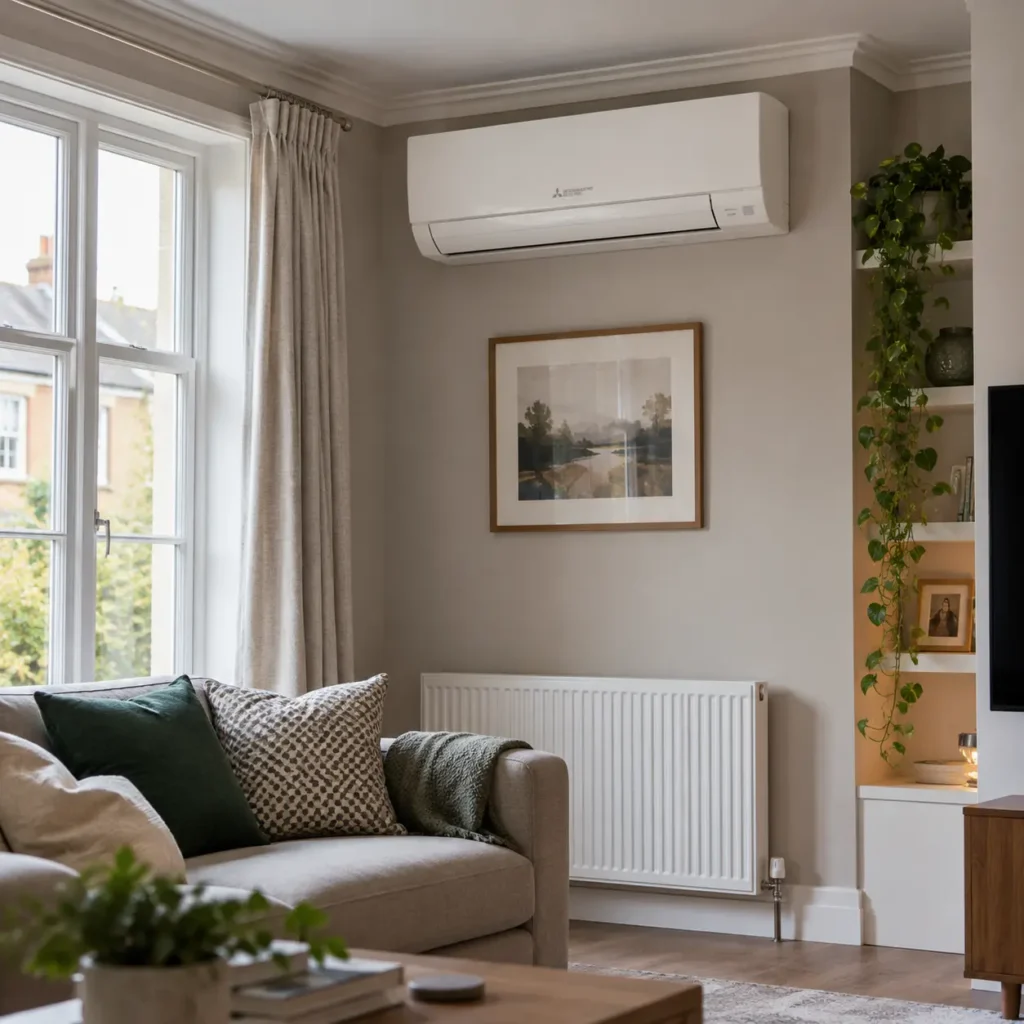
Ducted vs split air conditioning at a glance
| Factor | Split / multi-split | Ducted air conditioning |
|---|---|---|
| Best for | One to several selected rooms | Several rooms, whole floors or whole-home projects |
| Indoor appearance | Visible wall, floor or ceiling units | Mainly grilles or diffusers visible |
| Installation | Usually simpler | More complex; needs ducts and void space |
| Typical 2026 UK budget | About £1,500–£3,000 for one split; roughly £3,500–£7,000 for a 3–4 room multi-split | Commonly around £6,000–£15,000 for a domestic multi-room project |
| Room control | Straightforward with individual indoor units | Possible, but zoning must be designed in |
| Main advantage | Flexibility and lower upfront cost | Discreet finish and centralised air distribution |
| Main compromise | Indoor units remain visible | Higher cost and more building work |
These are budgeting ranges, not quotations. Current UK cost guides broadly cluster around £1,500–£3,000 for a fitted single split and £6,000–£15,000 for a domestic ducted project, although property layout, capacity, electrical work and installation complexity can move the final price substantially. Aircon Adviser
What “ducted vs split” actually means
There is an important terminology point: a ducted air-conditioning system can itself be a split system.
“Split” means the equipment is divided into indoor and outdoor sections connected by refrigerant pipework. A common single split has one indoor unit and one outdoor unit. A multi-split connects several indoor units to one outdoor unit.
A ducted system can use the same basic arrangement, but the indoor unit is concealed in a loft or ceiling void and sends conditioned air through ducts to grilles.
For example, Daikin describes residential concealed ceiling equipment designed to work with split outdoor units, confirming that “ducted” and “split” are not technically mutually exclusive categories. Daikin
So the practical homeowner comparison is usually visible room-based split units versus concealed ducted indoor units.
How split and ducted systems work
Split air conditioning
A single split serves one room or open-plan area. Refrigerant moves heat between an indoor unit and an outdoor compressor unit.
For several rooms, a multi-split reduces outdoor clutter. Daikin’s current residential range can connect up to five indoor units to one outdoor unit, while allowing separate room control. Daikin
For the underlying refrigeration cycle, see Get Free Quote’s guide to how air source heat pumps work rather than repeating that explanation here.
Ducted air conditioning
A ducted system hides the indoor fan-coil unit, usually in a loft, ceiling void or service space. Ducts carry heated or cooled air to grilles, while return air travels back to the unit.
The finish is discreet, but the ductwork needs space. Some residential concealed units can fit into a ceiling void of about 240mm, although the complete installation also needs room for ducts, insulation, connections and service access. Daikin
In many two-storey UK homes, that makes upstairs bedrooms easier to serve from a loft than ground-floor rooms.
Installation cost and disruption
Split systems normally win on simplicity. A straightforward installation needs a suitable indoor position, an outdoor-unit location, refrigerant pipework, condensate drainage and an electrical supply. A single-room installation can often be completed without major changes to ceilings.
Ducted installations need more design and building work. The installer must find space for the concealed unit, size and route ducts, position supply and return grilles, manage condensate and leave access for servicing. Bulkheads or lowered ceilings may be needed where no suitable void exists.
That is why ducted air conditioning often makes most sense during a renovation, extension or new build. When ceilings are already open, ducts are easier to integrate. In a finished house, the mechanical installation may also require substantial making good.
Before comparing prices, make sure every contractor is pricing the same scope. Get Free Quote’s guide to air conditioning installation in the UK explains the main installation elements that should appear in a quote.
Which is more efficient to run?
Neither system type wins automatically.
A correctly sized split can be efficient because it conditions only the room being used. A multi-split also lets you turn off unused rooms. Ducted systems can perform well with good zoning, short insulated duct runs and variable-speed equipment.
However, ducts add potential losses. Poor insulation, leakage, excessive bends or badly balanced airflow can waste energy. Conversely, an oversized split can cycle inefficiently and may control temperature or humidity less effectively.
Compare SEER, or Seasonal Energy Efficiency Ratio, for cooling and SCOP, or Seasonal Coefficient of Performance, for heating. More importantly, ask how the installer calculated the room loads, how low the equipment can modulate and how individual zones will operate.
For current running-cost calculations, Ofgem’s average electricity unit rate for a standard-variable Direct Debit customer across Great Britain is 26.32p/kWh from 1 October to 31 December 2026. Actual cost depends on the system’s electrical consumption, operating time and your own tariff rather than simply its advertised cooling capacity. Ofgem
Noise, appearance and room control
Ducted air conditioning wins on appearance because only grilles or diffusers remain visible.
It can also be very quiet in occupied rooms because the main fan unit sits away from the living space. However, ducted does not automatically mean silent. Poorly sized grilles, high air velocity, vibration or badly supported ductwork can create noticeable noise.
Modern wall-mounted splits can also operate very quietly at low fan speeds, but the indoor unit remains visible.
For control, split and multi-split systems are naturally easy to zone because individual rooms have their own indoor units. Ducted systems need deliberate zoning if you want different temperatures in different rooms. Without motorised dampers and suitable controls, one thermostat may govern rooms with very different solar gains and occupancy.
Which system suits which type of home?
| Situation | Stronger starting point | Why |
|---|---|---|
| One hot bedroom, loft room or office | Single split | Lowest-cost permanent route and direct control |
| Two to five selected rooms | Multi-split | One outdoor unit can serve several indoor units |
| Major renovation or new build | Ducted | Ducts can be integrated before finishes are completed |
| Bungalow with a generous loft | Ducted | Short duct routes can make concealment practical |
| Flat or terrace with little void space | Split / multi-split | Avoids bulky duct runs, subject to permissions |
| Design-led whole-home refurbishment | Ducted | Minimal visible equipment |
| Rooms used at different times | Multi-split or well-zoned ducted | Better control of unused spaces |
Heating, grants and planning rules
Most modern fixed residential air conditioners are reversible air-to-air heat pumps, meaning the same system can provide heating as well as cooling. Daikin
That matters more in 2026 because the Boiler Upgrade Scheme in England and Wales now provides £2,500 towards eligible residential air-to-air heat pumps. However, an ordinary bedroom air conditioner does not automatically qualify. Ofgem requires a BUS-funded heat pump to replace an eligible existing heating system and to have sufficient capacity for 100% of the property’s space-heating requirement. The installer must also satisfy the scheme’s certification requirements. Ofgem
See Get Free Quote’s Boiler Upgrade Scheme 2026 update before including the grant in your budget.
Planning also needs checking. In England, qualifying domestic air-source heat pumps can fall under permitted-development rights when the relevant conditions are satisfied, including compliance with the applicable MCS planning standard. Cooling-only air-conditioning equipment may be treated differently, while flats, listed buildings, conservation areas and leasehold properties can create additional restrictions. Check the specific proposal with your local planning authority. Planning Portal
Systems containing fluorinated refrigerants must also be handled by properly qualified people. GOV.UK states that the relevant qualifications are required for activities including installation, maintenance, leak checking and refrigerant recovery on stationary air-conditioning and heat-pump equipment. GOV.UK
How to choose between ducted and split air conditioning
- Decide which rooms genuinely need conditioning. One or two problem rooms normally favour splits. Conditioning most of the house may justify multi-split or ducted.
- Check the building first. Confirm ceiling or loft space, pipe and duct routes, drainage and the outdoor-unit position.
- Compare like-for-like designs. Ask every installer to price the same rooms, target temperatures and control requirements.
- Look beyond the efficiency label. Sizing, modulation, airflow, zoning and duct insulation affect real performance.
- Price the complete job. Include electrical work, condensate drainage, builders’ work, access panels, making good and servicing.
- Consider winter use. If the system will provide heating too, compare SCOP and any grant eligibility as well as summer cooling performance.
Get Your Free Air Source Heat Pump Quote
Find the right air source heat pump solution for your home. Tell us a few details and our team will help you explore suitable options at a competitive price.
Quick to complete. No obligation.
Get your quote
Enter your details below and one of our team will get back to you.
Frequently asked questions
Find clear answers to common questions comparing air source and ground source heat pumps, including efficiency, installation and running costs, winter performance, noise, land requirements and borehole depth.
Not universally. Ducted is better for a discreet, integrated multi-room finish. Split systems are usually better for lower-cost retrofits and direct room-by-room control.
Usually. A single split commonly costs around £1,500–£3,000 installed, while domestic ducted projects often fall around £6,000–£15,000 because they need concealed equipment, ductwork and more labour. Aircon Adviser
Neither is automatically cheaper. Actual consumption depends on equipment efficiency, system sizing, zoning, insulation, set temperature and usage.
Yes, if the design includes suitable zoning controls and motorised dampers. A basic ducted system may otherwise control several rooms together.
A normal single split is designed for one room or defined open-plan zone. A multi-split uses one outdoor unit with several indoor units to serve separate rooms.
It depends on the product. Some current domestic systems support up to five indoor units from one outdoor unit. Daikin
Not necessarily, but it needs sufficient concealed space for the indoor unit and ductwork. A loft, false ceiling or purpose-built service void normally makes installation much easier.
It can be quieter in the room because the main indoor unit is concealed elsewhere. However, airflow noise and vibration still depend heavily on duct and grille design.
For one or two bedrooms, quiet wall-mounted splits are often the simplest option. For several upstairs bedrooms with a usable loft, a well-designed ducted system can provide a very discreet solution.
Yes, where the selected equipment is reversible. These systems operate as air-to-air heat pumps in heating mode.
Only certain installations qualify. BUS currently supports eligible residential air-to-air heat pumps in England and Wales, but the installation must meet scheme requirements rather than simply being an additional cooling unit. Ofgem
Possibly. The answer depends on the system, property, location and UK nation. Do not assume that every outdoor condenser qualifies as permitted development.
For work involving regulated fluorinated refrigerants, yes. Appropriate qualifications are legally required for relevant installation and servicing work. GOV.UK
It depends heavily on access and building work. Ducted installations normally take longer than a simple single split because ducts, grilles, controls and concealed equipment all need fitting.
Both need filters kept clean and periodic professional checks in line with manufacturer instructions. Ducted systems also need accessible filters, grilles, drains and duct components so they can be inspected and maintained.
Ducted vs split air conditioning: the verdict
For most existing UK homes, split or multi-split air conditioning is the better-value and easier retrofit. It limits building work and gives straightforward room-by-room control.
Ducted air conditioning is stronger when concealment and multi-room comfort are priorities, provided the property has sufficient void space and the budget supports the extra work. It is particularly attractive in bungalows, extensions, new builds and major refurbishments where ductwork can be designed in from the start.
The best quotation is not simply the cheapest one or the system with the highest efficiency label. It is the proposal that clearly explains room loads, equipment selection, airflow, controls, electrical work, condensate drainage, noise assumptions and exclusions.
To compare professionally scoped options, visit Get Free Quote’s UK air-conditioning guide and request quotations that separate equipment, installation and any associated building work.