Air Conditioning Installation UK: Costs & Home Guide 2026
Check Your Eligibility for Boiler Upgrade Scheme (BUS)
Complete your details below to check your eligibility.
Thank you
We've received your details and will be in touch shortly.
Quick answer: what does air conditioning installation involve?
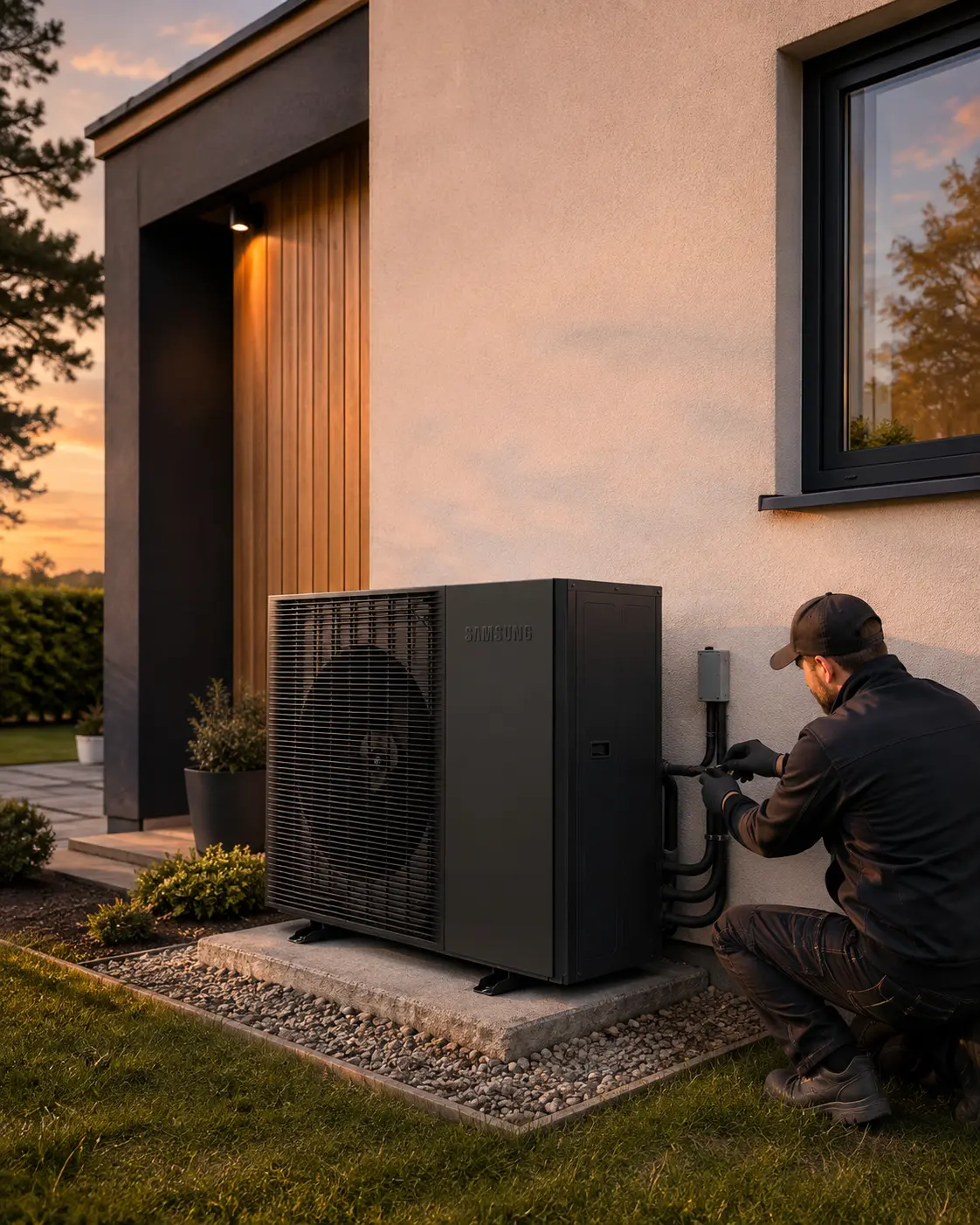
A typical UK home air conditioning installation uses a split system with an indoor unit and an outdoor condenser connected by insulated refrigerant pipework and electrical cabling. A survey should determine the cooling load, suitable unit size, drainage route, outdoor-unit position and electrical requirements.
Current UK estimates put a professionally installed single-room split system at roughly £1,600–£2,300 in many straightforward cases, although specification and installation complexity can push the price higher. Energy Saving Trust gives a typical figure of about £1,900 for a one-room air-to-air heat pump. Checkatrade
Work involving fluorinated refrigerant must be completed by appropriately qualified personnel. GOV.UK
After understanding the system you need, you can compare home-improvement quotes through Get Free Quote.
Air Conditioning Installation UK: Costs, Systems and What Homeowners Need to Know
Installing fixed air conditioning can make bedrooms, home offices and living spaces much easier to use during hot weather. Modern split systems can also provide efficient heating, which means many products sold as domestic air conditioning are technically air-to-air heat pumps.
For UK homeowners, however, choosing a system involves more than picking a unit with enough cooling power. You need to consider system sizing, indoor and outdoor unit positions, noise, electrical requirements, refrigerant regulations, planning rules and running costs.
This guide explains how air conditioning installation in the UK works, what different systems cost, how the refrigeration cycle actually cools your home and what to compare before accepting an installation quote.
Which type of air conditioning is best for a UK home?
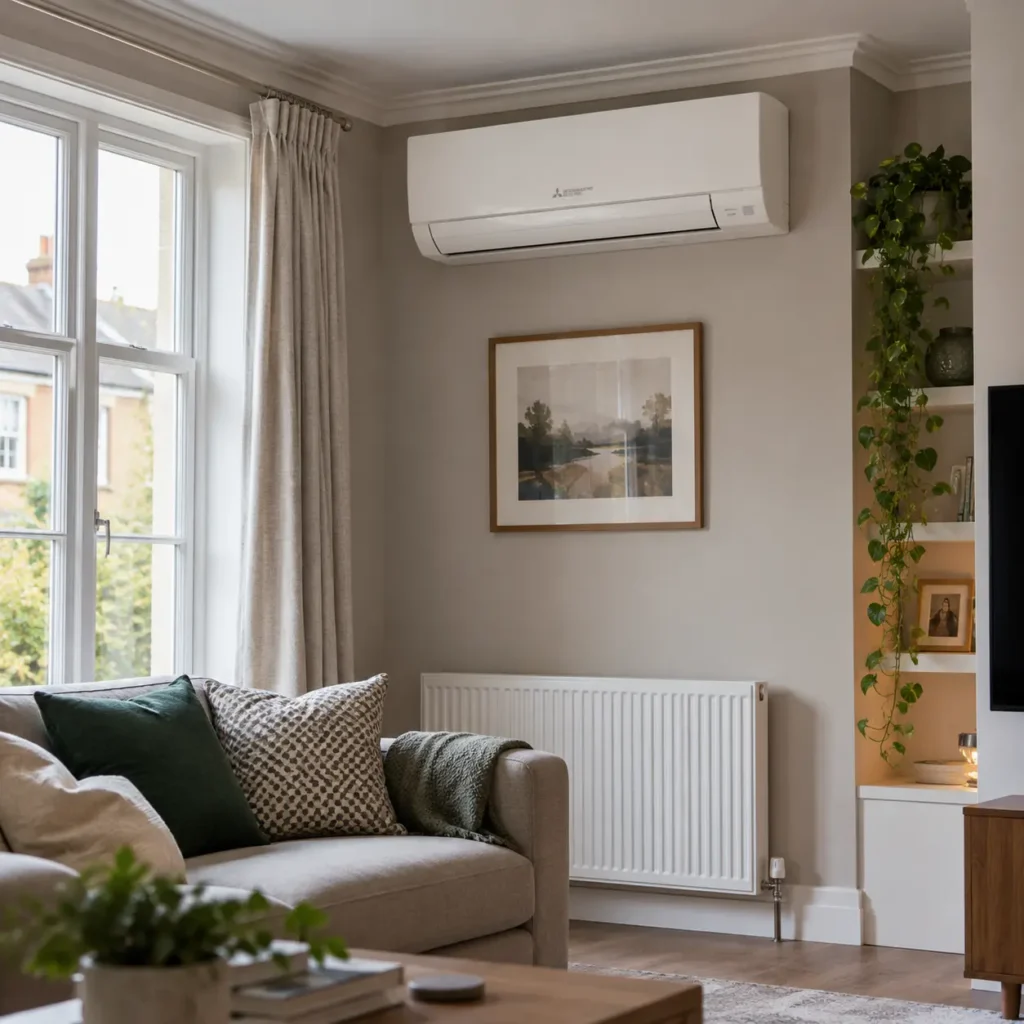
For most permanent residential installations, the decision is between single-split, multi-split and ducted air conditioning.
| System | Best suited to | Main advantage | Main consideration |
|---|---|---|---|
| Single-split | One bedroom, office or living room | Simple, efficient fixed cooling | Requires an indoor and outdoor unit |
| Multi-split | Several rooms | Several indoor units can share an outdoor unit | More pipework and careful system design needed |
| Ducted | Whole-home projects and major renovations | Discreet ceiling or wall outlets | Higher cost and space needed for ductwork |
| Monobloc | Homes where an external condenser is difficult | No conventional outdoor condenser | May offer fewer positioning and performance options |
Portable air conditioners are cheaper initially but are fundamentally different. They reject heat through a flexible hose, usually through a window, and tend to be less efficient and noisier than fixed split systems. Energy Saving Trust recommends reducing unwanted heat first through measures such as shading and ventilation before relying on active cooling. Energy Saving Trust
Improving the building itself can also reduce the amount of cooling required. Homeowners considering wider fabric improvements can review home insulation options alongside cooling requirements.
How does air conditioning actually cool a room?
An air conditioner does not simply create cold air. It moves heat from inside your home to the outside using a refrigerant circulating through a closed refrigeration circuit.
1. The evaporator absorbs indoor heat
Warm room air passes across the indoor unit’s evaporator coil.
Liquid refrigerant inside the coil absorbs that heat and evaporates. The indoor fan then returns cooler air to the room.
Moisture can also condense on the cold coil, which is why air conditioners usually reduce humidity as well as temperature. The resulting condensate must drain safely away.
2. The compressor raises refrigerant pressure
The refrigerant travels to the outdoor unit as a gas.
A compressor increases its pressure and temperature, allowing the system to release the heat it collected indoors.
3. The condenser releases heat outside
The hot refrigerant passes through the outdoor condenser coil.
A fan moves outside air across the coil, transferring the collected heat into the outdoor environment.
4. The expansion device reduces the pressure
The refrigerant then passes through an expansion valve or similar metering device.
Its pressure and temperature fall before it returns to the indoor evaporator, and the cycle begins again.
Can the same system heat your home?
Many modern split air conditioners are reversible. When heating is required, the refrigeration cycle changes direction and the system takes heat from outside air and releases it indoors.
Energy Saving Trust describes these systems as air-to-air heat pumps and confirms that they can provide both heating and cooling. Energy Saving Trust
They differ from the conventional air-to-water systems covered on Get Free Quote’s air source heat pump page. Air-to-water heat pumps normally supply radiators, underfloor heating and a hot-water cylinder. Air-to-air systems generally heat or cool the air directly and usually do not provide domestic hot water. Energy Saving Trust
When used for heating in cold weather, outdoor coils can accumulate frost. Reversible systems may periodically enter a defrost cycle to remove it. That temporarily affects heating output but is part of normal heat-pump operation.
What happens during an air conditioning installation?
A professional installation should begin with a survey rather than a simple recommendation based only on floor area.
The installer should consider room dimensions, ceiling height, glazing, orientation, insulation, occupancy and internal heat gains. Oversizing can cause poor temperature control and unnecessary cycling, while an undersized system may run continuously without maintaining the target temperature.
The installation typically involves:
- Confirming indoor and outdoor unit positions.
- Drilling an opening for refrigerant pipework, electrical connections and drainage.
- Mounting the indoor unit.
- Mounting or supporting the outdoor condenser.
- Running insulated copper refrigerant pipes between them.
- Installing the condensate drain.
- Completing the required electrical supply and isolation.
- Pressure-testing and evacuating the refrigerant circuit.
- Commissioning the unit and checking operation.
A straightforward single split installation can often be completed in a day. More complicated multi-room or ducted projects can take considerably longer. Checkatrade
How much does air conditioning installation cost in the UK?
Prices vary significantly, so published figures should be treated as budgeting guidance rather than quotations.
Checkatrade’s 2026 figures put a 12,000 BTU wall-mounted unit at roughly £620–£890, with installation averaging another £960–£1,380. It also lists additional electrical work as a possible extra cost. Checkatrade
Energy Saving Trust’s October 2026 guidance gives a typical air-to-air heat-pump cost of about £1,900 for one room and around £3,700 for a three-bedroom semi-detached home, although the specification and required work affect the final price.
| Cost factor | Why it changes the quotation |
|---|---|
| Number of rooms | More indoor units increase equipment, pipework and labour |
| Cooling capacity | Larger heat loads require higher-capacity equipment |
| Pipe length | Long or difficult routes increase materials and labour |
| Outdoor-unit position | Roofs, high walls and restricted access increase complexity |
| Electrical work | New circuits, isolators or consumer-unit changes may be required |
| Condensate drainage | Pumps may be needed where gravity drainage is impossible |
| System type | Ducted systems generally require more building work |
| Making good | Decoration and concealment can add to the project cost |
Request an itemised quotation so you can see which of these elements are included.
How much does air conditioning cost to run?
Running cost depends primarily on electrical input, operating time, efficiency and your electricity tariff.
For 1 October to 31 December 2026, Ofgem’s average electricity rate for a standard-variable Direct Debit customer across Great Britain is 26.32p/kWh. Your own tariff may differ. Ofgem
For example, if a system averages 0.8kW of electrical demand while operating:
0.8kW × 26.32p/kWh = about 21p per hour.
Do not confuse a unit’s cooling capacity with its electricity consumption. A system rated at 3.5kW cooling output does not necessarily consume 3.5kW of electricity.
When comparing products, check SEER, the Seasonal Energy Efficiency Ratio for cooling. Heating-capable products also display SCOP, or Seasonal Coefficient of Performance. These measures appear on air-conditioner energy labels and help compare seasonal efficiency. Create Energy Label
Do you need planning permission for air conditioning?
Do not assume that every installation is automatically permitted.
The Planning Portal says domestic air conditioning may constitute permitted development where all relevant limits and conditions are satisfied. Planning Portal
There is an important distinction for reversible systems. England’s permitted-development rules for domestic air-source heat pumps were amended in 2025 and include the condition that an installation relying on those heat-pump rights must not be solely used for cooling. Legislation.gov.uk
Listed buildings, flats, conservation areas, leasehold properties and unusual external-unit positions can introduce additional restrictions.
Planning rules also vary between the UK nations. Ask your installer and, where necessary, your local planning authority before work begins.
Does an air conditioning installer need F-Gas certification?
For systems containing regulated fluorinated refrigerants, appropriate competence is a legal requirement.
GOV.UK states that people installing new stationary refrigeration, air-conditioning and heat-pump systems containing F gas need the relevant qualification. Businesses servicing stationary F-gas equipment operated by others also need company certification. GOV.UK
Check the current GOV.UK F-gas qualification requirements before appointing an installer.
Also ask for evidence of suitable insurance, electrical competence where applicable and manufacturer installation approval if this affects warranty cover.
How to compare air conditioning installation quotes
Do not compare quotes only by total price.
Check that each contractor is pricing broadly the same design and specification. Ask for the exact manufacturer and model, cooling and heating capacity, indoor and outdoor sound figures, SEER and SCOP, warranty, pipework allowance, drainage arrangements and electrical work.
Also establish whether the quote includes commissioning, making good, waste removal and future servicing.
Get Free Quote explains its comparison role and the checks homeowners should consider on its About Get Free Quote page.
Get Your Free Air Source Heat Pump Quote
Find the right air source heat pump solution for your home. Tell us a few details and our team will help you explore suitable options at a competitive price.
Quick to complete. No obligation.
Get your quote
Enter your details below and one of our team will get back to you.
Frequently asked questions
Find clear answers to common questions comparing air source and ground source heat pumps, including efficiency, installation and running costs, winter performance, noise, land requirements and borehole depth.
A straightforward single-room split installation often falls around £1,600–£2,300 using current published cost data, but complex installations can cost more. Energy Saving Trust gives about £1,900 as a typical one-room air-to-air heat-pump figure. Checkatrade
A straightforward single split system can often be installed within one working day. Multi-split and ducted installations can take several days.
Yes. Many modern split systems are reversible air-to-air heat pumps and can provide both cooling and heating. Energy Saving Trust
Conventional split air conditioning generally does not. Air-to-water heat pumps are more commonly designed to supply central heating and stored hot water.
Usually for permanent use. Split systems are generally quieter and more efficient because the compressor and heat rejection components sit outside.
It depends on room layout and cooling loads. One indoor unit may suit a single room, while several separate spaces may require multi-split or ducted equipment.
An installer should calculate the cooling load using room size, glazing, orientation, insulation, occupancy and other heat gains rather than relying on floor area alone.
Most split and multi-split systems do. Some monobloc products use wall ducts instead and do not require a conventional outdoor condenser.
Possibly. Some installations may fall within permitted development, but limits and conditions apply. Check local requirements before installing external equipment. Planning Portal
Anyone carrying out relevant work on systems containing regulated F gas must hold the appropriate qualification. GOV.UK
Modern indoor units can operate quietly at low fan speeds, but noise varies substantially by product. Compare published indoor and outdoor sound data before buying.
SEER means Seasonal Energy Efficiency Ratio. It indicates seasonal cooling efficiency; higher values generally represent greater efficiency under the test methodology.
SCOP means Seasonal Coefficient of Performance and measures seasonal heating performance for heating-capable systems.
Follow the manufacturer's maintenance schedule. Filters usually require more frequent homeowner cleaning than professional servicing intervals.
Yes. Moisture condenses on the cold indoor evaporator during normal cooling, so air conditioning also dehumidifies the room.
Most domestic split systems do not. They recirculate indoor air, so normal ventilation remains necessary. Energy Saving Trust
Solar PV can contribute electricity while it is generating, particularly because cooling demand often occurs during daylight. Actual savings depend on solar generation, AC consumption and other household demand.
Not necessarily, but usage matters. At Ofgem's current 26.32p/kWh average electricity rate, an average 0.8kW electrical draw would cost around 21p per operating hour. Your tariff and the unit's actual demand will determine the real figure.
Is air conditioning worth installing in a UK home?
It can be, particularly where specific rooms regularly overheat and passive measures cannot keep them comfortable.
Bedrooms, loft conversions, highly glazed rooms and south- or west-facing home offices are common candidates. A reversible split system can offer more year-round value because it also provides heating.
However, installing more capacity than your home needs is not necessarily better. Start by reducing solar gain, improving shading and ventilation, and addressing relevant building-fabric problems. Then size active cooling for the remaining load.
For homeowners ready to investigate a project, contact Get Free Quote to discuss comparison options.