3kW Solar System Cost UK 2026: Price, Output & Savings
Check Your Eligibility for Boiler Upgrade Scheme (BUS)
Complete your details below to check your eligibility.
Thank you
We've received your details and will be in touch shortly.
Quick answer: how much does a 3kW solar system cost in the UK?
A 3kW solar system typically costs around £5,000–£6,500 installed in the UK in 2026, excluding battery storage. Government cost data provides a useful cross-check: domestic retrofit systems up to 4kW averaged about £2,109 per installed kW in 2025/26, equivalent to roughly £6,327 when applied to 3kWp. GOV.UK
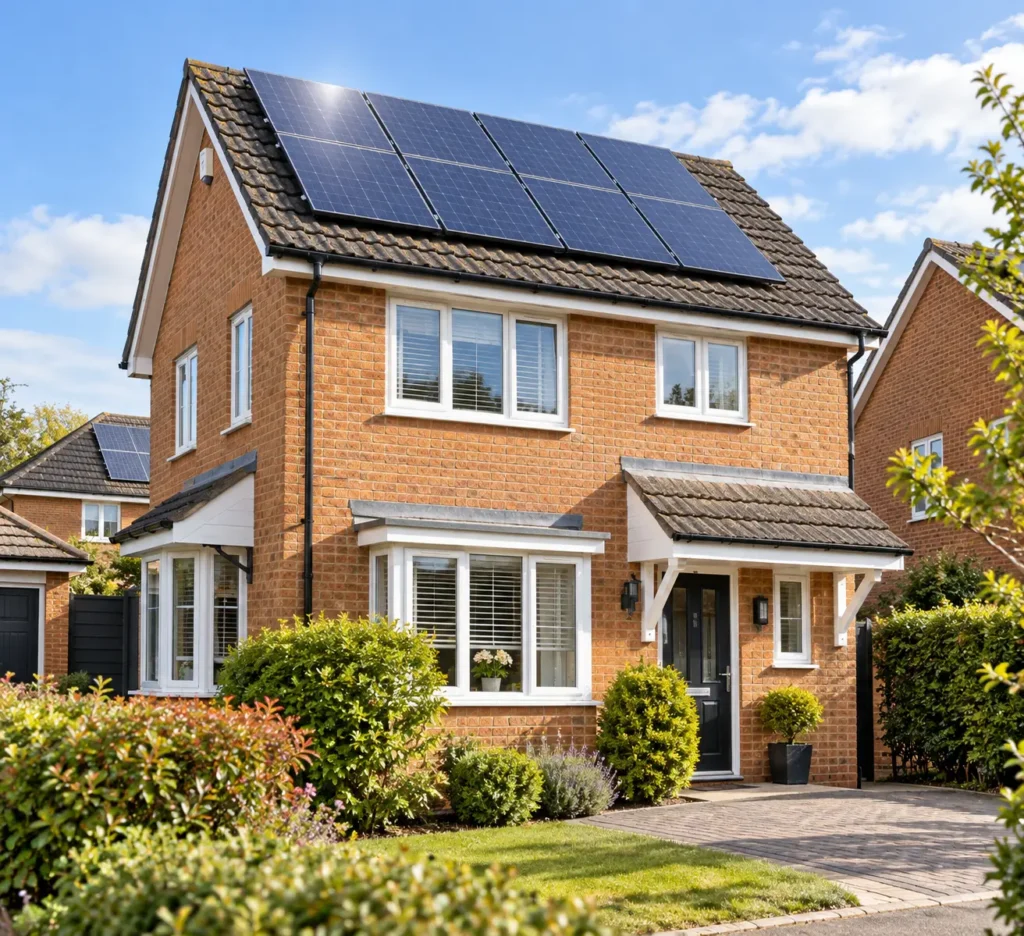
A modern 3kWp array may use roughly seven 430W panels and need around 14m² of roof space. On a favourable south-facing roof, annual generation of around 2,500–2,600kWh is a useful central estimate. Location, orientation, pitch and shading can change that significantly. solar.org.uk
3kW Solar System Cost UK 2026: Price, Output, Savings and Payback
A 3kW solar panel system sits at the smaller end of UK domestic installations. It can suit terraced houses, smaller semis, low-usage households and properties with limited usable roof space.
In 2026, a practical budget is roughly £5,000–£6,500 for a straightforward 3kWp solar-only installation. The latest government-derived data also shows why small systems can look relatively expensive per kilowatt. Domestic retrofit installations up to 4kW averaged about £2,109 per kW in 2025/26. Applied directly to a 3kWp system, that is about £6,327. GOV.UK
This guide explains what a 3kW system includes, likely electricity generation, cost factors, savings, payback and whether 3kW is the right size for your home.
If you want a price based on your actual roof rather than national averages, start with Get Free Quote and compare property-specific proposals.
3kW solar system cost at a glance
| Item | Typical 2026 guide |
|---|---|
| Solar-only installed cost | Around £5,000–£6,500 |
| Domestic-retrofit benchmark | About £6,327 using £2,109/kW |
| Typical panel count | Around 7 × 430W panels |
| Approximate roof space | Around 14m² |
| Indicative annual generation | Around 2,500–2,600kWh on a favourable roof |
| Battery storage | Often around £5,000–£8,000 extra |
| VAT | Qualifying domestic installations currently 0% until 31 March 2027 |
The Department for Energy Security and Net Zero solar PV cost data comes from MCS installation records. It therefore provides a useful market benchmark, but it is not a quotation for an individual property. Roof access, specification and electrical work can all move the final price. GOV.UK
For wider system-size comparisons, see Get Free Quote’s solar panel cost UK guide.
What is included in a 3kW solar installation price?
A complete quotation should cover much more than the panels. Normally, you are paying for system design, modules, mounting equipment, an inverter, scaffolding, electrical work, labour, testing, commissioning and handover paperwork.
That helps explain why a 3kW array does not necessarily cost three-quarters of a 4kW system. Scaffolding, surveys and much of the installer’s labour are fixed costs. Smaller arrays can therefore cost more for each kWp installed.
Ask whether the price includes DNO work, MCS certification where applicable, monitoring, warranties and possible consumer-unit upgrades. Get Free Quote’s solar panel installation quote guide provides a fuller checklist.
VAT on solar panels in 2026
Qualifying energy-saving installations in UK homes currently benefit from 0% VAT. HMRC’s published timetable keeps the zero rate until 31 March 2027, after which the reduced rate is currently scheduled to return. Check the latest GOV.UK VAT guidance for energy-saving products before relying on the tax treatment in a quotation. GOV.UK
What affects the cost of a 3kW solar system?
Roof access can make a substantial difference. A simple pitched roof with straightforward scaffold access is generally cheaper than a roof with dormers, fragile coverings, several elevations or difficult access.
Equipment also affects the quotation. Higher-efficiency panels can help where usable roof space is limited. Microinverters, optimisers or a premium hybrid inverter can add cost, although they should address a genuine design requirement rather than simply make the specification look more advanced.
Electrical work is another variable. Some homes need consumer-unit work, earthing changes or longer cable routes. If your roof needs replacing soon, it generally makes sense to complete that work before installing solar.
How much electricity will a 3kW solar system generate?
A 3kWp system does not produce 3kW continuously. Kilowatt-peak, or kWp, describes the rated capacity of the panels under standard test conditions.
For a south-facing roof at a useful pitch, annual generation around 2,500–2,600kWh is a reasonable central estimate. One UK modelling analysis put a 3kWp south-facing array at about 2,568kWh per year for a median location, while results varied considerably between locations. solar.org.uk
Actual output depends on where you live, roof direction, pitch, shading and system losses. Energy Saving Trust says an east- or west-facing array tends to generate around 15–20% less energy than a directly south-facing equivalent. Energy Saving Trust
Get Free Quote’s solar panel output UK guide explains those variables in more detail.
How much could a 3kW solar system save?
Savings come from two sources: electricity you use directly and electricity you export.
Self-used solar is normally more valuable because it replaces electricity you would otherwise buy. From 1 October to 31 December 2026, Ofgem’s average electricity price-cap unit rate for a Direct Debit customer on a standard variable tariff is 26.32p/kWh. See Ofgem’s current energy price-cap rates. Ofgem
Surplus electricity can earn money through the Smart Export Guarantee (SEG) in Great Britain. Suppliers determine their individual export rates and contract terms. Ofgem explains how the Smart Export Guarantee works. Ofgem
For example, suppose your system generates 2,550kWh annually and you use 40% directly. That means 1,020kWh avoids grid imports. At 26.32p/kWh, those units would be worth about £268.
The remaining 1,530kWh could earn export income. Using an illustrative 12p/kWh export rate—around the figure Energy Saving Trust currently uses as a typical example—would add approximately £184, giving an annual value of roughly £452. Energy Saving Trust
That is an illustration rather than a savings guarantee. Your generation, electricity tariff, export tariff and consumption pattern may differ substantially.
What is the payback period on a 3kW solar system?
Payback depends on five main numbers: installation cost, annual generation, self-consumption, import electricity price and export rate.
Energy Saving Trust’s current examples show solar payback periods of roughly 9–12 years across selected locations in England, Scotland and Wales when export income is included. A 3kW installation may take longer or shorter because smaller systems have relatively high fixed installation costs and every household uses electricity differently. Energy Saving Trust
Solar panels should last 25 years or more, while Energy Saving Trust says an inverter may need replacing after around 12 years. Include potential inverter replacement when assessing long-term returns. Energy Saving Trust
Is a battery worth adding to a 3kW system?
A battery can increase the amount of solar electricity you use yourself. However, storage can cost as much as the solar array.
Energy Saving Trust currently estimates typical home battery storage at around £5,000–£8,000. Energy Saving Trust
Ask installers for two separate financial models: one for solar only and another for solar plus storage. You can then compare the battery’s additional cost with its expected extra savings, tariff benefits and backup functionality.
With a modest 3kWp array, a smaller battery may also make more sense than a large unit that rarely receives enough surplus solar generation to fill it.
Is 3kW the right solar system size for your home?
A 3kW installation can work particularly well where roof space is limited or electricity demand is modest. It may suit households consuming roughly 2,000–2,700kWh annually, although consumption alone should not determine system size. solar.org.uk
Think about future electricity use too. An EV, heat pump, electric water heating or increased home working could make a larger array more attractive if your roof and grid connection can accommodate it.
| Situation | 3kW verdict |
|---|---|
| Small roof or terraced home | Often a strong fit |
| Low annual electricity use | Often suitable |
| Someone home during daylight hours | Good self-consumption potential |
| EV or heat pump planned | Compare with 4–6kW or larger |
| Significant roof shading | Needs property-specific modelling |
| Large unshaded roof and higher usage | Compare with a larger system |
A conventional 3kW single-phase installation also sits below the 3.68kW G98 threshold, although connection rules depend on the aggregate generating capacity and inverter arrangement. Energy Networks Association guidance states that 16A per phase corresponds to 3.68kW on a single-phase supply. Your installer should identify and manage the correct DNO process. energynetworks.org
How to compare 3kW solar quotes
Compare quotations on the same basis. Check total kWp, panel model, inverter specification, predicted annual generation, roof layout, warranties, scaffolding, electrical work and DNO responsibilities.
If a battery is included, separate its price from the solar-only figure. Otherwise, one package can appear much more expensive simply because it contains considerably more equipment.
Next, divide the solar-only price by the array capacity. This gives you a £/kWp figure that can be checked against current government data.
Finally, challenge unusually high generation or savings claims. Ask installers to show the roof orientation, shading, electricity-price and self-consumption assumptions used in their calculations.
You can compare solar panel installation quotes before deciding which design offers the best fit and value.
Get Your Free Air Source Heat Pump Quote
Find the right air source heat pump solution for your home. Tell us a few details and our team will help you explore suitable options at a competitive price.
Quick to complete. No obligation.
Get your quote
Enter your details below and one of our team will get back to you.
Frequently asked questions
Find clear answers to common questions about 3kW solar systems in the UK, including installation costs, panel numbers, roof space, electricity generation, batteries, payback, VAT, planning permission and export payments.
A reasonable guide is around £5,000–£6,500 installed without a battery. Individual quotations can be higher or lower depending on the roof, equipment and electrical work.
Around seven modern 430W panels would produce roughly 3kWp. Lower-wattage panels may require eight or more modules.
Approximately 14m² is a useful guide for seven modern panels, although exact dimensions vary by panel model.
Around 2,500–2,600kWh annually is a reasonable central estimate for a favourable UK roof. Location, shading and orientation can change this considerably.
A 2,550kWh annual output averages about 7kWh per day across the year, but actual daily production is much higher in summer and considerably lower in winter.
It can be enough for a smaller or lower-consumption household. Homes with an EV, heat pump or high electricity demand may benefit from a larger system.
It depends on roof area and electricity demand. A 4kW system generates more electricity and often costs less per kW, while 3kW may suit a smaller roof or lower consumption.
There is no fixed answer. Installation cost, output, self-consumption and export rates determine payback. Current wider UK solar examples commonly fall around the 9–12-year range.
Possibly, but compare the economics carefully. Battery storage commonly costs around £5,000–£8,000, so the additional investment can be substantial compared with a 3kW array.
Usually, yes. However, inverter choice and system design can affect how easy and economical a future battery retrofit will be.
Yes. Solar PV works in daylight rather than requiring hot weather, but winter generation is much lower because days are shorter and solar radiation is weaker.
Potentially, yes, in Great Britain. Solar PV is eligible for SEG when the scheme requirements are met. Ofgem says installations of 50kW or less normally need suitable certification, such as MCS or an equivalent scheme.
Qualifying professionally installed residential solar currently benefits from 0% VAT, with the present zero-rate period scheduled to run until 31 March 2027.
Domestic rooftop solar usually falls under permitted-development rules, although exceptions can apply to listed buildings, conservation areas and certain other properties. Check the rules applying in your part of the UK.
MCS is not simply a legal requirement for every solar installation, but certification is important for consumer protection and commonly used to demonstrate eligibility for SEG payments. Ofgem also recognises equivalent certification in its SEG rules.
Conclusion
For a 3kW solar system in the UK, around £5,000–£6,500 is a useful 2026 solar-only budget. Current domestic-retrofit data also points to roughly £6,300 when the latest up-to-4kW average is applied directly to a 3kWp installation.
A well-positioned system may generate around 2,500–2,600kWh per year. However, the financial return depends heavily on self-consumption, your electricity price and the export tariff you choose.
The main question is therefore not whether 3kW is a “good” size in isolation. It is whether 3kW matches your roof, current electricity demand and future plans. Compare at least three detailed proposals and favour transparent assumptions over the lowest headline price.