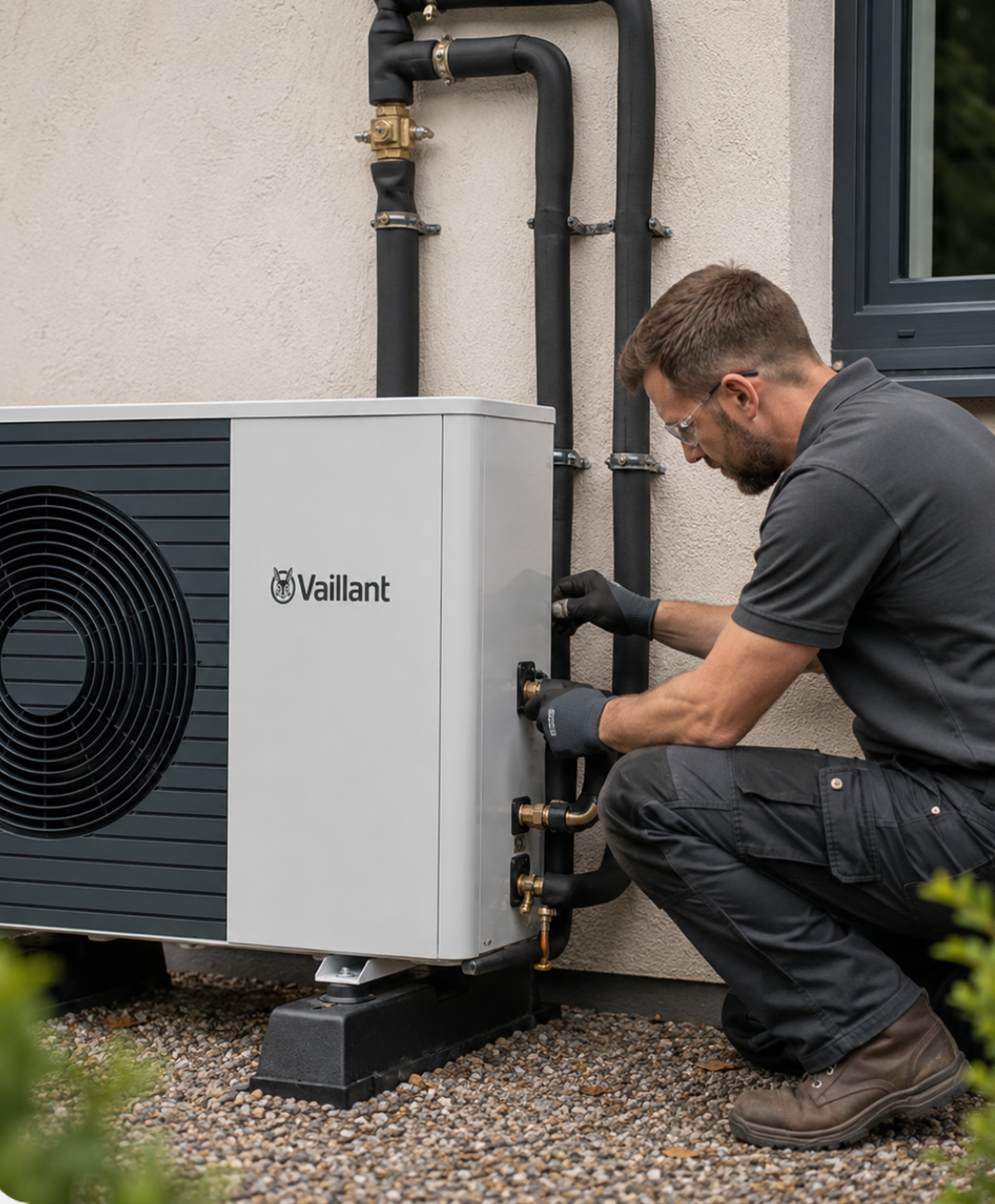
5kW Air Conditioning Room Size: UK Sizing Guide
Check Your Eligibility for Boiler Upgrade Scheme (BUS)
Complete your details below to check your eligibility.
Thank you
We've received your details and will be in touch shortly.
Quick Answer: What Room Size Is a 5kW Air Conditioner Suitable For?
A 5kW air conditioner will often suit a UK room of around 35–50m², assuming a standard ceiling height and average insulation. Around 40–50m² may be realistic for a normally insulated, moderately glazed room, while a sunny open-plan kitchen, loft conversion or heavily glazed space may bring the practical range closer to 30–40m².
Daikin UK uses approximately 0.1kW per square metre as an initial rule of thumb for typical UK rooms, which would put 5kW at around 50m² before adjustments. Ceiling height, glazing, sunlight, insulation, occupants and appliances can all increase the cooling requirement.
5kW Air Conditioning Room Size: How Big a Room Can a 5kW AC Cool in the UK?
A 5kW air conditioner is often considered for larger UK living rooms, open-plan kitchen-diners, loft spaces and similar areas. However, there is no single room-size figure that works for every property.
For a typical UK room with an average ceiling height and reasonable insulation, a 5kW system is often a sensible starting point for roughly 35–50m². The upper end assumes fairly normal heat gains. Large south- or west-facing windows, roof glazing, poor insulation, high ceilings, several occupants or cooking appliances can reduce the area a 5kW unit can comfortably serve.
The important point is that “5kW” describes cooling capacity, not a guaranteed floor area. Correct sizing depends on how much heat enters and builds up in the room.
If you are planning an installation, you can compare options and request a free quote before choosing a particular capacity.
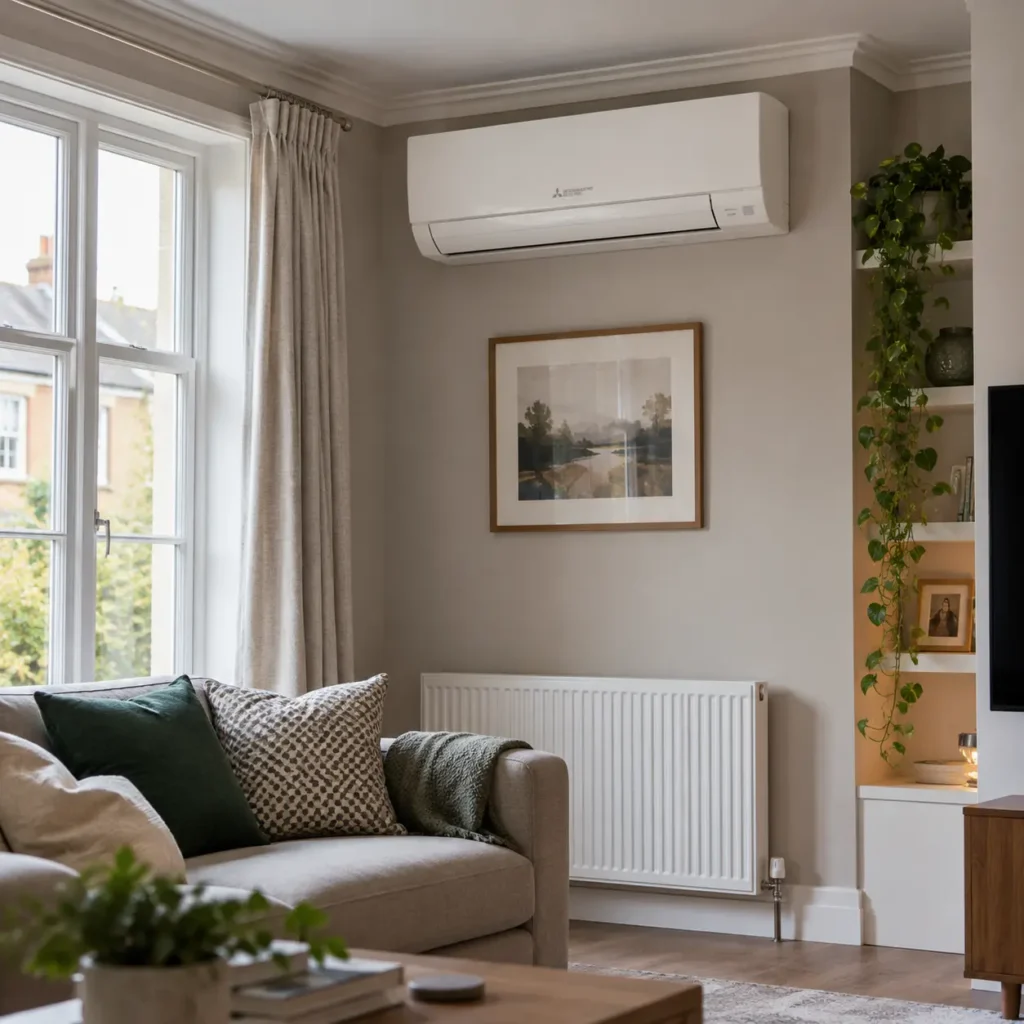
5kW Air Conditioning Room Size at a Glance
| Room conditions | Approximate area where 5kW may be suitable | Main consideration |
|---|---|---|
| Well insulated, average glazing, standard ceiling | 40–50m² | Lower heat gain allows the capacity to cover more floor area |
| Typical large lounge or open-plan space | 35–45m² | Common domestic application |
| South/west-facing with large windows | 30–40m² | Solar gain increases cooling demand |
| Open-plan kitchen-diner | 30–40m² | Cooking, appliances and occupants add heat |
| Loft or highly glazed room | 25–40m² | Roof and solar gains can make floor area misleading |
These figures are starting estimates rather than installation specifications. Daikin’s current UK guidance notes that large sun-facing windows and kitchens can each increase capacity requirements, while higher ceilings also increase the cooling load.
Two 40m² rooms can therefore require different systems. A shaded, insulated lounge is very different from a room with bifold doors, rooflights and strong afternoon sun.
What Does 5kW Mean in Air Conditioning?
The 5kW figure normally refers to the air conditioner’s nominal cooling capacity. In simple terms, it describes the rate at which the system can remove heat from a room.
It does not mean a 5kW air conditioner continuously consumes 5kW of electricity.
For example, Panasonic lists a wall-mounted system with 5.0kW nominal cooling capacity but approximately 1.41kW nominal electrical input in cooling mode. Its output can also modulate above and below the nominal figure.
You may also see 5kW described as approximately 17,000–18,000 BTU/h. BTU per hour is simply another way of expressing cooling capacity.
For a broader explanation of system types, heating and cooling, see Get Free Quote’s Air Con UK guide.
What Room Size Can a 5kW Air Conditioner Cool?
Daikin UK’s current sizing guidance provides a useful starting point of approximately 0.1kW per square metre for a typical room with average ceiling heights and insulation.
Using that simple calculation:
50m² × 0.1kW = 5.0kW
That means a 50m² room can initially appear to be a good match for a 5kW system.
However, floor area is only the first step. Daikin also highlights ceiling height, insulation, window area and orientation, occupancy, room use and internal equipment as factors that change the required capacity. Its examples suggest kitchens can need around 10–20% more capacity, while large south- or west-facing windows can also increase cooling requirements.
That is why 35–50m² is more useful as a practical planning range than simply saying every 5kW unit is suitable for 50m².
Example: 40m² Open-Plan Kitchen-Diner
Start with the rough sizing calculation:
40m² × 0.1kW = 4.0kW
Now consider the room itself.
If it includes a large glazed door, strong afternoon sun, an oven, hob and several people, its peak cooling load will be higher than the basic floor-area calculation suggests.
In those circumstances, a 5kW system could be entirely reasonable.
Example: 50m² Shaded Living Room
A 50m² living area with standard ceilings, good insulation and moderate glazing starts at approximately 5kW using the same rule of thumb.
A 5kW system could therefore be suitable. However, there is less spare capacity for unusually high solar gain, poor insulation or high occupancy.
Treat 50m² as a possible application rather than an automatic maximum.
What Can Make a 5kW Air Conditioner Too Small?
Large Windows and Direct Sunlight
Solar heat entering through glass is one of the main reasons simple room-size calculators can be misleading.
Bifold doors, rooflights and large south- or west-facing windows can significantly increase cooling demand.
External shading, blinds and other passive measures can help reduce overheating. Energy Saving Trust also recommends considering shading and improved ventilation before relying entirely on mechanical cooling.
High Ceilings
Most simple floor-area estimates assume a normal domestic ceiling of around 2.4m.
A room with a 3m ceiling has approximately 25% more volume than one with the same floor area and a 2.4m ceiling. Daikin advises accounting for this additional volume when calculating the required capacity.
Insulation and Air Leakage
A well-insulated room generally holds its target temperature more easily.
Poor insulation and uncontrolled air leakage allow heat to enter faster, increasing the amount of cooling required.
Where wider building-fabric problems contribute to overheating, reviewing home insulation options may make more sense than simply installing a larger air conditioner.
Kitchens, People and Electrical Equipment
Ovens, hobs, gaming PCs, monitors, televisions and other electrical equipment release heat into a room.
People also add heat and moisture.
A 35m² kitchen-living area can therefore require similar cooling capacity to a much larger lounge with fewer internal heat sources.
Room Shape and Layout
A wall-mounted unit needs to distribute conditioned air effectively.
Long rooms, L-shaped layouts, partial walls and adjoining rooms can create hot spots even where the total floor area appears suitable.
Correct positioning matters almost as much as headline capacity.
Is a 5kW Air Conditioner Too Big for a Smaller Room?
It can be.
Buying extra capacity does not automatically improve comfort.
A substantially oversized system can reach the thermostat set point very quickly before the whole room has been conditioned evenly. Depending on the system and conditions, excessive oversizing can contribute to frequent cycling and poorer humidity control.
Modern inverter air conditioners can reduce compressor output as cooling demand falls. This makes them more flexible than older fixed-speed systems, but it does not remove the need for correct sizing.
Daikin specifically warns that undersized systems can run continuously while oversized systems may cycle too frequently.
The aim is therefore not to buy the biggest unit within budget. It is to choose a system whose operating range suits the room.
How to Estimate the Right Air-Conditioning Size
Use this five-step process as an initial check.
Measure the floor area. Multiply the room’s length by its width in metres.
Start at roughly 0.1kW per m². This provides a useful UK screening estimate for average ceiling heights and insulation.
Consider ceiling height. Higher ceilings increase the volume the system must condition.
Identify additional heat gains. Look for large windows, direct sunlight, roof glazing, cooking equipment, computers and high occupancy.
Ask for a proper load assessment. The installer should be able to explain why the proposed capacity suits the room rather than simply quoting a unit based on floor area.
For a permanent split system, the survey should also consider indoor-unit positioning, outdoor-unit airflow, pipe routes, condensate drainage and electrical requirements. The air-conditioning installation UK guide covers these wider installation considerations.
Where equipment contains regulated F-gases, GOV.UK states that people carrying out relevant installation and refrigerant work must hold the appropriate qualifications.
Can One 5kW Air Conditioner Cool Several Rooms?
Do not assume that one 5kW wall unit can cool an entire floor simply because the combined room area is below 50m².
A single indoor unit is primarily designed to condition the space in which it is installed.
Leaving doors open may allow some cool air to reach neighbouring rooms. However, temperature control is likely to be uneven, particularly around corridors, corners and closed bedrooms.
If several separate rooms need reliable cooling, individual indoor units connected to a multi-split system or another properly zoned design will usually provide better control.
Does a 5kW Air Conditioner Also Provide 5kW of Heating?
Not necessarily.
Many permanent split air conditioners are reversible air-to-air heat pumps, which means they can provide both heating and cooling. Energy Saving Trust confirms that air-to-air systems use indoor and outdoor units and can be configured for both functions.
The heating capacity does not have to equal the cooling capacity.
For example, the Panasonic model referenced earlier is rated at 5.0kW nominal cooling capacity and 5.8kW nominal heating capacity.
If winter heating is an important part of the project, the installer should therefore check both the summer cooling load and winter heating requirement.
Is a 5kW Air Conditioner Right for Your Room?
A 5kW air conditioner is most likely to suit a large single room or open-plan space of approximately 35–50m².
Use the lower end of that range when the room has:
strong south- or west-facing sunlight
extensive glazing
rooflights
cooking equipment
high ceilings
several regular occupants
weaker insulation
significant electrical equipment
The upper end becomes more realistic where ceilings are conventional, glazing is moderate and heat gains are relatively low.
Do not choose 5kW solely because an online chart says it covers a particular maximum floor area. Ask for a cooling-load assessment and compare the proposed model’s output range, seasonal efficiency, noise and installation requirements.
If you want to compare suitable systems and quotations, contact Get Free Quote for a no-obligation discussion.
Get Your Free Air Source Heat Pump Quote
Find the right air source heat pump solution for your home. Tell us a few details and our team will help you explore suitable options at a competitive price.
Quick to complete. No obligation.
Get your quote
Enter your details below and one of our team will get back to you.
Frequently asked questions
Find clear answers to common questions comparing air source and ground source heat pumps, including efficiency, installation and running costs, winter performance, noise, land requirements and borehole depth.
A 5kW air conditioner will often suit a room of roughly 35–50m² in a UK home. The actual figure depends on ceiling height, insulation, glazing, sunlight, occupancy and internal heat gains.
Potentially. Using the common UK starting point of approximately 0.1kW per m², 50m² equates to about 5kW. Large windows, direct sun, kitchens or high ceilings may push the required capacity above 5kW.
It may be for a normal 30m² room, but not always. A loft room, kitchen, conservatory-style space or heavily glazed south-facing room can have a much higher cooling load than its floor area suggests.
5kW of cooling capacity is approximately 17,000 BTU/h, and products in this capacity class are often described as approximately 18,000 BTU units.
No. The 5kW rating normally describes cooling output. Electrical consumption is considerably lower and varies by model and operating conditions.
The main factors are floor area, ceiling height, insulation, window size, window orientation, sunlight, number of occupants, electrical equipment, cooking appliances and room layout.
Often, yes. Strong sunlight through south- and west-facing glazing increases solar heat gain, so the same floor area can require more cooling capacity.
It can be. A 5kW unit is often considered for open-plan spaces around 30–45m², but cooking equipment, glazing and occupancy should be included in the cooling-load calculation.
Possibly, but loft rooms can experience unusually high heat gains through the roof and rooflights. A smaller floor area can therefore require surprisingly high cooling capacity.
Yes. Higher ceilings increase room volume. A room with a 3m ceiling contains around 25% more volume than the same floor area with a 2.4m ceiling.
It may provide some cooling through an open doorway, but one indoor unit rarely gives precise temperature control across separate rooms. A multi-split or zoned system is normally better.
No. An undersized system may struggle to reach the desired temperature, while a substantially oversized system can cycle excessively or provide uneven comfort.
Common signs include continuous high-output operation, slow temperature reduction and failure to maintain the set temperature during hot weather. Dirty filters or other faults can cause similar symptoms, so capacity should not be assumed to be the only problem.
Many modern split systems can. Reversible units operate as air-to-air heat pumps, although their heating capacity may be different from their 5kW cooling rating.
For a permanently installed split system, a survey is strongly advisable. It allows the installer to assess heat gains, room layout, unit positioning, refrigerant pipework, drainage and electrical requirements.
Conclusion
For UK homeowners, 5kW air conditioning room size is best treated as a range rather than one fixed figure.
Around 35–50m² is a useful first-pass guide. A straightforward 50m² room may suit 5kW, while a much smaller room with extensive glazing, a high ceiling or strong solar gain can require similar capacity.
Floor area gets you into the right ballpark. Glazing, sunlight, ceiling height, insulation, occupancy and room use determine whether 5kW is genuinely the right answer.
The best air conditioner is therefore not the largest system you can install. It is the one properly matched to the room’s actual cooling load.