Air Con UK: Costs, Types, Heating & Grants (2026)
Check Your Eligibility for Boiler Upgrade Scheme (BUS)
Complete your details below to check your eligibility.
Thank you
We've received your details and will be in touch shortly.
Quick Answer: Is Air Con Worth Having in the UK?
For homes that regularly overheat, permanent split air conditioning can provide much better temperature control than fans or many portable units. Modern reversible systems can also heat rooms during colder weather because they operate as air-to-air heat pumps.
Energy Saving Trust currently gives indicative air-to-air heat-pump costs of about £1,900 for one room and around £3,700 for a three-bedroom semi-detached home, although actual quotations depend on the property and system design. Eligible residential air-to-air heat pumps in England and Wales can also receive £2,500 through the Boiler Upgrade Scheme.
Air Con UK: Costs, Types, Heating, Cooling and Grants in 2026
Air conditioning is becoming a more practical option for UK homes that struggle with summer overheating. However, choosing air con in the UK is not simply a matter of buying the biggest unit available.
You need to decide whether you want occasional cooling, permanent whole-room comfort or a system that can also heat your home in winter. Room size, insulation, glazing, noise, installation requirements and running costs all affect the right choice.
There is another important distinction. Many modern fixed air-conditioning systems are technically air-to-air heat pumps. They can move heat out of your home for cooling and reverse the process to provide heating.
This guide explains the main air-con options available to UK homeowners, how they work, typical costs, energy use, grants and what to check before installing one.
If you are ready to compare your options, you can also compare free quotes through Get Free Quote.
Air Con UK Options at a Glance
| Type | Best For | Main Strength | Main Consideration |
|---|---|---|---|
| Portable air conditioner | Occasional cooling or renters | No permanent installation | Usually noisier and less efficient than a split system |
| Single-split system | Bedroom, lounge or home office | Efficient permanent heating and cooling | Requires indoor and outdoor units |
| Multi-split system | Several rooms | Multiple indoor units using one outdoor unit | More complex pipework and design |
| Air-to-air heat pump | Homes wanting heating and cooling | Can provide efficient room heating as well as cooling | Usually does not provide domestic hot water |
| Air-to-water heat pump | Whole-home wet central heating | Heats radiators, UFH and usually hot water | Not the same as conventional room air conditioning |
What Does Air Con Mean in the UK?
For most homeowners, “air con” means a system that removes heat from an indoor space and releases it outdoors.
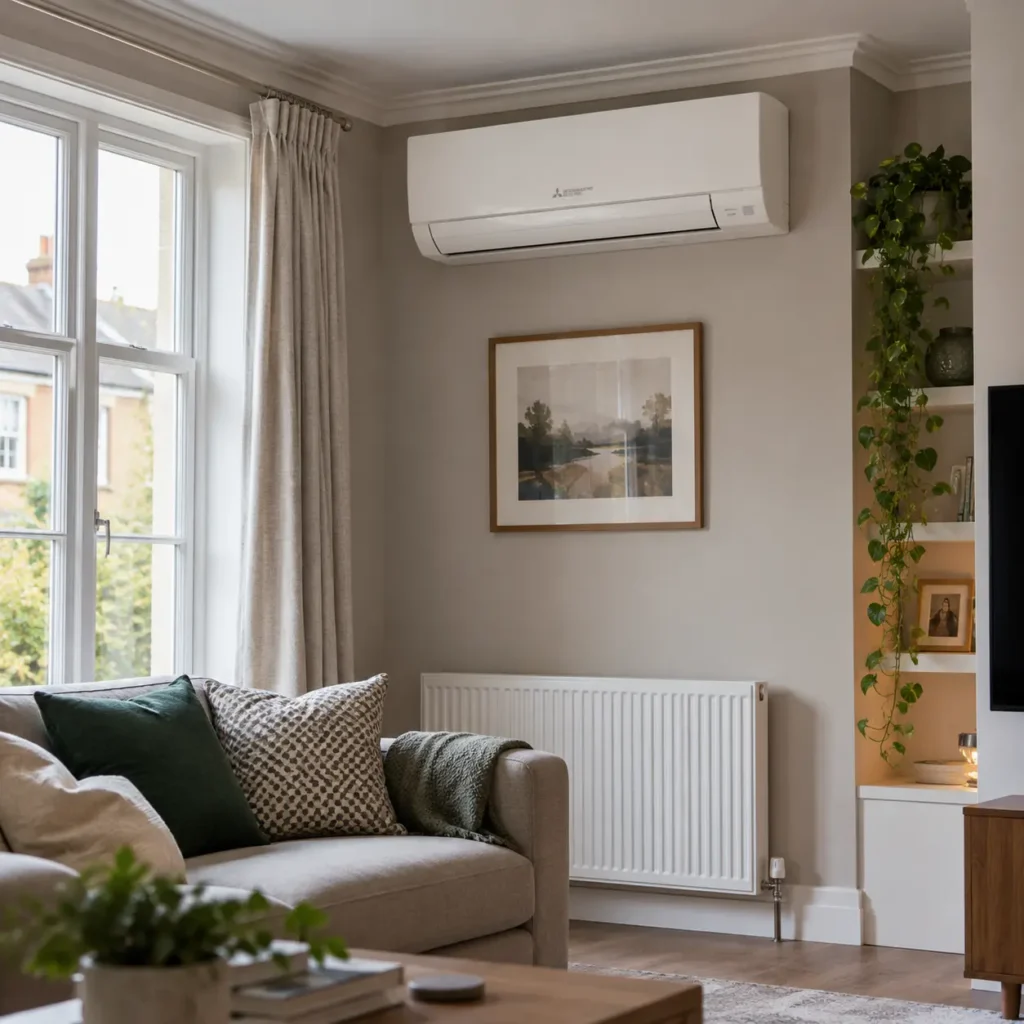
Portable units do this from a self-contained appliance, normally using a hose through a window. Permanent split systems separate the indoor and outdoor components.
Modern split systems often provide both cooling and heating. In technical terms, these reversible systems operate as air-to-air heat pumps.
Energy Saving Trust explains that air-to-air heat pumps use an outdoor unit connected to one or more indoor units by refrigerant pipework. Unlike an air-to-water system, they heat or cool the air directly instead of sending heated water through radiators.
For a broader explanation of the alternative technology, see Get Free Quote’s air source heat pump beginner’s guide.
Which Type of Air Conditioning Is Best for a UK Home?
A single-split system often makes sense when one room causes most of the problem. Typical examples include a south-facing bedroom, loft conversion, conservatory-style space or home office.
The indoor wall unit connects to an outdoor condenser. Because the compressor sits outside, a professionally designed split system can be considerably more comfortable acoustically than having a portable compressor running in the room.
A multi-split system connects several indoor units to one outdoor unit. This can suit homeowners who want cooling in several bedrooms or living areas without installing a separate outdoor unit for every room.
Portable air conditioners remain useful where permanent alterations are impossible. However, UK consumer discussions repeatedly raise concerns about hose arrangements, noise and warm outside air being pulled back into rooms by some single-hose designs.
The right answer therefore depends on how many rooms need conditioning and how frequently you expect to use it.
How Does Air Conditioning Actually Work?
Air conditioning does not simply “create cold”. It moves heat.
The process uses a refrigerant circulating between an indoor and outdoor heat exchanger.
In cooling mode, refrigerant absorbs heat from the indoor air at the evaporator. The compressor then raises the refrigerant’s pressure and temperature. At the outdoor condenser, that heat transfers to the outside air.
An expansion device reduces the refrigerant pressure so the cycle can begin again.
A reversible air-to-air heat pump can change the direction of heat transfer. In winter, it extracts heat from outdoor air and transfers it indoors.
That is the same underlying refrigeration principle used by other heat pumps. However, an air-to-water system transfers heat into water for radiators or underfloor heating instead. For a detailed explanation of the evaporator, compressor, condenser and expansion stage, read Get Free Quote’s guide to how air source heat pumps work.
How Much Does Air Con Cost in the UK?
Installation cost depends on the number and capacity of indoor units, pipe lengths, electrical work, outdoor-unit position and access.
For air-to-air heat pumps, Energy Saving Trust currently cites approximately:
£1,900 for a single-room installation
£3,700 for a three-bedroom semi-detached home
These are indicative figures, not guaranteed air-conditioning quotations. Complex multi-room designs, difficult access or additional electrical and building work can change the price materially.
A quotation should make clear which equipment is supplied, its heating and cooling capacity, electrical requirements, pipework, drainage, commissioning and warranty.
Avoid comparing quotations only on the number of kilowatts advertised. Correct sizing matters because oversized and undersized systems can both create comfort and efficiency problems.
How Much Does Air Conditioning Cost to Run?
There is no reliable universal hourly figure.
The basic calculation is:
Electrical input in kW × hours used × your electricity price per kWh
However, an air conditioner’s advertised cooling capacity is not necessarily the amount of electricity it continuously consumes.
Inverter-controlled systems adjust compressor output as the room approaches the target temperature. Actual consumption therefore varies with outdoor temperature, insulation, solar gain, set temperature and system efficiency.
British Gas similarly notes that UK air-conditioning running costs depend on electricity tariffs, usage, property characteristics and system efficiency.
When comparing systems, look at seasonal efficiency rather than judging them solely on maximum output.
Heat-pump buyers may also encounter COP, or Coefficient of Performance. A COP of 3 means the system delivers three units of useful heat for every unit of electricity used at that particular test condition. Get Free Quote’s heat-pump COP guide explains the distinction between COP and seasonal performance.
Can Air Conditioning Heat Your Home in Winter?
Many modern split systems can.
When a reversible system operates in heating mode, it functions as an air-to-air heat pump. Rather than rejecting heat outdoors, it extracts available thermal energy from outside air and releases it inside.
This makes the technology potentially attractive for flats, smaller homes, extensions and properties without conventional wet central heating.
However, air-to-air systems normally do not heat the water for your shower, bath and taps. Energy Saving Trust says most households using them will need a separate domestic-hot-water solution.
That is one of the biggest differences from an air-to-water heat pump, which normally supplies heating water to radiators or underfloor heating and can also heat a hot-water cylinder.
Can You Get a Grant for Air Conditioning?
Potentially — but the qualifying installation must meet the rules for an eligible air-to-air heat pump rather than simply being treated as ordinary cooling equipment.
The Boiler Upgrade Scheme currently provides £2,500 towards eligible residential air-to-air heat pumps in England and Wales. GOV.UK and Ofgem both confirm the current £2,500 grant.
Eligibility requirements apply, including technical and installer conditions. Do not assume that every split air-conditioning quotation automatically qualifies.
For the wider grant rules, see Get Free Quote’s Boiler Upgrade Scheme 2026 updates.
Do You Need Planning Permission for Air Con?
Rules depend on the system, property and location.
In England, qualifying domestic air source heat pumps can fall under permitted-development rights when the relevant conditions are satisfied. The rules were amended in 2025, including changes affecting unit numbers and size limits.
That does not mean every proposed air-conditioning installation is automatically permitted.
Flats, listed buildings, conservation areas, leasehold properties and installations with unusual locations require particular care. Check the current position with your local planning authority before committing where there is any doubt.
Who Should Install a Split Air-Conditioning System?
Refrigerant rules matter.
GOV.UK states that people working on equipment containing regulated F-gases must hold appropriate qualifications. Businesses servicing stationary refrigeration, air-conditioning and heat-pump equipment can also require company certification.
The refrigerant used by the specific product matters, so avoid assuming that rules applying to one model automatically apply to another.
A competent installation also needs correct electrical work, condensate drainage, refrigerant pipework, outdoor-unit airflow and commissioning.
How to Choose the Right Air Con for Your Home
Start with the room rather than the appliance.
Identify which rooms actually overheat. One bedroom may need a very different solution from a whole property.
Have the cooling load assessed. Floor area alone is not enough. Glazing, orientation, insulation, occupancy and equipment all affect heat gain.
Decide whether you want heating too. If winter heating matters, compare reversible air-to-air heat pumps rather than cooling-only equipment.
Consider noise. Check both indoor and outdoor sound data, especially for bedrooms and installations near neighbours.
Plan the outdoor-unit location. It needs suitable airflow, service access and appropriate drainage without creating unnecessary disturbance.
Compare seasonal efficiency. A cheaper unit can cost more over time if it uses substantially more electricity.
Check grants before ordering. If you want an eligible air-to-air heat pump, confirm Boiler Upgrade Scheme requirements before work starts.
Compare complete quotations. Look at equipment, installation, electrical work, warranties and servicing rather than headline price alone.
Get Your Free Air Source Heat Pump Quote
Find the right air source heat pump solution for your home. Tell us a few details and our team will help you explore suitable options at a competitive price.
Quick to complete. No obligation.
Get your quote
Enter your details below and one of our team will get back to you.
Frequently asked questions
Find clear answers to common questions comparing air source and ground source heat pumps, including efficiency, installation and running costs, winter performance, noise, land requirements and borehole depth.
Energy Saving Trust currently gives indicative air-to-air heat-pump costs of about £1,900 for one room and £3,700 for a three-bedroom semi-detached home. Actual air-conditioning quotes vary with capacity, number of units, access and installation complexity.
It depends on electrical input, usage, your electricity tariff and the efficiency of the system. Calculate an approximate cost by multiplying electrical consumption in kW by operating hours and your electricity price per kWh.
It can be worthwhile if bedrooms or living spaces regularly overheat. Permanent systems become more attractive when they are used for both summer cooling and winter heating.
Many modern split systems can provide heating by reversing the refrigeration cycle. These systems operate as air-to-air heat pumps.
Some are. A reversible split air conditioner is effectively an air-to-air heat pump because it can transfer heat in either direction. Cooling-only systems cannot provide the same heating function.
Usually not. Most air-to-air systems heat and cool rooms but need a separate system for showers, baths and hot taps.
Eligible residential air-to-air heat pumps in England and Wales can currently receive £2,500 through the Boiler Upgrade Scheme. Ordinary cooling equipment does not automatically qualify.
Portable units suit temporary use and properties where permanent installation is not possible. Split systems are generally the stronger option for frequent, long-term room cooling and heating.
A multi-split system connects several indoor units to one outdoor unit. It allows individual rooms to be conditioned without installing an outdoor condenser for every room.
Size should be based on a cooling-load assessment rather than floor area alone. Room dimensions, windows, orientation, insulation, occupancy and heat-generating equipment all affect the required capacity.
Not always. Some qualifying domestic air source heat pumps have permitted-development rights in England, but conditions apply. Flats, listed buildings, conservation areas and other properties may require additional checks.
Working with regulated F-gas refrigerants requires appropriate qualifications. Electrical, refrigerant, condensate and commissioning requirements also make professional installation advisable for most fixed systems.
Noise varies considerably by system. Split systems keep the compressor outside, while portable systems contain major mechanical components indoors. Check manufacturer indoor and outdoor sound-power data before buying.
Yes. You can use separate single-split systems or a multi-split system with multiple indoor units. The best arrangement depends on room layout, pipe routes and cooling loads.
Most domestic split systems recirculate indoor air rather than providing whole-house fresh-air ventilation. Normal ventilation is therefore still required.
Yes. Solar panels can generate electricity while the air conditioner is operating, potentially offsetting part of its grid consumption when solar output and cooling demand coincide.
Is Air Con Worth It in the UK?
Air conditioning makes the strongest case where overheating is persistent rather than limited to a few unusually warm afternoons.
For one troublesome room, a properly sized single-split system may offer the best balance of comfort, efficiency and cost. Multi-split systems can make more sense where several rooms regularly overheat.
If you also need heating, consider the decision as a heating-and-cooling project rather than buying cooling equipment in isolation. An eligible air-to-air heat pump can provide year-round temperature control, and the current £2,500 grant may materially change the financial comparison.
The final decision should come from your property’s actual cooling and heating needs, not simply the largest unit an installer can supply.