Wall-Mounted vs Ducted Air Conditioning UK Guide
Check Your Eligibility for Boiler Upgrade Scheme (BUS)
Complete your details below to check your eligibility.
Thank you
We've received your details and will be in touch shortly.
Quick answer
For most existing UK homes, wall-mounted air conditioning is the more practical option. It is usually faster and less disruptive to retrofit, provides simple room-by-room control and avoids extensive hidden ductwork.
Ducted air conditioning is often better for major renovations, new builds and premium interiors where keeping equipment out of sight matters. It can serve several rooms from concealed indoor units and discreet grilles, but it needs enough void space, good duct design and planned service access.
Neither system is automatically cheaper to run. Real efficiency depends on equipment performance, correct sizing, zoning, duct losses, temperature settings and how many rooms you condition.
Wall-Mounted vs Ducted Air Conditioning: Which Is Best for UK Homes?
Choosing between wall-mounted vs ducted air conditioning is mainly a decision about your property, not which technology is universally “better”.
Wall-mounted systems are normally the simpler choice for existing UK homes because they need less building work, cost less to install and give straightforward room-by-room control. Ducted air conditioning hides most indoor equipment and can deliver a cleaner finish, but it needs suitable ceiling, loft or service space for the indoor unit and ducts.
Both options can provide cooling and, with reversible air-to-air heat-pump equipment, heating. The important differences are installation disruption, appearance, zoning, maintenance access and how many rooms you want to condition.
Compare free quotes: Get Free Quote can help you compare air-conditioning options and property-specific quotations before you commit.
Wall-mounted vs ducted air conditioning at a glance
| Factor | Wall-mounted air conditioning | Ducted air conditioning |
|---|---|---|
| Best suited to | Existing homes, single rooms, phased upgrades | Renovations, new builds, multi-room projects |
| Indoor appearance | Indoor unit visible | Mainly grilles visible |
| Installation disruption | Usually lower | Usually higher |
| Room-by-room control | Straightforward | Depends on zoning design |
| Space needed | Wall space plus pipe/drain route | Ceiling, loft or service void plus ducts |
| Maintenance access | Generally simple | Needs planned access panels |
| Upfront cost | Usually lower | Usually higher |
| Retrofit suitability | Strong | Property-dependent |
How do wall-mounted and ducted systems work?
Both use the same refrigeration principle.
In cooling mode, refrigerant absorbs heat indoors and carries it to the outdoor unit, where the heat is released. A compressor and expansion device keep this cycle moving. A reversible system can switch direction to provide heating.
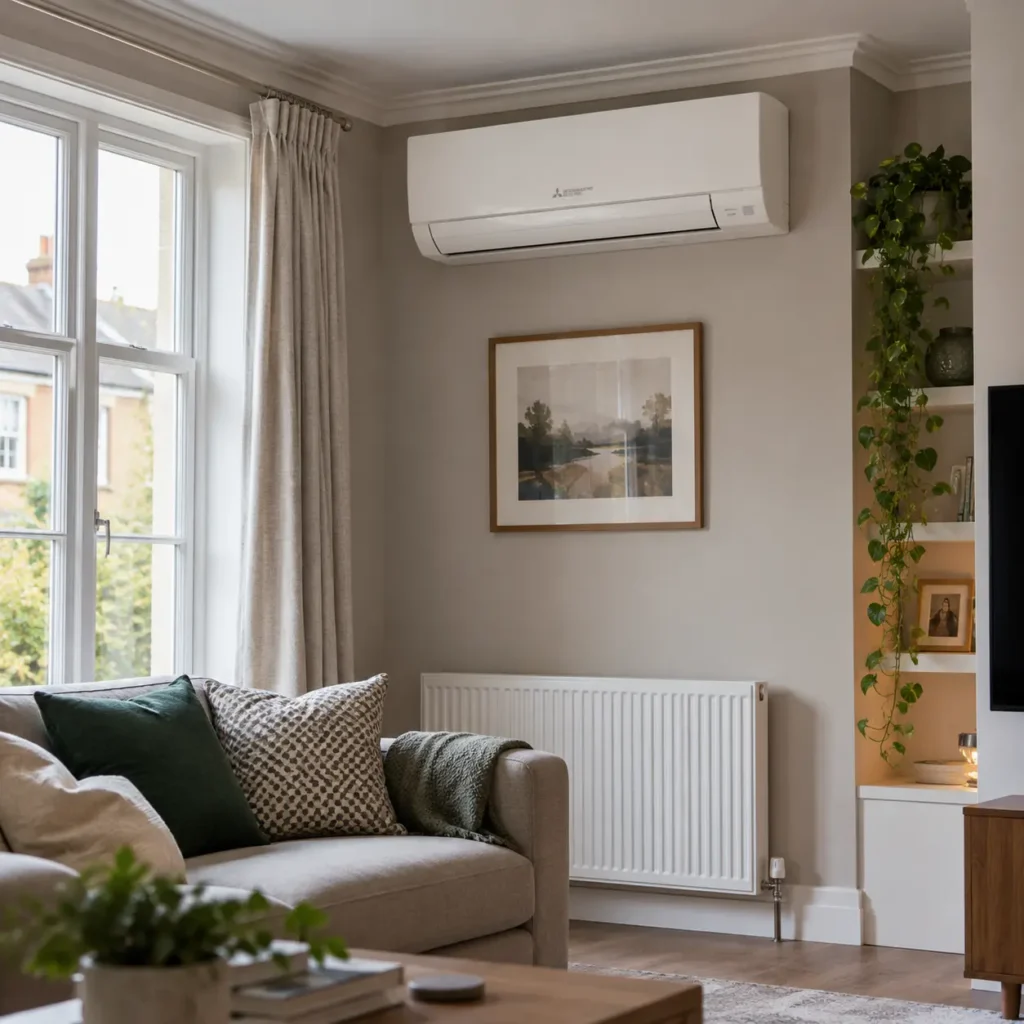
A wall-mounted split places the indoor fan coil high on the wall and delivers conditioned air directly into that room. A multi-split can connect several indoor units to one outdoor unit, within the manufacturer’s design limits.
A ducted system hides the indoor fan coil in a loft, ceiling void or service area and sends air through insulated ducts to grilles. It also needs a return-air path.
Energy Saving Trust’s air-to-air heat-pump guidance notes that ducted versions can be harder to retrofit into older or larger homes because the required ductwork may be difficult to accommodate.
Which is better for an existing UK home?
For a finished house or flat, wall-mounted air conditioning usually has the advantage.
The installer still needs routes for refrigerant pipework, electrics and condensate drainage, but the work is normally more contained. You usually avoid lowering ceilings or creating large boxed-in routes between rooms.
Wall-mounted systems are particularly practical for bedrooms, loft conversions, home offices, conservatories, garden rooms and open-plan living areas. They also work well when only one or two rooms overheat.
If several rooms need conditioning, compare individual splits with a multi-split arrangement. A multi-split may reduce the number of outdoor units, while separate systems can offer greater independence. The best design depends on pipe routes, simultaneous loads and manufacturer limits.
For broader options, see Get Free Quote’s UK air conditioning guide and air-conditioning installation guide.
When does ducted air conditioning make more sense?
Ducted air conditioning becomes more attractive when building work already gives you somewhere to hide it.
During a renovation, extension or new build, ceiling voids, bulkheads and service routes can be planned before plastering. That makes it easier to position supply grilles, return-air paths and access panels properly.
Ducted systems are especially worth considering when you want a discreet finish, several rooms need conditioning, you have usable loft or ceiling space, or visible wall units would conflict with the interior design.
However, “ducted” does not automatically mean “whole-house”. A concealed unit may serve one large room, several rooms or one floor. The design must suit the fan pressure, duct lengths, grille sizes and each room’s heating or cooling load.
A hybrid layout can also work well: ducted downstairs during a major refurbishment, with wall-mounted units upstairs where you want less disruption.
Costs, disruption and maintenance
Wall-mounted systems generally cost less because they need less ductwork and fewer building alterations.
Energy Saving Trust currently gives indicative air-to-air heat-pump costs of about £1,900 for one room and around £3,700 for a three-bedroom semi-detached home. Actual air-conditioning quotations can vary substantially with capacity, equipment, pipe runs, electrics and access.
Ducted installations are harder to price generically. Ductwork, grilles, controls, zoning, access panels, acoustic treatment and builders’ work can all increase the total.
| Issue | Wall-mounted | Ducted |
|---|---|---|
| Initial installation | Usually lower | Usually higher |
| Builders’ work | Often limited | Can be significant |
| Filter access | Usually direct from room | Via access panel or service area |
| Future alterations | Relatively flexible | More dependent on hidden duct layout |
Treat online figures as guides only. A survey is needed for an accurate quotation.
Which is more efficient to run?
Neither format wins automatically.
Wall-mounted systems can be economical when you condition only occupied rooms. Each indoor unit can usually operate as its own zone, so an unused bedroom does not need the same treatment as a living room.
A well-designed ducted system can also be efficient, particularly with effective zoning and short, insulated ducts. Poorly sealed or badly insulated ducts can waste useful heating or cooling. Badly sized ducts and grilles can also increase fan energy and noise.
When comparing quotes, ask for the proposed unit’s seasonal efficiency figures and an estimate based on your expected use. A strong brochure rating does not guarantee the lowest bill in your home.
Which is quieter and more discreet?
Ducted air conditioning is normally the winner for appearance because only grilles are visible. The main indoor fan is also away from the occupied room, which can reduce equipment noise.
That does not mean ducted is automatically silent. Poor duct design can create rushing air, whistling grilles or vibration. Larger grilles and lower air velocities often improve acoustic comfort.
Wall-mounted units keep the fan in the room, but modern premium models can operate very quietly at low fan speed. Placement matters too. The unit needs a clear airflow path without blowing directly onto beds, desks or seating.
Can either system heat the home as well as cool it?
Yes, if you choose a reversible air-to-air heat pump rather than cooling-only equipment.
This matters in 2026 because the Boiler Upgrade Scheme guidance on GOV.UK now includes a £2,500 grant category for eligible residential air-to-air heat pumps in England and Wales.
However, this is not an automatic £2,500 discount for installing a single-room air-conditioning unit. The funded system must meet the scheme’s technical and whole-property heating requirements.
There is also an important practical caveat. As of 16 October 2026, Energy Saving Trust states that MCS-certified air-to-air installers are not yet available and says homeowners will need to wait for the certification and eligible-system route to become usable.
If heating is a major reason for the project, read Get Free Quote’s guide to Boiler Upgrade Scheme qualifying heating systems and BUS application guide before assuming a grant will apply.
How to choose between wall-mounted and ducted air conditioning
Decide how many rooms need conditioning. One or two problem rooms usually favour wall-mounted units.
Check the available space. Assess wall positions, outdoor-unit locations, drainage routes, loft space and ceiling voids.
Set your appearance priority. If visible indoor units are unacceptable, ducted may justify the extra work.
Plan zoning. Ask how each room will be controlled and what happens when only one zone calls for heating or cooling.
Compare whole-project cost. Include electrical work, builders’ work, decoration and access panels.
Plan maintenance access. Filters, drains, fans and concealed components must remain serviceable.
Check installer competence. GOV.UK’s F-gas qualification guidance states that people working on stationary air-conditioning equipment containing F-gas need the appropriate qualifications. Relevant businesses also need the required company F-gas certification.
Check property restrictions. External units, flats, listed buildings, conservation areas and leasehold properties may need additional checks. Planning rules also differ across the UK.
Get Your Free Air Source Heat Pump Quote
Find the right air source heat pump solution for your home. Tell us a few details and our team will help you explore suitable options at a competitive price.
Quick to complete. No obligation.
Get your quote
Enter your details below and one of our team will get back to you.
Frequently asked questions
Find clear answers to common questions comparing air source and ground source heat pumps, including efficiency, installation and running costs, winter performance, noise, land requirements and borehole depth.
Wall-mounted air conditioning is usually cheaper to install. Ducted systems require concealed indoor equipment, ductwork, grilles and often more building work.
Wall-mounted systems are normally easier to retrofit into a finished house because they need much less hidden space and structural alteration.
Yes, but several indoor units may be required. These can use separate outdoor units or, where suitable, a multi-split system connected to one outdoor unit.
Sometimes. A loft, service void, cupboard or purpose-built bulkhead may provide enough space. Without a suitable route for ducts, installation becomes considerably more difficult.
Not automatically. Efficiency depends on equipment performance, system sizing, duct insulation, zoning, temperature settings and how the system is used.
A well-designed ducted system can be quieter inside the room because the main fan unit is concealed. Poor duct or grille design can still create airflow noise.
Many modern wall-mounted systems are reversible air-to-air heat pumps and can provide both heating and cooling.
Yes. Reversible ducted air-to-air systems can distribute heated or cooled air through the same duct network.
Standard split and most residential ducted air-conditioning systems mainly recirculate indoor air. They do not replace proper ventilation unless a separate fresh-air system has been designed into the installation.
Wall-mounted units generally provide easier access to filters and indoor components. Ducted systems need suitable access panels for the concealed equipment.
Often, yes, provided there is enough space for the equipment, ductwork, drainage, insulation and safe servicing access. The proposed equipment must also be suitable for that location.
Yes. A hybrid design can make sense where one part of a property is being renovated while other rooms need a simpler retrofit solution.
It depends on the equipment, property and location. External units, flats, listed buildings and properties in protected areas deserve particular attention. Planning frameworks also differ between England, Wales, Scotland and Northern Ireland.
Where the equipment contains F-gas and the work involves the refrigerant circuit, the engineer must hold the appropriate qualification. Companies carrying out relevant installation or servicing work also require certification.
The 2026 scheme includes a £2,500 category for eligible residential air-to-air heat pumps in England and Wales, but it is not a grant for any ordinary single-room air-conditioning installation. The system must meet BUS requirements. Energy Saving Trust also reported on 16 October 2026 that the required MCS-certified air-to-air installer route was not yet available.
Wall-mounted vs ducted air conditioning: the verdict
For most existing UK homes, wall-mounted air conditioning is the sensible default. It is flexible, comparatively straightforward to retrofit and ideal for solving overheating in specific rooms.
Ducted air conditioning is usually stronger when you are renovating or building and want multi-room comfort with minimal visible equipment. It can produce an excellent result, but only when the property has enough space for ductwork and the airflow, access and zoning are designed from the start.
Compare like-for-like designs rather than unit prices alone. Get Free Quote can help you compare free, no-obligation quotations and understand what each installer has included.