Best Air Conditioning Units UK 2026: 5 Top Choices
Check Your Eligibility for Boiler Upgrade Scheme (BUS)
Complete your details below to check your eligibility.
Thank you
We've received your details and will be in touch shortly.
Quick Answer: What Is the Best Air Conditioning Unit in the UK?
For most UK homes, the Mitsubishi Electric MSZ-AY is an excellent all-round choice because it combines very low noise, strong seasonal efficiency and smart controls. Daikin Perfera is a strong premium alternative where efficiency and year-round heating matter. Panasonic Etherea stands out for efficiency and air-quality features, while Samsung WindFree Comfort S2 is attractive if you dislike direct cold draughts. Toshiba Seiya S4 is a sensible value-focused option.
The best unit still depends on correct sizing. A high-specification system badly matched to its room can be a poorer choice than a simpler unit selected using an appropriate heat-load calculation.
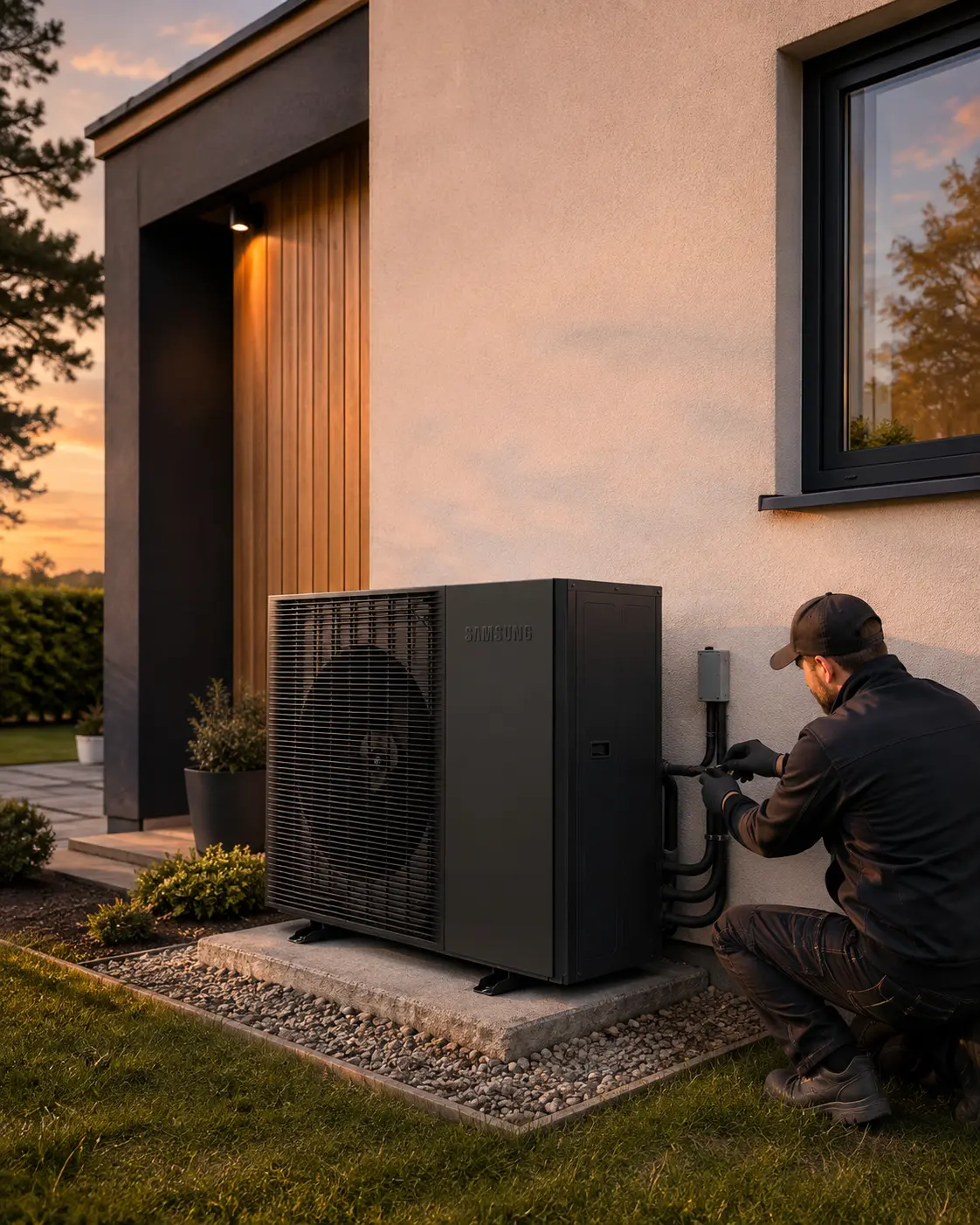
ondenser connected by insulated refrigerant pipework and electrical cabling. A survey should determine the cooling load, suitable unit size, drainage route, outdoor-unit position and electrical requirements.
Current UK estimates put a professionally installed single-room split system at roughly £1,600–£2,300 in many straightforward cases, although specification and installation complexity can push the price higher. Energy Saving Trust gives a typical figure of about £1,900 for a one-room air-to-air heat pump. Checkatrade
Work involving fluorinated refrigerant must be completed by appropriately qualified personnel. GOV.UK
After understanding the system you need, you can compare home-improvement quotes through Get Free Quote.
Best Air Conditioning Units UK: 2026 Buyer’s Guide
Choosing the best air conditioning units UK homeowners can buy is less about finding one universal winner and more about matching a proven system to your room, budget and priorities.
For most homeowners who can install a permanent system, a modern wall-mounted split air conditioner is the strongest choice. It is normally quieter and more efficient for regular cooling than a portable unit. Most current fixed systems can also reverse their operating cycle to heat a room in winter.
The models worth shortlisting in 2026 come from established manufacturers such as Mitsubishi Electric, Daikin, Panasonic, Samsung and Toshiba. This guide compares five leading fixed systems and explains what actually matters before you buy.
Ready to compare suitable systems? Compare free, no-obligation quotes for your property.
Best Air Conditioning Units UK: Quick Comparison
| Unit | Best for | Cooling range | Lowest quoted indoor sound | Standout point |
|---|---|---|---|---|
| Mitsubishi Electric MSZ-AY | Best all-rounder | 2.5–5.0 kW | 18 dB(A) on smaller models | Quiet, efficient M Series option |
| Daikin Perfera | Premium comfort | Up to 7.1 kW | 19 dB(A) | Up to A+++ heating and cooling |
| Panasonic Etherea | Efficiency and air quality | 2.0–7.1 kW | 19 dB(A) | A+++ models, nanoe X and Wi-Fi |
| Samsung WindFree Comfort S2 | Draught-sensitive rooms | 2.5–6.8 kW | 16 dB(A) on 2.5 kW model | WindFree low-velocity cooling |
| Toshiba Seiya S4 | Strong value | Varies by pairing | 19 dB(A) | A++ cooling and heating |
Specifications vary by capacity and indoor/outdoor pairing. Always compare the exact model on your quotation rather than assuming every size achieves the manufacturer’s headline specification.
1. Mitsubishi Electric MSZ-AY: Best All-Round Choice
The Mitsubishi Electric MSZ-AY would be our first shortlist option for a typical bedroom, office or living room. Mitsubishi Electric positions the range as a wall-mounted inverter heat-pump system using R32 refrigerant, with modern controls and a broad residential application. See Mitsubishi Electric’s current home air-conditioning range
Its strongest case is balance. Smaller MSZ-AY models can operate at very low indoor sound levels, while selected configurations achieve A+++ cooling performance.
Best for: homeowners wanting a quiet, premium-leaning all-rounder without paying mainly for designer styling.
2. Daikin Perfera: Best Premium Comfort Choice
Daikin Perfera is a strong option for buyers who expect to use their system throughout the year. Daikin quotes sound pressure down to 19 dB(A), cooling capacities up to 7.1 kW and energy labels up to A+++ for heating and cooling, depending on the system configuration. Review Daikin’s Perfera specifications
Because Perfera is a reversible air-to-air heat pump, it can provide room heating as well as summer cooling.
Best for: bedrooms and living spaces where low noise, seasonal efficiency and year-round comfort matter.
3. Panasonic Etherea: Best for Efficiency and Air-Quality Features
Panasonic Etherea combines low noise with strong seasonal performance. Panasonic’s current UK range includes capacities from around 2.0 kW upwards, selected A+++ models, operation down to 19 dB(A), built-in Wi-Fi and nanoe X technology. View Panasonic Etherea’s UK specifications
For a current 2.5 kW pairing, Panasonic publishes a SEER of 9.50 and SCOP of 5.20. These seasonal figures provide a more useful comparison than judging efficiency at only one operating point.
Best for: buyers who value efficient heating and cooling, app control and additional air-treatment features.
4. Samsung WindFree Comfort S2: Best for Avoiding Cold Draughts
Samsung WindFree Comfort S2 takes a distinctive approach to airflow. After the room has cooled, WindFree mode distributes conditioned air through thousands of small openings rather than relying only on a strong direct jet. See Samsung’s WindFree Comfort S2 range
Samsung’s 2.5 kW UK model is rated A++ for cooling and heating and has a quoted low indoor sound level of 16 dB(A).
Best for: bedrooms, lounges or home offices where people may sit or sleep in the normal airflow path.
5. Toshiba Seiya S4: Best Value-Focused Established Brand
Toshiba Seiya S4 suits buyers who want a recognised manufacturer without moving into the most design-led premium ranges.
Toshiba lists A++ performance for both cooling and heating and quiet operation down to 19 dB(A). It also includes practical functions such as self-cleaning and motorised airflow control. Explore Toshiba Seiya S4 specifications
Best for: bedrooms, offices and garden rooms where quiet, efficient cooling matters more than premium styling.
How to Choose the Right Air Conditioning Unit
Start With the Cooling Load
Room area is only a starting point. Glazing, roof exposure, insulation, orientation, occupancy and electrical equipment all affect the amount of heat your system needs to remove.
A south-facing loft room, for example, may require more cooling capacity than a larger but well-shaded bedroom.
Use a proper air-conditioning sizing assessment before deciding between common capacities such as 2.0, 2.5, 3.5 or 5.0 kW.
Compare Noise and Seasonal Efficiency
For bedrooms, check the lowest indoor sound-pressure figure rather than relying on a vague “quiet” claim. Several leading residential systems publish minimum figures around 18–20 dB(A) on suitable smaller models.
Also compare SEER, which measures seasonal cooling efficiency, and SCOP, which measures seasonal heating efficiency. Higher figures generally indicate more heating or cooling output relative to electricity consumption across the relevant season.
Choose the Right System Layout
A single split connects one indoor unit to one outdoor unit. A multi-split connects several indoor units to one outdoor unit.
Multi-split systems can reduce the number of external condensers, although correct design becomes increasingly important as more rooms are added. If you need several rooms conditioned, compare single-split and multi-split air conditioning rather than assuming one arrangement will always be cheaper or more efficient.
Portable air conditioners still have a place for renters, temporary cooling and rooms where an external condenser is impractical. For regular cooling, however, a fixed split is normally the stronger long-term solution. Our portable versus split air-conditioning guide examines that decision in more detail.
How Does a Split Air Conditioner Work?
A split air conditioner moves heat rather than “making cold”.
Refrigerant absorbs heat from room air at the indoor evaporator. The compressor raises the refrigerant’s pressure and temperature. The outdoor condenser then releases the absorbed heat outside. An expansion device lowers the refrigerant pressure so the cycle can begin again.
Most modern domestic split systems are reversible air-to-air heat pumps. In heating mode, the refrigeration cycle reverses. The system extracts heat from outdoor air and releases it inside.
During cold, damp weather, a system operating in heating mode may periodically run a defrost cycle to clear ice from the outdoor coil.
Which Air Conditioner Is Best for Your Situation?
| Buyer or room | Strong shortlist | Why |
|---|---|---|
| Bedroom | Mitsubishi Electric MSZ-AY / Panasonic Etherea | Very low quoted indoor noise |
| Premium living room | Daikin Perfera | Strong efficiency and comfort features |
| Draught-sensitive user | Samsung WindFree Comfort S2 | Low-velocity WindFree mode |
| Value-focused homeowner | Toshiba Seiya S4 | Quiet operation and A++ performance |
| Several rooms | Multi-split from a major brand | Fewer outdoor units |
How Much Does Home Air Conditioning Cost in the UK?
As a planning figure, current 2026 UK installer guides commonly place a professionally fitted 2.5–3.5 kW single-split system at roughly £1,500–£3,000. Premium designer units, longer pipe runs, difficult access, electrical upgrades and multi-room systems can push the price higher.
Treat these figures as budgeting ranges rather than quotations. A survey may be necessary to confirm the system size, pipe route, condensate drainage, electrical work and outdoor-unit position.
Running costs also depend on the exact model, room heat load, thermostat setting, electricity tariff and hours of operation.
Planning, Installation and F-Gas Rules
In England, some reversible domestic air-to-air heat-pump installations can fall under permitted development when every relevant condition is met. Current Planning Portal guidance says qualifying equipment must not be used solely for cooling and includes requirements covering system size, siting, protected properties and the applicable MCS planning standard. Rules elsewhere in the UK can differ. Check current Planning Portal guidance before installation
Refrigerant work is regulated separately. GOV.UK states that people installing, servicing, maintaining, leak-checking or recovering F-gas from stationary air-conditioning systems must hold the appropriate qualification. Businesses carrying out relevant F-gas work for others also require company certification. Read the current GOV.UK F-gas qualification guidance
Before commissioning work, understand what is included in your air-conditioning installation quote and check the proposed equipment, electrical work, drainage, controls and commissioning arrangements.
Get Your Free Air Source Heat Pump Quote
Find the right air source heat pump solution for your home. Tell us a few details and our team will help you explore suitable options at a competitive price.
Quick to complete. No obligation.
Get your quote
Enter your details below and one of our team will get back to you.
Frequently asked questions
Find clear answers to common questions comparing air source and ground source heat pumps, including efficiency, installation and running costs, winter performance, noise, land requirements and borehole depth.
There is no universal winner, but Mitsubishi Electric MSZ-AY, Daikin Perfera and Panasonic Etherea are strong starting points for many UK homes. The right choice depends on room sizing, noise requirements, features and budget.
Prioritise low indoor noise and gentle airflow. Mitsubishi Electric MSZ-AY and Panasonic Etherea are particularly strong candidates because smaller models publish very low minimum sound levels.
For regular use, usually yes. Fixed split systems are generally quieter and more efficient because the compressor and heat-rejection equipment sit outside. Portable units remain useful where permanent installation is not practical.
Do not choose capacity from floor area alone. Windows, solar gain, insulation, roof exposure, occupancy and equipment all affect cooling load. A heat-load calculation provides a more reliable answer.
It can be, but room size alone cannot confirm this. A highly glazed, south-facing or poorly insulated bedroom may need more capacity than another room with the same floor area.
Most modern fixed residential split systems are reversible air-to-air heat pumps, so they can both cool and heat.
SEER measures seasonal cooling efficiency. SCOP measures seasonal heating efficiency. They are useful when comparing how efficiently different systems perform across a season.
Several premium residential systems publish minimum indoor figures around 18–20 dB(A), with certain current Samsung configurations quoted even lower. Compare like-for-like capacities and fan settings rather than brand claims alone.
Neither manufacturer is automatically better for every property. Compare the exact Daikin and Mitsubishi Electric models that match your required capacity, then consider sound, efficiency, controls, appearance and installed price.
Yes. Etherea is particularly competitive where seasonal efficiency, quiet operation, built-in Wi-Fi and Panasonic's air-treatment features are priorities.
Its main distinction is airflow comfort. WindFree mode distributes conditioned air through many small openings to reduce the sensation of a direct cold draught.
A single split is often simplest for one room. Multi-split systems become attractive when several rooms require heating and cooling but you want fewer outdoor units.
It depends on the system, property and location. In England, some reversible air-to-air heat-pump installations may qualify as permitted development when all applicable conditions are met. Check current rules before installation.
Anyone carrying out regulated refrigerant work on equipment containing F-gas must hold the appropriate qualification. Relevant companies working on equipment for others also require certification.
A useful 2026 planning range for a straightforward professionally installed 2.5–3.5 kW single split is roughly £1,500–£3,000. The actual quote depends on equipment, property layout and installation complexity.
Final Recommendation
For most UK homeowners, start by comparing Mitsubishi Electric MSZ-AY, Daikin Perfera and Panasonic Etherea in the capacity your room actually requires.
Add Samsung WindFree Comfort S2 if gentle airflow is a priority, and Toshiba Seiya S4 if you want a simpler value-focused system.
Do not choose from brand reputation alone. Get the room load right, compare the exact model’s sound and seasonal-efficiency figures, confirm warranty conditions and make sure the quotation covers the complete installation.
If you are ready to move from a shortlist to real prices, compare free quotes for a correctly sized system and ask each installer to explain why the proposed unit suits your property.