Solar Panels on a Barn Roof: UK Guide 2026
Check Your Eligibility for Boiler Upgrade Scheme (BUS)
Complete your details below to check your eligibility.
Thank you
We've received your details and will be in touch shortly.
Quick answer: can you put solar panels on a barn roof?
Yes. Solar panels can be installed on many UK barn roofs if the building can safely carry the additional loads and the installation meets planning, electrical and access requirements.
Modern steel-framed barns with sound profiled-metal roofs can be particularly suitable. Older timber, fibre-cement or asbestos-cement roofs require more investigation.
Before installation, a survey should consider structural condition, roof covering, fixings, corrosion, orientation, shading, safe access, cable routes and electrical infrastructure. On farms, system size should normally reflect daytime electricity use and the available grid connection rather than simply the maximum number of panels that will fit.
Solar Panels on a Barn Roof: UK Guide to Suitability, Planning and Installation
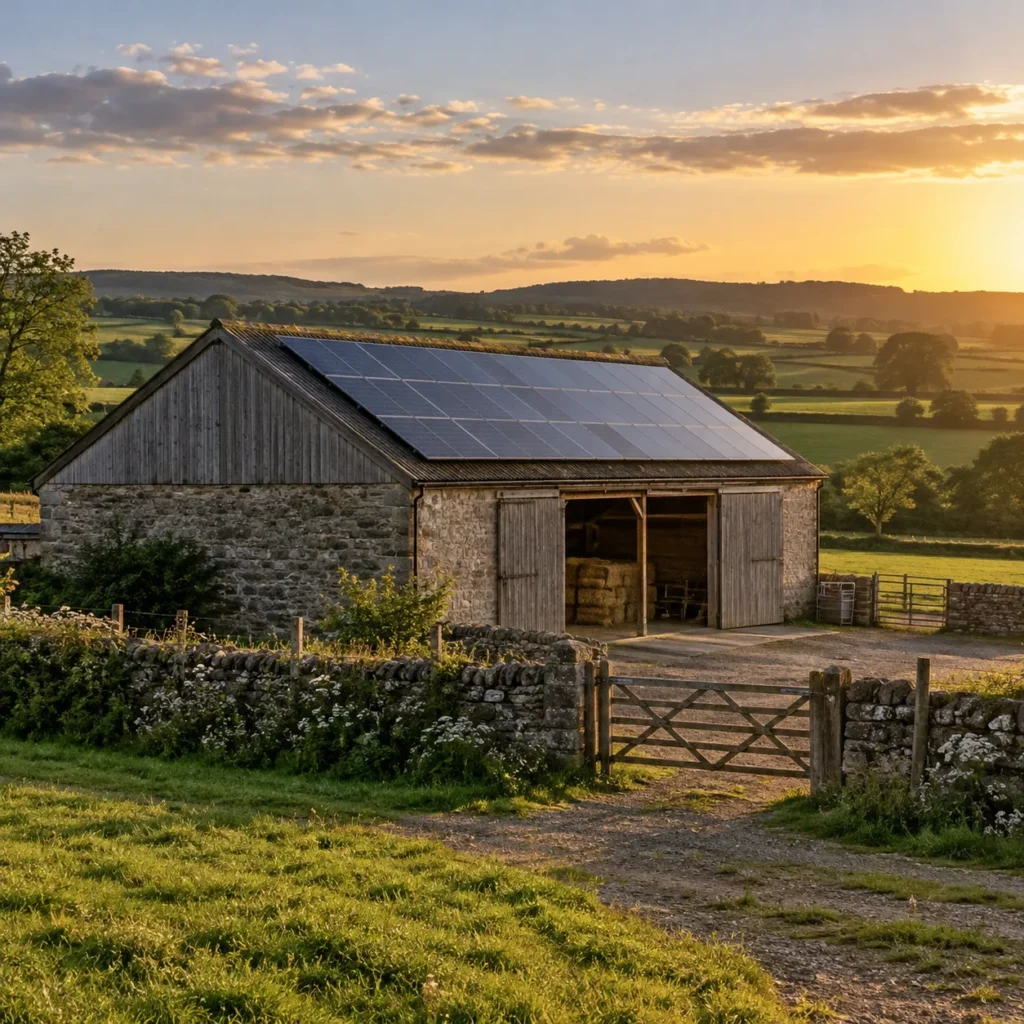
Putting solar panels on a barn roof can be one of the most practical ways to generate electricity on a farm, smallholding or rural property. Barns often provide large, relatively unobstructed roof areas. They also let you generate electricity without using productive land for a ground-mounted solar array.
However, a large roof does not automatically make a good solar roof. The structure, roof covering, orientation, shading, electrical supply, grid connection and planning position all need checking. Older agricultural buildings may also have fragile fibre-cement sheets, asbestos-containing materials, corroded purlins or ageing roof lights.
This guide explains what to check before installing solar panels on a barn roof, how planning and grid rules can affect the project, and when roof repairs or replacement should come first.
If you are at an early stage, Get Free Quote can help you compare suitable options once the building and electricity requirements are understood.
Barn roof suitability at a glance
| Barn roof | Solar suitability | Main checks |
|---|---|---|
| Modern profiled metal | Often very good | Structure, fixings, corrosion and wind loading |
| Standing-seam metal | Often very good | Compatible clamps, seam condition and structure |
| Older fibre cement | Case by case | Fragility, asbestos, purlins and remaining roof life |
| Tile or slate | Often suitable | Rafters, fixings and weatherproofing |
| Flat or low-pitch roof | Often suitable | Mounting, drainage, wind loading and setbacks |
| Roof needing major repairs | Usually repair first | Compare reroofing now with removing solar later |
Is a barn roof suitable for solar panels?
The first question is structural rather than electrical.
A solar array adds permanent load to a building and changes the forces created by wind. The mounting system must transfer those loads safely into the purlins, rafters, portal frame or other supporting structure.
On older agricultural buildings, years of corrosion, timber decay, water ingress or previous alterations can reduce the structure’s capacity. Long roof spans and lightweight coverings also mean assumptions based on ordinary domestic roofs are not appropriate.
A competent survey should establish the roof construction and identify signs of movement, damage or deterioration. Current MCS solar requirements refer installers to recognised structural and electrical design standards, and unusual structures may require input from a structural engineer. Read the current MCS MIS 3002 Solar PV standard
Check the remaining life of the roof
Solar panels can remain in use for many years. Installing them over a roof already approaching replacement can therefore create avoidable expense.
Corroded sheets, failed fixings, persistent leaks or deteriorated supporting members should be addressed before the array covers them. Otherwise, future roof work may require panels and mounting equipment to be removed and subsequently reinstalled.
If major work is already likely, compare reroofing first with the future cost of dismantling the solar system. The guide to whether you need a new roof before installing solar panels explains this decision in more detail.
What if the barn has asbestos or a fragile roof?
This is a particularly important consideration on agricultural buildings.
The Health and Safety Executive says most fibre-cement agricultural roofs should be treated as fragile. Roof lights are often fragile as well. HSE also notes that farms commonly contain asbestos-containing materials, including asbestos-cement roof sheets. HSE guidance on fragile agricultural roofs
Never assume an old corrugated roof is safe to walk on because it looks sound from ground level.
Where asbestos may be present, its type and condition should be established before work begins. HSE advises checking existing asbestos information and, in many circumstances, arranging assessment by a competent asbestos surveyor.
Some projects can proceed safely with the existing roof. In others, replacement before solar will make more sense. The correct decision depends on condition, structural capacity, safe working requirements and expected remaining roof life.
Does roof direction, pitch or shading matter?
Yes, although a barn does not need a perfect south-facing roof to make solar worthwhile.
South-facing panels normally maximise annual generation. East- and west-facing arrays can still generate substantial electricity and can spread production across more of the working day.
That can be useful on farms where machinery, cooling, ventilation or other loads operate throughout daylight hours.
Shading may matter more than orientation. Trees, grain silos, neighbouring sheds, vents and other structures can reduce output, so the layout should prioritise the least-shaded roof areas.
Energy Saving Trust also notes that east- and west-facing solar can remain productive, while significant shading can materially affect generation. Energy Saving Trust rooftop solar guidance
How many solar panels should go on a barn roof?
Do not size the installation from roof area alone.
For many farms, the highest-value solar electricity is the power consumed on site because it replaces electricity that would otherwise be purchased from the grid.
Dairy equipment, refrigeration, poultry ventilation, workshops, packing equipment, irrigation and grain-handling systems can all create useful daytime demand.
Start with recent bills and, where available, half-hourly electricity data. Compare consumption with the proposed solar-generation profile.
A barn might physically accommodate a very large array, yet a smaller system could offer better economics if daytime consumption is modest or the local network imposes a restrictive export limit. Future loads such as EV charging, additional refrigeration or electrified machinery should also be considered.
For broader system sizing, pricing and payback, see the dedicated solar panels for farms UK guide rather than duplicating those calculations here. The existing farm guide correctly focuses on matching system size to actual demand rather than roof area alone.
Do you need planning permission for solar panels on a barn roof?
Planning rules differ across England, Scotland, Wales and Northern Ireland, so the relevant national rules and local restrictions must be checked.
In England, solar on a non-domestic building can qualify as permitted development under Part 14, Class J.
Current Class J rules include a maximum projection of 0.2 metres beyond the plane of a pitched roof, a maximum height of 1 metre above the highest part of a flat roof and a requirement to keep equipment at least 1 metre from the external roof edge. Listed buildings, buildings within the curtilage of a listed building and scheduled monuments are excluded. Read the current Class J legislation
Larger installations also need closer attention.
UK legislation defines electrical microgeneration at up to 50kW. Class J(c), covering other rooftop solar rather than microgeneration, requires the developer to go through the prior-approval procedure covering design, external appearance and particularly glare. The procedure includes a 56-day determination period.
Therefore, check the planning position before ordering equipment, particularly for large arrays or heritage sites.
What are the DNO and grid-connection requirements?
A grid-connected solar installation operates in parallel with the public electricity network, so the local Distribution Network Operator, or DNO, needs to be considered.
Under Energy Networks Association guidance, G98 microgeneration is limited to 16A per phase. This corresponds to 3.68kW on single phase or 11.04kW across a three-phase supply. Larger installations generally follow the G99 connection process. Energy Networks Association distributed-generation guidance
Most substantial barn installations exceed domestic-scale G98 limits.
The DNO may accept the proposed export capacity, impose an export limitation or identify network reinforcement requirements. This can influence both system design and project cost.
Grid enquiries should therefore happen early rather than after the array has been fully designed.
How much do solar panels on a barn roof cost?
There is no dependable fixed price for a barn installation.
Cost depends on system capacity, equipment specification, mounting method, building height, access, structural work, roof repairs, asbestos management, cable routes, switchgear, metering and DNO requirements.
For that reason, compare like-for-like scopes rather than headline prices.
A lower quotation may exclude roof repairs, access equipment, structural work, grid applications or electrical upgrades. Conversely, a structurally sound barn with straightforward access can make installation considerably simpler.
A detailed solar panel installation survey should turn early estimates into a site-specific design by checking the roof, layout, access and electrical arrangements.
What happens during a barn solar installation?
A well-planned project normally follows this sequence:
Review existing and future electricity demand.
Inspect the roof and supporting structure.
Confirm the roof covering, asbestos risk and safe access.
Model shading and expected solar generation.
Produce the panel layout and electrical design.
Check planning or prior-approval requirements.
Complete the appropriate DNO process.
Finalise the installation specification and quotation.
Install the mounting system, panels, inverter and electrical equipment.
Test, commission and hand over the installation.
The final design should follow the survey rather than the other way round.
Get Your Free Air Source Heat Pump Quote
Find the right air source heat pump solution for your home. Tell us a few details and our team will help you explore suitable options at a competitive price.
Quick to complete. No obligation.
Get your quote
Enter your details below and one of our team will get back to you.
Frequently asked questions
Find clear answers to common questions about solar panels on agricultural barns, including structural surveys, corrugated and asbestos-cement roofs, roof orientation, planning permission, DNO connections, export limits, Smart Export Guarantee payments, batteries and comparing installation quotes.
Yes. Many agricultural barns can support rooftop solar, subject to structural, electrical, planning and access checks. Modern steel-framed buildings with sound roofs are often particularly suitable.
A structural assessment is advisable where the building's capacity is not already clear. Older frames, long spans, corrosion, timber decay or unusual construction can make more detailed engineering checks necessary.
Yes. Profiled-metal agricultural roofs are commonly suitable for solar when the sheets, fixings and supporting structure are in good condition and an appropriate mounting system is used.
Potentially, but asbestos and fragility must be properly assessed first. Depending on condition and remaining life, replacement before installing solar may be the better option.
No. South-facing roofs usually maximise annual output, but east- and west-facing roofs can still perform well and may better match electricity demand at different times of day.
Yes, where orientation, shading and structural conditions are suitable. Using both roof slopes can spread generation across the day.
It depends on usable roof area, panel dimensions, setbacks, shading and structural capacity. The economically sensible number may also be limited by electricity demand or grid-export capacity.
Not always. In England, qualifying non-domestic rooftop solar can fall under Class J permitted-development rights, but restrictions and prior-approval requirements apply. Scotland, Wales and Northern Ireland have separate planning systems.
Systems above the electrical microgeneration threshold fall into the “other solar PV” category under Class J. That category uses a prior-approval process concerning design, appearance and glare.
Most substantial farm installations require engagement with the local DNO. Systems beyond G98 limits generally follow the G99 connection process.
Yes. Network capacity can result in an export limit or, in some cases, required reinforcement. An export-limitation system may allow a larger generation system while restricting power sent to the network, subject to DNO acceptance.
Eligible generators in Great Britain can receive payments through the Smart Export Guarantee. Ofgem states that eligible renewable installations can participate up to 5MW, subject to scheme requirements.
Often yes if the roof is already nearing the end of its useful life. Replacing it first can avoid paying to remove and reinstall the array when reroofing becomes necessary.
No. A battery may help where generation and consumption occur at different times, but farms with strong daytime electricity demand may already consume a high proportion of their solar generation directly.
Compare the proposed generation, structural scope, mounting system, roof works, access arrangements, inverter design, DNO work, monitoring, warranties and commissioning requirements—not simply the total price.
Are solar panels on a barn roof worth it?
They can be particularly attractive when the barn has a sound roof and the property consumes significant electricity during daylight hours.
The strongest projects normally combine four things:
plenty of remaining roof life
a straightforward structural solution
strong on-site use of solar electricity
an acceptable grid-connection route
Projects become less attractive when expensive roof replacement, asbestos work, structural strengthening or grid reinforcement emerges late in the process.
Assess those risks before comparing headline payback figures.
Once the roof, electricity demand and DNO position are understood, you can compare solar panel quotes on a much more meaningful like-for-like basis.