How Does an Air Source Heat Pump Work? UK Home Guide
August 14, 2026
Check Your Eligibility for Boiler Upgrade Scheme (BUS)
Complete your details below to check your eligibility.
Thank you
We've received your details and will be in touch shortly.
Quick Answer: How Does an Air Source Heat Pump Heat a House?
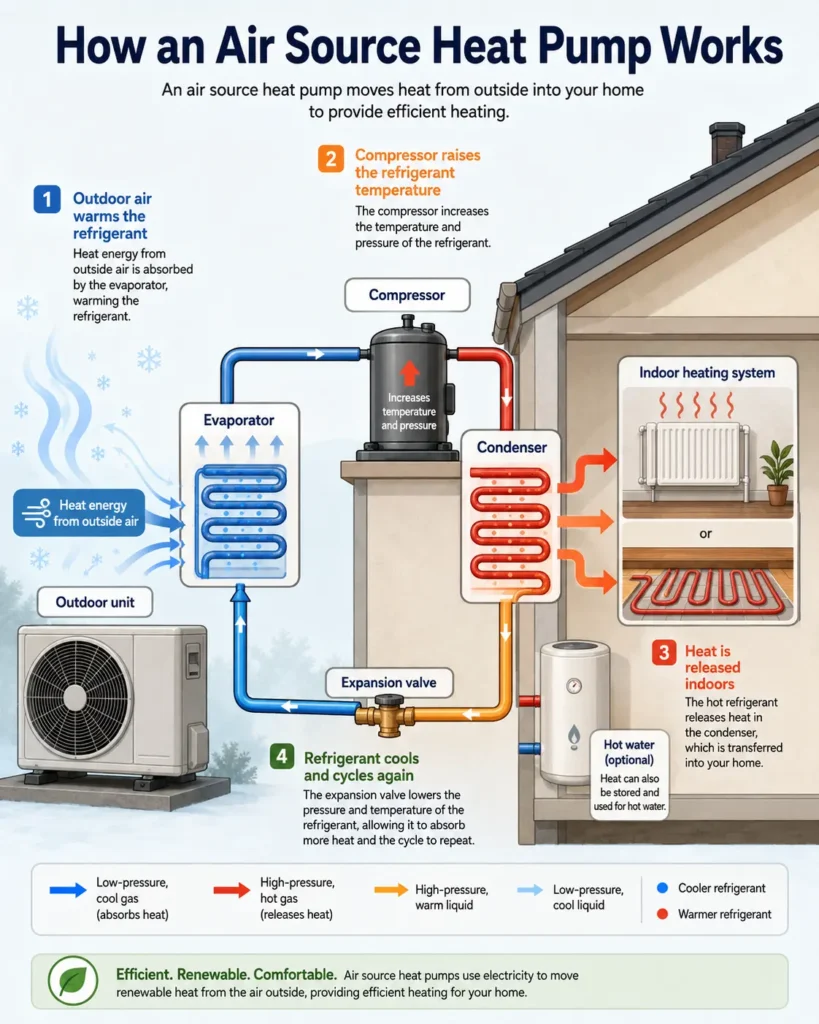
An air source heat pump does not blow outdoor air into your home. Its outdoor unit draws air across a heat exchanger containing refrigerant. The refrigerant absorbs heat, and an electrically powered compressor raises its temperature. In an air-to-water system, that heat is transferred into water, which circulates through radiators or underfloor heating.
Your rooms are warmed by these heat emitters, while a separate cylinder normally stores hot water for taps and showers. Because the system moves existing heat rather than creating all its heat from electricity, a well-designed heat pump can deliver several units of useful heat for each unit of electricity used.
Source: https://energysavingtrust.org.uk/advice/air-source-heat-pumps/
How Does an Air Source Heat Pump Work to Heat Your Home?
An air source heat pump heats your home by taking low-temperature heat from the outdoor air, raising its temperature and transferring that energy into your central-heating system. In most UK homes, it warms water for radiators or underfloor heating and can also heat water stored in a cylinder for showers and taps.
Unlike a gas boiler, which typically sends very hot water around the system in shorter bursts, a heat pump is usually more efficient when it delivers gentler heat for longer. This guide focuses on the journey from the outdoor unit to the rooms in your home.
For the deeper refrigeration-cycle explanation, read how air source heat pumps work. For a broader buyer overview, see air source heat pump explained.
Considering a heat pump? Get a free quote based on your property and heating needs.
Air Source Heat Pump vs Gas Boiler: What Feels Different?
| Feature | Air source heat pump | Typical gas boiler |
|---|---|---|
| Heat source | Moves heat from outdoor air | Burns gas |
| Radiators | Usually warm for longer | Often hotter for shorter periods |
| Heating style | Steady, long-running heat | Faster bursts of heat |
| Hot water | Usually stored in a cylinder | Cylinder or instant combi hot water |
| Best efficiency | Lower flow temperatures and good design | Depends on boiler and controls |
How an Air Source Heat Pump Heats Your Home Step by Step
1. The outdoor unit collects heat
A fan draws outside air across a heat exchanger. Refrigerant inside is colder than the outdoor air, allowing it to absorb thermal energy even in cold weather.
2. The compressor raises the temperature
The refrigerant becomes a vapour and enters an electrically powered compressor. Compression increases its pressure and temperature, turning low-temperature outdoor heat into useful heating energy.
3. Heat transfers into your heating water
In an air-to-water system, the hot refrigerant passes through another heat exchanger and transfers energy into the water circulating around your heating system. The refrigerant then cools and repeats the cycle.
4. Warm water reaches your rooms
A circulation pump moves the heated water through radiators or underfloor heating. These emitters release heat into each room. The outdoor air itself never travels through your radiators.
5. Controls maintain comfort
Heat pumps generally work best by replacing the heat your home is losing instead of repeatedly allowing it to cool and reheating it quickly. Weather-compensating controls can lower the water temperature in mild weather and raise it when outdoor temperatures fall.
Why Do Heat-Pump Radiators Feel Less Hot?
Energy Saving Trust says heat pumps commonly send water to radiators at around 35–45°C, although the correct temperature is property-specific. A boiler may have been running the same radiators considerably hotter.
A heat-pump radiator can therefore feel warm rather than scorching and still heat the room effectively because it operates for longer.
If a radiator cannot replace the heat a room loses at the proposed flow temperature, it may need to be replaced by a larger or higher-output model. That is why every room should be assessed separately.
How Does an Air Source Heat Pump Heat Hot Water?
Most air-to-water heat pumps also provide domestic hot water, usually through an insulated cylinder rather than instantaneously like a combi boiler.
When the cylinder needs reheating, many systems temporarily direct the heat pump’s output towards hot water. Once the required temperature is reached, the system returns to space heating. A correctly sized installation accounts for this normal operating pattern.
Stored hot-water systems also use a periodic high-temperature sterilisation cycle. Energy Saving Trust notes that cylinders should regularly reach more than 60°C for Legionella protection.
Does an Air Source Heat Pump Work in Winter?
Yes. Cold air still contains thermal energy, so suitable air source heat pumps continue operating below freezing.
Efficiency generally falls as outdoor temperatures drop because the system has to work harder to raise the temperature of the available heat. Frost may also form on the outdoor coil, so the unit occasionally runs a defrost cycle. Water, mist or vapour around the outdoor unit during defrost can be normal.
The key question is whether the selected model can meet your home’s calculated heat loss at the expected local winter design temperature.
Radiators or Underfloor Heating: Which Works Best?
Both can work well.
Underfloor heating suits heat pumps because its large surface area can release useful heat using relatively low water temperatures. Radiators are also common in retrofit installations.
Existing radiators do not automatically need replacing. A good design may keep suitable radiators, upgrade only the undersized ones and aim for the lowest practical flow temperature that still heats every room comfortably.
How to Know Whether Your Home Is Suitable
Before comparing heat-pump brands:
- Calculate room-by-room heat loss. Size the system around the home’s winter heating requirement.
- Check every radiator. Confirm whether it can meet the room demand at the proposed flow temperature.
- Plan the cylinder. Make sure its location and capacity suit the household.
- Assess the outdoor position. Allow for airflow, access and noise.
- Review insulation and draughts. Lower heat loss can improve performance, but older homes are not automatically unsuitable.
- Check controls and design. Weather compensation, pipework and commissioning matter.
- Compare complete quotations. Look beyond brand and headline kW output.
MCS publishes UK heat-pump design and installation standards, so ask installers to explain the design assumptions behind their proposal.
Air Source Heat Pump Cost Guide
Energy Saving Trust currently gives an indicative typical installation cost of around £12,000, although property size, radiator changes, cylinder work and electrical upgrades can change the total.
| Cost item | Typical UK position in 2026 |
|---|---|
| Air source heat pump installation | Around £12,000 before grants |
| Standard Boiler Upgrade Scheme support | £7,500 for an eligible air-to-water heat pump |
| Certain off-gas oil/LPG replacements | £9,000 under the temporary 2026 uplift |
| Radiator, cylinder or electrical upgrades | Property-specific |
| Running costs | Depend on heat demand, efficiency, tariff and controls |
For current eligibility, see our Boiler Upgrade Scheme 2026 updates and the official GOV.UK Boiler Upgrade Scheme guidance.
There is no universal payback period. Running costs depend on annual heat demand, seasonal efficiency, electricity tariffs, flow temperature and the system being replaced. A survey is required for an accurate quotation.
Why the Installer Matters
A heat pump is one component of a complete heating system. Installation quality affects comfort, electricity use, operating temperature, noise, reliability and warranty compliance.
A good installer should explain the room-by-room heat loss, proposed heat-pump size, radiator changes, flow temperature, cylinder size, controls, expected seasonal performance, warranty and aftercare.
The Energy Saving Trust and MCS provide independent information for homeowners comparing installations.
Get Your Free Air Source Heat Pump Quote
Find the right air source heat pump solution for your home. Tell us a few details and our team will help you explore suitable options at a competitive price.
Quick to complete. No obligation.
Get your quote
Enter your details below and one of our team will get back to you.
Is an Air Source Heat Pump Worth It?
For many UK homes, it can be — if the property is suitable, the system is designed properly and the economics work.
It may be particularly attractive when an old heating system already needs replacing, for off-gas homes, or for households wanting to reduce direct fossil-fuel use. Grants can also reduce the upfront cost.
The best system is not automatically the unit with the highest output or the cheapest quote. It is the design that can meet the home’s heat loss comfortably at an efficient flow temperature.
Conclusion
An air source heat pump heats your home by collecting low-temperature heat from outside air, raising its temperature, transferring that energy into water and circulating the warm water through radiators or underfloor heating.
The main difference from a boiler is the heating style: steady warmth at lower flow temperatures rather than short bursts of very hot water.
Before buying, ask for a room-by-room heat-loss calculation, radiator assessment, hot-water plan and realistic running-cost assumptions.
Want to know what would work in your property? Get a free, no-obligation quote and compare properly surveyed options before deciding.
Frequently asked questions
Find clear answers to common questions about how air source heat pumps work with radiators, hot water, combi boiler replacements, cold-weather operation and defrost cycles.
Even cold air contains thermal energy. The refrigerant in the outdoor heat exchanger is colder than the surrounding air, allowing it to absorb some of that heat.
No. In an air-to-water system, the outdoor unit transfers heat into water. That heated water then circulates through your radiators or underfloor heating.
Heat pumps often use lower flow temperatures than boilers and run for longer. Warm radiators can be completely normal if the rooms are reaching their target temperature.
There is no single correct temperature. Energy Saving Trust says heat pumps commonly supply radiators at around 35–45°C, but the correct design temperature depends on the property and emitters.
Heat pumps commonly run for longer periods than boilers. Maintaining a steady temperature can be more efficient than repeatedly letting the home cool and demanding a rapid reheat.
Yes. An air-to-water heat pump can normally heat both the central-heating circuit and a domestic hot-water cylinder.
Many systems prioritise one demand at a time. When the cylinder needs heating, the system may temporarily pause space heating before switching back.
Yes, but the arrangement usually changes. Most air-to-water heat-pump systems use a hot-water cylinder rather than producing unlimited hot water instantaneously like a combi.
Yes. Suitable modern systems continue operating below 0°C, although efficiency and available output vary with outdoor temperature and model.
Frost can build up on the outdoor coil in cold, damp weather. The heat pump periodically adjusts or reverses operation to melt the frost so it can continue transferring heat effectively.