
Air Source Heat Pump vs Biomass Boiler: Which Is Better for UK Homes in 2026?
Check Your Eligibility for Boiler Upgrade Scheme (BUS)
Complete your details below to check your eligibility.
Thank you
We've received your details and will be in touch shortly.

If you are comparing a heat pump vs biomass boiler, an air source heat pump is the stronger default for most UK homes. Biomass remains a specialist option for rural, off-gas properties with high heat demand, fuel-storage space and a dependable wood-fuel supply.
Quick Answer
For most homeowners, choose an air source heat pump if the property can be heated efficiently at sensible flow temperatures and you want low day-to-day maintenance, no fuel deliveries and stronger grant support.
Choose a biomass boiler when your home genuinely benefits from higher-temperature heating, you have space for a boiler, flue and bulk fuel store, and you have reliable access to competitively priced wood fuel.
Biomass can still suit large rural or difficult-to-retrofit properties, but it brings more maintenance and local air-pollution considerations. In 2026, the temporary £9,000 BUS grant for qualifying off-gas oil/LPG homes makes heat pumps particularly attractive in England and Wales.
Source: https://www.edfenergy.com/energywise/ground-source-vs-air-source-heat-pumps
Air Source Heat Pump vs Biomass Boiler: Which Is Better for UK Homes in 2026?
The 2026 grant rules sharpen the difference. In England and Wales, the Boiler Upgrade Scheme (BUS) provides £7,500 for an eligible air-to-water heat pump, rising to £9,000 until 31 March 2027 for qualifying off-gas homes replacing oil or LPG. Eligible biomass boilers receive £5,000, but only in qualifying rural properties without a mains-gas connection.
This guide focuses on the buying decision: cost, running cost, grants, property fit, maintenance and fuel logistics.
Want a property-specific answer? Get a Free Quote and compare suitable heating options before committing to either technology.
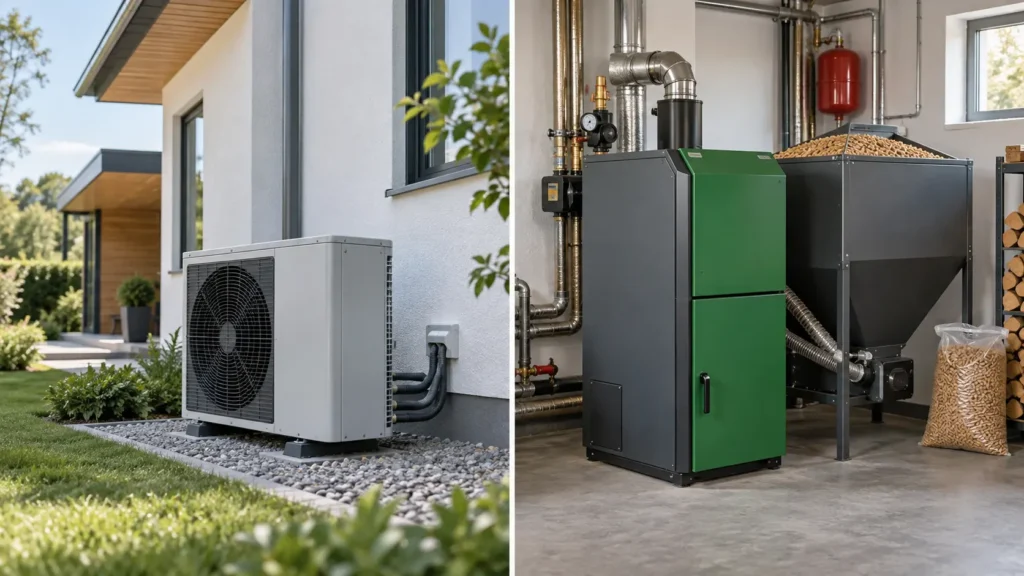
Heat Pump vs Biomass Boiler: Quick Comparison
| Factor | Air Source Heat Pump | Biomass Boiler |
|---|---|---|
| Best fit | Most homes that can run efficiently at lower flow temperatures | Rural, off-gas homes with high heat demand and storage space |
| Typical installation benchmark | Around £12,000 | Around £9,200 for an automatically fed pellet boiler; site works can add more |
| BUS support in England & Wales | £7,500; £9,000 for qualifying off-gas oil/LPG homes until 31 March 2027 | £5,000 with tighter rural/off-gas eligibility |
| Running-cost driver | Electricity price ÷ seasonal efficiency | Pellet price ÷ boiler efficiency |
| User maintenance | Low | Cleaning, ash and flue/chimney maintenance |
| Space | Outdoor unit plus hot-water storage | Boiler, flue, fuel store and delivery access |
| Local emissions | No on-site combustion | Produces particulate matter and nitrogen oxides |
| Strongest buyer case | Low-hassle whole-home heating | Large rural property with cheap/reliable wood fuel |
Energy Saving Trust currently gives typical installation benchmarks of around £12,000 for an air source heat pump and around £9,200 for an automatically fed pellet biomass boiler. Actual quotations can vary considerably.
Where an Air Source Heat Pump Wins
The biggest advantage is operational simplicity. There is no pellet store, fuel delivery, ash removal or combustion flue. That matters in suburban homes, smaller plots and for owners who do not want regular fuel handling.
The grant position also favours heat pumps. Standard BUS support is £7,500, while eligible off-gas properties replacing oil or LPG can receive £9,000 until 31 March 2027. Biomass receives £5,000 and qualifies under narrower conditions.
A heat pump is usually the first option to test where there is suitable outdoor space and the heating system can meet room heat losses at lower water temperatures.
For a broader value check, see are air source heat pumps worth it? and our air source heat pump pros and cons.
Where a Biomass Boiler Still Makes Sense
Biomass becomes more interesting when the property creates a genuine reason for it.
A large rural house with high peak heat demand, an existing plant room, suitable flue route and easy bulk-fuel access can be a strong candidate. It can also suit homes where the existing radiator system genuinely needs higher flow temperatures and major fabric improvements are impractical.
Fuel access can change the economics. Competitively priced bulk pellets, or a suitable sustainable local wood supply, can make biomass more attractive.
However, processing, drying, storage, handling and appliance compatibility still have a cost. Pellet deliveries also require suitable access and a dry fuel store.
Biomass should therefore be selected because the site, heat demand and fuel logistics favour it, not simply because it is classified as renewable.
Running Costs: Which Is Actually Cheaper?
There is no universal winner because the systems expose homeowners to different price risks.
Using Ofgem’s average direct-debit electricity rate of 26.11p/kWh for July–September 2026, a heat pump achieving a seasonal coefficient of performance (SCOP) of 3.0 produces useful heat at roughly 8.7p/kWh. At SCOP 3.5, that falls to approximately 7.5p/kWh.
Energy Saving Trust says bulk pellets can cost around £400 per tonne, while Forest Research gives wood pellets a net calorific value of approximately 4.8kWh/kg. At an illustrative 90% boiler efficiency, that works out at roughly 9.3p per useful kWh, before auxiliary electricity and servicing.
For a home requiring 12,000kWh of useful heat annually, that gives an illustrative cost of:
- Heat pump at SCOP 3.5: about £895
- Heat pump at SCOP 3.0: about £1,044
- Biomass at £400/tonne and 90% efficiency: about £1,111
These are comparison figures rather than bill predictions. Electricity tariffs, real seasonal efficiency, pellet prices, servicing and household heat demand can materially change the result.
For homeowners currently comparing against mains gas, see our air source heat pump vs gas boiler guide.
Useful external references: Ofgem energy price cap rates and Forest Research fuel calorific values.
Heat Pump vs Biomass Boiler Cost Guide 2026
| Cost Factor | Air Source Heat Pump | Biomass Boiler |
|---|---|---|
| Typical benchmark before grant | Around £12,000 | Around £9,200 for an automatically fed pellet boiler |
| England & Wales BUS | £7,500 standard; £9,000 for qualifying off-gas oil/LPG homes | £5,000 for qualifying rural, off-gas properties |
| Illustrative balance after grant | Around £4,500, or £3,000 with the £9,000 uplift | Around £4,200 before property-specific extras |
| Illustrative useful-heat cost | About 7.5–8.7p/kWh at SCOP 3.5–3.0 | About 9.3p/kWh at £400/t pellets and 90% efficiency |
| Biggest cost variables | Radiators, cylinder, electrics, heat loss and siting | Fuel store, flue, access, boiler size and fuel choice |
These are benchmarks, not quotations. Fuel stores, flues, radiator changes, pipework, electrics and site access can move the final figure significantly. A property survey is required for a dependable comparison.
For the latest eligibility rules, see our Boiler Upgrade Scheme 2026 updates.
Official scheme details are also available through Ofgem’s Boiler Upgrade Scheme guidance.
A Crucial 2026 Grant Detail Many Comparisons Miss
Biomass still qualifies for the Boiler Upgrade Scheme in 2026.
Some current comparison pages incorrectly state that biomass support has ended. Ofgem currently confirms a £5,000 biomass grant.
However, biomass eligibility is much narrower. Under current BUS rules, the biomass boiler must be installed in a rural property with no mains-gas connection and must satisfy the scheme’s other technology requirements.
There is another important restriction.
If you already have a biomass boiler and want to replace it with an air source heat pump, do not assume you can claim BUS funding. Ofgem states that the new system must replace an existing fossil-fuel or electric heating system and cannot replace an existing low-carbon heating system.
That point is particularly relevant for existing biomass owners frustrated by pellet costs, servicing or cleaning.
What about Scotland?
Scotland operates separate funding arrangements through Home Energy Scotland. Current Scottish support includes grant and interest-free loan funding for heat pumps, with additional support available to qualifying rural and island properties. Biomass funding is more restrictive and generally requires evidence that zero-emission alternatives such as heat pumps are unsuitable.
What About Older, Listed or Very Large Homes?
Do not use property age alone to decide between biomass and a heat pump.
An older home can still suit a heat pump if its room-by-room heat loss is manageable and the radiators or underfloor heating can deliver enough heat at the intended operating temperature.
A very large, high-heat-loss property with limited scope for fabric upgrades may strengthen the case for biomass, particularly where higher-temperature radiators already exist and there is ample plant-room and fuel-storage space.
Listed buildings add another constraint.
A heat pump requires an external unit. Biomass requires a combustion flue and fuel infrastructure. Either option can therefore interact with planning, listed-building or conservation-area requirements.
The correct comparison is between two complete heating designs, not two appliance specifications.
If air source is not obviously the right heat-pump technology for the property, see air source vs ground source heat pump.
Maintenance, Fuel Storage and Air Quality
This is where biomass carries the clearest lifestyle cost.
Energy Saving Trust recommends regular cleaning of biomass boilers, chimney and flue sweeping at least twice a year, and an annual maintenance check. Automated pellet feeding reduces manual work but does not eliminate fuel deliveries, ash or combustion-system maintenance.
Air source heat pumps still need appropriate servicing, but there is no fuel handling or ash removal.
Biomass also affects local air quality. Wood combustion releases particulate matter and nitrogen oxides. In smoke control areas, rules apply to fuels and appliances, so location can materially affect whether biomass is sensible.
GOV.UK smoke control area rules
For dense urban areas or places already experiencing air-quality problems, this can be a significant reason to favour a heat pump.
Get Your Free Air Source Heat Pump Quote
Find the right air source heat pump solution for your home. Tell us a few details and our team will help you explore suitable options at a competitive price.
Quick to complete. No obligation.
Get your quote
Enter your details below and one of our team will get back to you.
How to Choose Between a Heat Pump and Biomass Boiler: 7 Steps
- Get a room-by-room heat-loss calculation. Do not size the replacement simply from the rating of the old boiler.
- Check required flow temperatures. Establish what the existing radiators or underfloor heating can deliver during cold weather.
- Price the complete installation. Include emitters, cylinders, electrics, flues and fuel storage where applicable.
- Confirm grant eligibility. Compare the grant you can actually receive, not the maximum headline amount.
- Model running costs. Use a realistic SCOP, your electricity tariff, local pellet prices and expected annual heat demand.
- Consider the lifestyle cost. Decide whether fuel deliveries, ash and additional biomass maintenance are acceptable long term.
- Compare property-specific designs. A quotation should tell you how the proposed system will heat your particular home.
Heat Pump or Biomass Boiler?
For most UK homeowners, an air source heat pump is the better first option to investigate. It is easier to live with, avoids on-site combustion, requires less fuel infrastructure and currently benefits from stronger grant support — particularly for qualifying oil and LPG homes off the gas grid.
Biomass is not obsolete. It remains a credible specialist solution where the property genuinely favours it: high heat demand, higher-temperature requirements, generous plant and storage space, and access to reliable, competitively priced wood fuel.
The most useful question is therefore not:
“Which technology is greener?”
It is:
“Which complete heating system fits my property at the lowest realistic lifetime cost and hassle?”
Ready to compare your options? Get a Free Quote and assess property-specific heat pump options before committing to a heating system.
Frequently asked questions
Find clear answers to common questions comparing air source and ground source heat pumps, including efficiency, installation and running costs, winter performance, noise, land requirements and borehole depth.
For most UK homes, an air source heat pump is the more practical option because it requires less fuel infrastructure and routine user maintenance. Biomass becomes more attractive for certain large rural properties with suitable fuel access.
It can be. At September 2026 electricity prices, a well-performing heat pump can produce useful heat more cheaply than pellets costing around £400 per tonne. Poor heat-pump efficiency or unusually cheap biomass fuel can reverse the result.
Energy Saving Trust currently quotes around £12,000 for a typical air source heat pump and around £9,200 for an automatically fed pellet biomass boiler, but property-specific work can substantially change either figure.
Yes. Eligible biomass boilers currently qualify for £5,000 under BUS in England and Wales.
No. The temporary £9,000 BUS rate applies to qualifying air-to-water or ground-source heat pumps installed in eligible off-gas properties replacing oil or LPG.
Normally not. BUS does not currently fund replacing an existing low-carbon heating system with another low-carbon system.
Neither should be chosen purely because the house is old. Heat loss, radiator output, flow temperature, insulation constraints and available plant space matter more than the property's age.
Sometimes, particularly where an existing boiler room and suitable chimney infrastructure are available. However, a new biomass flue can itself create heritage and planning issues.
Yes. Correctly selected heat pumps operate below freezing, although efficiency and available output change as outdoor temperatures fall. The system should be sized around the property's winter design conditions.
Biomass. It involves combustion equipment, ash and fuel handling, and Energy Saving Trust recommends regular cleaning plus chimney/flue maintenance.
More than the boiler footprint alone. You need space for the appliance, fuel store, flue and safe access for fuel delivery and maintenance.
Sometimes. The answer depends on room heat loss and the output of existing radiators at the proposed flow temperature.
Often, particularly because biomass boilers can operate more like conventional boiler systems. However, the complete heating system still needs to be assessed and correctly sized.
There is no universal winner. Heat pumps have an outdoor fan and compressor, while biomass systems can generate noise from combustion equipment, pumps and automatic fuel-feed mechanisms.
A heat pump. It does not burn fuel at the property. Biomass combustion produces particulate matter and nitrogen oxides.


