
Heat Pump for a Semi-Detached House: UK Guide 2026
Check Your Eligibility for Boiler Upgrade Scheme (BUS)
Complete your details below to check your eligibility.
Thank you
We've received your details and will be in touch shortly.

Quick answer: can you install a heat pump in a semi-detached house?
Yes. A correctly designed air-to-water heat pump can heat a semi-detached house through radiators or underfloor heating and provide stored hot water. The main checks are calculated heat loss, radiator output, hot-water cylinder space, electrical supply and outdoor-unit location.
For semis, siting deserves particular attention because the neighbouring house may be close. The installer should check airflow, servicing clearances and the applicable MCS sound calculation.
In England, the old one-metre boundary restriction was removed in May 2025, although permitted development still depends on other conditions, including MCS planning standards.
Can You Install an Air Source Heat Pump in a Semi-Detached House? UK Guide 2026
Yes. In most cases, an air source heat pump can be installed in a semi-detached house. Sharing one wall with a neighbour is not, by itself, a problem.
What matters is the home’s heat loss, the output of its radiators, space for hot-water storage, the outdoor-unit position and compliance with noise and planning rules. For many UK semis, those requirements are achievable. MCS guidance specifically bases heat-pump sizing on calculated room-by-room heat loss rather than property type or bedroom count.
This guide focuses on what is different about installing a heat pump in a semi detached house: neighbour proximity, outdoor siting, MCS noise calculations, radiator sizing, cylinder space, costs and grants.
Get a Free Quote: Compare quotes based on a room-by-room heat-loss survey rather than choosing a heat pump from its headline kW rating alone.
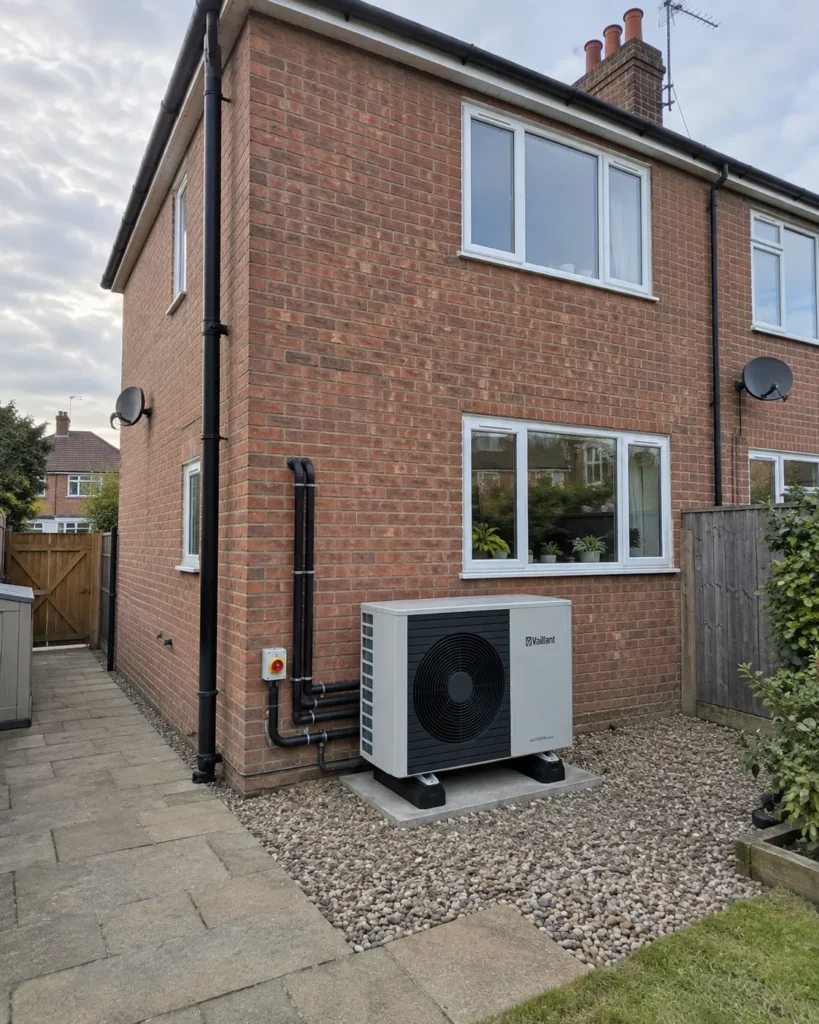
Semi-detached heat pump suitability at a glance
| Check | What to assess | Why it matters |
|---|---|---|
| Heat loss | Room-by-room calculation | Determines required system output |
| Outdoor space | Airflow and service access | Affects performance and maintenance |
| Neighbour proximity | MCS sound assessment | Critical where windows are close |
| Radiators | Output at proposed flow temperature | Some may need upgrading |
| Hot water | Cylinder space and capacity | Most air-to-water systems store hot water |
| Planning | Rules for your UK nation and site | Restrictions can affect siting |
Is a semi-detached house suitable for an air source heat pump?
Usually, yes. Property type matters less than heat demand.
A heat pump should be sized around how much heat your home loses on a cold day. That depends on floor area, insulation, glazing, air leakage, construction and local winter conditions. Two three-bedroom semis can therefore need different heat-pump outputs. MCS heat-load methodology considers factors including building fabric, dimensions, ventilation and winter external temperatures.
Sharing a party wall can help because it usually loses less heat than an external wall when the neighbouring home is heated. However, an older solid-wall semi may still have a higher heat demand than a larger modern property.
The useful question is: “What is the calculated heat loss of each room, and can the heating system replace it efficiently?”
For the technical mechanism, see Getfreequote.co.uk’s guide to how air source heat pumps work.
What makes a semi-detached installation different?
The heat pump works exactly as it would in a detached home. The practical differences are mainly about space and neighbours.
The outdoor unit may sit closer to a neighbouring window or garden, so noise assessment matters. Side passages can look convenient but may restrict airflow or reflect sound. Homes moving from a combi boiler also need a plan for stored hot water.
These issues rarely make a semi unsuitable. They simply need to be resolved during design rather than after the equipment arrives.
Where can the outdoor unit go?
A rear garden is often straightforward, but a side passage, side wall or another position may work if the unit has enough airflow, safe access and an acceptable acoustic impact.
The installer should follow the manufacturer’s clearance requirements and allow room for servicing. Condensate and defrost water also need safe drainage.
Avoid boxing the unit into a tight enclosure unless the manufacturer permits it. Nearby hard walls can reflect sound, so narrow gaps between buildings need careful assessment. Where possible, keep the unit away from neighbouring bedroom windows and other noise-sensitive rooms.
Noise, neighbours and planning permission
This is often the biggest concern for semi-detached homeowners.
In England, rules changed on 29 May 2025. The previous restriction preventing an air source heat pump from being within one metre of the boundary was removed. For a semi-detached house, permitted development allows no more than one air source heat pump, and the outdoor compressor unit must not exceed 1.5 cubic metres. The installation must also comply with MCS 020(a), the sound calculation used for permitted-development installations.
MCS 020(a) uses a permitted-development noise limit of 37 dB LAeq,5mins at the defined assessment positions, ignoring the effect of the façade. Those assessment positions relate to doors or windows serving habitable rooms at neighbouring properties.
Wales updated its permitted-development rights on 1 June 2026. A non-detached home can also have one air source heat pump under PDR, subject to MCS 020(a), the 1.5 cubic metre limit and other conditions. Current Welsh Government heat-pump planning guidance
Scotland has separate permitted-development rules, including compliance with MCS planning standards, while Northern Ireland has its own planning system. Listed buildings, conservation areas and unusual siting can also change what is allowed, so check with the relevant planning authority if there is any doubt.
You normally do not need a neighbour’s permission simply because you live in a semi, provided the installation remains on your property and complies with the applicable rules. Shared structures, leasehold restrictions or legal rights can create separate issues.
Do you need new radiators?
Not necessarily.
Heat pumps commonly work with lower heating-water temperatures than boilers. Energy Saving Trust says heat pumps often send water to radiators at around 35–45°C, although the correct design temperature is property-specific.
Your installer should calculate each room’s heat demand and compare it with the radiator’s output at the proposed flow temperature. Some existing radiators may be large enough; others may need larger double- or triple-panel replacements. Underfloor heating can work well, but it is not required.
Ask for a radiator schedule showing which emitters can stay and which need changing.
Where does the hot-water cylinder go?
Most air-to-water heat pumps store hot water instead of producing it instantly like a combi boiler.
A semi moving from a combi therefore often needs a cylinder. Energy Saving Trust notes that many cylinders can fit in a cupboard with roughly an 80 cm by 80 cm footprint, although dimensions vary.
An airing cupboard, utility room, suitable loft or garage may be possible depending on the design. Cylinder capacity should match household hot-water use, not simply bedroom count.
How much does a heat pump cost for a semi-detached house?
Energy Saving Trust currently gives a typical air source heat pump installation cost of around £12,000 before grants. A semi can cost more or less depending on capacity, radiator upgrades, cylinder work, electrical changes, pipework, access and installation complexity.
For a more focused breakdown, see Getfreequote.co.uk’s heat pump cost for a three-bedroom house and its guide to hidden heat-pump installation costs.
Running costs are also property-specific. Energy Saving Trust says heat pumps on standard electricity tariffs can currently cost slightly more to run than new gas or oil boilers in some circumstances. Suitable time-of-use tariffs can improve the comparison.
What grants are available in 2026?
In England and Wales, the Boiler Upgrade Scheme currently provides £7,500 towards an eligible air-to-water heat pump.
From 21 July 2026 to 31 March 2027, qualifying properties without a mains gas connection that replace oil or LPG heating can receive £9,000 towards an eligible air-to-water or ground source heat pump. The scheme is installer-led and requires an eligible MCS-certified installation.
Getfreequote.co.uk’s Boiler Upgrade Scheme 2026 update explains the current grant levels in more detail.
How to decide if your semi is heat-pump ready
- Get a room-by-room heat-loss calculation. This establishes the heating requirement.
- Check radiator output. Ask what each radiator can deliver at the proposed flow temperature.
- Choose the outdoor position early. Confirm airflow, clearances, servicing, drainage and pipe route.
- Ask for the MCS sound calculation. This matters especially where neighbouring windows are close.
- Plan hot-water storage. Confirm cylinder size, location and expected recovery time.
- Check planning and grant eligibility. Do this before paying a large deposit.
- Compare seasonal performance and running-cost assumptions. Ask what electricity price, heat demand and efficiency the estimate uses.
For the installation stages, see Getfreequote.co.uk’s air source heat pump installation guide.
Get Your Free Air Source Heat Pump Quote
Find the right air source heat pump solution for your home. Tell us a few details and our team will help you explore suitable options at a competitive price.
Quick to complete. No obligation.
Get your quote
Enter your details below and one of our team will get back to you.
Frequently asked questions
Find clear answers to common questions about installing air source heat pumps in semi-detached homes, including neighbour permissions, boundaries, planning, noise, side passages, radiators, cylinders, costs and grants.
Yes. Most semi-detached homes can potentially use an air source heat pump if the system is correctly sized and there is suitable outdoor space.
Usually not if the equipment and work remain entirely on your property and comply with planning rules. Shared land, leasehold terms, covenants or work to jointly owned structures can change this.
There is no longer a general one-metre minimum under England’s permitted-development rules. That restriction was removed on 29 May 2025. Noise and the other PDR requirements still apply.
Often not. Many installations qualify as permitted development, but the exact conditions differ between England, Wales, Scotland and Northern Ireland. Listed buildings and some sensitive locations need extra checks.
Potentially. The installer must confirm manufacturer clearances, airflow, service access, drainage and noise performance. A narrow gap between hard walls can make acoustic design more difficult.
Not inherently. Position and model selection matter. For English permitted-development installations, MCS 020(a) uses a 37 dB LAeq,5mins limit at the defined neighbouring assessment positions.
Potentially, yes. Each homeowner would need a compliant installation on their property. Noise, siting and applicable planning conditions should be assessed for each system.
You cannot reliably size a heat pump from bedroom count alone. MCS methodology uses room-by-room heat-loss calculations based on the building and local winter conditions.
Not necessarily. Some existing radiators may already provide enough heat at the proposed lower flow temperature. Others may need higher-output replacements.
No. Properly sized radiators work with air-to-water heat pumps. Underfloor heating is useful because its large surface area can work effectively at lower water temperatures.
Yes. However, most air-to-water heat pumps normally use stored hot water, so you will usually need a suitable cylinder or another hot-water solution.
It depends on the model and household demand. Energy Saving Trust says many cylinders can fit in a cupboard with approximately an 80 cm by 80 cm footprint.
Yes. Age alone does not make a property unsuitable. Heat loss, insulation, radiator capacity, required flow temperature and system design matter more.
Energy Saving Trust currently gives an indicative typical air source heat pump installation cost of around £12,000 before grants. Your actual quotation could be higher or lower.
Eligible air-to-water installations in England and Wales normally receive £7,500 under the Boiler Upgrade Scheme. Qualifying off-gas oil or LPG properties can receive £9,000 until 31 March 2027.
Conclusion:
A semi-detached house is not unsuitable for a heat pump simply because it shares a wall with a neighbour. The decisive factors are measurable: heat loss, radiator output, hot-water demand, outdoor space, noise and planning compliance.
The part that needs extra care is outdoor-unit siting. A technically convenient position can still be poor if it restricts airflow or directs sound towards a neighbour.
The best next step is a property-specific survey showing the heat-loss figures, proposed flow temperature, radiator changes, cylinder arrangement and MCS noise assessment.
Compare Free Quotes: Use Getfreequote.co.uk to compare properly surveyed heat-pump options for your semi-detached home before deciding.


