
Air Source Heat Pump for a Flat: Can You Install One? UK Guide
Check Your Eligibility for Boiler Upgrade Scheme (BUS)
Complete your details below to check your eligibility.
Thank you
We've received your details and will be in touch shortly.

Quick answer: can you install an air source heat pump in a flat?
Yes. An air source heat pump can work in a flat if there is a suitable location for the outdoor unit, the system can meet the property’s heating requirement and all necessary permissions are obtained. Leaseholders often need written consent from their freeholder or managing agent because the installation can affect external walls, balconies, roofs or communal areas. Planning permission may also be required. In England, an installation on a block of flats can sometimes qualify as permitted development, although stricter conditions apply than for many houses.
Source: https://www.edfenergy.com/energywise/ground-source-vs-air-source-heat-pumps
Can You Install an Air Source Heat Pump in a Flat? UK Guide 2026
Yes, you can install an air source heat pump in some flats, but the decision is more complicated than it is for most houses. The heat pump itself may be suitable, yet the project can still be restricted by the lease, freeholder consent, planning rules, noise requirements or lack of space for equipment.
For many flat owners, the first question is whether an air-to-water or air-to-air heat pump makes more sense. Air-to-water systems can supply radiators, underfloor heating and stored hot water. Air-to-air systems heat rooms directly and can be easier to accommodate in smaller flats, although they normally require a separate hot-water solution.
This guide focuses on the issues that actually determine whether an air source heat pump for a flat is practical in the UK.
Considering a heat pump? Before choosing equipment, arrange a property-specific survey covering heat loss, outdoor-unit positioning, noise, permissions, hot water, existing heating and electrical requirements.
Air-to-water vs air-to-air heat pumps for flats
| Option | How it heats the flat | Hot water | Main advantage for flats | Main consideration |
|---|---|---|---|---|
| Air-to-water | Water through radiators or underfloor heating | Usually yes, via a cylinder | Can replace a conventional wet heating system | Requires cylinder space and suitable emitters |
| Air-to-air | Warm air through indoor fan units | Usually no | Can suit smaller flats without wet central heating | A separate hot-water solution is normally needed |
Both technologies move heat rather than producing all their heat directly from electricity. For a detailed explanation of the evaporator, refrigerant, compressor and refrigeration cycle, read our guide to how air source heat pumps work. This avoids duplicating technical information already covered elsewhere on GetFreeQuote.
Energy Saving Trust specifically identifies air-to-air heat pumps as an option that can suit smaller homes and flats.
Can an air source heat pump work efficiently in a flat?
Yes. Being a flat does not prevent a heat pump from operating efficiently. The important question is whether the system has been designed around the property’s heat loss and heating arrangement.
An installer should calculate room-by-room heat loss rather than simply choosing a heat pump from the flat’s floor area. Existing radiators also need checking because air-to-water systems generally operate at lower water temperatures than traditional boilers.
That does not automatically mean every radiator needs replacing. Some may already provide sufficient output. Others may need to be larger or upgraded.
A proper survey should establish this before the final system is specified. For an overview of the work involved, see our air source heat pump installation guide.
Where can the outdoor unit go?
Finding a suitable outdoor position is often the biggest challenge.
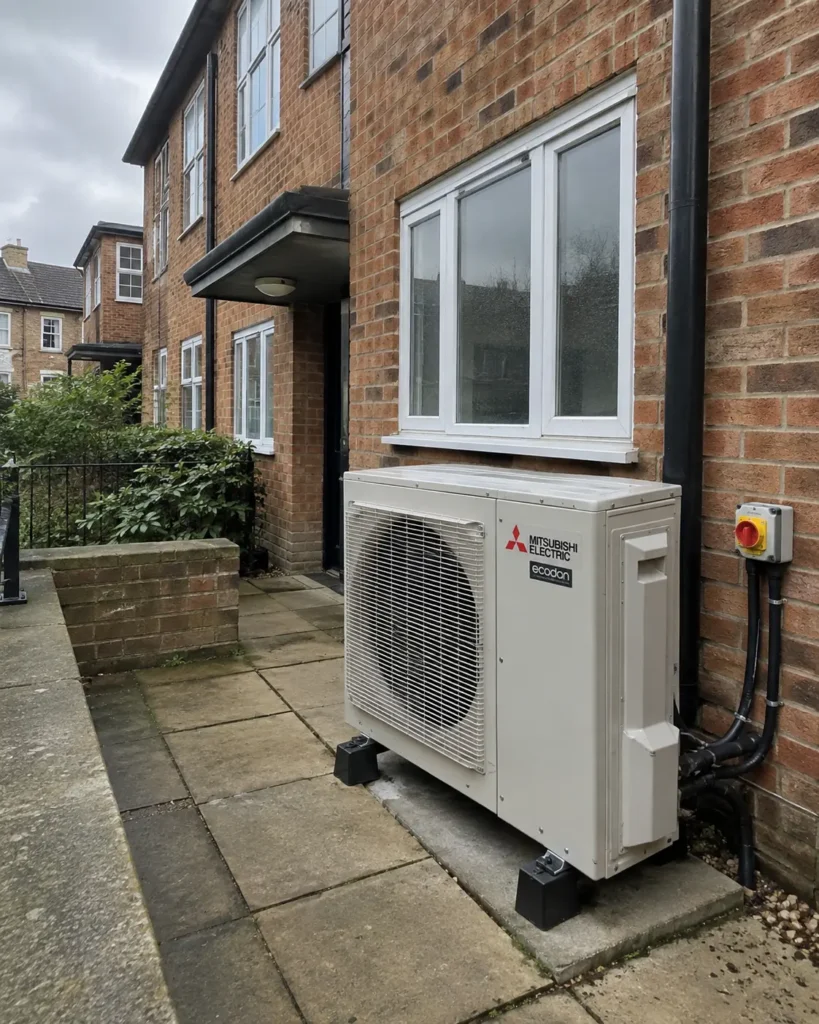
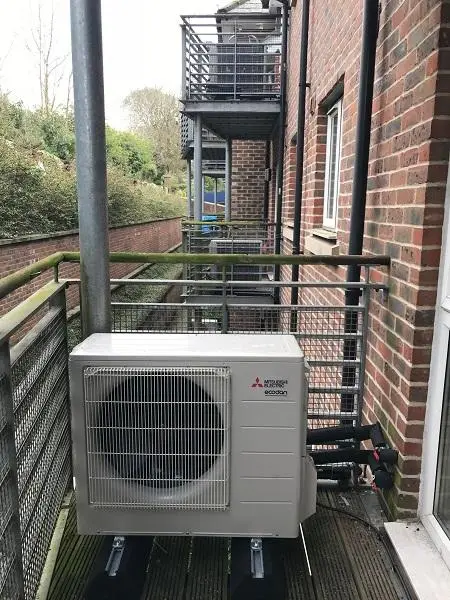
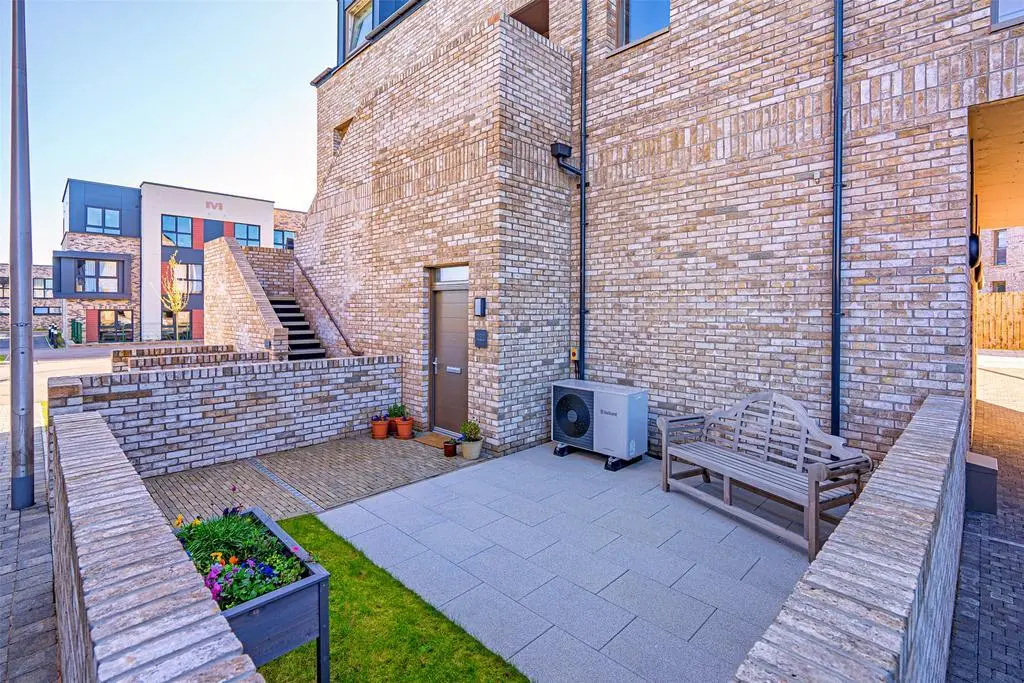
Depending on the building, possible locations can include a private balcony, approved ground-level space, a flat roof or another external location.
However, simply finding enough physical room is not sufficient. The heat pump needs unrestricted airflow, drainage for condensate and safe access for future servicing. Engineers must also consider vibration and sound reaching neighbouring flats.
A balcony installation can therefore work in some buildings, but it needs proper assessment. Wall mounting can create additional complications because the external wall may belong to the freeholder rather than the individual leaseholder.
Establish who owns the proposed installation area before spending money on detailed design.
Do leaseholders need freeholder permission?
In many cases, yes.
Planning permission and freeholder consent are two separate matters. An installation could satisfy planning rules but still breach the lease if it alters part of the building that the leaseholder does not have permission to change.
London City Hall’s Flats Retrofit Toolkit highlights that heat-pump installations can involve both individual flats and communal parts of a building. Landlords, managing agents, leaseholders and residents may therefore need to be involved.
A freeholder or managing agent could request equipment specifications, proposed drawings, acoustic information, contractor insurance or details of how the unit will be fixed.
Get written permission where required before installation starts.
If you rent your flat rather than owning the leasehold, significant alterations would normally need to be agreed with the landlord.
Do you need planning permission for an air source heat pump on a flat?
Sometimes.
For properties in England, the current Planning Portal air source heat pump guidance confirms that an installation on a block of flats can qualify as permitted development where all the relevant conditions are satisfied.
There are important restrictions.
For a block of flats, the outdoor compressor unit must not exceed 0.6 cubic metres. Crucially, only the first air source heat pump installation on a block of flats or within its curtilage benefits from this particular permitted-development provision. Further installations will normally require a planning application.
A block also needs to consist wholly of flats for these particular rights to apply.
Other restrictions cover listed buildings, scheduled monuments, certain highway-facing positions and roof installations. An outdoor unit on a flat roof must be at least one metre from the external edge.
The installation must also meet MCS 020a, the current MCS planning standard for air source heat pumps.
Those specific rules relate to England. Wales changed its air-source heat-pump permitted-development rules on 1 June 2026, while Scotland and Northern Ireland operate separate planning systems. Always check the rules applying to the property and ask the local planning authority where necessary.
What about heat-pump noise in a block of flats?
Noise deserves particular attention because neighbouring bedrooms and living rooms can be close to the outdoor unit.
The MCS planning methodology considers factors such as the heat pump’s sound characteristics, distance from neighbouring habitable rooms and the effects of barriers and surrounding surfaces.
MCS guidance specifically notes that flats, terraces and tenements can present a greater noise-assessment challenge because neighbouring rooms are often closer to proposed equipment.
This does not mean heat pumps are inherently unsuitable for flats. It means positioning matters.
Ask your installer to show you the acoustic assessment before accepting the proposed location.
Where will the hot-water cylinder go?
For an air-to-water system, indoor space may be the next important constraint.
Most systems provide domestic hot water through a cylinder. A flat currently using a combi boiler may not have one, so the design needs to identify where it could go and how the pipework would reach it.
If there is no practical cylinder position, an air-to-air heat pump may deserve consideration. It can provide space heating without installing a new wet central-heating circuit, although domestic hot water normally needs to come from another system.
This distinction can make air-to-air particularly relevant for smaller flats.
How much does an air source heat pump for a flat cost?
There is no reliable universal price for flats.
Energy Saving Trust currently estimates a typical air source heat pump installation at around £12,000, but property size, radiator changes, access, electrical work and installation complexity can materially change the figure.
Air-to-air installations can cost considerably less. Energy Saving Trust gives indicative figures of around £1,900 for one room and roughly £3,700 for a three-bedroom semi-detached home. These are examples rather than quotations for an individual flat.
Running costs are equally property-specific. Heating demand, electricity tariff, seasonal efficiency and the system being replaced all matter. See our guide to air source heat pump running costs for a fuller explanation.
Can you get a heat-pump grant for a flat?
Potentially, provided the property and installation satisfy the scheme requirements.
As of September 2026, the Boiler Upgrade Scheme in England and Wales provides £7,500 for eligible air-to-water heat pumps and £2,500 for eligible residential air-to-air systems. Qualifying off-gas-grid properties replacing oil or LPG can currently receive £9,000 towards an eligible air-to-water heat pump, with that uplift available until 31 March 2027.
The scheme is installer-led and participating heat-pump installations require an MCS-certified installer.
For the detailed eligibility rules, see our Boiler Upgrade Scheme 2026 updates guide rather than relying only on the headline grant.
Air source heat pump for a flat: feasibility checklist
| Check | What needs to be established |
|---|---|
| Outdoor space | A compliant location with adequate airflow and maintenance access |
| Ownership | Who owns the balcony, wall, roof or ground area |
| Lease | Whether freeholder or managing-agent consent is required |
| Planning | Whether permitted development applies or permission is needed |
| Noise | Whether the position meets the relevant acoustic requirements |
| Heat loss | The room-by-room design heat requirement |
| Radiators | Whether existing emitters provide sufficient output |
| Hot water | Space for a cylinder or a suitable alternative |
| Electrics | Whether the electrical supply is adequate |
| Maintenance | Safe future access for servicing and replacement |
A competent survey should answer these questions before you sign a contract.
When might a heat pump not be suitable for a flat?
An individual air-to-water installation may be impractical where there is no acceptable outdoor position, no cylinder space, no workable pipe route or no permission to alter the building.
It can also become poor value if meeting planning and building requirements requires disproportionate structural work.
In those circumstances, do not force an air-to-water solution simply because a grant is available. Air-to-air could be simpler for some flats. In larger blocks, a communal heat-pump system designed for the building as a whole may make more sense than many individual outdoor units.
The right answer depends on both the flat and the building around it.
Get Your Free Air Source Heat Pump Quote
Find the right air source heat pump solution for your home. Tell us a few details and our team will help you explore suitable options at a competitive price.
Quick to complete. No obligation.
Get your quote
Enter your details below and one of our team will get back to you.
Frequently asked questions
Find clear answers to common questions about installing air source heat pumps in flats and apartment blocks, including balconies, roofs, freeholder consent, planning, noise, radiators, cylinders, grants and communal systems.
Potentially. The balcony must offer sufficient airflow, safe servicing access, suitable drainage and an acceptable noise position. You may also need freeholder and planning approval.
Often, yes. External walls, roofs and balconies can fall under the freeholder's ownership or control, so check your lease before carrying out work.
No. Planning rights and leasehold permission are separate. A project can satisfy planning law while still requiring consent under the lease.
Not automatically. In England, only the first qualifying ASHP installation on a block of flats benefits from the relevant permitted-development right. Additional units will normally require planning permission.
Potentially. Under England's permitted-development rules, all parts of the unit must be at least one metre from the external edge of a flat roof. Other conditions still apply.
Additional consent is likely to be necessary. Permitted-development rights have important exclusions affecting listed buildings and their curtilage. Seek advice before commissioning work.
Not necessarily. However, flats often have neighbouring habitable rooms close to the proposed unit, making proper acoustic assessment particularly important.
Sometimes. Each radiator should be checked against the required room heat loss and proposed water temperature. Existing radiators may be adequate in some rooms.
Most air-to-water systems use stored hot water, so usually yes. Air-to-air heat pumps normally do not provide domestic hot water.
It can be. Air-to-air may suit smaller flats or properties without wet central heating. Air-to-water is usually more appropriate where you want the heat pump to supply radiators and stored hot water.
Yes, if the system is correctly sized and designed to distribute heat throughout the property. The number and position of indoor units will depend on the layout.
Potentially. Eligibility depends on the property and installation rather than simply whether the home is a flat. Current BUS rules apply in England and Wales.
Standard support is currently £7,500 for eligible air-to-water heat pumps and £2,500 for eligible residential air-to-air heat pumps. Some qualifying off-gas-grid oil/LPG properties can receive £9,000 towards an air-to-water system until 31 March 2027.
It depends heavily on the system and building. Energy Saving Trust's broader typical figure for an air source heat pump is around £12,000, while air-to-air systems can cost considerably less.
An air-to-water heat pump potentially can, but the system normally uses a hot-water cylinder rather than producing instantaneous hot water like a combi boiler.
Yes, technically. However, roof or balcony access, planning, pipe routes, maintenance access and freeholder consent may determine whether the installation is practical.
An individual conventional ASHP becomes more difficult. Depending on the building, air-to-air arrangements, specialist internal systems or a communal heat-pump solution may deserve investigation.
Yes. Communal heat-pump systems can serve multiple dwellings and may avoid some problems associated with fitting a separate outdoor unit to every flat. They require building-level design and agreement.
Conclusion:
You can install an air source heat pump in a flat, but suitability depends on more than available floor area.
Start by checking the proposed outdoor location, lease and freeholder consent, planning rules, noise, servicing access, heat loss and hot-water requirements. Air-to-water systems can provide central heating and stored hot water where there is enough space. Air-to-air systems can be a practical alternative for smaller flats or properties without wet central heating.
Most importantly, get these questions answered before choosing a heat-pump model.
Ready to investigate your options? Get a free, no-obligation heat pump quote through GetFreeQuote.co.uk and compare solutions based on your actual property.


