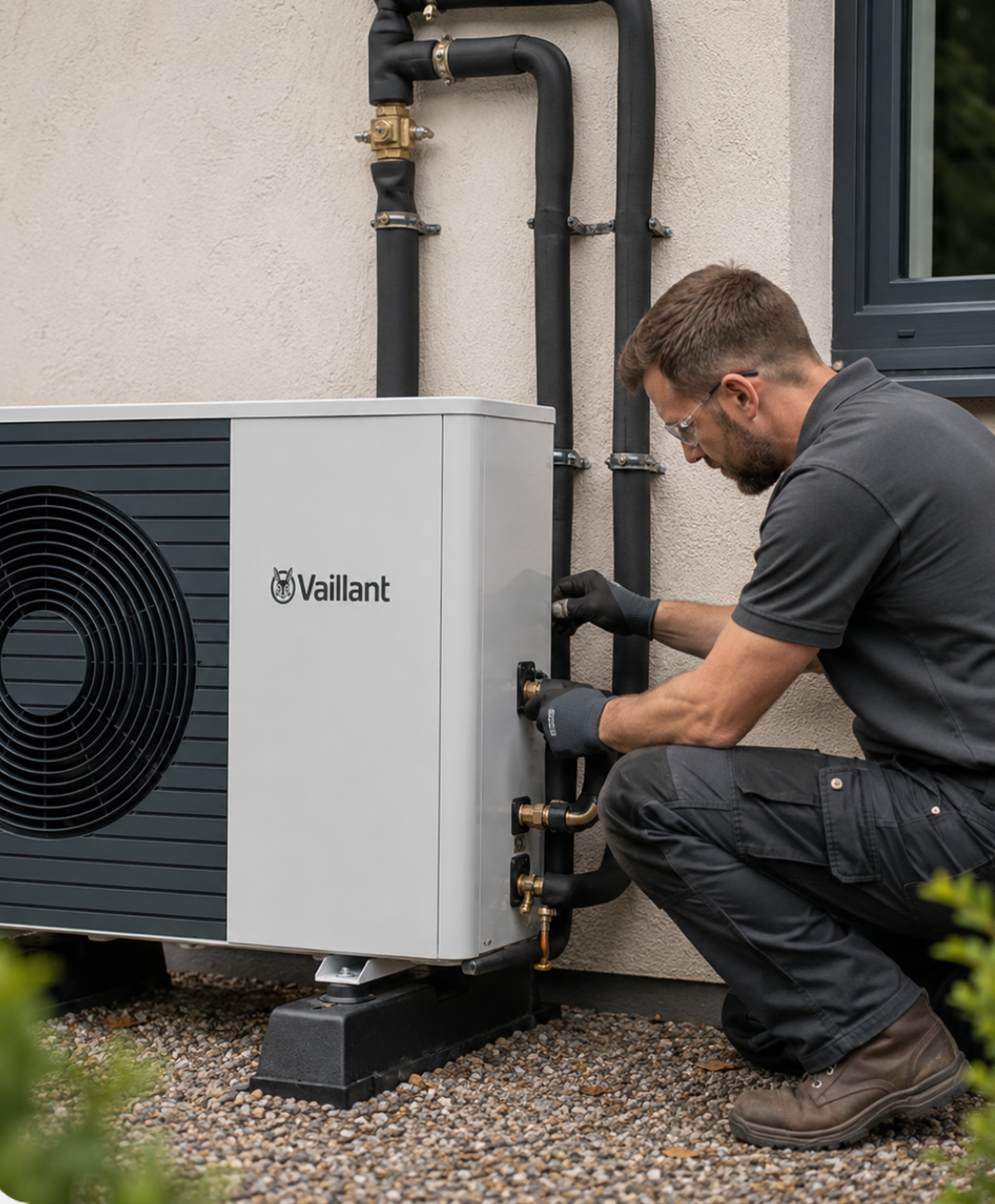
Quietest Air Conditioning UK: Best Low-Noise Units 2026
Check Your Eligibility for Boiler Upgrade Scheme (BUS)
Complete your details below to check your eligibility.
Thank you
We've received your details and will be in touch shortly.
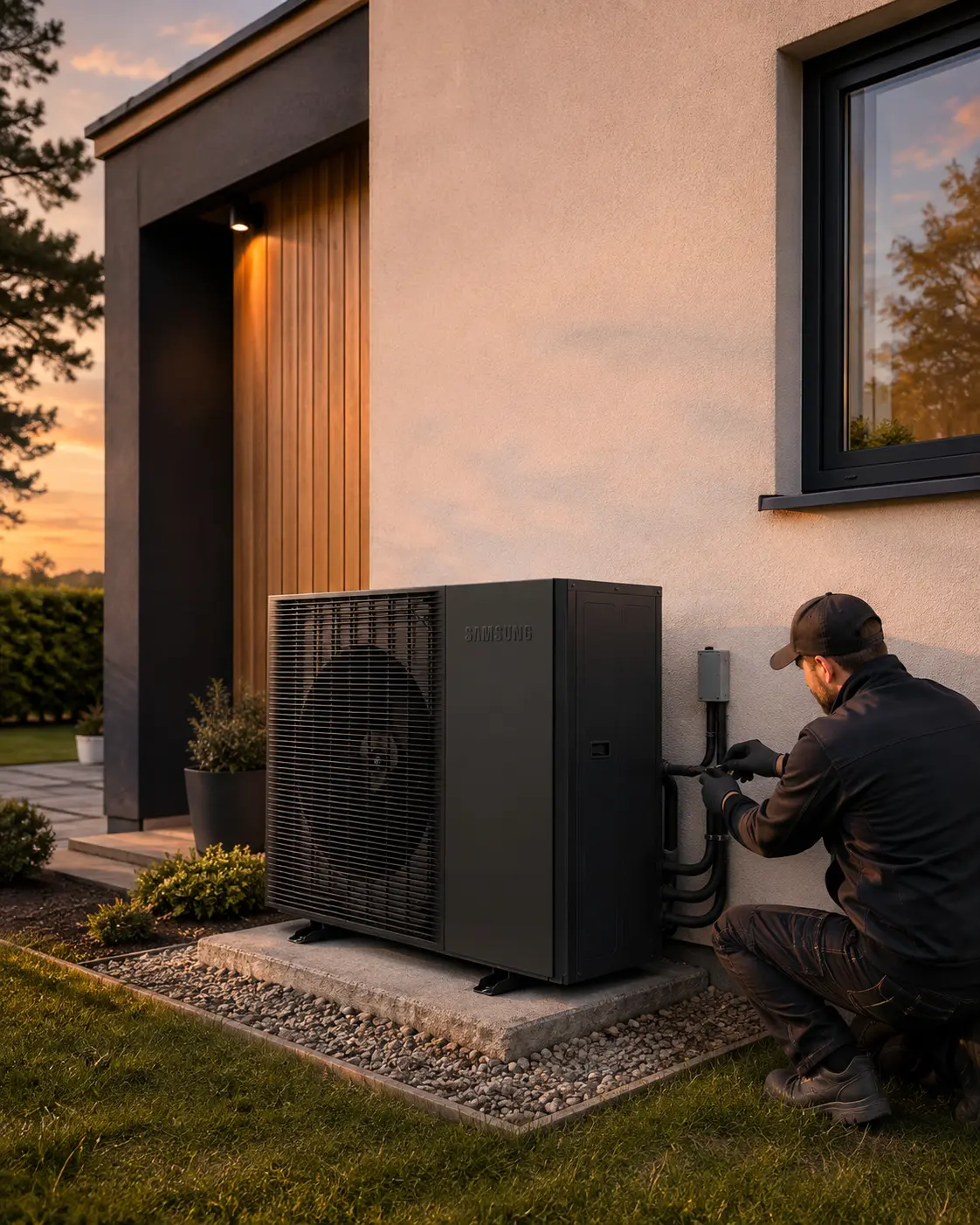
Quick answer: what is the quietest air conditioning in the UK?
For most UK homes, a high-quality wall-mounted split system is the quietest practical form of air conditioning. Current 2.5kW models from Daikin, Panasonic and Toshiba publish indoor sound-pressure figures of about 19 dB(A) on their quietest setting, while Fujitsu General lists 20 dB(A) for one comparable 2.5kW model. These are laboratory figures at low fan speed, not guaranteed noise levels at your pillow or desk. A correctly sized inverter system is more likely to spend long periods running gently once the room reaches temperature. Outdoor-unit placement, vibration control and condensate drainage can matter as much as a one-decibel brochure difference. Daikin
Want to compare suitable systems for your property? Get free, no-obligation quotations and compare your options through Get Free Quote. Compare home-improvement quotes with Get Free Quote
Quietest Air Conditioning UK: The Best Low-Noise Options for Bedrooms and Homes (2026)
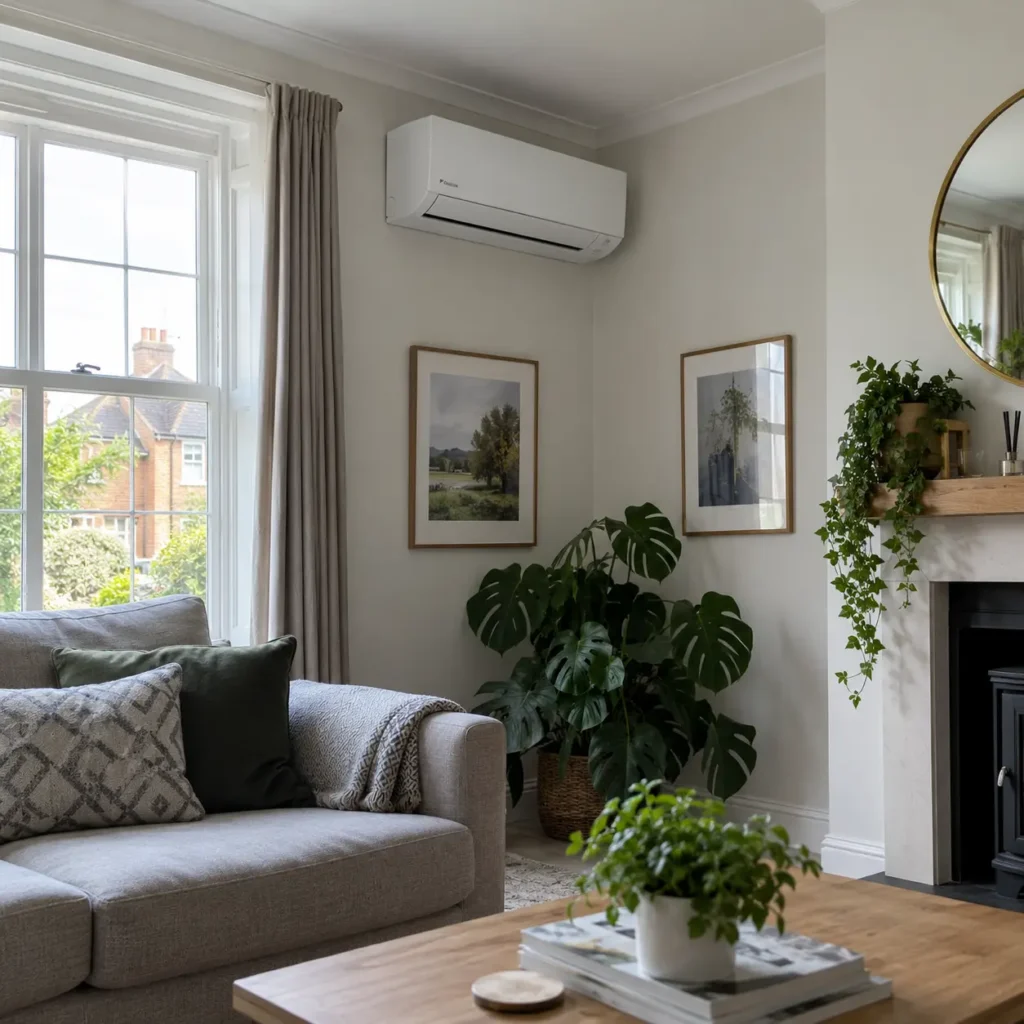
If noise is a priority, the system type and exact model matter more than the badge on the front. The quietest fixed wall-mounted split systems sold in the UK can operate at around 19–20 dB(A) indoors on their lowest fan setting. They are much quieter in the room than most portable air conditioners because the split system’s compressor sits outside.
Several premium 2.5kW wall units now reach the same 19 dB(A) figure, so there is no single automatic “quietest” winner. The better question is which model stays quiet at realistic fan speeds, whether the outdoor unit can be positioned responsibly, and whether the system is correctly sized.
This guide compares current manufacturer sound data and explains what to check before installing quiet air conditioning in a UK bedroom, home office or living space.
Which air conditioners are quietest?
For a bedroom or home office, fixed split air conditioning usually has the strongest acoustic advantage. The indoor unit mainly contains a fan and heat exchanger, while the compressor sits outside.
Portable air conditioners keep the compressor in the room. That makes them convenient, but usually harder to ignore at night. If you are still weighing temporary and permanent options, Get Free Quote’s dedicated comparison explains the wider differences. Portable vs split air conditioning guide
Ducted air conditioning can also be very quiet because the fan unit can sit in a loft or ceiling void. However, high air velocity, undersized grilles, vibration or poorly isolated ductwork can create hiss or structural noise.
Quietest split-system models: current manufacturer figures
The table compares current 2.5kW-class wall units using manufacturer-published indoor sound-pressure data. Confirm the exact model numbers on your quotation because specifications vary by capacity and pairing.
| System | Best suited to | Main advantage | Main consideration |
|---|---|---|---|
| Single-split | One bedroom, office or living room | Simple, efficient fixed cooling | Requires an indoor and outdoor unit |
| Multi-split | Several rooms | Several indoor units can share an outdoor unit | More pipework and careful system design needed |
| Ducted | Whole-home projects and major renovations | Discreet ceiling or wall outlets | Higher cost and space needed for ductwork |
| Monobloc | Homes where an external condenser is difficult | No conventional outdoor condenser | May offer fewer positioning and performance options |
The figures come from current manufacturer technical information. Daikin
Daikin Perfera technical data · Panasonic Etherea specifications · Toshiba HAORI product information · Fujitsu General ASEH09KMCG specifications
A one-decibel brochure difference is unlikely to decide comfort once room acoustics, fan speed, placement and vibration are involved.
Larger units can also have higher minimum sound levels. That is another reason to size the system correctly rather than buying extra capacity “just in case”. Get Free Quote’s sizing guide explains why room area, glazing, solar gain and insulation all matter. Air conditioning sizing UK guide
What does 19 dB(A) actually mean?
Decibels use a logarithmic scale, so the numbers do not behave like ordinary linear measurements. You should not read 40 dB(A) as simply “twice as loud” as 20 dB(A).
The “A” means the measurement is weighted to reflect the sensitivity of human hearing. It is useful for comparison, but one figure does not describe the character of the sound. MCS similarly defines dB(A) as an A-weighted sound measurement designed to approximate the frequency sensitivity of human hearing. MCS Certified
Smooth airflow can be easy to tolerate. A buzz, rattle, clicking relay, refrigerant noise or vibration through a wall may be more noticeable in a quiet bedroom even at a modest measured level.
Sound pressure vs sound power: do not compare the wrong numbers
Manufacturer literature can show both sound pressure and sound power.
Sound pressure is the measured sound at a particular position under specified conditions. This is normally the more useful figure when comparing indoor units.
Sound power describes the total acoustic energy produced by the source. It is a different quantity, so you should not compare a sound-power figure for one unit with a sound-pressure figure for another. MCS Certified
The distinction matters for outdoor planning. MCS 020 a, used for qualifying domestic air-source heat-pump permitted-development installations in England, tells installers to start with the manufacturer’s A-weighted sound-power level. It also states that a “low noise mode” sound-power figure must not be used for that assessment. MCS Certified
Read the MCS 020 a sound-calculation standard
Which type of air conditioning is quietest?
For most retrofit bedrooms, a correctly sized wall-mounted split is the easiest route to very low indoor noise.
A ducted system can be quieter at the grille when designed well because the main fan is remote from the room. It is most attractive where there is suitable loft or ceiling space.
A portable unit is usually the weakest choice for a noise-sensitive sleeper because its compressor remains indoors. It can still suit renters or occasional heatwave use.
For a broader look at system types, heating and cooling options, see Get Free Quote’s main domestic air-conditioning guide. Air Con UK guide
What makes air conditioning noisy in real homes?
Incorrect sizing
A system that is too large can reach the thermostat target quickly and then change output more aggressively. A well-matched inverter system can usually maintain temperature at lower output for longer.
Outdoor-unit vibration
A condenser fixed to a lightweight wall or poor brackets can transmit vibration into bedrooms. Suitable supports, anti-vibration measures and sensible positioning reduce this risk.
Condensate pumps
Gravity drainage is preferable where practical because a condensate pump adds another mechanical noise source. In a very quiet bedroom, even intermittent pump noise can be noticeable. Recent UK homeowner discussions specifically flag condensate pumps and vibration transfer as issues worth considering in noise-sensitive bedrooms. Reddit
High airflow
At low speed, premium indoor units can be extremely quiet. At high fan speed, airflow rises substantially. Pre-cooling the room before bed and then maintaining temperature gently can therefore be quieter than asking the system to pull down a hot room at midnight.
How to choose quiet air conditioning for a bedroom
- Get the capacity right. Ask for a cooling-load assessment rather than choosing by floor area alone.
- Check low and high fan figures. A headline “19 dB” claim matters only if the quoted model achieves it.
- Plan the outdoor-unit position. Avoid locations likely to transmit vibration into a bedroom wall or direct noise towards a neighbour.
- Ask about condensate drainage. Find out whether gravity drainage is possible and what pump would be used if not.
- Check night-mode behaviour. Some units reduce fan speed, display brightness or outdoor output.
- Compare the whole installation. Pipe routes, brackets, wall construction and commissioning can affect the finished result.
If you are moving from product research to quotations, the installation guide covers surveying, drainage, electrical work and commissioning in more detail. Air conditioning installation UK guide
Outdoor-unit noise, neighbours and planning
Outdoor noise deserves as much attention as bedroom noise.
In England, permitted-development rules for domestic air-source heat pumps were amended in 2025. Reversible air-to-air systems that provide heating as well as cooling can potentially fall within those rights when all conditions are met, while a system used solely for cooling does not qualify under that specific heat-pump right. Legislation.gov.uk
For installations relying on MCS 020 a, calculated sound pressure at relevant neighbouring assessment positions must be 37 dB(A) or lower. The calculation considers sound power, distance, reflective surfaces and barriers. Meeting the sound test alone does not guarantee permitted-development status because other conditions also apply. MCS Certified
Check the Planning Portal guidance for air-source heat pumps
Treat outdoor-unit location and noise assessment as part of the design, not an afterthought.
Which quiet air conditioner should you choose?
If you want the lowest published indoor figure for a typical bedroom-sized system, several current premium models reach around 19 dB(A). Daikin Perfera, Panasonic Etherea and Toshiba HAORI all belong on a shortlist, while Fujitsu General’s comparable 2.5kW model is close at 20 dB(A). Daikin
Do not choose between them on one decibel alone. Compare the capacity you need, sound at several fan speeds, outdoor sound data, controls, efficiency, warranty support and installation design.
For a noise-sensitive bedroom, the strongest starting point is usually a correctly sized small-capacity inverter split that can settle into low-speed operation for long periods, paired with an outdoor unit positioned to minimise vibration and neighbour impact.
Get Your Free Air Source Heat Pump Quote
Find the right air source heat pump solution for your home. Tell us a few details and our team will help you explore suitable options at a competitive price.
Quick to complete. No obligation.
Get your quote
Enter your details below and one of our team will get back to you.
Frequently asked questions
Find clear answers to common questions comparing air source and ground source heat pumps, including efficiency, installation and running costs, winter performance, noise, land requirements and borehole depth.
Premium wall-mounted split systems are among the quietest practical options. Several current 2.5kW-class models publish minimum indoor sound-pressure figures around 19 dB(A). Daikin
It is a very low manufacturer sound rating. However, the figure normally applies under controlled test conditions and at the quietest fan setting. Room acoustics, vibration and installation quality affect what you actually hear.
Usually, yes. A split system places its compressor outdoors. A conventional portable air conditioner keeps the compressor and main mechanical components inside the room.
It can be. Ducted systems move the main indoor fan away from the room, but poorly designed ducts or grilles can create airflow and vibration noise. A premium wall split can already be extremely quiet on low speed.
Current manufacturer information shows 19 dB(A) options in selected Daikin Perfera, Panasonic Etherea and Toshiba HAORI models. Always check the exact capacity and model being quoted. Daikin
In a real home, a one-decibel specification difference should rarely determine the purchase by itself. Fan behaviour, tonal noise, vibration and placement can be more important.
They can be. Larger-capacity units often move more air and may have higher minimum sound levels. Compare the exact capacity you need instead of assuming every model in a product range has the same noise rating.
Sound pressure describes the sound measured at a specified point or distance. It is commonly used in manufacturer specifications to describe indoor operating noise.
Sound power describes the total acoustic energy emitted by the source. It is different from sound pressure and is particularly relevant to formal outdoor noise calculations. MCS Certified
Yes. Distance, barriers, reflective walls, unit output and placement all affect neighbour noise. Avoid treating the outdoor condenser location as an afterthought.
For qualifying permitted-development heat-pump installations in England using MCS 020 a, the calculated sound pressure at relevant neighbouring assessment positions must be no more than 37 dB(A). It is not a universal noise limit for every air conditioner or every planning situation. MCS Certified
MCS 020 a says the sound-power level in “low noise mode” must not be used for the permitted-development assessment. MCS Certified
Quiet mode normally reduces airflow or operating intensity. That is often ideal for maintaining an already comfortable bedroom, but the unit may need higher output when the room first needs cooling.
Yes. Pumps can produce intermittent buzzing or clicking. Where the layout allows it, gravity drainage removes that additional mechanical noise source.
There is no universal bedroom size. A small room commonly needs a lower-capacity system than a large living space, but glazing, orientation, insulation, ceiling height and heat gains should determine the final capacity.
Modern split systems can operate for long periods and often become quieter once the room reaches the selected temperature. Use sensible temperature settings, keep filters clean and follow the manufacturer’s operating instructions.
Conclusion
Several high-quality wall-mounted split systems now publish indoor sound-pressure figures around 19–20 dB(A) at their quietest setting.
The bigger differences appear in real use. Correct sizing helps avoid unnecessary high-speed operation. Good outdoor-unit placement limits vibration and neighbour disturbance. Gravity drainage can remove another potential bedroom noise source.
If quiet sleep is the priority, shortlist exact models that match your room, then compare complete installations rather than headline brochure figures alone.