
Do Heat Pumps Work Below Freezing? UK Guide 2026
Check Your Eligibility for Boiler Upgrade Scheme (BUS)
Complete your details below to check your eligibility.
Thank you
We've received your details and will be in touch shortly.

Quick Answer: Do Heat Pumps Work Below Freezing?
Yes. Air source heat pumps work below freezing because outdoor air still contains thermal energy at 0°C and below. The refrigerant passing through the outdoor evaporator is colder than the surrounding air, so heat can still move into it.
Efficiency usually falls as temperatures drop because the compressor has to work harder to raise that heat to a useful temperature. Defrost cycles can also temporarily reduce output. Some current UK-market units publish operating limits around -25°C to -28°C. However, the important figures are the unit’s heating capacity and CoP at your home’s winter design conditions, not just its absolute minimum operating temperature.
Do Heat Pumps Work Below Freezing? UK Winter Performance Explained
Yes. Modern air source heat pumps can continue heating a home when the outside temperature falls below 0°C. Cold weather reduces efficiency and can reduce available heating output, but freezing conditions do not make a heat pump stop working.
For UK homeowners, the better question is whether a specific heat pump can meet the home’s heat loss at the coldest design temperature for that area. That depends on manufacturer performance data, the required flow temperature and a room-by-room heat-loss calculation.
This guide explains why heat pumps can extract heat from sub-zero air, what happens to CoP in cold weather, how defrost cycles work and what to check before choosing a system.
Compare heat-pump quotes: If you are considering a heat pump, Get Free Quote can help you compare options after a proper property assessment.
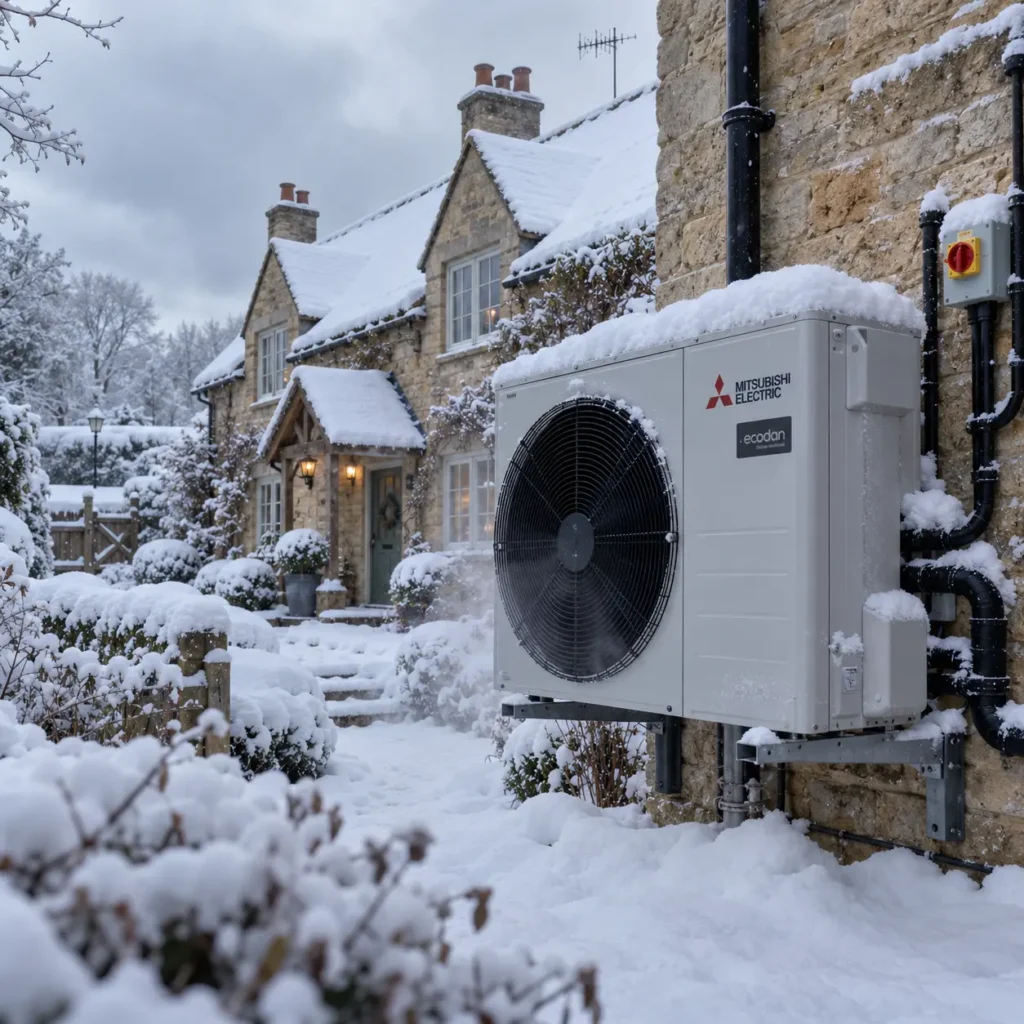
Heat Pumps Below Freezing: What Changes?
| Outdoor condition | What usually happens | What the homeowner should know |
|---|---|---|
| Mild winter weather | Higher efficiency and lower heat demand | The system can usually run at a lower flow temperature |
| Around 0°C | Efficiency falls compared with mild weather | Frost can form on the outdoor coil in damp conditions |
| Several degrees below 0°C | The compressor works harder and the home loses heat faster | Correct sizing and radiator output become more important |
| Severe sub-zero weather | Output and CoP depend strongly on model and design | Check manufacturer data at the design temperature |
Why Can a Heat Pump Extract Heat From Air Below Freezing?
An air source heat pump does not need warm-feeling air. It needs the refrigerant in the outdoor heat exchanger to be colder than the air passing over it.
A fan draws outdoor air across the evaporator. The low-temperature refrigerant absorbs energy and evaporates. The compressor then raises its pressure and temperature. The condenser transfers heat into the home’s heating water, and an expansion valve lowers the refrigerant’s pressure so the cycle can repeat.
That is why useful heat can still be collected below 0°C. The process is covered in more detail in our guide to how air source heat pumps work.
As outdoor air gets colder, the temperature difference the system must overcome becomes larger. The colder the source air and the hotter the heating water, the harder the compressor generally has to work. GOV.UK likewise notes that heat energy remains available in air and ground below freezing.
How Much Does Efficiency Fall in Freezing Weather?
Heat-pump efficiency at a particular operating point is often expressed as Coefficient of Performance, or CoP. A CoP of 3 means roughly three units of heat are delivered for each unit of electricity used within the stated measurement boundary.
Real UK data shows CoP can remain above 2 in common sub-zero design conditions. The government-funded Electrification of Heat Demonstration Project installed 742 heat-pump systems across British homes. Its final analysis found a median 30-minute CoP for air source heat pumps of 3.37 at 10°C, 2.37 at -3°C and 2.30 at -5°C.
These are dataset medians, not a promise for an individual home. Performance depends on the heat pump, flow temperature, controls, hot-water use and building heat loss.
Flow temperature matters too. In the same project, median CoP across heat pumps was 3.50 at a 35°C flow temperature, 2.38 at 55°C and 2.02 above 65°C. For more detail, see our guide to air source heat pump efficiency.
Energy Systems Catapult: final heat-pump performance findings
How Cold Can Modern Heat Pumps Operate?
The minimum operating temperature is model-specific.
Vaillant states that its aroTHERM plus can operate down to -25°C. Daikin states that its Altherma 4 H can operate down to -28°C. These figures show that current equipment can be engineered for temperatures far below a typical UK frost.
However, an operating limit is not the same as guaranteed comfort in every house. A unit may still run at a very low temperature while providing less output than it does in milder weather. The designer therefore needs to check capacity at the outdoor temperature and flow temperature relevant to the property.
For a fuller explanation of operating limits and flow temperatures, see our guide to air source heat pump temperature.
What Is a Heat Pump Defrost Cycle?
Frost on the outdoor coil is a normal part of winter operation for an air source heat pump.
As the evaporator absorbs heat, its surface can become cold enough for moisture in the air to freeze. If frost built up unchecked, it would restrict airflow and reduce heat transfer.
Modern systems therefore use automatic defrost. The heat pump temporarily changes operation so heat reaches the outdoor coil and melts the frost. You may notice steam or vapour, water beneath the unit, a change in sound or a brief interruption in heating.
This is not automatically a fault. Energy Saving Trust’s installer guidance says domestic systems need sufficient thermal energy available in the heating circuit to carry out defrost cycles.
MCS’s 2025 heat-pump design standard also says an air source system should be able to maintain internal design temperatures across multiple defrost cycles. In other words, defrosting should be allowed for in the design rather than treated as an unexpected winter problem.
Read the MCS Heat Pump Design Standard
Why System Sizing Matters More in Cold Weather
A heat pump should be sized against the home’s heat loss at a defined outdoor design temperature, not average winter weather.
MCS uses location-based temperatures derived from CIBSE data. Its current calculator lists 99.6% design temperatures of about -3.0°C for London, -5.1°C for Birmingham, -5.4°C for Edinburgh, -5.6°C for Glasgow and -4.5°C for Manchester. Altitude can make the design temperature lower.
Cold weather therefore creates two pressures at once: the house loses heat faster, while an air source heat pump may operate at a lower CoP.
For systems intended to cover the full space-heating load, the MCS design standard says the selected heat pump should provide at least 100% of the calculated heat load at the relevant flow temperature without relying on a supplementary electric heater.
That is why a proper heat-loss calculation for a heat pump matters. A headline “8kW” or “12kW” label does not tell you how much heat the unit will provide at -5°C while producing the flow temperature your radiators need.
What About Radiators and Underfloor Heating?
The key question is whether each room’s emitters can release enough heat at the design flow temperature.
Heat pumps usually run more efficiently with lower water temperatures than traditional boilers. If a radiator is too small, the designer may need a larger radiator, a higher-output model or a higher flow temperature. Raising the flow temperature can increase radiator output, but it usually reduces heat-pump efficiency. The Energy Systems Catapult data above demonstrates the strong relationship between flow temperature and measured CoP.
Underfloor heating often suits heat pumps well because its large surface area can deliver useful heat at comparatively low water temperatures.
A good cold-weather design therefore matches three things: the building’s heat loss, the heat pump’s output and the capacity of the radiators or underfloor heating.
Will a Heat Pump Need Backup Heating Below Freezing?
Not necessarily.
Some systems include an electric boost heater for unusually demanding conditions, while hybrid systems combine a heat pump with another heat source. But ordinary freezing weather should not automatically mean a full heat-pump system needs backup heat.
If supplementary heating operates frequently, electricity use can rise and the system may need checking. Possible causes include incorrect sizing, an unsuitable heating curve, insufficient radiator output or a control issue.
Energy Saving Trust notes that heat pumps can perform at -15°C or lower, while additional heating can assist if output becomes insufficient during unusually cold periods.
Get Your Free Air Source Heat Pump Quote
Find the right air source heat pump solution for your home. Tell us a few details and our team will help you explore suitable options at a competitive price.
Quick to complete. No obligation.
Get your quote
Enter your details below and one of our team will get back to you.
Frequently asked questions
Find clear answers to common questions about air source heat pump performance in winter, including sub-zero operation, cold-weather efficiency, frost and defrost cycles, electricity use, backup heating, radiators and winter system design.
No. Modern air source heat pumps are designed to keep operating below freezing. Efficiency normally falls as the outside temperature drops, but there is no sudden cut-off at 0°C.
It depends on the model. Current examples include the Vaillant aroTHERM plus at -25°C and Daikin Altherma 4 H at -28°C. Always check the specification for the exact model being proposed.
Yes, provided the system has been correctly designed for the property. Energy Systems Catapult measured a median 30-minute CoP of 2.30 for air source heat pumps at -5°C in its UK demonstration project.
They can be. Efficiency normally falls as temperatures drop, but UK monitoring shows air source heat pumps can still deliver more than two units of heat per unit of electricity at common sub-zero design temperatures.
The refrigerant in the evaporator is colder than the outdoor air. Heat therefore transfers from the air into the refrigerant before the compressor raises its pressure and temperature.
Moisture in cold air can freeze on the outdoor heat exchanger because the evaporator surface can be colder than the surrounding air. Some frost is normal.
It temporarily sends heat to the outdoor coil to melt accumulated frost and restore normal airflow and heat transfer.
Usually, yes. Visible vapour can appear as ice melts during a defrost cycle. Water underneath the outdoor unit can also be normal.
Generally, yes. The compressor usually has to work harder, while the building itself loses heat faster in colder weather.
Not automatically. Some systems contain backup elements, but a properly designed full heat-pump installation should be sized to meet the calculated space-heating load under its design conditions.
Normally, weather compensation should adjust the heating-water temperature automatically as outdoor conditions change. Large manual changes are not usually necessary when the system is correctly commissioned.
No. They need to provide enough heat to match each room’s heat loss. Larger radiators can often achieve the required output using cooler water.
Not always. Each radiator should be checked against the room heat loss and proposed flow temperature. Existing radiators that provide sufficient output can remain.
Yes, but the system should be designed for the appropriate local outdoor temperature. MCS design figures vary by location, with colder design conditions used in places such as Edinburgh and Glasgow.
Ask for the calculated property heat loss, outdoor design temperature, design flow temperature, and the heat pump’s heating output and CoP at those conditions.
Do Heat Pumps Work Below Freezing in the UK? The Practical Answer
Yes. A modern, correctly designed air source heat pump can work below freezing and heat a UK home through normal winter cold spells.
What changes is efficiency, available capacity and the frequency of defrost cycles. That makes accurate system design more important, not heat pumps unsuitable.
When comparing quotes, ask for four figures: the property’s design heat loss, the local outdoor design temperature, the proposed flow temperature, and the heat pump’s output and CoP at those conditions. Those numbers are more useful than the unit’s minimum operating temperature.
If they have been calculated properly, sub-zero weather should be a condition the system is designed to handle, not a surprise.


