
Do Air Source Heat Pumps Work in UK Weather?
Check Your Eligibility for Boiler Upgrade Scheme (BUS)
Complete your details below to check your eligibility.
Thank you
We've received your details and will be in touch shortly.

Quick Answer: Do Heat Pumps Work in UK Weather?
Yes. Modern air source heat pumps are well suited to UK weather when the system is correctly sized and designed. The UK’s long-term average winter temperature is about 4.09°C, although colder spells occur and local conditions vary significantly.
During colder weather, a heat pump’s efficiency normally falls because extracting heat becomes harder. UK field monitoring found a median whole-system COP of 2.57 at 0°C and 2.30 at -5°C. That means the monitored systems were still producing more than twice as much useful heat as the electrical energy being consumed.
Correct sizing, suitable radiators, sensible flow temperatures and weather-compensated controls are therefore more important than simply asking whether a heat pump works below freezing.
Find out whether a heat pump could suit your property with Get a Free Quote.
Do Air Source Heat Pumps Work in UK Weather?
Yes. A correctly designed air source heat pump can heat a UK home throughout winter, including during freezing weather.
Cold conditions do reduce efficiency because the heat pump has to work harder to extract heat from outdoor air. However, below-zero temperatures do not mean the system stops working. UK field data shows air source heat pumps continuing to deliver substantially more heat than the electricity they consume at 0°C and -5°C.
The more important question is whether the heat pump, radiators and controls have been designed for your property’s heat loss on cold days.
This guide explains how heat pumps cope with typical UK weather, frost, snow and freezing temperatures, what happens during defrost cycles, and what determines real winter performance.
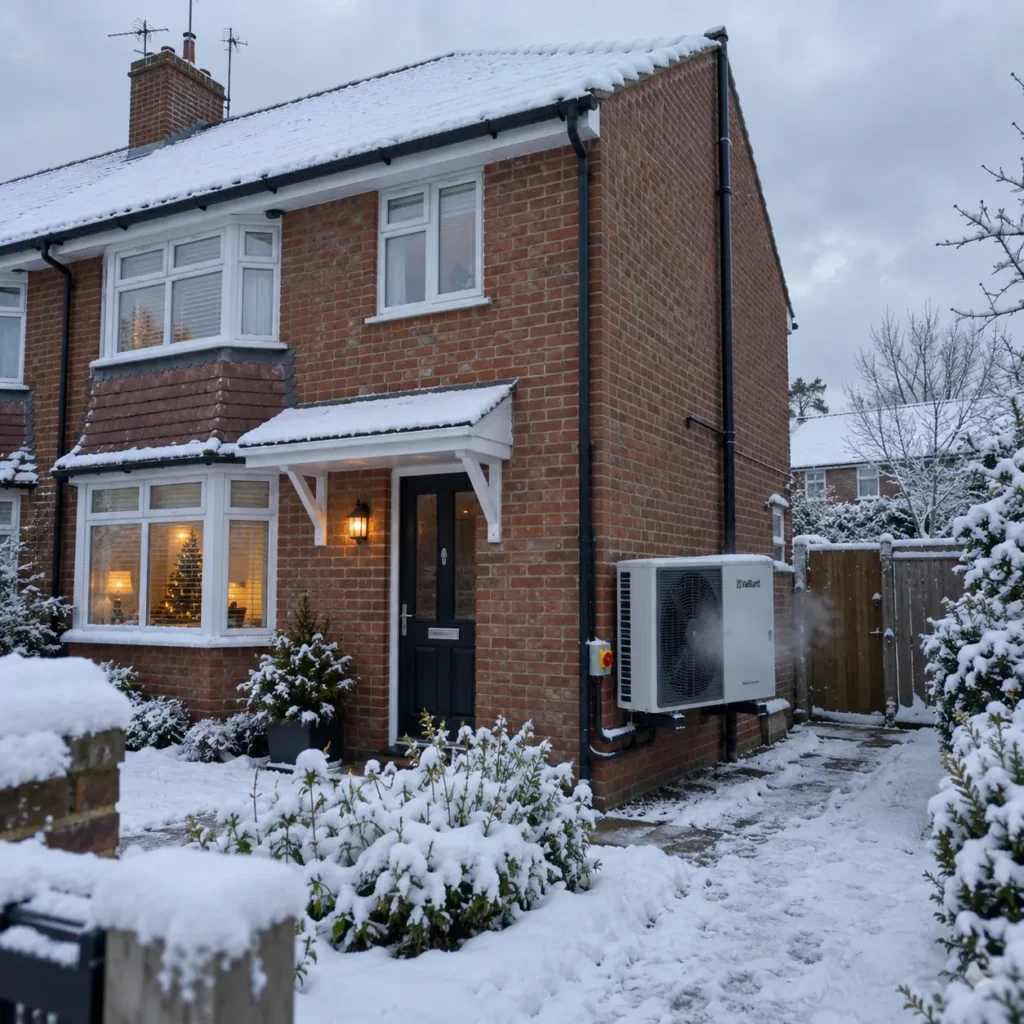
Why Can a Heat Pump Extract Heat From Cold Air?
Cold air still contains thermal energy.
An air source heat pump does not wait for outdoor air to feel warm. Instead, refrigerant inside the outdoor unit absorbs low-temperature heat through an evaporator.
The refrigerant then passes through a compressor. Increasing its pressure raises its temperature. At the condenser, that heat transfers into water that circulates through your radiators or underfloor heating.
An expansion valve then reduces the refrigerant pressure so the cycle can start again.
This refrigeration cycle is why a heat pump can continue collecting energy when outdoor temperatures fall below 0°C.
For a more detailed explanation of the evaporator, compressor, refrigerant, condenser and expansion valve, see our guide to how air source heat pumps work.
How Does UK Weather Affect an Air Source Heat Pump?
UK winters are generally moderate compared with many countries that use heat pumps extensively. However, British conditions present their own challenge: periods of cold, damp weather can encourage frost formation on the outdoor heat exchanger.
| UK weather condition | What happens to the heat pump | What it means for you |
|---|---|---|
| Mild winter weather | Outdoor air contains more readily available heat | Efficiency is generally higher |
| Around 0°C | The compressor works harder and frost may form | Efficiency falls, but heating continues |
| Several degrees below freezing | Heat output and efficiency become more demanding | Correct cold-weather sizing matters |
| Cold and damp | Frost may build on the outdoor coil | Automatic defrost cycles become more frequent |
| Snow | Operation can continue if airflow and drainage remain clear | Correct outdoor-unit positioning matters |
| Rain and wind | Normal outdoor operation continues | Strong winds can increase the property's heat loss |
The key point is that cold weather changes performance rather than switching the heat pump off.
Energy Saving Trust also notes that source temperature affects efficiency: the colder the outdoor air becomes, the harder an air source heat pump must work.
What Happens to a Heat Pump Below Freezing?
Efficiency usually falls gradually as outdoor temperatures drop.
The Department for Energy Security and Net Zero-funded Electrification of Heat Demonstration Project monitored hundreds of UK systems. For air source heat pumps, the measured median whole-system COP was:
- 2.57 at 0°C
- 2.50 at -1°C
- 2.44 at -2°C
- 2.37 at -3°C
- 2.33 at -4°C
- 2.30 at -5°C
A COP of 2.30 means about 2.3 units of heat were delivered for each unit of electrical energy consumed under that measurement boundary.
That does not mean every heat pump will achieve those figures. Performance varies according to equipment, flow temperature, heating demand, controls and system design.
The figures do demonstrate something important, however: UK heat pumps do not suddenly become ineffective at freezing point.
For a deeper explanation of operating temperatures and flow temperatures, see the air source heat pump temperature guide.
Why Do Heat Pumps Defrost in Cold Weather?
Cold and damp weather can cause moisture in the air to freeze onto the outdoor heat exchanger.
A layer of ice restricts airflow and makes heat transfer harder. The heat pump therefore enters an automatic defrost cycle.
During defrost, the system temporarily redirects heat to warm the outdoor coil and melt the frost. You might notice steam or vapour near the unit afterwards. Water may also drain from underneath it.
This is normal operation, not necessarily a fault.
Defrost cycles consume some energy and temporarily interrupt normal heat production, so repeated defrosting reduces efficiency. This is one reason the heat pump must be capable of meeting the property’s winter heating requirement under realistic conditions.
Manufacturer guidance also confirms that cold, damp conditions can trigger normal automatic defrost cycles.
Do Heat Pumps Work in Snow and Heavy Rain?
Normal rain is not a reason for an outdoor heat pump to stop operating.
Snow is also manageable, but the outdoor unit needs unrestricted airflow. Its location, mounting height, clearances and drainage should follow the manufacturer’s requirements.
Do not box the outdoor unit in simply to protect it from the weather. Restricting airflow can reduce performance.
Drainage becomes particularly important during freezing conditions because defrosting produces water. Heat-pump installation standards specifically consider safe removal of condensate so that water does not create problematic ice around the unit.
How Efficient Is a Heat Pump During a UK Winter?
A heat pump will usually consume more electricity per unit of heat on a very cold day than on a mild one.
However, one cold-weather COP figure does not tell you what the system will achieve over an entire year.
For that, seasonal performance is more useful.
The Electrification of Heat project reported a median whole-system Seasonal Performance Factor of 2.78 for monitored air source heat pumps, showing substantial improvement compared with earlier UK field trials.
Individual systems can perform significantly above or below the median.
Flow temperature is particularly important. The greater the temperature difference between the outside air and the heating water being produced, the harder the compressor generally needs to work.
That is why suitably sized radiators or underfloor heating can help. They can deliver enough heat using lower water temperatures.
Our air source heat pump efficiency guide explains COP, SCOP and measured seasonal performance in more detail.
What Determines Whether Your Home Stays Warm?
The heat pump’s advertised minimum operating temperature is not the most useful figure to focus on.
A system needs to meet your property’s calculated heat loss when local outdoor temperatures reach the winter design condition.
A detached house with exposed walls, high ceilings and significant draughts may require much more heat than a compact, well-insulated terrace.
The installer therefore needs to calculate heat loss room by room.
Radiators must then provide enough output at the proposed water temperature. A radiator that was adequate with 70°C water from a boiler might provide insufficient heat if the new system is designed around substantially cooler water.
This does not automatically mean replacing every radiator. The calculation should identify which existing emitters can remain and which need changing.
Weather Compensation Makes a Major Difference
Heat pumps do not need to produce the same water temperature throughout the year.
Weather compensation adjusts the heating flow temperature according to outdoor conditions.
During mild weather, the system can use cooler water. As outside temperatures fall, it gradually raises the flow temperature to match the home’s increasing heat loss.
Energy Saving Trust explains that an incorrectly set heating curve can increase running costs. It also recommends operating heat pumps for longer periods rather than treating them like boilers that deliver short bursts of high-temperature heat.
This steady approach helps a properly designed heat pump maintain comfortable temperatures without unnecessary peaks in flow temperature.
Will Very Cold Weather Make a Heat Pump Expensive to Run?
Electricity consumption normally increases during cold periods for two reasons.
First, your home loses heat faster, so it needs more energy.
Second, the heat pump’s COP usually decreases as outdoor temperatures fall.
Those effects mean one freezing day can cost more than a mild winter day. However, annual running costs depend on the whole heating season rather than the coldest few hours of the year.
Your electricity tariff, annual heat demand, seasonal efficiency and required flow temperature all matter.
See our air source heat pump running-cost guide for property-specific examples.
Do Heat Pumps Need Backup Heating in Extreme Cold?
Some systems include an electrical backup or boost heater.
Energy Saving Trust notes that heat pumps can operate at around -15°C or below, depending on the equipment, but supplementary heating may sometimes assist during unusually cold conditions. Occasional use is different from relying heavily on backup heating every winter.
Frequent backup-heater operation can warrant investigation of the heating curve, radiators, system settings or original design.
The objective should be to select and design the heat pump around the property’s expected winter demand, rather than routinely compensating for an undersized system with direct electric heating.
Get Your Free Air Source Heat Pump Quote
Find the right air source heat pump solution for your home. Tell us a few details and our team will help you explore suitable options at a competitive price.
Quick to complete. No obligation.
Get your quote
Enter your details below and one of our team will get back to you.
Frequently asked questions
Find clear answers to common questions about air source heat pump performance in winter, including sub-zero operation, cold-weather efficiency, frost and defrost cycles, electricity use, backup heating, radiators and winter system design.
Yes. Air source heat pumps continue extracting heat from outdoor air below freezing. Efficiency normally falls as outdoor temperature drops, but UK monitoring recorded substantial heat output even at -5°C.
It depends on the model. Many current systems are designed to operate at temperatures well below typical UK winter conditions. Always check the manufacturer's output data rather than comparing minimum operating temperatures alone.
No. UK field monitoring recorded a median whole-system COP of approximately 2.30 at -5°C across monitored air source heat pumps.
They can be. The correct system should be sized against the property's local winter design temperature and calculated heat loss rather than using a single UK-wide assumption.
Normal frost should be handled by the unit's automatic defrost function. Persistent abnormal ice build-up may justify checking airflow, drainage or the equipment.
What looks like smoke can be water vapour produced during or immediately after a defrost cycle. This can be normal.
Yes, provided the outdoor unit retains suitable airflow and drainage. Installation clearances and manufacturer instructions should be followed.
Normal rain should not prevent an outdoor heat pump operating. Outdoor units are designed for external installation, although siting and drainage still matter.
Generally, yes. The colder the heat source, the harder the heat pump needs to work. Seasonal efficiency averages performance across changing weather conditions.
A correctly designed system should be selected to maintain its intended indoor design temperatures during winter conditions. The answer depends on the home's heat loss and heating-system design.
Potentially, yes, but designing for a higher indoor temperature increases the calculated heat demand. Tell the installer your actual preferred room temperatures before system sizing.
No. Heat pumps can work with radiators. The important factor is whether the emitters provide sufficient output at the proposed flow temperature.
Large temperature setbacks are often less suitable than the heating pattern used with a conventional boiler. Energy Saving Trust recommends longer, steadier operation for efficient heat-pump use.
Your home loses heat faster during colder weather while the heat pump generally operates at a lower COP. Both effects can increase electricity consumption.
Some systems include supplementary electrical heating for exceptional conditions or specific functions. Regular heavy reliance on backup heat may warrant checking the system design and settings.
Do Air Source Heat Pumps Work in UK Weather? The Final Answer
Yes. UK weather is not inherently too cold for an air source heat pump.
The UK’s long-term average winter temperature is around 4.09°C, while modern heat pumps continue operating during the below-zero conditions that occur during colder spells.
Cold weather does reduce efficiency. Frost also causes temporary defrost cycles. Neither issue means the technology stops working.
The crucial factors are the home’s heat loss, the heat pump’s output at the local winter design temperature, radiator or underfloor-heating capacity, flow temperature and control settings.
Before comparing brands, ask for a room-by-room heat-loss calculation and the proposed cold-weather operating conditions.
That will tell you far more about whether your home will stay warm than the headline minimum temperature printed on a heat-pump brochure.


