
How to Improve Heat Pump Efficiency | UK Guide 2026
Check Your Eligibility for Boiler Upgrade Scheme (BUS)
Complete your details below to check your eligibility.
Thank you
We've received your details and will be in touch shortly.

Quick answer: how can you improve heat pump efficiency?
To improve air source heat pump efficiency, lower the heating flow temperature as far as comfort allows, make sure weather compensation is set correctly and avoid repeatedly switching the system on and off. Heat pumps generally perform best when they provide gentle, steady heat for longer periods.
Correctly sized radiators, underfloor heating and sensible insulation improvements can also help because they allow the home to stay warm with cooler heating water. Keep the outdoor unit clear of obstructions, service the system as recommended and investigate persistent short cycling, poor room temperatures or frequent immersion or backup-heater use.
How to Improve Heat Pump Efficiency: UK Guide
An air source heat pump can be highly efficient, but real-world performance depends on more than the outdoor unit. If you want to improve heat pump efficiency, focus on reducing the temperature the system must produce, helping it run steadily and making sure your home can release enough heat at lower water temperatures.
For most UK homes, the biggest gains come from the heating curve, flow temperature, radiator or underfloor-heating performance, heat loss, hot-water settings and maintenance. You do not need to chase the highest possible COP every hour. The aim is comfortable rooms with the lowest practical system temperatures and as little unnecessary cycling or electric backup as possible.
If your system only keeps the house warm at unusually high flow temperatures, or electricity use seems excessive, the problem may lie with design, commissioning or controls rather than the heat pump itself.
Considering a new or replacement system? Get Free Quote can help you compare survey-led heat pump quotations and assess the proposed system designs before choosing an installer.
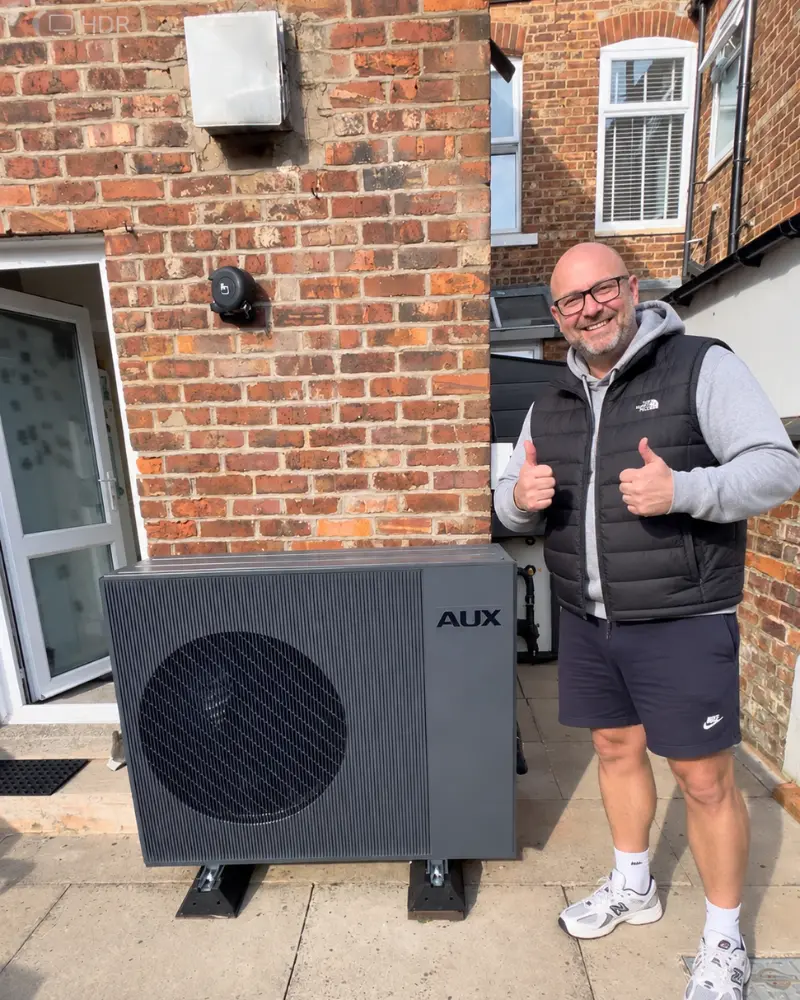
The biggest efficiency improvements at a glance
| Action | Why it helps | Who? |
|---|---|---|
| Reduce the heating curve gradually | Lowers flow temperature and compressor workload | Homeowner, if controls are understood |
| Use steadier heating periods | Avoids large temperature recoveries and unnecessary cycling | Homeowner |
| Improve radiator or emitter output | Helps rooms stay warm at lower water temperatures | Engineer/design check |
| Reduce avoidable heat loss | Lowers the heat demand the system must meet | Homeowner or specialist |
| Keep the outdoor unit clear | Preserves airflow across the heat exchanger | Homeowner |
| Check servicing and system flow | Helps the system transfer heat correctly | Engineer |
Why lower flow temperatures improve heat pump efficiency
A heat pump moves heat from a colder place to a warmer one. In an air-to-water system, refrigerant absorbs heat outdoors, the compressor raises its pressure and temperature, and the system transfers that heat into your heating water.
The larger the temperature lift between outdoor air and heating water, the harder the compressor generally has to work. A system supplying radiators at 40°C will therefore normally operate more efficiently than the same heat pump trying to produce 55°C water under similar conditions.
MCS guidance strongly favours low design temperatures and weather compensation. Its domestic heat-pump guidance gives an example where operating a mixed radiator and underfloor-heating design at 55°C rather than 45°C would reduce whole-system efficiency by about 15%.
For more detail on COP, SCOP and measured seasonal performance, see Get Free Quote’s air source heat pump efficiency guide.
1. Adjust the heating curve before simply raising the thermostat
Weather compensation changes heating flow temperature according to outdoor conditions. In mild weather, the home loses less heat, so the system can use cooler water. When it gets colder, the controller increases the target flow temperature.
The Energy Saving Trust guide to running a heat pump efficiently recommends checking that this heating curve is not set unnecessarily high. Its practical guidance suggests reducing it gradually, often in one-degree steps, until you find the lowest setting that still keeps the property comfortable.
The target is not the lowest number possible. It is the lowest flow temperature that maintains your chosen room temperature in the conditions outside.
For more context, see Get Free Quote’s air source heat pump temperature guide.
2. Let the heat pump run low and steady
A boiler can deliver a large burst of high-temperature heat. A heat pump is normally happier supplying lower-temperature heat for longer.
Turning the heating off for long periods can allow the building fabric to cool. The system may then need a longer recovery period or higher flow temperature to bring the property back to temperature.
Energy Saving Trust therefore advises longer operating periods rather than treating a heat pump like an on-off boiler. Lower flow temperatures also mean the heating system responds more slowly, so allowing sufficient operating time becomes more important.
That does not mean every home needs one temperature 24 hours a day. Schedules still depend on heat loss, occupancy, electricity tariff and controls. However, large temperature swings are rarely the best starting point for maximum efficiency.
3. Check whether your radiators can deliver enough heat at lower temperatures
Lowering flow temperature only works if radiators or underfloor heating can still release enough heat into each room.
Radiator output falls as water temperature falls. A larger radiator has more surface area, so it can often deliver the required room heat at a lower flow temperature. Underfloor heating can also work well because the floor provides a very large emitter area.
Replacing one or two undersized radiators can sometimes allow a lower heating curve for the whole system. However, do not assume every radiator needs replacing. A room-by-room heat-loss calculation should show what each room requires and whether the existing emitter can provide it.
MCS’s current heat-load tools calculate heating requirements in accordance with BS EN 12831-1:2017.
See Get Free Quote’s guide to using a heat pump with existing radiators for the practical checks that matter.
4. Reduce heat loss where it helps the system run cooler
Insulation does not directly change the heat pump’s refrigeration cycle. Instead, it reduces how much heat the building loses.
That can allow the system to maintain comfort with a lower flow temperature, smaller heat output or both. The Centre for Sustainable Energy’s heat-pump guidance explains that reducing a property’s heating demand through insulation and airtightness can make higher seasonal efficiency easier to achieve.
Start with sensible improvements for the property, such as adequate loft insulation, repairing obvious draughts and addressing missing insulation where technically appropriate.
Older and traditionally built properties need extra care. Insulation and draught-proofing measures should not create moisture or ventilation problems simply to reduce heat demand.
5. Optimise hot water without compromising hygiene
Domestic hot water is usually a tougher job for a heat pump than space heating because the cylinder needs hotter water than the radiators often do.
Avoid setting the normal cylinder temperature higher than necessary, but do not disable pasteurisation or Legionella-protection cycles. Follow the manufacturer’s and installer’s settings for hygiene protection.
Energy Saving Trust says that on a standard electricity tariff, heating domestic hot water in the middle of the afternoon can be useful because outdoor air is generally warmer then. With a time-of-use tariff, cheaper electricity periods may be more financially important.
Also check whether an immersion heater or backup heating mode is operating more than expected. Government research has previously identified excessive immersion-heater use as one factor associated with poor whole-system seasonal performance.
6. Keep the outdoor unit clear and the heating circuit healthy
The outdoor unit must move a large volume of air across its heat exchanger. Leaves, dense vegetation, bins or improvised screens can restrict that airflow.
Energy Saving Trust advises keeping the unit clear of obstructions and servicing the heat pump according to manufacturer guidance, commonly around once a year. Typical servicing can include checking controls, coils, filters, refrigerant condition, pumps and other major components.
MCS guidance also highlights clean filters and maintaining the correct system flow rate.
Do not dismantle the outdoor unit yourself. Visual checks and clearing loose debris are reasonable, but refrigerant, electrical, pressure, pump and internal-component checks belong with a competent engineer.
7. Measure performance, but look for trends
COP changes with outdoor temperature, flow temperature, hot-water demand and defrost operation. One cold-day reading does not tell you whether the system is efficient over a year.
If your controller shows heat output and electricity input, monitor weekly or monthly trends. Useful warning signs include electricity consumption rising sharply without a corresponding weather change, rooms no longer reaching temperature, frequent cycling, repeated backup-heater use or a heating curve that continually needs raising.
For bill-focused examples and the relationship between seasonal performance and electricity consumption, see Get Free Quote’s air source heat pump running-costs guide.
What about heat pump efficiency in winter and during defrost?
Efficiency normally falls as outdoor temperature drops because the heat pump has to create a larger temperature lift.
Cold, damp weather can also cause frost to form on the outdoor heat exchanger. The system periodically reverses operation to remove that frost in a defrost cycle.
Defrosting is normal and necessary. It does not automatically mean there is a fault. However, unusually frequent or prolonged defrosting, heavy ice that does not clear, blocked drainage or restricted airflow deserve investigation.
When should you call an engineer?
Call a competent heat-pump engineer if the home cannot reach its design temperature without very high flow temperatures, the system short-cycles persistently, backup heating runs unexpectedly, pressure or flow faults appear, or electricity use changes sharply without an obvious reason.
Ask them to check the heating curve, room-by-room heat loss, radiator outputs, system flow rate, balancing, filters or strainers, controls and whether the heat pump is correctly sized.
A poorly performing heat pump should be diagnosed systematically rather than simply having its flow temperature raised until the rooms become warm.
Get Your Free Air Source Heat Pump Quote
Find the right air source heat pump solution for your home. Tell us a few details and our team will help you explore suitable options at a competitive price.
Quick to complete. No obligation.
Get your quote
Enter your details below and one of our team will get back to you.
Frequently asked questions
Find clear answers to common questions about air source heat pump efficiency and settings, including flow temperature, weather compensation, heating schedules, radiators, insulation, underfloor heating, defrosting, tariffs, solar PV, servicing and performance problems.
There is no single ideal temperature for every home. The best setting is the lowest flow temperature that can maintain comfortable room temperatures during the weather outside. Many systems are designed around lower-temperature operation, often roughly 35–45°C, but property heat loss and radiator sizing determine what is achievable.
Usually, yes. Lower heating-water temperatures reduce the temperature lift the compressor needs to create, which generally improves efficiency.
Longer, steadier operating periods often suit heat pumps better than repeatedly switching them off and asking them to recover quickly later. However, the best schedule still depends on the property, controls, occupancy and tariff.
Not necessarily. Some homes need around 50°C or more during colder conditions. However, if the property can remain comfortable at a lower temperature, reducing the flow temperature will normally improve efficiency.
Weather compensation automatically lowers heating-water temperature when the weather becomes milder and raises it when conditions become colder. This helps the heat pump match the building's heating demand more closely and can reduce unnecessary cycling.
Large overnight setbacks can create a substantial recovery load the next morning. A smaller setback or steadier temperature may work better for many heat-pump systems.
Yes, where existing radiators are limiting the system. Greater radiator surface area can provide the required room heat using cooler water, allowing a lower flow temperature.
Insulation mainly reduces the home's heat demand rather than changing the heat pump itself. Lower heat loss can make it easier to heat the property at lower flow temperatures, which can improve seasonal system efficiency.
It can be particularly well suited to heat pumps because its large surface area can provide useful heat at relatively low water temperatures. However, a correctly designed radiator system can also perform very efficiently.
Colder outdoor air creates a greater temperature difference between the heat source and the heating water. The compressor therefore has to work harder. Defrost cycles during cold, damp conditions can also temporarily reduce performance.
Some defrosting is completely normal in cold, damp weather. Very frequent cycles, persistent heavy ice or ice that fails to clear can indicate an airflow, drainage or technical problem that should be investigated.
Solar panels do not directly increase the heat pump's COP. They can, however, supply some of the electricity the system uses and therefore reduce the amount purchased from the grid.
No. A specialist or time-of-use tariff changes the price paid for electricity rather than the thermodynamic efficiency of the heat pump. Smart scheduling can nevertheless reduce running costs.
Follow the manufacturer's servicing schedule. Energy Saving Trust says this will usually mean an engineer service around once a year.
Warning signs include unusually high electricity use, rooms failing to reach temperature, persistent short cycling, frequent backup-heater use, flow or pressure errors, continual icing or needing unusually high flow temperatures to remain comfortable.
Conclusion
The most effective way to improve heat pump efficiency is to reduce the amount of work the compressor has to do while still keeping your home comfortable.
Start with the heating curve and flow temperature. Then look at operating pattern, radiator capacity, heat loss, hot-water settings and maintenance. Small changes can help, but persistent poor performance often points to a design, commissioning or hydraulic issue that needs proper diagnosis.
A good system should adjust to the weather, run steadily and deliver the required room temperatures with the lowest practical water temperature.
Planning a new heat pump or replacing a poorly performing system? Ask each installer to show the proposed room-by-room heat loss, design flow temperature and expected seasonal performance in writing before comparing quotations.


