
Air Source Heat Pump Servicing: How Often? UK Guide
Check Your Eligibility for Boiler Upgrade Scheme (BUS)
Complete your details below to check your eligibility.
Thank you
We've received your details and will be in touch shortly.

Quick Answer: How Often Should an Air Source Heat Pump Be Serviced?
Most air source heat pumps should be serviced every 12 months. According to Energy Saving Trust’s heat-pump maintenance guidance, homeowners should follow the manufacturer’s advice, which is usually an annual service. Some manufacturers also require yearly servicing to keep a warranty or guarantee valid.
Between services, keep the outdoor unit clear of leaves, bins and other obstructions, watch for error codes and follow the user manual. Book an engineer sooner if heating performance drops, the system becomes unusually noisy, pressure keeps falling, leaks appear or faults repeatedly return.
The safest rule is simple: check the manual and warranty, then schedule the next service before that interval expires.
How Often Should an Air Source Heat Pump Be Serviced?
For most UK homes, an air source heat pump should be professionally serviced once a year. The exact interval should follow the manufacturer’s instructions because requirements can vary by model, warranty and system design.
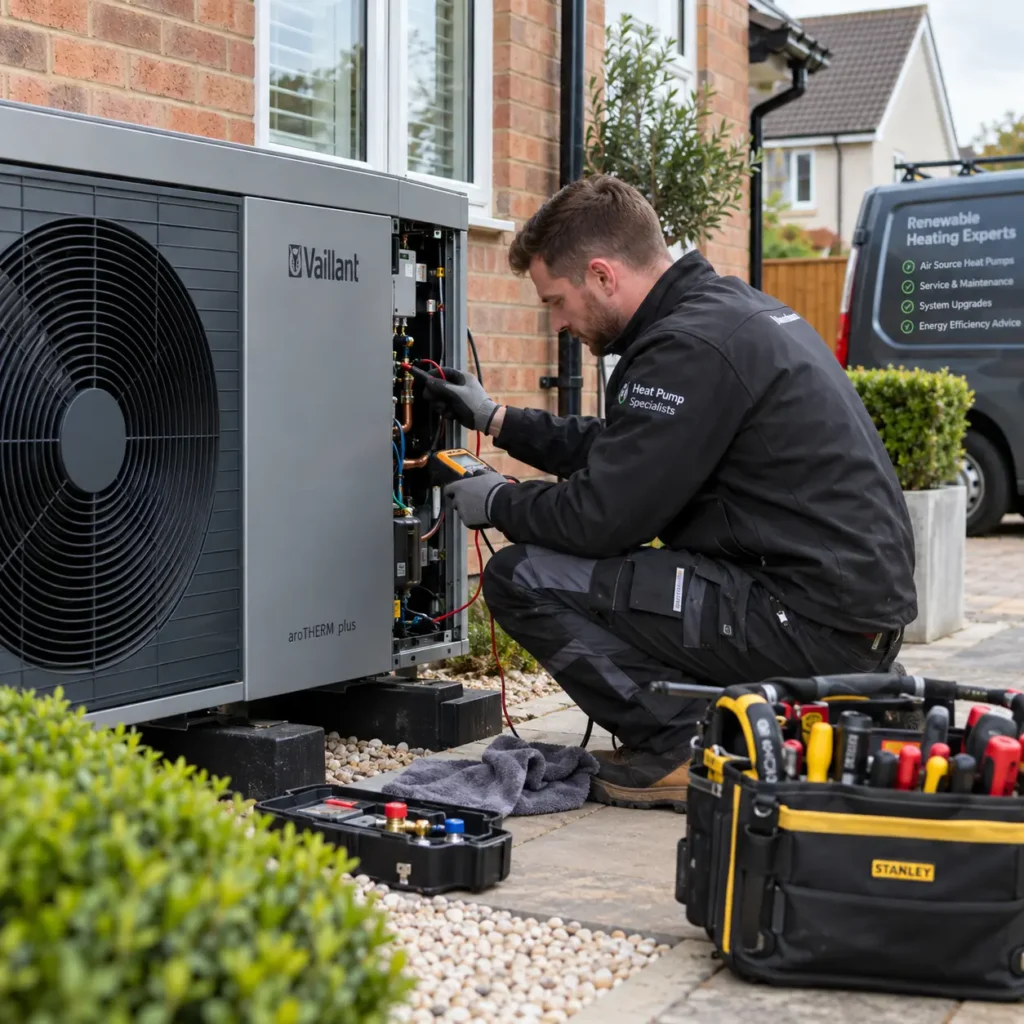
Annual servicing is planned maintenance rather than a repair visit. It checks whether the outdoor unit, water circuit, controls, electrics and other relevant components are operating as intended. It can also identify developing problems before they affect comfort or cause a breakdown.
If you are new to the technology, our guide to how air source heat pumps work explains the system behind these checks.
Considering a new heat pump? Compare survey-led installation options before choosing equipment or accepting a quotation.
How Often Should an Air Source Heat Pump Be Serviced?
For a typical domestic air source heat pump, once every 12 months is the normal interval. Energy Saving Trust says an engineer should service a heat pump according to the manufacturer’s advice, usually once a year.
The manufacturer’s schedule takes priority over any general rule. Check the installation handover pack, user manual and warranty terms.
The current MCS Heat Pump Standard requires relevant handover information to include maintenance requirements and warranty details. It also requires the handover documentation to state the recommended interval for the first periodic inspection.
| Situation | Practical approach |
|---|---|
| Normal domestic use | Usually one professional service every 12 months |
| New installation | Follow the first inspection interval in the handover documents |
| System under warranty | Do not miss any servicing interval required by the warranty |
| Persistent faults or reduced performance | Arrange diagnosis rather than waiting for the annual service |
| Outdoor unit exposed to heavy debris | Check and clear the surrounding area more often |
Keep service reports with your warranty paperwork so there is a clear maintenance history.
What Does an Air Source Heat Pump Service Include?
A proper service should assess the heat pump as part of a complete heating system. Exact checks vary by manufacturer and installation.
Outdoor unit, airflow and drainage
The engineer may inspect the coil, fan, casing and air path, then clean components where the manufacturer allows it. Restricted airflow can make the outdoor unit work harder.
Condensate drainage and abnormal icing also deserve attention. Frost can be normal in cold, damp weather because heat pumps use automatic defrost cycles. Heavy icing that does not clear can indicate a fault.
Water circuit and heating components
For an air-to-water system, servicing may include checking pressure, circulation pumps, filters or strainers, valves, flow and return temperatures, expansion components and visible pipework.
Where antifreeze or corrosion inhibitor is used, the engineer may check it in line with the system specification. If you have a hot-water cylinder, confirm whether it is included in the quoted service.
Energy Saving Trust lists common service checks including electrical safety, thermostat operation, filters and coils, refrigerant condition and major components such as the compressor, fan and pump.
Controls, electrics and performance
A service commonly includes electrical safety checks, thermostat or controller operation, fault history and a performance assessment.
Running cost is influenced by more than the heat pump itself. Flow temperature, weather compensation, schedules and system balancing can all change how hard the compressor works.
If electricity use has risen, compare the findings with your wider air source heat pump running costs rather than assuming the heat pump itself needs replacing.
Refrigerant checks
The engineer may inspect for refrigerant leakage and perform manufacturer-required checks.
Where fluorinated greenhouse gases are involved, refrigerant work is regulated. GOV.UK states that people working on equipment containing F-gas need the relevant qualifications, while businesses servicing qualifying stationary equipment may also require company certification.
Homeowners should not open the refrigerant circuit or attempt DIY refrigerant repairs.
Why Does Annual Servicing Matter?
One reason is warranty protection. Requirements differ between manufacturers, so always check your own paperwork.
Vaillant states that its heat pumps should be serviced annually and says failure to do so can invalidate its guarantee. Daikin also advises annual servicing and states that yearly servicing is required to maintain warranty cover.
Servicing also gives an engineer an opportunity to find developing faults before winter demand exposes them. A blocked filter, deteriorating electrical connection or control problem may be easier to address during planned maintenance than after a breakdown.
Finally, it helps preserve efficient operation. Servicing cannot correct poor system design, but it can identify dirty heat-transfer surfaces, restricted flow or control issues that may reduce performance.
See our air source heat pump efficiency guide for the wider factors that affect seasonal performance.
When Should You Arrange an Earlier Service?
Do not wait for the annual date if the system has a persistent problem.
Arrange professional diagnosis for repeated fault codes, new mechanical noises, leaks, pressure that repeatedly drops, unreliable hot water, rooms no longer reaching their usual temperature, or ice that does not clear after defrosting.
A sudden increase in electricity use can also justify investigation. However, higher consumption does not automatically mean there is a fault. Colder weather, thermostat changes, electricity tariffs and increased hot-water demand can also raise bills.
If a newly installed system has never performed properly, the issue may involve commissioning, controls or design rather than routine maintenance. Our air source heat pump installation guide explains the main installation and commissioning stages.
What Maintenance Can You Do Yourself Between Services?
Homeowner maintenance should be simple and non-invasive.
Energy Saving Trust advises keeping the outdoor unit clear of obstructions such as leaves, wheelie bins and other items that restrict airflow.
Remove loose leaves and vegetation, keep stored items away from the air path, and look for visible blockages around the coil or drainage area. Follow the manufacturer’s instructions for any filters designed for user cleaning.
Check the controller for warning messages and learn what normal defrost behaviour looks like. If the manual explains how to view system pressure, you can monitor it, but repeated pressure loss needs investigation.
Avoid removing panels, pressure-washing the coil, altering refrigerant pipework or changing technical installer settings.
How Much Does Air Source Heat Pump Servicing Cost in the UK?
There is no single UK price.
Energy Saving Trust says heat-pump servicing typically costs around £150. Daikin gives an indicative annual servicing range of approximately £150–£300, while Baxi currently advertises one-off air source heat pump servicing from £200.
For budgeting, roughly £150–£300 is therefore a reasonable indicative range for many domestic air source heat pump services in 2026. It is not a guaranteed quotation.
Before booking, ask whether the price includes:
- The heat pump only or the hot-water cylinder as well.
- VAT and travel.
- A written service report.
- Cleaning required by the manufacturer.
- Diagnostic work.
- Replacement parts or repairs.
Comparing like-for-like service scopes matters more than simply choosing the lowest headline price.
Who Should Service an Air Source Heat Pump?
Use a competent engineer who is trained and experienced with heat pumps and, ideally, familiar with your manufacturer.
MCS certification is particularly important for qualifying heat-pump installations and is a useful quality signal. However, servicing competence still needs to match the work being carried out.
If an engineer will work on an F-gas refrigerant circuit, the relevant legal qualification requirements apply.
When booking, provide the make, model, installation date and any fault codes. Ask whether the engineer can complete the manufacturer’s service checklist and provide a written record afterwards.
When Is the Best Time of Year to Book a Service?
Any time is suitable if you remain within the required service interval.
Late spring, summer or early autumn can be practical because any faults can be addressed before the main heating season. Energy Saving Trust similarly recommends annual servicing and suggests doing it before winter where practical.
However, do not delay a warranty-required service simply to reach your preferred season. If the annual deadline falls during winter, book it on time.
Is Annual Air Source Heat Pump Servicing Worth It?
For most homeowners, annual servicing is a sensible part of ownership.
It supports warranty compliance where required, creates a maintenance history and gives a trained engineer a regular opportunity to identify problems.
It cannot guarantee low bills or prevent every breakdown. Correct sizing, good installation, suitable heat emitters and properly configured controls still matter.
Treat servicing as one part of long-term system care, alongside running costs, warranty protection and access to repair support.
Get Your Free Air Source Heat Pump Quote
Find the right air source heat pump solution for your home. Tell us a few details and our team will help you explore suitable options at a competitive price.
Quick to complete. No obligation.
Get your quote
Enter your details below and one of our team will get back to you.
Frequently asked questions
Find clear answers to common questions about air source heat pump servicing, maintenance, warranties, service costs, outdoor-unit care, system pressure, hot-water cylinders and service records.
Usually once every 12 months. Always check the manufacturer’s instructions because the specified interval should take priority. Energy Saving Trust also recommends annual servicing in most cases.
There is no single rule making an annual service compulsory for every domestic heat pump simply because it is a heat pump. However, your manufacturer may make annual servicing a condition of warranty or guarantee cover.
It can. For example, Vaillant explicitly states that failure to service its heat pumps annually can invalidate the guarantee. Check the conditions applying to your own system.
You can carry out simple homeowner checks such as keeping the outdoor unit clear. Professional servicing, electrical work and refrigerant work should be left to appropriately competent engineers.
It can include checking the outdoor coil and fan, filters, water pressure and flow, controls, electrical connections, refrigerant condition, pumps and overall system performance. Exact checks depend on the manufacturer.
A useful 2026 budgeting range is around £150–£300 for many domestic systems. Energy Saving Trust quotes around £150, although actual prices depend on location, manufacturer and service scope.
Spring, summer or early autumn can be convenient because there is time to fix problems before winter. The more important point is not to exceed the manufacturer’s required interval.
Yes, if the manufacturer specifies regular servicing. Preventive maintenance is intended to identify issues before they become obvious faults.
MCS certification is central to qualifying installations, but routine servicing requirements depend on the work involved and the manufacturer. Refrigerant work involving F-gas requires the appropriate qualifications.
Not necessarily. Some quotes cover only the heat pump. Ask whether your cylinder and its relevant controls or safety components are included.
Yes. Keeping the outdoor unit clear helps maintain unrestricted airflow. Do not dismantle the unit or use aggressive cleaning methods unless the manufacturer instructs you to do so.
Not always. Frost can form during cold, damp weather and the unit should periodically defrost itself. Persistent ice that does not clear may need professional investigation.
Yes. Repeated pressure loss may indicate a problem that needs diagnosing. Continually topping up the system without finding the cause is not a substitute for a repair.
Servicing may help where dirt, restricted flow or incorrect operation is reducing performance. However, running costs also depend heavily on system design, flow temperatures, tariffs, weather and household demand.
Yes. Keep invoices and service reports with your installation and warranty documents. They provide a useful maintenance history and may help demonstrate compliance with warranty conditions.
Conclusion
Most UK air source heat pumps should be serviced once a year unless the manufacturer specifies otherwise.
Check the manual and warranty, keep the outdoor unit unobstructed between visits, and arrange an engineer sooner if performance changes or faults appear.
A good service should check the parts that affect airflow, water circulation, controls, electrical safety and overall performance. Any regulated refrigerant work should be carried out by appropriately qualified people.
If you are planning a heat-pump installation or comparing replacement heating options, Get Free Quote can help you compare suitable home-improvement quotations without obligation.


