
Best Heat Pump Temperature Settings UK | 2026 Guide
Check Your Eligibility for Boiler Upgrade Scheme (BUS)
Complete your details below to check your eligibility.
Thank you
We've received your details and will be in touch shortly.

Quick Answer
For most homes, the best heat pump temperature settings are the lowest settings that keep every occupied room comfortable. A sensible starting point is around 18–21°C indoors, with weather compensation controlling the heating-water temperature. Well-designed radiator systems may often run around 35–45°C, while underfloor heating can often work at roughly 30–40°C. Use long, steady heating periods rather than large temperature swings. If you use a night setback, keep it modest. Hot-water settings are separate from space heating: follow the manufacturer’s comfort and hygiene settings, including the scheduled high-temperature disinfection cycle. Exact settings depend on heat loss, emitters, controls and the heat-pump model.
Best Temperature Settings for an Air Source Heat Pump
The best heat pump temperature settings are not one fixed set of numbers for every home. The aim is to keep your home comfortable while asking the heat pump to produce the coolest water your radiators or underfloor heating can use effectively.
For many UK homes, that means a room temperature around 18–21°C, weather compensation switched on, and a space-heating flow temperature often around 30–45°C when the system has been designed for low-temperature operation. Some homes need higher flow temperatures, especially in cold weather or where existing radiators have limited output.
This guide focuses on day-to-day settings: room temperature, flow temperature, heating curves, setbacks and hot water. For the separate question of outdoor operating temperatures, see the air source heat pump temperature guide.
Get a free quote: If you are planning a heat-pump installation, compare property-specific designs rather than choosing settings from a generic chart.
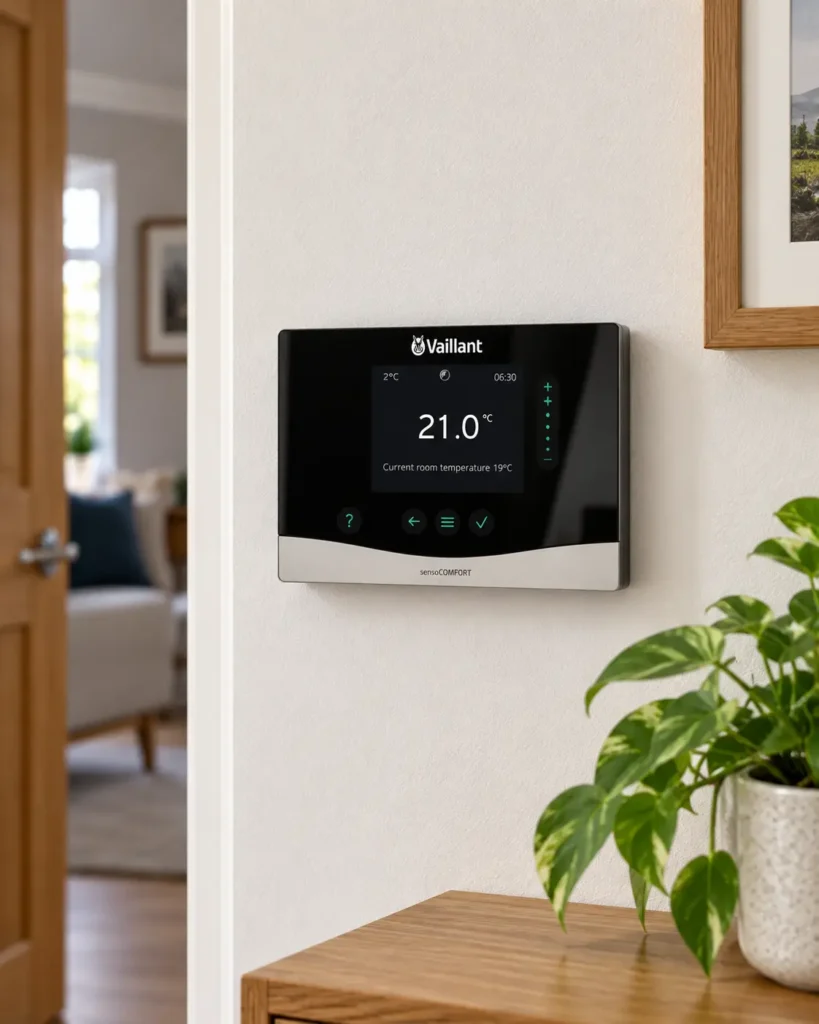
Best Heat Pump Settings at a Glance
| Setting | Useful starting point | Main consideration |
|---|---|---|
| Room temperature | 18–21°C | Lowest comfortable temperature for your household |
| Radiator flow temperature | Often 35–45°C | Only where emitters can meet the room heat loss |
| Underfloor heating flow temperature | Often 30–40°C | Floor construction and design matter |
| Overnight setback | Small rather than dramatic | Large drops can create a long recovery |
| Weather compensation | Usually on | Heating curve should match the home |
| Hot-water comfort setting | Commonly around 48–55°C | Follow system instructions |
| Disinfection cycle | System-specific, often above 60°C periodically | Do not disable hygiene controls without advice |
These are starting points, not universal commissioning values. Your installer’s heat-loss calculation and design flow temperature should take priority.
What Room Temperature Should You Set?
For many households, around 18–21°C is a practical comfort range. Current MCS design-temperature reference data uses room-specific design temperatures, including 21°C for living rooms and 22°C for bathrooms.
Do not treat the thermostat like an accelerator. Setting it to 24°C does not make a heat pump warm the house faster. It simply asks the system to keep heating until the higher target is reached.
Choose a comfortable target and keep it relatively stable. Older people, young children and people with health-related heating needs may need warmer conditions, so comfort and health come first.
What Is the Best Heat Pump Flow Temperature?
Flow temperature is the temperature of the water leaving the heat pump for your radiators or underfloor heating.
The most efficient setting is usually the lowest temperature that can still replace the heat your home is losing. Lower water temperatures reduce the temperature lift the compressor must achieve, which generally improves efficiency. UK field evidence also shows a relationship between higher average flow temperatures and lower seasonal heat-pump efficiency.
In a well-designed low-temperature radiator system, 35–45°C is a useful reference range. Underfloor heating can often work lower because it has a larger heat-emitting area. However, an older property with smaller radiators may need 50°C or more during cold weather.
Do not force the flow temperature down just to hit an internet target. If 40°C cannot keep the coldest room comfortable, the system needs a different setting or a design check.
For more detail on why temperature affects performance, see the air source heat pump efficiency guide.
Use Weather Compensation Instead of Chasing the Weather
Weather compensation adjusts flow temperature according to outdoor conditions. When it is mild, the heat pump can send cooler water around the home. As it gets colder, the controller raises the flow temperature.
Energy Saving Trust guidance on running a heat pump efficiently says the heating curve should be set during installation, but it can sometimes be higher than necessary. Its guidance suggests making small reductions and checking whether the home remains comfortable.
The principle is simple: the system should deliver only as much water temperature as the property needs at that outdoor temperature. Weather compensation can therefore maintain steadier operation and improve efficiency compared with unnecessarily high fixed temperatures.
How to Adjust a Heating Curve
If every room is consistently too warm, the curve may be too high. Reduce it in a small step, then give the building time to respond.
If the home is comfortable in mild weather but too cold on the coldest days, the cold-weather end of the curve may need attention.
Change one setting at a time. Otherwise, you will not know which adjustment improved or worsened performance.
Should You Use an Overnight Setback?
Heat pumps usually suit long, steady heating periods better than short, high-temperature bursts.
A small overnight setback can reduce heat demand while you sleep. However, a large setback may leave the system recovering several degrees during the coldest part of the morning.
Energy Saving Trust recommends longer running periods and describes lowering indoor temperature by a few degrees when appropriate as a useful heat-pump strategy.
Many households can start with no setback or a modest reduction of around 1–2°C, then adjust according to comfort and how the property responds. Homes with underfloor heating often change temperature slowly, so large scheduled swings can be particularly impractical.
A time-of-use electricity tariff can change the calculation. Some households may pre-heat slightly during cheaper periods while still avoiding extreme temperature changes.
What Temperature Should Heat-Pump Hot Water Be?
Domestic hot water needs a separate approach because it normally requires a higher temperature than space heating.
Energy Saving Trust’s installer guidance notes that normal hot-water comfort settings are often around 48°C, while many systems use the compressor to reach roughly 50–55°C. A separate disinfection cycle periodically raises the cylinder to a higher temperature, often 60°C or above, sometimes using an immersion heater.
Do not lower or disable the disinfection programme simply to reduce electricity use. Follow the heat-pump and cylinder manufacturer’s instructions and the settings given at commissioning.
Where controls allow it, a time-of-use tariff may make a cheaper period attractive for heating water. Energy Saving Trust also notes that, on a standard tariff, scheduling hot-water production when outside air is warmer can improve the efficiency of an air source heat pump.
Radiators and Underfloor Heating Need Different Settings
Radiators need hotter water as they become smaller relative to the room’s heat loss. That is why efficient heat-pump radiators may feel only warm rather than boiler-hot.
If your radiators can deliver enough heat at 40°C, running them at 50°C merely to make them feel hotter can reduce efficiency. If they cannot, the answer may be a higher design flow temperature, larger radiators, better balancing or reduced building heat loss.
The heat-pump radiator guide covers emitter suitability in more detail.
Underfloor heating usually works at lower water temperatures because the floor provides a large emitting area. It also responds slowly, so give it time before making repeated thermostat changes.
Best Heat Pump Settings for Winter
You should not normally need a completely different manual setup for winter. Weather compensation should raise the flow temperature automatically as outdoor temperature falls.
During a cold spell, check whether the coldest occupied room holds its target temperature. If it does, avoid increasing the curve simply because the radiators feel cooler than boiler radiators.
Defrost cycles are normal in cold, damp weather and are not a reason to raise the thermostat. Heating boost or backup resistance heat can help in specific conditions, but Energy Saving Trust advises configuring boost so it operates only when genuinely needed.
Temperature, weather and seasonal efficiency all affect bills, so see the air source heat pump running-cost guide for the financial side.
How to Fine-Tune Your Heat Pump
- Pick a realistic room target, such as 19–21°C.
- Check the commissioning settings and note the design flow temperature before changing anything.
- Change one thing at a time, using small adjustments.
- Lower the heating curve gradually if the home remains comfortably warm.
- Test through different weather, not just one mild day.
- Watch the coldest room, which often shows whether flow temperature is sufficient.
- Compare electricity use over days, because weather and hot-water demand distort short snapshots.
| What you notice | What to check first |
|---|---|
| Too warm in mild weather | Heating curve may be too high |
| Fine in mild weather, cold in a cold snap | Cold-weather curve, emitter output or system design |
| Long morning recovery | Setback may be too deep |
| High hot-water electricity use | Hot-water setpoint, schedule and immersion/boost |
| Frequent starting and stopping | Controls, water flow and closed emitters |
| One room stays cold | Radiator size, balancing and room heat loss |
Treat this table as a troubleshooting starting point, not a diagnosis.
When Should You Ask an Installer to Check the Settings?
Ask a competent heat-pump engineer to review the system if it cannot reach its designed room temperature, needs a much higher flow temperature than the design documents suggest, uses direct-electric backup frequently, short-cycles persistently or you do not have the commissioning information.
Settings cannot compensate for an undersized heat pump, inadequate emitters, poor water flow or an inaccurate heat-loss calculation. MCS guidance treats room-by-room heat-loss assessment as fundamental to correct heat-pump sizing and system design.
Get Your Free Air Source Heat Pump Quote
Find the right air source heat pump solution for your home. Tell us a few details and our team will help you explore suitable options at a competitive price.
Quick to complete. No obligation.
Get your quote
Enter your details below and one of our team will get back to you.
Frequently asked questions
Find clear answers to common questions about heat pump temperature settings, flow temperatures, weather compensation, radiators, underfloor heating, hot water, thermostats and heating-curve adjustments.
For many UK homes, a room target of around 18–21°C combined with weather compensation and the lowest practical heating flow temperature is a sensible approach. Exact settings depend on the property and system design.
A suitably designed low-temperature radiator system may often operate around 35–45°C. Some properties require 50°C or more during colder weather.
Around 30–40°C is common for heat-pump underfloor heating, although the correct figure depends on floor construction, heat loss and system design.
Not necessarily. Many systems can operate at 50°C or higher. However, efficiency normally falls as the required water temperature rises, so there is little benefit in using 50°C if 40–45°C keeps the property comfortable.
Long operating periods are normal and can be efficient. A heat pump does not necessarily need to run continuously for 24 hours, but repeatedly switching it off and reheating a cold house may be less effective than maintaining a steadier temperature.
A modest setback can work well. Large setbacks may create a long morning recovery, particularly with underfloor heating or high thermal-mass properties.
Usually, yes, where the system has been designed and commissioned to use it. Weather compensation reduces flow temperature in milder conditions and raises it as outdoor temperatures fall.
Lower flow temperatures generally improve efficiency if the home still reaches its target temperature. There is no guaranteed saving because the result depends on the property, weather, electricity tariff and system performance.
Normal stored hot-water settings are often around 48–55°C, depending on the system. A separate scheduled hygiene cycle may periodically raise the cylinder above 60°C.
You should not disable a manufacturer's hot-water hygiene programme simply to reduce electricity consumption. Follow the commissioning settings and manufacturer's instructions.
Normally, no. The thermostat sets the target room temperature. Increasing that target does not automatically increase the heat pump's heating rate.
Usually not if weather compensation is correctly configured. The controller should increase the required flow temperature automatically as outdoor conditions become colder.
It depends on the hydraulic design. Closing many emitters can reduce system water flow and may cause control problems on some installations. Follow the commissioning instructions before making major changes.
The radiators or underfloor heating may not provide enough output at that temperature, particularly during cold weather. Heat loss, emitter size, balancing and the heating curve should all be checked.
Give the property enough time to respond before making another change. A full day or longer can be sensible, particularly with underfloor heating or high thermal mass. Energy Saving Trust advises gradual adjustments rather than large changes.
Conclusion:
The best heat pump temperature settings are the lowest practical settings that keep your home comfortable without forcing repeated recovery cycles.
For many UK homes, start with a steady 18–21°C room target, use weather compensation, keep setbacks modest and aim for the lowest effective flow temperature. Treat hot-water temperature separately and keep the required hygiene cycle intact.
If you are still choosing a system, compare designs using the proposed flow temperature, emitter output and expected seasonal efficiency—not just the heat-pump model. A property-specific survey is the right place to establish those figures.


