
Heat Pump Not Heating? Causes & Fixes UK Guide 2026
Check Your Eligibility for Boiler Upgrade Scheme (BUS)
Complete your details below to check your eligibility.
Thank you
We've received your details and will be in touch shortly.

Quick answer: why is my heat pump not heating?
A heat pump that runs but does not warm the house properly may have an incorrect thermostat or heating schedule, unsuitable weather-compensation settings, inadequate water flow, air in the heating system, incorrectly balanced radiators, undersized emitters or a system that cannot meet the property’s heat loss.
Cold weather and temporary defrost cycles can also reduce heat output without indicating a fault.
Start with the controller, heating schedule, room temperature and any displayed error codes. Make sure the outdoor unit has unobstructed airflow. If the system repeatedly stops, shows a fault, cannot reach its target temperature or remains cold after basic checks, contact a heat-pump engineer rather than opening the unit or attempting refrigerant or electrical repairs. Manufacturer fault guidance recommends professional diagnosis for internal faults.
If you qualify for the standard £7,500 Boiler Upgrade Scheme grant, your contribution could fall to around £500 to £5,000.
In addition, some installers offer £0 customer-contribution deals for suitable smaller homes when the complete installation can be delivered within the available grant funding.
However, the price can rise if you need several new radiators, a new hot-water cylinder, electrical upgrades or major pipework changes.
Therefore, the best way to establish your true cost is through a property survey and room-by-room heat-loss calculation.
Why Is My Air Source Heat Pump Not Heating Properly?
If your heat pump is not heating your home properly, it does not automatically mean the outdoor unit has failed. A surprising number of heating problems come from controls, flow temperature, poor water circulation, undersized radiators or a system that has not been set up correctly.
Air source heat pumps also feel different from gas boilers. Their radiators are normally cooler, and they often run for much longer periods. Energy Saving Trust says heat pumps commonly supply radiators with water at around 35–45°C, although the correct temperature depends on the property and heating design.
The important question is therefore not whether your radiators feel very hot. It is whether the system can maintain the indoor temperature you have asked for.
This guide explains the checks you can safely make yourself, the most common reasons an air source heat pump struggles to heat a home and when you should call an engineer.
If the problem appears to involve the original system design or you are considering replacement options, you can also compare heating quotes with Get Free Quote.
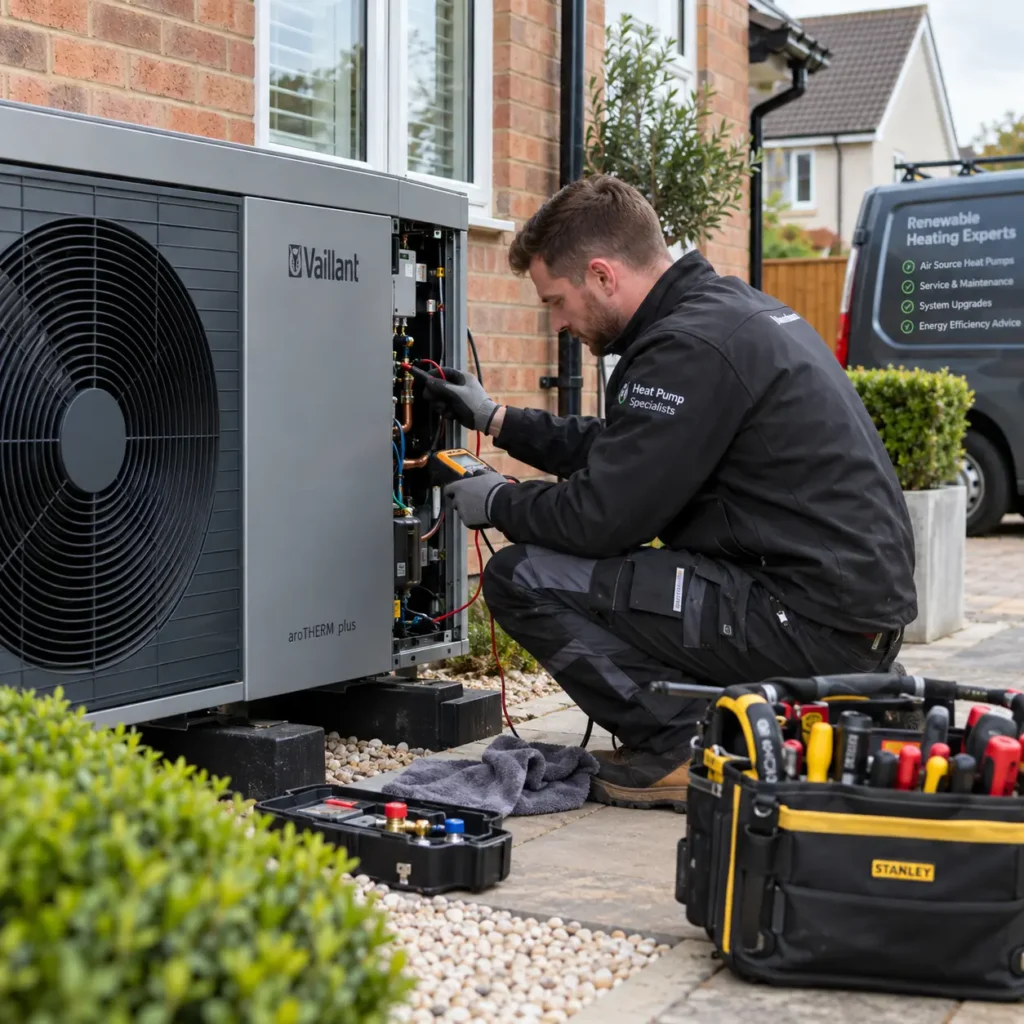
Heat pump not heating: symptoms at a glance
| Situation | Recommended action |
|---|---|
| One simple setting was wrong and normal heating returns | Continue monitoring |
| Outdoor unit was obstructed and works normally once safely cleared | Monitor performance |
| Recurring error or flow code appears | Contact a qualified heat-pump engineer |
| Home cannot maintain temperature in cold weather | Request system/design checks |
| Several radiators have poor circulation | Have the hydraulic system inspected |
| Outdoor coil remains heavily iced | Arrange diagnosis |
| Breaker repeatedly trips | Stop resetting it and call a professional |
| Refrigerant, compressor, electrical or internal component fault is suspected | Professional repair only |
First, check whether the heat pump is actually underperforming
A radiator connected to a heat pump often feels noticeably cooler than one connected to a traditional boiler.
That can be completely normal.
Heat pumps usually work most efficiently by delivering lower-temperature water for longer periods. Energy Saving Trust notes that radiators can still heat a property effectively at these lower temperatures, although some homes need larger emitters.
Judge performance by room temperature, not radiator temperature.
If your thermostat is set to 20°C and the home remains close to 20°C during normal conditions, warm rather than hot radiators are not necessarily a problem.
For a deeper explanation of suitable temperatures, see the Get Free Quote guide to air source heat pump temperatures.
What should you check before calling an engineer?
Start with the simple controls you can inspect without dismantling anything.
Check that space heating is enabled rather than the system being set to hot-water-only, holiday or cooling mode. Then check the thermostat target and heating schedule.
Look at the controller for warnings or fault codes. Energy Saving Trust recommends investigating recurring control-screen warnings rather than ignoring them.
Next, inspect the outdoor unit from outside. Remove obvious leaves or other loose obstructions around it without removing covers. Good airflow matters, and Energy Saving Trust specifically recommends keeping outdoor units free from items and debris that obstruct air circulation.
If your manufacturer provides a pressure reading, compare it with the operating range in your own manual. Do not assume that a pressure quoted for another model applies to yours.
Incorrect controls or weather compensation
One of the most important settings is the weather-compensation curve, sometimes called the heating curve.
Weather compensation changes the heating-water temperature according to the temperature outside. When outdoor conditions become colder, the system normally raises its flow temperature. During milder weather, it lowers it.
That allows the heat pump to provide enough heat without producing unnecessarily hot water.
Energy Saving Trust explains that weather compensation helps the system adjust its output as weather conditions change. MCS guidance likewise says weather compensation should be available on MCS space-heating installations.
If the curve is set too low, your heat pump may appear to operate normally while the house gradually becomes colder.
Conversely, simply turning the curve dramatically higher is not always the right fix because higher flow temperatures generally reduce heat-pump efficiency. MCS guidance emphasises that efficiency improves as required flow temperature falls.
Is the flow temperature too low?
Flow temperature means the temperature of the water leaving the heat pump for your radiators or underfloor heating.
Many radiator systems operate around 35–45°C, but that range is not a universal target. A property with higher heat loss or smaller radiators may require a different design temperature.
If the flow temperature is below what the heating system was designed for, the radiators may not release enough heat to replace the heat being lost through walls, windows, floors and ventilation.
However, raising the setting without knowing the design can mask another problem. A better approach is to establish the system’s specified design flow temperature and weather-compensation settings.
Poor water circulation can limit heat output
An air-to-water heat pump relies on sufficient water circulating through the heating system.
Problems such as trapped air, blocked strainers, partially closed valves, circulation-pump faults or incorrect balancing can reduce that flow.
This matters because the heat produced by the heat pump still has to reach the radiators or underfloor heating.
Manufacturer fault documentation illustrates the point. Vaillant lists causes of low-flow faults including air, blocked dirt filters, circulation-pump problems and closed heating circuits. It also advises professional repair rather than homeowner intervention inside the appliance.
If several radiators remain unexpectedly cold or the heat pump repeatedly stops with a flow-related error, arrange professional diagnosis.
Your radiators may not provide enough heat
A heat pump can be working perfectly while the rooms remain cold if the radiators are too small for the operating temperature.
Radiator output falls as the temperature difference between the radiator and the room decreases. That is why systems designed around lower flow temperatures often use larger radiators.
Energy Saving Trust explains that increasing radiator surface area can provide sufficient room heating while using lower-temperature water.
Do not assume every radiator needs replacing. Each room should ideally be checked against its calculated heat loss.
If one bedroom is always cold while the rest of the property is comfortable, for example, the problem may be local to that room rather than the heat pump itself.
Read the Get Free Quote guide to heat-pump radiators and radiator sizing for more detail.
Could the heat pump itself be too small?
If the entire property becomes progressively colder whenever outdoor temperatures fall, system sizing deserves investigation.
Heat-pump sizing should be based on the building’s design heat loss rather than floor area alone.
A system that cannot provide enough heat at the local design outdoor temperature may run continuously without catching up. Conversely, a cold house does not prove that the heat pump is undersized: incorrect controls, restricted flow and inadequate radiators can produce similar symptoms.
Ask for the original heat-loss calculation and design documentation before drawing conclusions.
The Get Free Quote guide to heat-loss calculations for heat pumps explains what those figures mean.
Does frost on the outdoor unit mean it has stopped working?
Not necessarily.
During cold, damp conditions, moisture can freeze on the outdoor heat exchanger. The heat pump then periodically enters a defrost cycle to remove the ice.
During defrost, space-heating output may temporarily reduce. You might also notice the outdoor fan stop, water beneath the unit or a cloud of vapour.
Daikin describes these defrost cycles as a normal part of cold-weather operation.
The concern is persistent heavy icing that does not clear, repeated faults or a system that fails to restore normal heating afterwards.
Why does the heating stop when hot water is being produced?
Many air-to-water systems alternate between heating the house and heating the domestic hot-water cylinder.
When the cylinder requires heat, the controls may temporarily prioritise hot water. MCS guidance notes that domestic hot-water production normally requires different, often higher, temperatures from space heating.
A short interruption to radiator heating can therefore be normal.
However, excessive hot-water schedules, incorrect controls or valve problems can leave too little time for space heating. If the house regularly becomes cold after long cylinder-heating periods, ask an engineer to review the control strategy.
When should you call a heat-pump engineer?
| Cost factor | How it affects the quote | What you should check |
|---|---|---|
| Heat loss | Higher heat loss can require more heating output | Ask for room-by-room calculations |
| Radiators | Some may need replacing with larger models | Ask which radiators stay and which change |
| Hot-water cylinder | Combi-boiler homes normally need stored hot water | Check whether the cylinder is included |
| Electrical work | Older homes may need upgrades | Confirm all electrical work is included |
| Outdoor-unit position | Difficult access or long pipe runs increase labour | Agree the location before signing |
| System design | Better design can improve efficiency | Ask about flow temperature and expected seasonal performance |
Do not remove sealed covers or attempt electrical or refrigerant repairs yourself.
If performance has gradually deteriorated rather than stopped suddenly, servicing may also identify dirty components, circulation problems or developing faults. Energy Saving Trust says servicing should follow the manufacturer’s recommendations and is commonly carried out annually. You can also read the Get Free Quote guide to air source heat pump servicing.
Get Your Free Air Source Heat Pump Quote
Find the right air source heat pump solution for your home. Tell us a few details and our team will help you explore suitable options at a competitive price.
Quick to complete. No obligation.
Get your quote
Enter your details below and one of our team will get back to you.
Frequently asked questions
Find clear answers to common air source heat pump heating issues, including cold rooms, radiator temperatures, flow temperature, defrosting, ice, low water flow, error codes, hot-water priority, insulation and servicing.
The system may have incorrect control settings, insufficient flow temperature, restricted water circulation, undersized radiators or insufficient heating capacity. Check whether every room is affected and whether the controller displays a warning.
Not necessarily. Heat pumps commonly run radiators at lower temperatures than boilers and compensate by operating for longer. The important test is whether the room reaches its target temperature.
There is no universal setting. Around 35–45°C is common for suitably designed radiator systems, but the correct figure depends on heat loss, radiator output and outdoor temperature.
That can indicate an undersized radiator, trapped air, a valve or balancing problem, or higher heat loss in that particular room.
Modern systems can continue operating below 0°C. Efficiency and available output can change as outdoor temperature falls, so correct system sizing remains important.
It may simply be water vapour during a defrost cycle. Defrosting is normal during cold, damp weather.
Light frost followed by automatic defrosting can be normal. Thick ice that remains in place or repeatedly causes faults should be inspected professionally.
Yes. Air, blocked filters or strainers, pump problems, closed valves and other restrictions can reduce water flow and trigger faults.
No. Record the error code and consult the manual. A recurring fault should be diagnosed rather than repeatedly reset.
The heat pump may be prioritising the hot-water cylinder, or there could be a control or valve issue affecting the space-heating circuit.
Long operating periods can be normal. Heat pumps are generally designed to maintain temperature steadily rather than repeatedly producing short bursts of very hot water.
Yes. If an emitter cannot provide the room's required heat output at the system's design water temperature, the room may remain cold even though the heat pump itself is operating correctly.
High building heat loss increases the amount of heat the system must replace. However, poor comfort should still be investigated as a complete system issue rather than automatically blamed on insulation.
Usually, weather compensation should make the required adjustment automatically. Large manual increases can reduce efficiency and may hide an incorrectly configured heating curve.
Follow the manufacturer's requirements. Energy Saving Trust says servicing is usually required around once a year.
Conclusion
When an air source heat pump is not heating properly, start by separating normal heat-pump behaviour from a genuine performance problem.
Warm radiators, long operating periods and occasional defrost cycles can all be normal. A house that consistently fails to reach its target temperature is different.
Check the heating mode, thermostat, schedule, displayed faults and outdoor airflow first. After that, the main areas to investigate are weather compensation, flow temperature, water circulation, radiator output and whether the original system design matches the property’s heat loss.
If those checks do not identify the cause, ask a qualified heat-pump engineer to assess the whole system rather than simply increasing temperatures or replacing components.
For a property-specific assessment or to compare heating options, request a free, no-obligation quote from Get Free Quote.


