
Heat Pump Distance From Neighbour: UK Rules 2026
Check Your Eligibility for Boiler Upgrade Scheme (BUS)
Complete your details below to check your eligibility.
Thank you
We've received your details and will be in touch shortly.

Quick answer: how far should a heat pump be from a neighbour?
There is no universal minimum heat pump distance from neighbour properties across the UK. In England, the previous rule requiring the unit to remain at least one metre from the property boundary was removed on 29 May 2025. Wales removed its former three-metre boundary restriction from 1 June 2026, and Scotland does not specify a general minimum boundary distance under its current domestic permitted-development rules. Northern Ireland still has a one-metre restriction from the boundary of another dwelling’s curtilage.
Where MCS 020a applies, the crucial acoustic test is instead the calculated sound level at relevant neighbouring habitable-room windows or doors. The permitted-development limit is 37.0 dB(A) at each assessment position.
How Far Should a Heat Pump Be From a Neighbour’s Property? UK Rules for 2026
There is no single UK-wide distance that an air source heat pump must be from a neighbour’s property.
For most homeowners, the important questions are not simply “How far is the boundary?” but “Where are the neighbour’s bedroom and living-room windows?”, “How noisy is the proposed unit?” and “Will the installation meet the planning rules where I live?”
The rules have also changed recently. England removed its former one-metre boundary restriction in May 2025, while Wales removed its previous three-metre restriction when updated permitted-development rights took effect on 1 June 2026. Scotland has no general minimum boundary distance under its current domestic permitted-development rules. Northern Ireland is different and retains a one-metre restriction in relation to the boundary of another dwelling’s curtilage.
If you are considering a heat pump, compare suitable home-heating quotes through Get Free Quote after the outdoor position has been properly assessed.
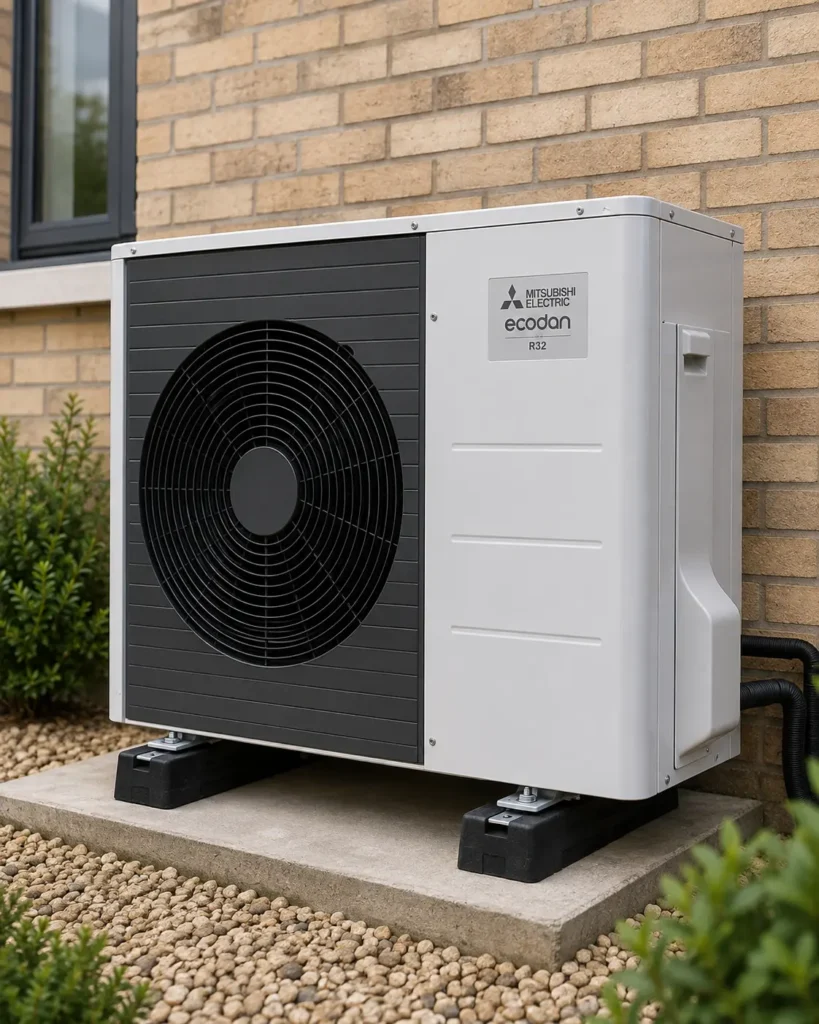
Heat pump distance from neighbour: UK rules at a glance
| UK nation | General boundary rule for domestic permitted development | Important point |
|---|---|---|
| England | No fixed one-metre boundary setback | The old one-metre restriction was removed in May 2025. MCS 020a noise compliance remains important. |
| Wales | No former three-metre setback under the rules effective from 1 June 2026 | Installations must comply with MCS 020(a), including assessment of neighbour sound impact. |
| Scotland | No general minimum boundary distance | Current Class 6H rules contain separate siting restrictions and require compliance with MCS planning standards or equivalent. The Scottish Government decided in 2026 not to proceed with proposed PDR changes at that time. |
| Northern Ireland | At least 1 metre from the boundary of the curtilage of another dwelling house | Other location, height and heritage restrictions also apply. |
Because planning law is devolved, advice written specifically for England should not automatically be applied elsewhere.
Our broader air source heat pump planning-permission guide covers the wider planning questions beyond neighbour distance.
Why the neighbour’s window matters more than the fence
For acoustic compliance, measuring from the heat pump to the boundary alone can give a misleading answer.
Under MCS 020a, an assessment position is one metre outside the centre of a door or window serving a neighbouring habitable room. Habitable rooms include rooms intended for sleeping or living, but exclude areas such as bathrooms, toilets, corridors, laundry rooms and utility rooms.
That means two houses with identical gardens can require very different installations.
A heat pump close to a fence might still have plenty of separation from the neighbour’s nearest bedroom window. Conversely, a wider garden may have an overlooking first-floor bedroom that becomes the controlling assessment point.
MCS also states that installers may need to assess several windows or doors. The closest one is not automatically the worst acoustic position because a more distant window can have a clearer line of sight.
This is why the right air source heat pump location cannot be determined from boundary distance alone.
What is the 37 dB heat-pump noise limit?
MCS 020a calculates the expected sound pressure level at each relevant assessment position.
For permitted-development compliance under the standard, the calculated result must be 37.0 dB(A) or lower at every assessment position. If it exceeds 37.0 dB(A), the installation does not pass the permitted-development noise test.
The calculation considers four particularly important factors: the manufacturer’s A-weighted sound power figure, the distance between the heat pump and assessment position, nearby surfaces that reflect sound, and qualifying acoustic barriers.
One useful detail for homeowners comparing quotations is that MCS says the manufacturer’s low-noise-mode figure must not be used for this calculation. The relevant sound-power figure comes from the manufacturer’s specified product data.
Therefore, a salesperson saying that a particular unit “runs quietly at night” is not a substitute for seeing the completed acoustic calculation.
How much difference does distance make?
Moving the heat pump farther from a neighbouring window can substantially reduce the calculated sound level.
The MCS formula includes distance as an inverse-square term. In simple conditions, doubling the distance produces roughly a 6 dB reduction in calculated sound pressure before allowing for other effects such as reflections and barriers.
However, this does not create a universal rule such as “four metres is safe” or “eight metres is required”.
Consider two installations at the same distance. One outdoor unit may have a lower sound-power rating. Another may sit between several hard walls that reflect sound towards the neighbour. A solid wall might screen one installation, while an open fence provides no acoustic correction to another.
The correct distance is therefore the distance at which the specific model, in the proposed location, passes the applicable assessment.
Can a fence let you position a heat pump closer to a neighbour?
Potentially, but only when the barrier genuinely blocks sound and does not compromise the heat pump.
MCS 020a distinguishes between qualifying solid barriers and open or ineffective screening. A solid masonry wall or sufficiently substantial solid fence can receive an acoustic correction in the calculation. With a qualifying Type 1 barrier and no line of sight, the methodology allows a correction of up to 10 dB. Open fences, vegetation and fences with significant gaps do not qualify.
However, a heat pump should not simply be boxed in. Outdoor units need clear airflow and manufacturer-specified service space. Screens can also create additional reflective surfaces if badly designed.
MCS’s own noise-mitigation guidance recommends considering a quieter heat pump, increasing separation from reflective surfaces, improving the barrier or moving the proposed unit when an installation fails the assessment. Read the MCS noise-mitigation guidance
What about small gardens, terraces and semi-detached homes?
Neighbour distance needs particular attention where houses are closely spaced.
A narrow side passage can look like an obvious location, but two walls and the ground can increase reflected sound. MCS treats surfaces within one metre of the unit as potential reflective surfaces when they meet its dimensional criteria. A heat pump surrounded by more than three qualifying reflective surfaces, such as in a small lightwell, will not meet the MCS 020a method.
Before assuming a compact property is unsuitable, compare alternative positions. A rear corner with a longer route to neighbouring windows may work better than the shortest pipe route beside the house.
Our air source heat pump space requirements guide explains the physical clearance issues, while the heat pump guide for semi-detached houses looks specifically at homes with close neighbours.
What if the proposed heat-pump position fails the noise test?
Failing the MCS 020a calculation does not necessarily mean the property cannot have a heat pump.
The design can often be reconsidered. Moving the outdoor unit, selecting a quieter model, changing its relationship with nearby reflective walls or adding an appropriate acoustic barrier can reduce the calculated level.
MCS specifically advises considering these measures when the result exceeds 37 dB(A).
Where the installation still falls outside the permitted-development requirements, a planning application may provide another route. Passing the 37 dB test is a condition of the permitted-development route; it is not a statement that every installation above 37 dB is automatically prohibited in all circumstances.
Can a neighbour still complain about a compliant heat pump?
Yes. Planning compliance and noise-nuisance law are related but separate issues.
In England, councils have a duty to investigate complaints that could amount to a statutory nuisance. Noise can qualify when it unreasonably and substantially interferes with the use or enjoyment of a home, or injures or is likely to injure health. If a council determines that a statutory nuisance exists, it can serve an abatement notice. Read GOV.UK guidance on statutory nuisance
That does not mean a neighbour can veto a compliant installation simply because they dislike it. It does mean good design is preferable to relying on the minimum planning threshold.
Keep the completed acoustic assessment, product data and installation records after the system is commissioned.
How to choose a heat-pump position near neighbours
A practical survey should work in this order:
- Identify every relevant neighbouring bedroom and living-room window or door, including upper floors rather than measuring only to the fence.
- Choose the actual heat-pump model so the assessment uses the correct sound-power figure.
- Check the planning rules for your UK nation, plus any conservation-area, listed-building or property-specific restrictions.
- Model more than one location where space allows. A few extra metres, a better line of sight or fewer reflective walls can change the result significantly.
- Check airflow, servicing and drainage as well as acoustics. A position that passes the noise calculation but restricts the unit is not a good installation.
- Ask for the completed MCS sound calculation before approving the final position, rather than relying on a generic claim that the unit is “quiet”.
Get Your Free Air Source Heat Pump Quote
Find the right air source heat pump solution for your home. Tell us a few details and our team will help you explore suitable options at a competitive price.
Quick to complete. No obligation.
Get your quote
Enter your details below and one of our team will get back to you.
Frequently asked questions
Find clear answers to common questions about air source heat pump boundary rules, MCS 020a noise limits, neighbour assessment positions, permitted development, barriers, quiet mode and planning requirements across the UK.
England no longer has the former one-metre property-boundary restriction. It was removed from the permitted-development rules in May 2025. The installation must still meet the other requirements, including MCS 020a acoustic compliance.
Not in England. That rule was removed in May 2025. Wales has also removed its former three-metre restriction. Northern Ireland has a separate one-metre rule relating to another dwelling's curtilage boundary.
There is no fixed distance under MCS 020a. The required separation depends on sound power, distance, reflective surfaces and qualifying barriers.
The calculated sound pressure must be 37.0 dB(A) or lower at every relevant assessment position for compliance with the MCS 020a permitted-development noise test.
The MCS assessment position is one metre outside the centre of a qualifying neighbouring habitable-room door or window.
Not as a habitable-room assessment position under MCS 020a. Bathrooms, toilets, service rooms, corridors, laundry rooms, hallways and utility rooms are excluded from its definition.
No. Welsh permitted-development rights changed on 1 June 2026. Current Welsh Government guidance no longer includes the former three-metre boundary condition and instead requires MCS 020(a) compliance among the applicable conditions.
Current Scottish domestic permitted-development rules do not specify a general minimum separation from a neighbouring boundary. Other siting and MCS-related requirements still apply.
Northern Ireland's permitted-development rules state that an air source heat pump cannot be installed within one metre of the boundary of the curtilage of another dwelling house.
A suitable solid barrier can reduce the calculated sound reaching an assessment position. MCS 020a gives qualifying barriers an acoustic correction according to their construction and line of sight. Open or damaged fences do not qualify.
No. MCS 020a states that vegetation does not count as a qualifying acoustic barrier.
Not for the MCS 020a permitted-development calculation. The standard says the sound-power level in low-noise mode must not be used.
There is no universal distance rule that automatically prevents it, but that bedroom window is likely to be a relevant acoustic assessment position. The proposed installation must satisfy the applicable planning and noise requirements.
The installation does not pass the MCS 020a permitted-development noise test. The designer can consider moving the unit, selecting a quieter model, improving barriers or using the planning-application route where appropriate.
Yes. Planning compliance does not prevent someone making a noise complaint. In England, councils must investigate complaints that could constitute a statutory nuisance. Whether a nuisance exists depends on the circumstances rather than the complaint alone.
Conclusion
The correct heat pump distance from neighbour properties is not a universal three-, five- or eight-metre rule.
For homes in England and Wales, current rules place far more emphasis on MCS 020a acoustic compliance than on an arbitrary boundary setback. Scotland also has no general minimum boundary distance, while Northern Ireland retains a specific one-metre rule.
The best location is the one that combines adequate airflow, service access and drainage with a documented acceptable sound level at neighbouring habitable rooms.
If space is tight, do not assume the project is impossible. Ask the surveyor to compare locations and show you the acoustic calculation before installation.


