
Heat Pump Neighbour Noise: UK Rules & Complaints 2026
Check Your Eligibility for Boiler Upgrade Scheme (BUS)
Complete your details below to check your eligibility.
Thank you
We've received your details and will be in touch shortly.

Quick Answer
Neighbours can complain about heat pump neighbour noise, including to the local council. In England, domestic air source heat pumps installed under permitted development must comply with MCS 020a. Its current calculation uses a 37 dB LAeq,5mins limit at defined assessment positions outside doors or windows serving habitable rooms at neighbouring properties.
That 37 dB figure is a permitted-development planning test. It is not a universal legal threshold below which a heat pump can never cause a nuisance. A council can separately investigate whether actual noise amounts to a statutory nuisance because it unreasonably and substantially interferes with the use or enjoyment of another home or is prejudicial to health.
Can Neighbours Complain About an Air Source Heat Pump? Heat Pump Neighbour Noise Rules Explained
Yes. A neighbour can complain about an air source heat pump if they believe its sound is disturbing them. However, a complaint does not automatically mean the heat pump is unlawful or too noisy.
The key is to separate three questions: does the installation qualify as permitted development, does it meet the MCS sound calculation used for that route, and does the noise become a statutory nuisance after installation? These are related, but they are not the same test.
This guide explains the current position, with detailed planning figures based on England’s 2026 rules. Planning is devolved, so requirements elsewhere in the UK can differ. The MCS standard itself notes that requirements outside England may be different.
Considering a heat pump? Compare heat pump quotes with Get Free Quote only after the proposed outdoor-unit position and noise assessment have been checked for your property.
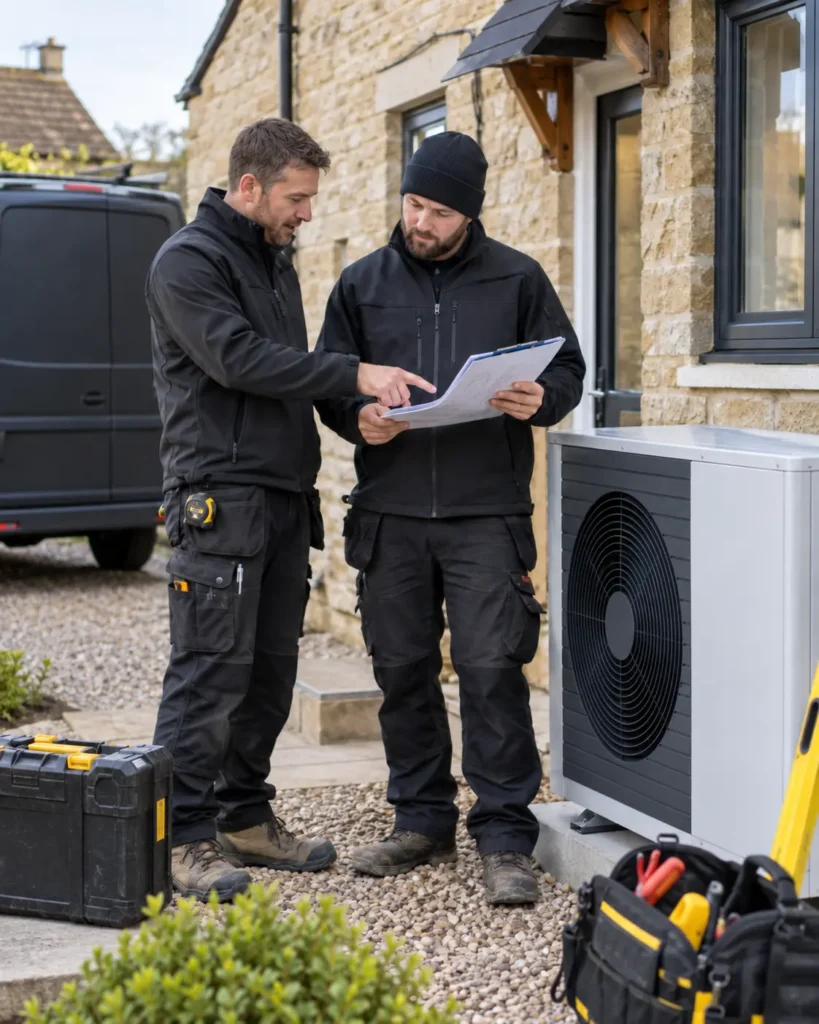
Heat Pump Neighbour Noise: The Three Rules to Understand
| Issue | What It Means |
|---|---|
| Permitted development | In England, the installation must satisfy all relevant Class G conditions, not only the noise test. |
| MCS 020a | The calculated level must be no more than 37 dB LAeq,5mins at each relevant assessment position. |
| Statutory nuisance | A separate environmental-health test can apply if actual noise substantially interferes with a neighbour’s home or is prejudicial to health. |
Understanding this distinction avoids a common mistake: treating one decibel figure as the complete legal answer.
Can a Neighbour Complain About an Air Source Heat Pump?
Yes. A neighbour can raise the issue with you, contact the local planning authority or make a noise complaint to the council’s environmental-health team.
A complaint is evidence that somebody is disturbed; it is not proof that the installation breaches planning rules.
Planning enforcement can look at whether permitted-development conditions were met. Environmental health can separately assess actual noise. GOV.UK states that councils must investigate complaints about noise that could amount to a statutory nuisance.
What Is the Current Heat Pump Noise Limit?
For domestic air source heat pumps relying on permitted development, MCS 020a uses a limit of 37 dB LAeq,5mins at the assessment position. You can read the current MCS 020a Air Source Heat Pump Sound Calculation standard.
MCS defines the assessment position as one metre outside the centre of a door or window serving a habitable room at a neighbouring property. Habitable rooms include rooms used for sleeping or living. Bathrooms, corridors, utility rooms and similar service spaces are excluded.
The calculation uses the manufacturer’s A-weighted sound power level, then considers factors including distance, directivity and qualifying acoustic barriers. A brochure noise number therefore cannot simply be compared with the 37 dB assessment limit without completing the calculation.
Ask your installer for the completed assessment. MCS 020a requires the contractor to retain one copy and provide another to the customer.
Is 37 dB the Legal Nuisance Limit?
No. It is the current MCS permitted-development noise limit.
In England, the statutory nuisance test is whether the noise unreasonably and substantially interferes with the use or enjoyment of premises, or injures health or is likely to do so. GOV.UK guidance on noise nuisance complaints explains the separate council process.
An installation can therefore pass its planning sound calculation and still be investigated if a neighbour later reports a serious noise problem.
Does a Heat Pump Still Need to Be One Metre From the Boundary?
Not in England.
The former rule preventing an air source heat pump from being installed within one metre of the property boundary was removed on 29 May 2025. Current permitted-development rules instead rely on the wider Class G conditions, including the MCS sound assessment.
This matters because older articles still repeat the one-metre rule. A heat pump can now be closer to a boundary in England, but that does not remove noise obligations, manufacturer clearances or other planning conditions.
For a deeper siting discussion, see GetFreeQuote’s air source heat pump location guide.
What Happens if a Neighbour Complains About Heat Pump Noise?
The first stage is often informal. Knowing when and where the sound is most noticeable can help identify whether the issue is fan noise, vibration, a particular operating condition or a maintenance problem.
If the matter reaches the council, planning enforcement may check whether the installation genuinely qualified as permitted development and whether the installed model and position correspond with the acoustic assessment.
Environmental health can investigate actual noise. If the council is satisfied that a statutory nuisance exists, or is likely to occur or recur, it must serve an abatement notice. The notice can require the nuisance to stop, be restricted or be reduced through specified steps.
What Makes Heat Pump Noise More Noticeable?
Heat pumps contain a fan and compressor, so they are not silent. Whether their sound becomes intrusive depends on more than a headline noise rating.
Narrow passages between buildings can reflect sound. The UK Government’s independent review of heat-pump noise recorded cases where close buildings created a “canyoning” effect. It also identified structure-borne noise where equipment had been attached to walls or roofs. Read the government review of air source heat pump noise.
Cold weather can make the unit work harder, while defrost operation can temporarily change how it sounds. At night, the same sound can also be more noticeable because surrounding background noise may be lower.
Loose panels, unsuitable mounting, vibration transmission or poor maintenance can make an installation sound different from its original design assumptions.
How to Reduce the Risk of Neighbour Complaints
Start with the proposed position, not simply the easiest wall.
Ask the installer to identify relevant neighbouring habitable-room openings and show the MCS 020a calculation for the actual model. Check that the model, location and barriers used in the assessment match the final installation.
Where several positions are possible, favour one with sensible distance and screening while preserving airflow and service access. Avoid creating a tight reflective channel towards a neighbouring bedroom where another practical location exists.
Wall mounting deserves particular care where vibration could travel through the structure. If an acoustic barrier is proposed, it should not obstruct the airflow or service clearances required by the manufacturer.
For the wider process, see GetFreeQuote’s air source heat pump installation guide.
What Should You Do if a Neighbour Complains After Installation?
Treat the complaint as fault-finding rather than an argument.
Record when the problem occurs and what the heat pump is doing. Check whether the unit is operating normally, whether panels or mounts are vibrating, and whether the installed model and position match the original assessment.
If the sound has changed, arrange a service. If the installation appears compliant but the dispute continues, an independent acoustic assessment can provide stronger evidence than relying on a phone-app measurement or a single brochure figure.
Do not automatically box the heat pump in. Restricting airflow can reduce performance and create new operational problems.
Can a Neighbour Stop a Heat Pump Being Installed?
A neighbour does not have an automatic veto over an installation that qualifies for permitted development. Permitted-development rights are a national grant of planning permission, provided every applicable condition is satisfied.
However, a neighbour can report a suspected breach of planning control or complain about actual noise.
If the project needs a planning application, neighbouring residents can comment through the normal planning process. The local planning authority then decides the application.
Even where planning permission or permitted-development rights apply, statutory nuisance law remains separate.
For related checks, see GetFreeQuote’s air source heat pump planning permission guide.
UK Differences: Do the Same Rules Apply Everywhere?
Planning rules are devolved, so do not assume every UK nation uses identical permitted-development conditions.
Wales updated its air source heat pump rules from 1 June 2026, and current Welsh Government guidance requires compliance with MCS 020(a).
Scotland has separate permitted-development rules and its current guidance links domestic air source heat pump installations to MCS planning standards.
Outside England, confirm the current requirements with the relevant planning authority before relying on an English planning rule.
If you are still deciding whether the technology suits your home, GetFreeQuote’s air source heat pump pros and cons guide covers the broader trade-offs.
Get Your Free Air Source Heat Pump Quote
Find the right air source heat pump solution for your home. Tell us a few details and our team will help you explore suitable options at a competitive price.
Quick to complete. No obligation.
Get your quote
Enter your details below and one of our team will get back to you.
Frequently asked questions
Find clear answers to common questions about air source heat pump neighbour noise, MCS 020a limits, permitted development, assessment positions, boundaries, councils, night-time operation, barriers, wall mounting and statutory nuisance.
Yes. They can raise the matter directly with you or complain to the council. The council can investigate potential planning breaches or statutory noise nuisance, depending on the circumstances.
Not automatically. In England, an installation that meets all permitted-development conditions does not require a neighbour's consent simply because they live nearby. Other rights, leases or planning restrictions can still apply.
The current MCS 020a permitted-development calculation uses 37 dB LAeq,5mins at each relevant neighbouring assessment position.
No, not under the current MCS 020a standard for air source heat pumps. The current permitted-development noise limit is 37 dB LAeq,5mins. Older content still quoting 42 dB may be referring to the previous MCS methodology.
MCS defines the assessment position as one metre outside the centre of a door or window serving a habitable room at a neighbouring property.
Not in England. The former one-metre boundary restriction was removed on 29 May 2025. Other planning and noise requirements still apply.
Yes, where appropriate. If environmental health establishes a statutory nuisance, the council must serve an abatement notice requiring the nuisance to be stopped or restricted.
There is no general national rule in England banning domestic heat pumps from operating overnight. However, planning conditions or an abatement notice can potentially restrict operation in individual cases.
They can be more noticeable when operating at higher output during colder conditions. Defrost cycles can also temporarily alter the sound produced.
A suitable solid barrier can reduce sound in some situations. MCS 020a includes barrier corrections in its calculation, but the barrier must meet the methodology and should not compromise heat-pump airflow or access.
It can increase the risk of structure-borne vibration if mounting and vibration isolation are unsuitable. The government's noise review recorded cases involving structure-borne transmission from wall- or roof-mounted equipment.
No. MCS 020a establishes compliance with the relevant permitted-development sound calculation. Statutory nuisance is a separate test based on actual circumstances.
Ask for the completed MCS 020a calculation, the manufacturer's sound-power data and clear confirmation of the model and installation position assessed. MCS requires the customer to receive a copy of the completed calculation.
The proposed installation cannot rely on the MCS sound condition for permitted development in that configuration. The model or position may need changing, or planning permission may need to be sought.
No. Planning is devolved. Wales, Scotland, England and Northern Ireland have their own planning regimes, so homeowners should check the rules applicable to the property's location.
Conclusion
Neighbours can complain about an air source heat pump, but the complaint itself does not decide whether the system breaches planning rules or creates a statutory nuisance.
For an English permitted-development installation, ask for the completed MCS 020a calculation for the exact model and location. It should demonstrate no more than 37 dB LAeq,5mins at the relevant neighbouring assessment positions.
After installation, actual noise still matters. If somebody raises a concern, check operation, vibration, maintenance and the original assessment before the disagreement escalates.
If you are considering a heat pump, Get Free Quote can help you compare property-specific quotations and proposed installation approaches before you commit.


