
Air Source Heat Pump Noise: How Noisy Are They? UK Guide
Check Your Eligibility for Boiler Upgrade Scheme (BUS)
Complete your details below to check your eligibility.
Thank you
We've received your details and will be in touch shortly.

Quick answer: are air source heat pumps noisy?
Modern air source heat pumps make audible sound from their fan, compressor and other moving components, but they should not normally cause significant disturbance when the equipment and location are suitable.
Do not compare manufacturer decibel figures without checking what they measure. Sound power describes the acoustic output of the machine itself. Sound pressure describes the sound experienced at a particular location and changes with distance and the surroundings.
For permitted-development assessments, MCS 020a uses the heat pump’s sound power, distance, surrounding reflective surfaces and acoustic barriers to calculate sound at relevant neighbouring doors or windows. The current calculation must achieve 37 dB LAeq,5mins or lower at the applicable assessment position.
Air Source Heat Pump Noise: Are Heat Pumps Noisy in the UK?
Noise is one of the most common concerns people have before installing an air source heat pump. The outdoor unit contains a fan and compressor, so it is not silent. However, a modern, correctly selected and sensibly positioned system should not sound like a loud industrial machine outside your home.
The important point is that air source heat pump noise cannot be judged from one decibel figure alone. Manufacturer specifications, the distance to neighbouring windows, nearby walls, mounting method and how hard the heat pump is working all affect what you actually hear.
Current UK rules also deserve careful attention. Some online guides still quote older noise limits. The current MCS 020a method uses a 37 dB LAeq,5mins permitted-development limit at defined neighbouring assessment positions, rather than simply asking whether the heat pump produces a certain number of decibels beside the unit.
This guide explains what a heat pump really sounds like, why some installations are noisier than others and what homeowners should check before approving a proposed location.
Considering a heat pump? You can compare home-improvement quotes through Get Free Quote after a property-specific survey has established where the outdoor unit could be positioned.
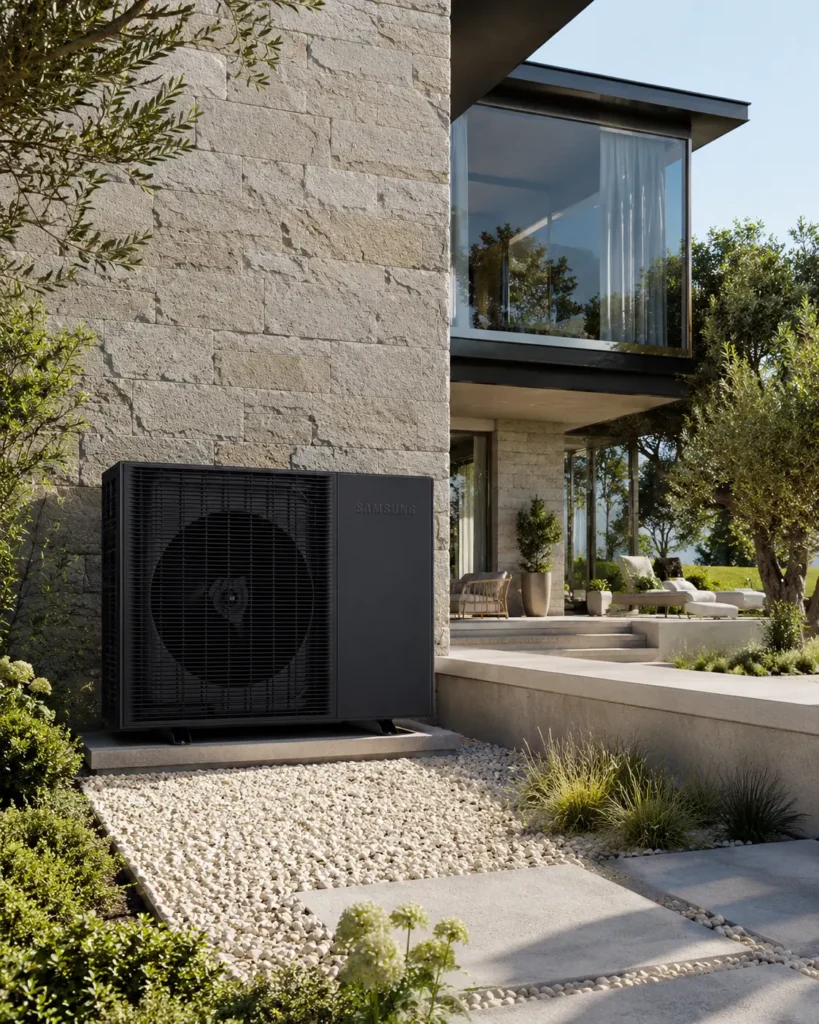
How Loud Is an Air Source Heat Pump?
There is no single meaningful decibel figure for every heat pump.
As one current manufacturer example, Vaillant’s technical data for several aroTHERM plus models lists A7/W35 sound-power figures from approximately 51 to 59 dB(A), depending on model.
That does not mean a neighbour experiences 59 dB outside their bedroom. Sound power measures the source. The sound pressure reaching another location usually decreases with distance and also depends on reflections and barriers.
| Measurement | What it means | Why it matters |
|---|---|---|
| Sound power, LWA | Acoustic energy produced by the heat pump | Used in the MCS calculation and useful when comparing models |
| Sound pressure | Sound experienced at a particular location | Changes with distance, surroundings and measurement position |
| MCS 020a result | Calculated sound at a defined neighbouring assessment position | Must meet the current 37 dB LAeq,5mins test for the MCS permitted-development sound calculation |
MCS specifically warns installers to use sound power rather than sound pressure when carrying out the calculation.
Visual suggestion: a simple diagram showing one outdoor heat pump, “sound power” at the unit and diminishing “sound pressure” rings towards a neighbouring window.
What Does an Air Source Heat Pump Sound Like?
The most noticeable sound usually comes from the large outdoor fan moving air through the heat exchanger. You may also hear a lower mechanical hum from the compressor.
MCS guidance identifies the compressor, fans and circulators as the principal sources of heat-pump sound.
For a homeowner, this normally means a fairly steady fan or humming sound rather than the combustion and start-up noises associated with some boilers.
The character of the noise matters as well as its measured level. A steady broadband fan noise can be less noticeable than a lower-frequency hum, vibration or repeated change in pitch, even where headline decibel figures look similar.
That helps explain why owner experiences differ. Government research found that heat-pump noise was a concern for a minority of consumers and that complaints were uncommon, but it also identified location and proximity among the causes when problems did arise.
For the refrigeration-cycle mechanics behind the fan and compressor, see how air source heat pumps work rather than repeating the full technical explanation here.
Why Can Heat Pumps Sound Louder in Winter?
Heat-pump output is not constant.
During mild weather, an inverter-driven system may run at a relatively low output. On colder days it can increase fan and compressor speed to meet the home’s heat demand. That can make the outdoor unit more noticeable.
Cold and damp conditions can also cause frost on the outdoor heat exchanger. The system periodically enters a defrost cycle to remove it, temporarily changing its operating behaviour.
Night-time sound may seem more obvious too. The heat pump has not necessarily become dramatically louder; the surrounding area may simply be quieter. MCS noise-mitigation guidance specifically notes that sound can become more noticeable during night-time because background noise is lower.
This is one reason a five-minute demonstration on a mild afternoon cannot tell you everything about how the unit will sound on a cold winter night.
What Are the Current Air Source Heat Pump Noise Rules?
This is an area where homeowners need current information.
Under MCS 020a, the permitted-development sound calculation tests whether noise from the installation will remain at or below 37 dB LAeq,5mins at the assessment position, ignoring the effect of the façade.
The defined assessment position is one metre outside the centre of a door or window serving a habitable room at a neighbouring property. Bedrooms and living rooms count; bathrooms, corridors and utility rooms do not.
The calculation takes account of:
- the heat pump’s published A-weighted sound power;
- nearby reflective surfaces;
- distance to the assessment position;
- qualifying acoustic barriers and line of sight; and
- more than one heat pump where applicable.
For a deeper property-siting discussion, read the air source heat pump location guide.
What changed in England?
England’s permitted-development rules changed in May 2025, including removal of the former one-metre property-boundary restriction and an increase in the permitted outdoor-unit size for houses.
The current Planning Portal confirms that MCS 020a compliance forms part of the permitted-development requirements and that, from 28 May 2026, MCS 020a is the applicable certification scheme for this purpose.
Planning is devolved, so rules are not identical in England, Wales, Scotland and Northern Ireland. Always check the regime applying to the property rather than assuming an English rule applies throughout the UK.
Will Your Neighbours Hear Your Heat Pump?
Possibly — especially outside and at close range — but “audible” and “a nuisance” are not the same thing.
The Department for Energy Security and Net Zero’s review found a low incidence of air source heat pump noise complaints. Where complaints occurred, installation quality, location and proximity were recurring factors.
The position of the outdoor unit is therefore often more important than homeowners expect.
Putting a relatively quiet heat pump in a narrow passage between two hard walls can create more acoustic problems than positioning the same unit in a more open area. MCS notes that nearby hard surfaces can reflect sound and recommends avoiding corners, confined spaces and hollow areas where practical.
There is also no universal answer such as “three metres from a neighbour is always enough”. The permitted-development calculation is property- and model-specific.
What Makes a Heat Pump Installation Noisier?
| Cause | What may happen | Practical response |
|---|---|---|
| Unit between several hard surfaces | Sound reflections increase | Consider a more open location |
| Outdoor unit close to bedrooms | Sound becomes more noticeable at night | Assess alternative positions |
| Poor vibration isolation | Hum or vibration enters the building structure | Use suitable anti-vibration mounting |
| Obstructed airflow | Fan may have to work in poor conditions | Maintain manufacturer clearances |
| Higher output during cold weather | Fan and compressor become more noticeable | Compare full operating data, not only quiet mode |
| Loose, worn or obstructed components | New rattling, buzzing or irregular sounds | Inspect and service the unit |
How to Reduce Air Source Heat Pump Noise
The best time to solve an acoustic problem is before the heat pump is installed.
First, compare the published sound-power level of the actual proposed model. A few decibels can influence whether a difficult site passes the MCS assessment.
Next, assess the location. Avoid positioning the unit directly beneath bedroom windows where another technically suitable position exists. Corners and tightly enclosed side passages also deserve caution because nearby hard surfaces can reflect sound.
Vibration control matters as well. MCS recommends appropriate anti-vibration feet, pads, mounts or grommets where applicable. Flexible connections can also help prevent vibration from transferring into an air-to-water heating system.
A suitable solid barrier can reduce calculated sound in some configurations. However, simply boxing in a heat pump is not a solution. The unit needs substantial airflow, manufacturer clearances and service access.
Some models offer quiet or night modes. These reduce fan or compressor speed, but MCS warns that doing so can also reduce heat output, hot-water recovery and potentially system efficiency. Quiet mode should therefore form part of the design rather than being treated as a cure for unsuitable positioning.
A proper survey should address these issues as part of the wider air source heat pump installation process.
Visual suggestion: annotated garden plan comparing a poor corner location with a better open location away from bedroom windows.
When Is Heat Pump Noise a Sign of a Problem?
A heat pump that has always produced a gentle fan sound is different from one that suddenly starts rattling, scraping or vibrating.
MCS recommends checking for failed or loose components, debris interfering with fan movement, overdue maintenance and changes to surrounding acoustic barriers when a previously acceptable installation becomes noisy.
Therefore, investigate a noticeable change rather than assuming that “heat pumps are just noisy”.
If a neighbour raises a genuine concern, addressing it early is sensible. In England, councils must investigate complaints that could amount to a statutory noise nuisance. Whether noise reaches that threshold depends on factors including its level, duration, frequency, timing and local context.
What Should You Ask Your Installer About Noise?
Before accepting a quotation, ask the installer to show you:
- the exact heat-pump model and its A-weighted sound-power level;
- the completed MCS 020a calculation for every relevant neighbouring assessment position;
- how nearby walls or fences were treated in that calculation;
- the proposed anti-vibration mounting arrangement;
- whether a quieter model or alternative location would materially improve the result;
- whether quiet mode has been assumed — it should not replace the required MCS sound-power input;
- how the unit will be accessed and maintained if a noise problem develops.
Also consider operating costs and system efficiency separately. A quieter location is useful only if the installation still provides adequate airflow and performs properly. The air source heat pump running-cost guide covers that side of the decision.
Get Your Free Air Source Heat Pump Quote
Find the right air source heat pump solution for your home. Tell us a few details and our team will help you explore suitable options at a competitive price.
Quick to complete. No obligation.
Get your quote
Enter your details below and one of our team will get back to you.
Frequently asked questions
Find clear answers to common questions about air source heat pump noise, including decibel ratings, MCS noise limits, assessment positions, night-time operation, winter sound, defrost cycles, siting, barriers, vibration, quiet mode and servicing.
They make audible fan and compressor noise, but a modern system should not normally create significant disturbance when correctly selected, positioned and installed.
It depends on the model and measurement used. Manufacturer sound-power figures should not be confused with sound-pressure readings taken at a particular distance.
The current MCS 020a permitted-development calculation uses 37 dB LAeq,5mins at the defined assessment position. Older online material frequently refers to the previous 42 dB methodology.
The assessment position is one metre outside the centre of a relevant neighbouring habitable-room door or window.
You may hear one depending on the unit's location, windows, construction and operating conditions. Careful siting and vibration isolation can substantially reduce indoor transmission.
They can seem more noticeable at night because background sound is lower. MCS specifically highlights this effect.
They may be. During colder conditions, the system can operate at higher fan and compressor speeds to meet heating demand.
It can. The heat pump temporarily changes operating conditions while removing frost from its outdoor heat exchanger, so its sound can change for a short period.
They can operate overnight when the property needs heat. Heat pumps commonly maintain temperature for longer periods rather than behaving exactly like an on/off boiler.
There is no universal distance. MCS 020a considers sound power, distance, reflections and barriers, so the correct answer depends on the specific installation.
A suitable solid barrier can sometimes reduce sound, but it must not restrict airflow, compromise safety or prevent servicing. MCS defines how qualifying barriers affect its calculation.
Not automatically. However, ground mounting can make it easier to isolate vibration from the building. Wall mounting requires particular attention to structure-borne vibration.
No. It reduces fan or compressor speed on suitable models. It may also reduce heating capacity or affect efficiency, so it should not compensate for poor siting.
A gentle mechanical hum may be normal. New rattling, scraping, excessive vibration or unusually loud buzzing should be investigated for loose parts, debris or another fault.
Yes, where increased noise is caused by a maintenance problem. MCS notes that inadequate maintenance can increase noise over time.
Conclusion: Should You Worry About Air Source Heat Pump Noise?
Air source heat pumps are not silent, but the evidence does not support treating them as inherently noisy.
The more useful question is: how much sound will this particular heat pump produce in this particular location?
Check the manufacturer’s sound-power data. Ask to see the MCS 020a calculation. Pay close attention to neighbouring bedroom windows, reflective walls and vibration control. Finally, consider how the system will behave during colder weather rather than judging it only under light-load conditions.
Current government research indicates that noise complaints are uncommon, but the cases that do occur show why product selection and location matter.
If you are comparing systems, obtain properly surveyed quotations that specify both the proposed heat pump and its final outdoor location rather than accepting a generic estimate.


