
Best Solar Panels 2026 UK: Top Panels Compared
Check Your Eligibility for Boiler Upgrade Scheme (BUS)
Complete your details below to check your eligibility.
Thank you
We've received your details and will be in touch shortly.

Quick Answer: What Are the Best Solar Panels in the UK in 2026?
For a space-constrained roof, AIKO Neostar 3P54 and LONGi Hi-MO X10 are particularly interesting because both use high-efficiency back-contact technology. AIKO’s Neostar 3P54 reaches up to 500W and 25% efficiency, while residential Hi-MO X10 variants reach roughly 24% efficiency depending on model.
Maxeon 7 is notable for its 40-year product and power coverage, REC Alpha Pure-RX combines 470W output with strong warranted long-term performance, and JA Solar DeepBlue 4.0 provides a compelling mainstream alternative where value matters more than extracting the absolute maximum power from each square metre.
There is therefore no single panel that is best for every UK roof.
Best Solar Panels 2026 UK: Top Panels Compared for Efficiency, Warranty and Value
Choosing the best solar panels in the UK in 2026 is not simply a question of buying the panel with the highest efficiency figure.
AIKO and LONGi now offer residential-sized back-contact panels approaching 25% module efficiency. Maxeon continues to stand out for its long warranty, while REC offers strong long-term output retention. Meanwhile, established n-type TOPCon panels from manufacturers such as JA Solar can offer excellent value where roof space is less restricted.
For most homeowners, the right choice depends on five things: available roof area, total system output, panel efficiency, warranty protection and the price of the complete installation.
This guide compares some of the strongest solar panels available to UK homeowners in 2026 and explains which specifications actually matter.
If you are already comparing installations, you can compare solar panel installation quotes rather than judging quotations on the panel brand alone.
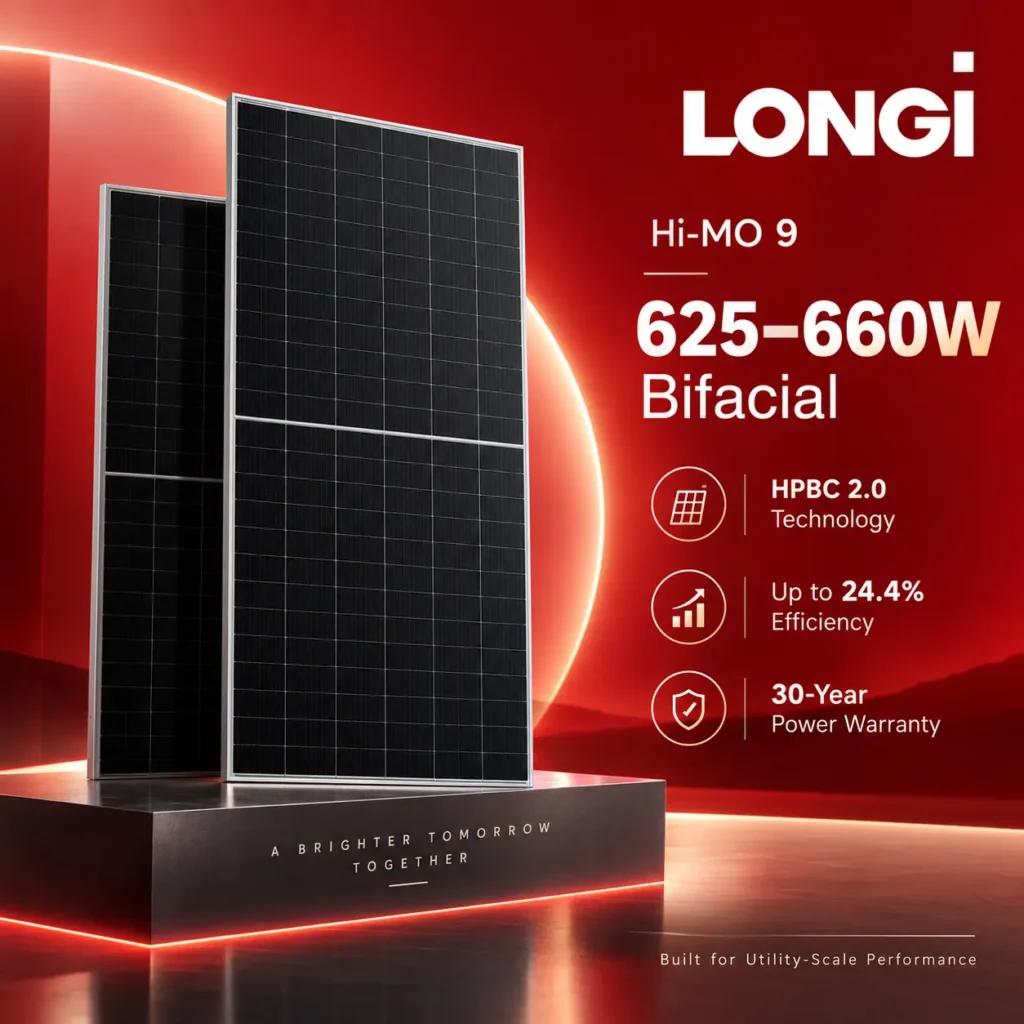
Best Solar Panels UK 2026 Compared
| Panel | Output / efficiency | Warranty position | Best suited to |
|---|---|---|---|
| AIKO Neostar 3P54 | Up to 500W / 25.0% | 15-year product warranty, extendable to 25; 30-year performance warranty | Maximum output from limited roof space |
| LONGi Hi-MO X10 | Around 475–505W residential variants / up to 24.7% depending on version | Check exact model and UK warranty supplied | High-efficiency, space-constrained roofs |
| Maxeon 7 | 435–445W / up to 24.1% | 40-year product and power coverage under applicable terms | Buyers prioritising long warranty cover |
| REC Alpha Pure-RX | Up to 470W / 22.6% | 20-year product, 25-year performance; enhanced ProTrust terms available | Long-term output retention and premium builds |
| JA Solar JAM54D40 | Up to 465W / up to 23.3% in current brochure | 15-year product / 30-year performance for relevant current variants | Strong mainstream value |
Specifications vary by exact suffix, market and warranty terms, so always ask for the model number in writing rather than accepting a brand name alone.
AIKO Neostar 3P54: Best for Maximum Efficiency
AIKO’s third-generation Neostar 3P54 is one of the most technically impressive residential modules available in 2026.
The manufacturer lists outputs from 470W to 500W and module efficiency of up to 25.0%. Its n-type ABC, or All Back Contact, design moves electrical contacts away from the front-facing surface, allowing more of the panel to collect sunlight. AIKO also specifies a temperature coefficient of -0.26%/°C and degradation of no more than 1% in year one followed by no more than 0.35% annually.
That makes it particularly attractive where the physical roof area limits how many panels will fit.
The important calculation is not simply watts per panel. Ask the designer how many panels actually fit the usable roof and compare the total proposed array capacity in kWp.
Best for
Small roofs, dormer-heavy properties and homeowners trying to maximise generation per square metre.
Things to consider
Premium efficiency does not automatically produce the shortest payback. Compare the extra cost against the additional annual generation your particular roof is expected to produce.
LONGi Hi-MO X10: Excellent High-Density Alternative
LONGi’s Hi-MO X10 is another major development in back-contact solar technology.
Its 54-cell residential products include Explorer versions around 475–490W with efficiency up to 24.1%, while higher-spec Scientist variants reach 495–505W and approximately 24.7%. LONGi uses its HPBC 2.0 back-contact architecture and has also developed features intended to reduce losses and hotspot temperatures during partial shading.
That combination makes the X10 worth comparing directly with AIKO when usable roof space is the main constraint.
Rather than choosing between them from efficiency percentages alone, ask installers to model both layouts. A slightly different module dimension can sometimes allow an extra panel to fit, making the lower-rated panel layout more productive overall.
Maxeon 7: Best for Long Warranty Cover
The Maxeon 7 remains distinctive because of its warranty proposition.
The 435–445W residential series reaches up to 24.1% efficiency, while Maxeon’s current warranty information lists 40-year product and power coverage for applicable Maxeon panels. The published Maxeon 7 specification also gives a maximum annual warranted degradation figure of 0.25%.
That can appeal to homeowners planning to keep their property for decades.
However, warranty length should never be considered in isolation. Read the registration conditions, exclusions and claims procedure and confirm exactly which legal entity backs the warranty offered with your installation.
REC Alpha Pure-RX: Best for Long-Term Output Retention
REC’s Alpha Pure-RX uses heterojunction, or HJT, cell technology.
It reaches 470W and 22.6% module efficiency. More importantly for a long-term comparison, REC warrants at least 92% of nameplate power in year 25. Standard cover is 20 years for the product and 25 years for performance, while qualifying installations through its ProTrust programme can receive enhanced cover.
REC also divides the module into four sections to help maintain generation when part of the panel is shaded.
It is therefore worth considering where longevity, premium construction and output retention matter more than chasing the highest headline efficiency.
JA Solar DeepBlue 4.0: Strong Mainstream Value
Not every property needs a premium back-contact panel.
JA Solar’s current JAM54D40 DeepBlue 4.0 family uses n-type cells and double-glass construction. Current manufacturer material lists outputs up to 465W and efficiencies reaching 23.3%, with a -0.29%/°C power temperature coefficient. Its June 2026 warranty schedule shows 15-year product and 30-year peak-power warranties for relevant JAM54D40 variants.
For a large, relatively unshaded roof, a competitively priced JA Solar array may offer better financial value than paying more for a marginal efficiency improvement.
This is why quotations should be compared at whole-system level, not panel level.
Which Solar Panel Specification Matters Most?
Efficiency
Efficiency measures how much incoming solar energy the panel converts into electricity under standard test conditions.
It matters most when roof area is restricted. If you have plenty of usable roof space, the difference between a 22.5% and 25% panel may matter less than the total installed cost.
Wattage
A 500W panel is not automatically better than a 450W panel because panel dimensions can differ.
Compare watts per square metre and the final kWp that fits your roof.
Product warranty
This covers faults in the physical panel subject to the warranty terms.
A 25- or 40-year headline sounds attractive, but also check who provides the warranty, whether registration is required and what happens if the installer disappears.
Performance warranty and degradation
Performance warranties describe how much output the manufacturer guarantees after years of degradation.
For example, REC specifies at least 92% after 25 years for the Alpha Pure-RX, while the Maxeon 7 specification limits warranted annual degradation to 0.25%.
Roof layout and shading
A strong system design can matter more than a small difference between two high-quality panels.
Chimneys, dormers, trees, roof orientation and different roof pitches can all affect annual generation.
If the roof itself needs attention, dealing with that before mounting a system can avoid expensive panel removal later. Get Free Quote also provides a separate service for comparing roofing quotations.
Which Solar Panel Is Best for Your Situation?
| Your priority | Panels worth comparing | Why |
|---|---|---|
| Very limited roof space | AIKO Neostar 3P54 / LONGi Hi-MO X10 | Very high power density |
| Long warranty | Maxeon 7 | Up to 40-year applicable coverage |
| Strong output retention | REC Alpha Pure-RX | 92% minimum power in year 25 |
| Value on a larger roof | JA Solar DeepBlue 4.0 | Competitive modern n-type technology |
| High-electricity home | AIKO / LONGi / JA Solar | Prioritise maximum practical array capacity |
| EV household | Property-specific | Larger daytime demand can increase self-consumption |
EV owners should also consider whether their charger can respond to surplus solar generation. You can separately compare solar-compatible EV charger installations.
Likewise, households planning wider electrification may want to consider future electricity demand from technologies such as an air source heat pump when sizing the array.
How Much Do Solar Panels Cost in the UK in 2026?
Energy Saving Trust currently estimates that an average domestic solar-panel system costs around £7,600 installed, although actual prices depend on array size, roof access, scaffolding, inverter choice, electrical work and battery storage. Energy Saving Trust’s solar-panel guidance
Qualifying installed solar panels in residential accommodation are currently subject to 0% VAT until 31 March 2027. Unless the legislation changes again, the reduced 5% rate applies from 1 April 2027. GOV.UK’s current VAT guidance for energy-saving materials
Solar can also earn export income. Ofgem’s Smart Export Guarantee requires relevant electricity suppliers to offer tariffs paying eligible small-scale generators for exported electricity. Your export provider does not have to be your normal import electricity supplier. Ofgem’s Smart Export Guarantee guidance
Energy Saving Trust’s July 2026 assumptions indicate typical solar payback of roughly nine to twelve years across its example UK locations and occupancy patterns when export payments are included. These are illustrative figures rather than promises for an individual property.
How to Choose the Best Solar Panels for Your Home
- Measure usable roof space. Panel dimensions can matter as much as efficiency.
- Compare total array capacity. Look at proposed kWp, not only watts per panel.
- Request the exact model number. Warranty and efficiency can change between variants from the same manufacturer.
- Check the generation estimate. It should account for location, orientation, pitch, shading and system losses.
- Compare warranties separately. Review panel, inverter, workmanship and battery warranties.
- Check certification. MCS requires certified contractors to register relevant installations and provide an MCS certificate as part of the handover process. MCS solar PV requirements
- Compare complete prices. Scaffolding, mounting, inverter, DNO work and electrical upgrades can outweigh differences in panel cost.
- Model a battery separately. A battery can increase self-consumption, but its financial case depends on consumption patterns, tariff, capacity and price.
Get Your Free Air Source Heat Pump Quote
Find the right air source heat pump solution for your home. Tell us a few details and our team will help you explore suitable options at a competitive price.
Quick to complete. No obligation.
Get your quote
Enter your details below and one of our team will get back to you.
Frequently asked questions
Find clear answers to common questions comparing air source and ground source heat pumps, including efficiency, installation and running costs, winter performance, noise, land requirements and borehole depth.
There is no universal winner. AIKO Neostar 3P54 and LONGi Hi-MO X10 suit space-constrained roofs, Maxeon 7 emphasises warranty length, REC Alpha Pure-RX offers strong long-term output retention, and JA Solar provides a strong mainstream value option.
Among panels relevant to UK residential installations in 2026, AIKO's Neostar 3P54 reaches up to 25.0% efficiency. Exact availability depends on installer stock and model.
No. Higher efficiency is most useful when roof area is limited. On a large roof, a slightly less efficient but cheaper panel can produce similar total system output at lower cost.
Not necessarily. A 500W panel may also be physically larger. Compare panel dimensions, efficiency and the total kWp that fits the roof.
Yes. Solar PV produces electricity from daylight rather than needing direct sunshine, although output falls when solar irradiance is lower.
Modern panels are normally designed to generate for several decades. Performance warranties commonly extend for 25–30 years, while some Maxeon products offer applicable 40-year coverage.
Degradation is the gradual reduction in maximum output as a panel ages. Compare both first-year degradation and the manufacturer's subsequent annual degradation allowance.
It can be, but determine whether it is a product warranty, performance warranty or both. Also check exclusions, registration requirements and who handles claims.
It depends on household electricity consumption, panel wattage, available roof space and desired system capacity. A proper proposal should provide both the panel count and total kWp.
They can be. Energy Saving Trust's current examples show indicative paybacks around nine to twelve years in several UK locations when export income is included, but individual results vary.
Energy Saving Trust currently uses approximately £7,600 as an average domestic installation cost. Property-specific quotations can differ substantially.
Qualifying installed residential solar panels are zero-rated for VAT until 31 March 2027 under current UK rules.
Eligible households in Great Britain can receive payments for exported electricity through Smart Export Guarantee tariffs.
Not automatically. Compare solar-only and solar-plus-battery forecasts using your actual electricity consumption and tariff.
Both matter. Panels determine DC generation, while the inverter converts that electricity for household use. Array design, inverter sizing and roof layout should therefore be considered together.
MCS certification is particularly important when you want an MCS-certified installation and can be relevant to export-tariff requirements. MCS requires products used within its solar PV scheme to meet its applicable certification requirements.
Many residential rooftop installations in England can fall under permitted development, subject to limits and conditions. Rules differ across the UK and additional restrictions can apply to listed buildings, conservation areas and other designated locations.
If significant roof work is likely within the next few years, it is usually sensible to assess it before installation. Removing and refitting a solar array later adds cost and disruption.
Conclusion: What Are the Best Solar Panels in the UK for 2026?
For maximum power from a constrained roof, AIKO Neostar 3P54 and LONGi Hi-MO X10 are two of the strongest panels to compare in 2026.
Maxeon 7 remains compelling where warranty duration is a major priority, while REC Alpha Pure-RX offers impressive long-term output protection. JA Solar DeepBlue 4.0 demonstrates why a good mainstream n-type panel can make more financial sense on a larger roof.
The key is to compare the complete proposed system rather than buying a brand name.
Ask each installer for the exact panel model, roof layout, total array capacity, estimated annual generation, warranty documents and fully itemised installed price.
Ready to compare? Visit Get Free Quote to explore your options and compare property-specific solar quotations.


