
Solar Panel Installation Birmingham: Costs & Quotes 2026
Check Your Eligibility for Boiler Upgrade Scheme (BUS)
Complete your details below to check your eligibility.
Thank you
We've received your details and will be in touch shortly.

Quick answer: is solar panel installation worthwhile in Birmingham?
Solar panels can work well on Birmingham homes because photovoltaic panels generate electricity from daylight, not only strong direct sunshine. A suitable roof with limited shading can therefore produce useful electricity throughout the year, although generation will be much higher in summer than winter.
Energy Saving Trust says a typical 4.5kWp household system costs around £7,600. Your actual return depends on how much electricity the system generates, how much you use directly, your electricity tariff and what you receive for exported power.
Most straightforward installations do not need full planning permission, but listed properties, conservation areas and some Birmingham estates need extra checks. Always obtain a property-specific design and written quotation before making a decision.
Solar Panel Installation Birmingham: Costs, Installers, Planning and Savings in 2026
If you are considering solar panel installation in Birmingham, the most important questions are usually practical: is your roof suitable, what should the system cost, how much electricity could it generate, do you need planning permission and how do you compare installers properly?
Birmingham homes range from Victorian terraces and inter-war semis to modern detached properties and flats. That means there is no single solar system that suits every property. Roof orientation, available space, shading, electricity consumption and future plans for a battery or electric vehicle can all affect the right design.
For a UK benchmark, Energy Saving Trust currently puts the cost of an average 4.5kWp domestic solar system at around £7,600, although actual Birmingham quotations can be higher or lower depending on the property and specification.
This guide explains what Birmingham homeowners should check before accepting a solar quotation, including costs, planning rules, batteries, grants, export payments and installation.
If you are ready to investigate your options, you can start through the Get Free Quote home-improvement comparison service and compare the proposals rather than relying on a single estimate.
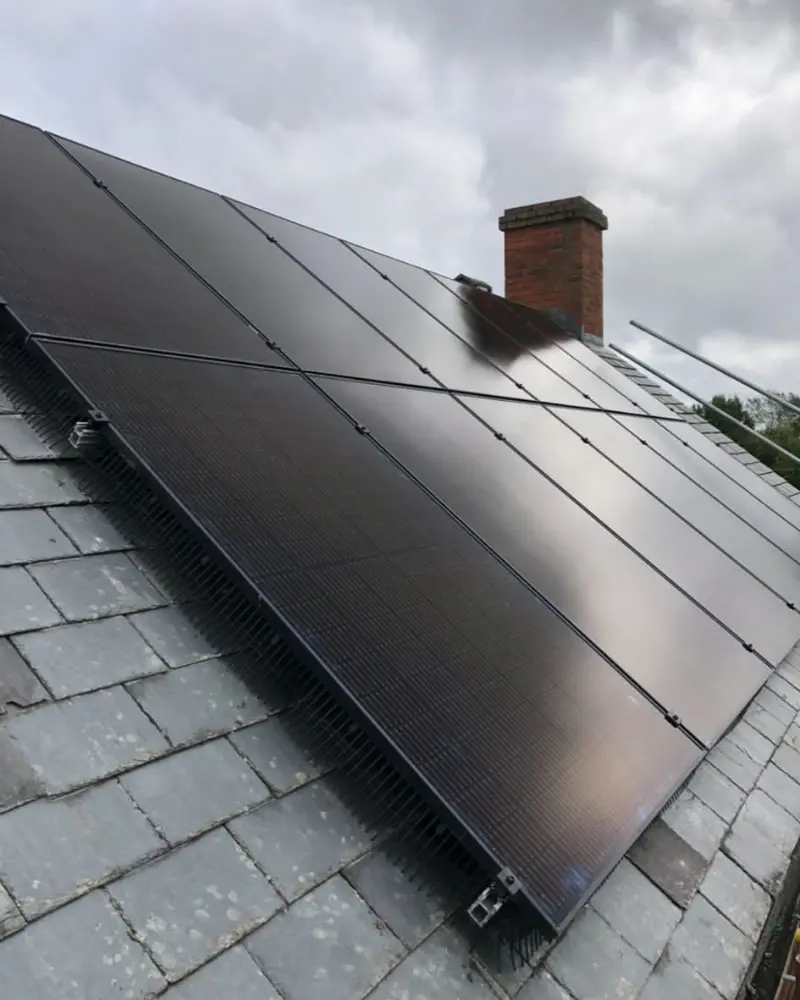
Birmingham solar installation at a glance
| Question | Current guidance |
|---|---|
| Typical UK domestic system | Around 4.5kWp |
| Typical installation cost | Around £7,600 as a national benchmark |
| Physical installation | Often around 1–2 days for a straightforward system |
| Planning permission | Usually permitted development, subject to conditions |
| Installer check | Consider an MCS-certified solar PV installer |
| Exported electricity | May earn payments through a Smart Export Guarantee tariff |
| Solar installation VAT | Qualifying residential installations remain zero-rated until 31 March 2027 under current rules |
| Birmingham funding | Some eligible households can access the Warm Homes Local Grant |
Sources: Energy Saving Trust, Planning Portal, Ofgem, HMRC and Birmingham City Council.
Is Birmingham suitable for solar panels?
You do not need to live in the sunniest part of Britain for solar PV to work. Solar cells convert daylight into electricity and continue generating on cloudy days, although output falls when sunlight is weaker.
The bigger issue is your individual roof.
A south-facing roof with little shade is normally favourable. However, east- and west-facing roofs can also be useful, particularly when household electricity demand occurs in the morning or afternoon.
An installer should assess:
- Roof direction and pitch.
- Shading from trees, chimneys and nearby buildings.
- Available roof area.
- Roof condition and structural suitability.
- Household electricity use.
- Possible future demand from an EV, battery or electric heating.
Do not judge two quotations solely by panel count. Panel wattage varies, so compare the proposed array size in kilowatt-peak, or kWp, and the estimated annual generation in kilowatt-hours, or kWh.
For more information about comparing systems nationally, see the Get Free Quote solar panel quote guide.
How much does solar panel installation cost in Birmingham?
Energy Saving Trust’s August 2026 guidance puts an average 4.5kWp home solar installation at about £7,600. This should be treated as an indicative benchmark rather than a Birmingham quotation.
Local prices can vary significantly because the panels themselves are only part of the project.
What changes the installation price?
| Cost factor | Why it matters |
|---|---|
| System size | More panels, mounting equipment and electrical capacity increase costs |
| Scaffolding | Access can represent a meaningful part of the installation price |
| Roof complexity | Dormers, several roof faces and difficult access add labour |
| Roof condition | Repairs may be sensible before covering the roof with panels |
| Inverter type | String inverters, optimisers and microinverters have different costs |
| Battery storage | Adds equipment and electrical work but can increase self-consumption |
| Electrical upgrades | Older consumer units or cabling may need additional work |
| Shading | Complex shading can influence layout and inverter design |
Ask installers to itemise major elements rather than giving you one unexplained total.
A cheaper quote is not automatically better if it includes fewer panels, lower usable battery capacity, shorter warranties or unrealistic generation assumptions.
What happens during a solar panel installation?
A professional installation normally begins well before anyone reaches the roof.
1. Property and electricity assessment
The installer reviews roof dimensions, orientation, shading, electricity consumption and the electrical installation.
Your future plans matter too. If you expect to buy an electric car, discuss that before the solar system is designed. You can also review solar-compatible EV charger options when planning a more integrated home-energy setup.
2. System design
You should receive a proposed panel layout, total system capacity, equipment specification and estimated annual generation.
Ask what assumptions the forecast uses. A higher generation figure is not necessarily more accurate.
3. Scaffolding and mounting
For most pitched roofs, installers erect scaffolding before fixing the mounting system to the roof structure.
4. Panels, inverter and electrical work
The solar panels generate direct-current electricity. The inverter converts it into alternating-current electricity that your household appliances can use.
A battery can also be incorporated where appropriate.
5. Testing and handover
After installation, the system should be commissioned and tested. You should receive operating information, relevant certificates, warranty details and monitoring instructions.
Energy Saving Trust says a typical physical installation takes around one to two days, although complex properties can take longer.
Do you need planning permission for solar panels in Birmingham?
For many houses, roof-mounted solar panels fall under permitted development rights, so a full planning application is not normally needed.
However, the rules changed on 27 August 2026, and Planning Portal confirms that transitional arrangements apply until August 2027. The rules include conditions designed to limit the effect on the appearance of the building and surrounding area.
Birmingham conservation areas and listed properties
Extra checks are particularly important if you own a listed building or live in one of Birmingham’s conservation areas.
Birmingham City Council advises owners to check whether planning permission, listed-building consent or other permissions are required. It also notes that properties in places such as Bournville or the Calthorpe Estate in Edgbaston can require estate-manager permission as well as normal planning checks.
Do not assume that seeing solar panels on a neighbouring property proves your own project is permitted.
Should you add a solar battery?
A battery stores electricity that would otherwise be exported, allowing you to use more of your own generation later.
That can be useful for households that are away during the day and consume more electricity in the evening.
However, a battery does not automatically produce the best financial return. Its value depends on:
- usable capacity;
- battery efficiency;
- warranty and expected life;
- household consumption pattern;
- electricity tariffs;
- export payments;
- whether cheap off-peak charging is available.
Ask for two calculations: one for solar only and one for solar plus battery. This makes the extra battery investment easier to judge.
If your longer-term plan includes technologies such as low-carbon electric heating, understanding how those systems affect electricity demand is also useful. Get Free Quote’s air source heat pump efficiency guide explains how household electricity requirements can change when heating is electrified.
Can you get paid for exporting solar electricity?
Yes. The Smart Export Guarantee requires participating electricity suppliers to offer payments for eligible low-carbon electricity exported to the grid.
Ofgem states that suppliers set their own tariff rates, contract lengths and other conditions. Export payments are based on metered electricity exported from the property.
This means you should not calculate solar payback using an export tariff you have not checked.
Tariffs can change, so compare current offers when your system is ready for export.
Energy Saving Trust also recommends using an MCS-certified installer and notes that MCS certification may be required for export tariffs.
Are solar panel grants available in Birmingham?
There is no universal grant that automatically pays for solar panels for every Birmingham homeowner.
However, Birmingham City Council currently participates in the Warm Homes Local Grant 2025–2028.
The council lists solar PV among the possible funded measures for qualifying households. Current priority areas include Balsall Heath, Bromford, Castle Vale, Sparkbrook, and Tyseley and Hay Mills. Eligibility and the measures offered depend on household and property circumstances.
Check the latest council eligibility before assuming that funding will apply to your project.
What about VAT?
Under current HMRC rules, qualifying installations of solar panels in residential accommodation are temporarily zero-rated for VAT until 31 March 2027. The reduced 5% rate is scheduled to apply from 1 April 2027.
Electrical storage batteries also currently qualify for the temporary zero rate in qualifying circumstances.
How to compare solar panel installers in Birmingham
Start by comparing the system design rather than the sales pitch.
A useful quotation should make clear:
- Total system capacity in kWp.
- Panel manufacturer and exact model.
- Inverter specification.
- Battery make, usable capacity and warranty, if included.
- Predicted annual generation and the assumptions behind it.
- Scaffolding and mounting costs.
- Electrical upgrades.
- DNO connection responsibilities.
- Product and workmanship warranties.
- MCS certification where applicable.
- Total price and payment schedule.
- What happens if the roof survey reveals additional work.
Energy Saving Trust recommends obtaining quotes from at least three installers and looking for MCS-certified installers.
Remember that Get Free Quote describes itself as a UK quote-comparison and introduction service rather than the installer carrying out the work. You can read more about how Get Free Quote evaluates and compares providers before submitting an enquiry.
Get Your Free Air Source Heat Pump Quote
Find the right air source heat pump solution for your home. Tell us a few details and our team will help you explore suitable options at a competitive price.
Quick to complete. No obligation.
Get your quote
Enter your details below and one of our team will get back to you.
Frequently asked questions
Find clear answers to common questions comparing air source and ground source heat pumps, including efficiency, installation and running costs, winter performance, noise, land requirements and borehole depth.
Yes. Solar PV uses daylight and can generate electricity in cloudy weather. Output varies with roof orientation, shading, system size and weather.
Energy Saving Trust currently uses around £7,600 as a benchmark for an average 4.5kWp UK household system. Birmingham quotations should still be based on an individual survey.
There is no fixed number. The correct array depends on panel wattage, roof area, annual electricity consumption and your objectives.
No. South-facing roofs are often favourable, but east- and west-facing roofs can also generate useful electricity.
Potentially, yes. The installer needs to assess usable roof area, shading, access and electrical requirements.
Many household installations qualify as permitted development. Listed buildings, conservation areas and installations outside the relevant limits need additional checks.
Possibly. However, the proposed location and property status matter. Birmingham City Council recommends checking the applicable permissions before work begins.
Energy Saving Trust says a typical domestic installation commonly takes around one to two days, although scaffolding, surveys and other preparation happen separately.
Energy Saving Trust recommends MCS-certified solar installers. Certification can also be important when applying for an export tariff.
Eligible households can receive payments for exported electricity through a Smart Export Guarantee tariff. Suppliers determine their own rates and conditions.
It can be useful when you generate electricity at times you cannot use it. Compare the cost and estimated savings of solar-only and solar-plus-battery systems separately.
Usually, yes, provided the system is designed appropriately. Discuss future battery plans before choosing the inverter.
Yes. Solar electricity can contribute to EV charging. Actual solar charging depends on generation, household demand, charger controls and when the vehicle is connected.
Some eligible Birmingham households may receive solar PV through the Warm Homes Local Grant. The council currently restricts the programme according to property, household and priority-area eligibility.
Qualifying residential installations are currently zero-rated for VAT until 31 March 2027. Under existing rules, the rate is scheduled to become 5% from 1 April 2027.
There is no single Birmingham payback period. Energy Saving Trust's current examples vary by location and household circumstances. Your calculation should include installation cost, self-consumed electricity, export income and realistic future assumptions.
Yes. Energy Saving Trust recommends getting at least three installer quotations so that price, equipment and expected performance can be compared.
Is solar panel installation in Birmingham worth considering?
For a suitable Birmingham property, solar panels can reduce the amount of electricity you buy from the grid and allow you to receive payments for eligible exported power.
The financial result depends on much more than the number of panels. Roof suitability, installation price, actual generation, your electricity consumption, tariff choice and battery economics all matter.
Therefore, compare like-for-like system designs. Look carefully at the annual-generation assumptions and treat headline savings as estimates rather than guarantees.
If you are considering an installation, gather recent electricity-use information and photographs or details of your roof before requesting quotes. That gives installers a better starting point and makes competing proposals easier to compare.
When you are ready, you can contact Get Free Quote about a Birmingham solar enquiry and compare available options without an obligation to proceed.


