
How Long Does It Take to Install Solar Panels? UK 2026
Check Your Eligibility for Boiler Upgrade Scheme (BUS)
Complete your details below to check your eligibility.
Thank you
We've received your details and will be in touch shortly.

Quick Answer
typical domestic solar PV system takes one to two days to install on site, according to Energy Saving Trust.
However, the complete process can span several weeks because surveying, system design, scaffolding, scheduling and grid-connection requirements may happen before installation.
Some systems can follow the G98 “connect and notify” process, while others require G99 approval before installation. Once the panels are fitted, the installer must test and commission the system and complete the relevant certification and handover paperwork.
In short: allow one to two days for the physical installation, but potentially several weeks for the complete project.
How Long Does It Take to Install Solar Panels in the UK? 2026 Timeline
For most UK homes, the physical solar panel installation takes around one to two days. Straightforward systems can sometimes be completed in a single working day, while complex roofs, battery storage, electrical upgrades or poor weather can extend the job.
The wider solar installation process usually takes longer. A site survey, system design, scaffolding, installer scheduling and, in some cases, Distribution Network Operator (DNO) approval all happen before or around installation.
This guide explains how long each stage can take, what causes delays and what homeowners should expect from survey through to commissioning.
Ready to compare installers? Get a free quote and compare likely costs, timescales and installation options before making a decision.
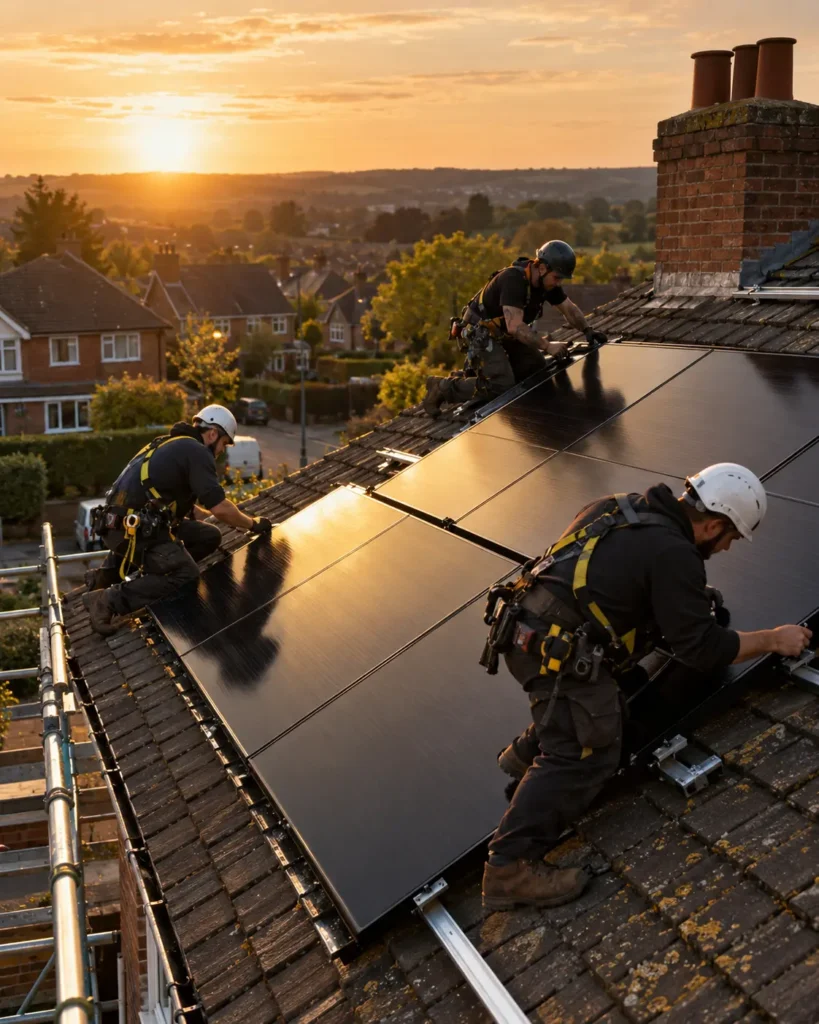
Typical Solar Installation Timeline
The most important distinction is between installation time and the complete project timeline.
Energy Saving Trust says a typical domestic solar system takes around one to two days to install.
However, the installer cannot normally arrive immediately after you request a quotation. Your property may first require a survey, system design and scaffolding arrangements. Grid-connection requirements can also affect the schedule.
| Stage | Typical Expectation | What Can Affect It? |
|---|---|---|
| Initial assessment and survey | Days to a few weeks | Installer availability, access and property information |
| System design and quotation | Usually several days | Roof layout, battery choice and system complexity |
| DNO process | Varies | Inverter capacity, batteries and local network requirements |
| Scaffolding | Often installed shortly beforehand | Access, permits and scaffold availability |
| Physical installation | Usually 1–2 days | Roof type, weather, system size and electrical work |
| Testing and commissioning | Usually completed with installation | Faults, configuration or remedial electrical work |
| Certification and handover | Can follow commissioning | Registration and installer administration |
| SEG application | Separate process | Supplier requirements, export meter data and documentation |
The practical lesson is simple: ask your installer for both the expected installation duration and the complete project timescale.
What Happens Before Installation Day?
A professional installation should begin with a detailed property assessment.
The site survey normally looks at:
Roof condition and available space
Roof orientation and pitch
Shading
Proposed panel layout
Cable routes
Inverter location
Consumer unit condition
Earthing arrangements
Scaffolding and safe access
Potential battery location
For a deeper explanation, see the solar panel installation survey guide.
Once the survey is complete, the installer can finalise the panel layout, inverter specification, expected generation and any battery or export-limitation equipment.
Identifying roof or electrical problems at this stage is important. Discovering them on installation day can delay the project.
Grid-connection checks
The installer must also determine which grid-connection procedure applies.
GOV.UK guidance on registering energy devices distinguishes between systems that can follow a “connect and notify” route and systems that require an “apply to connect” process.
This distinction can materially affect how quickly installation can proceed.
How Long Does Installation Day Take?
For a standard home, one to two days is the most useful benchmark.
During installation, the team typically:
Prepares the roof and access equipment.
Fits the mounting system.
Installs the solar panels.
Routes DC cabling.
Installs the inverter.
Completes the electrical connections.
Fits the required protection equipment.
Tests and commissions the system.
For more detail, see the solar panel installation process and the guide explaining how solar panels are installed.
When can installation be completed in one day?
A one-day installation is most realistic when the property has:
A straightforward pitched roof
Easy scaffolding access
One main roof face
No significant shading complications
A suitable consumer unit
Simple cable routes
No major remedial electrical work
No unusual mounting requirements
Larger or more complicated systems often need a second day.
A one-day installation also does not mean the entire solar project takes one day. Scaffolding, design, DNO requirements and survey work normally happen separately.
What Can Make Solar Panel Installation Take Longer?
Most delays can be identified during the survey.
| Factor | Why It Can Add Time |
|---|---|
| Complex or fragile roof | More careful access and fixing work may be needed |
| Multiple roof faces | Requires additional mounting and cable routes |
| Flat roof | Specialist mounting or ballast may be required |
| Battery storage | Adds equipment, wiring and commissioning |
| Consumer-unit upgrades | Electrical work may be needed before connection |
| Difficult scaffolding | Conservatories, narrow access or highways can complicate setup |
| Poor weather | High winds, rain, ice or unsafe conditions can stop roof work |
| Planning restrictions | Consent or specialist design may be needed |
| G99 requirements | DNO approval may be required before installation |
| Unexpected roof defects | Repairs may be necessary before panels can be fitted |
Therefore, the common one-to-two-day estimate assumes the property is ready for the agreed system.
DNO Approval: When Can It Affect the Schedule?
Your Distribution Network Operator manages the local electricity network.
Solar installations must follow the correct network-connection procedure.
The current MCS MIS 3002 Solar PV Standard, Issue 6.0 specifies:
G98 for installations up to and including 16A per phase
G99 for installations exceeding 16A per phase
G100 where export limitation applies
You can review the requirements in the MCS Solar PV Systems Standard.
G98 installations
Under the G98 “connect and notify” route, qualifying systems can generally be connected first, with the required notification submitted to the DNO afterwards.
GOV.UK guidance states that notification can be submitted within 28 days of installation.
G99 installations
Systems that require an “apply to connect” process need DNO approval before installation.
According to GOV.UK, a DNO can take up to 45 days to respond for certain low-voltage applications, although eligible fast-track procedures may be quicker.
This does not mean every larger solar installation takes an extra 45 days.
However, it does explain why two otherwise similar homes can have very different project schedules.
Ask your installer which DNO procedure applies before agreeing an installation date.
What Happens After the Panels Are Fitted?
Physical installation is not quite the end of the job.
The installer must test and commission the system.
Commissioning checks that components such as the:
Solar array
Inverter
Isolators
Protection equipment
Monitoring system
Electrical connections
are operating correctly.
The current MCS solar PV standard also requires suitable commissioning records and handover information.
A typical handover pack may include:
Commissioning records
Manufacturer instructions
Maintenance information
Product warranty information
System documentation
Relevant certificates
The MCS standard states that the installation should be registered on the MCS Installation Database and the certificate generated no later than 10 working days after commissioning.
For more detail, see the solar PV commissioning process.
What about Smart Export Guarantee payments?
If you want to receive payments for eligible electricity exported to the grid, you can apply for a Smart Export Guarantee tariff.
Ofgem’s Smart Export Guarantee guidance explains the process for generators.
SEG registration is separate from physically installing the panels.
How Disruptive Is Solar Panel Installation?
For most households, disruption is relatively limited.
Scaffolding may remain in place for several days before or after the work. Installers will also need access to areas such as:
The roof or loft
The proposed inverter location
The consumer unit
Cable routes through the property
The battery location, where applicable
Your electricity may need to be switched off briefly while the new system is connected.
However, this does not normally mean being without electricity throughout the entire installation.
You should also expect some drilling and general roof-work noise.
Keep access routes clear and make sure children and pets cannot enter working areas.
How to Avoid Unnecessary Installation Delays
Good preparation can significantly reduce the risk of disruption.
Before accepting a quotation, make sure the installer knows about your:
Roof type and condition
Electricity supply
Consumer unit
Existing solar equipment
Battery requirements
EV charger, if applicable
Access restrictions
Planning or listed-building status
You should also ask whether the quotation includes:
Scaffolding
DNO applications
Electrical upgrades
Testing and commissioning
MCS registration
Handover documentation
Monitoring setup
Check planning requirements early
In England, many domestic rooftop solar installations can fall within permitted-development rules, subject to conditions and exceptions.
Listed buildings, conservation areas and unusual installations may require additional checks.
Planning rules differ between UK nations, so always check the requirements that apply to your property.
The GOV.UK permitted-development guidance provides further information for properties in England.
Get Your Free Air Source Heat Pump Quote
Find the right air source heat pump solution for your home. Tell us a few details and our team will help you explore suitable options at a competitive price.
Quick to complete. No obligation.
Get your quote
Enter your details below and one of our team will get back to you.
Frequently asked questions
Find clear answers to common questions comparing air source and ground source heat pumps, including efficiency, installation and running costs, winter performance, noise, land requirements and borehole depth.
A typical UK domestic solar PV installation takes around one to two days on site. Complex roofs, batteries or additional electrical work can make the job longer.
Yes. A straightforward system on an accessible roof can sometimes be completed in one working day. However, one to two days is a more useful planning estimate for most households.
There is no fixed nationwide duration. The physical installation usually takes one to two days, but surveys, design, scheduling, scaffolding and DNO requirements can extend the complete project across several weeks.
Not necessarily. Scaffolding can be erected before the installation team arrives and removed after the solar work has been completed.
It can. Battery storage adds equipment, electrical protection, cabling, configuration and commissioning work.
Yes. High winds, heavy rain, ice and other unsafe roof conditions can postpone external work.
They can. Flat roofs may require specialist mounting arrangements and additional structural or loading considerations.
Under the G98 connect-and-notify route, qualifying installations can normally be connected first. GOV.UK says the relevant notification can be submitted to the DNO within 28 days after installation.
For an apply-to-connect installation, GOV.UK states that a DNO can take up to 45 days to respond for certain low-voltage energy devices. Eligible fast-track procedures can be quicker.
MCS MIS 3002 Issue 6.0 specifies G98 for installations up to and including 16A per phase and G99 for installations exceeding 16A per phase. Export-limited arrangements may also involve G100.
Usually only briefly. The electricity may need to be turned off while the solar installation is connected to your home's electrical system.
The system can operate once installation, testing and commissioning are complete and any required network connection conditions have been satisfied.
The current MCS solar PV standard says the installation should be registered and its MCS certificate generated no later than 10 working days after commissioning.
No. SEG relates to payments for eligible electricity exported to the grid. It is separate from generating and using solar electricity in your own home.
Yes, where permission or another form of consent is required. Many standard domestic installations can proceed without a planning application, but exceptions apply.
Final Answer: How Long Should You Allow?
For most UK homeowners, the practical answer is:
Allow one to two days for the physical solar panel installation, but expect the complete project to take longer.
Simple projects can move quickly.
More complicated roofs, battery storage, consumer-unit upgrades, planning issues, poor weather or pre-installation DNO approval can add days or weeks.
Before signing a contract, ask for an end-to-end project schedule covering:
Survey
System design
DNO process
Scaffolding
Installation
Commissioning
MCS certification
Final handover
That gives you a much more useful timeline than simply asking how many hours the installers will spend on your roof.
Ready to move forward? Compare quotations carefully and ask every installer to confirm both the expected installation duration and the complete project timeline.


