
Solar PV Commissioning Process UK: Tests & Certificates
Check Your Eligibility for Boiler Upgrade Scheme (BUS)
Complete your details below to check your eligibility.
Thank you
We've received your details and will be in touch shortly.

Quick answer: what happens during solar PV commissioning?
Solar PV commissioning is the formal inspection, testing and sign-off stage after installation. For an MCS installation, the system should follow a documented procedure confirming that it is safe, meets relevant installation and manufacturer requirements, and operates in line with the design. The current MCS solar PV standard expressly requires documented commissioning and points to inspection and testing aligned with the IET Code of Practice and BS EN 62446-1. MCS Certified
Typical checks include visual inspection, string open-circuit voltage, short-circuit current, polarity, insulation resistance, earth continuity where fitted, isolator checks and inverter functional checks. The installer also completes the relevant DNO process, electrical certification and handover information. MCS’s own model PV array test report contains these core test fields.
Solar PV Commissioning Process: UK Tests, Certificates and Handover Explained
Installing the panels is not the final step in a solar project. Before a UK solar PV system is properly handed over, it needs to be inspected, electrically tested, set up, connected in line with network rules and documented.
That final stage is the solar PV commissioning process. It checks that the system is safe, matches the design, operates as intended and has the records needed for maintenance, warranties and, where applicable, export payments.
For homeowners, commissioning matters because a system can appear to be generating while still having missing paperwork, incorrect settings or incomplete test records.
If you are still comparing systems, start with Get Free Quote’s solar panel guidance and compare written quotations that clearly include commissioning, certification and Distribution Network Operator (DNO) responsibilities.
Compare solar quotes before installation and ask each provider exactly what commissioning tests, certificates and handover documents are included.
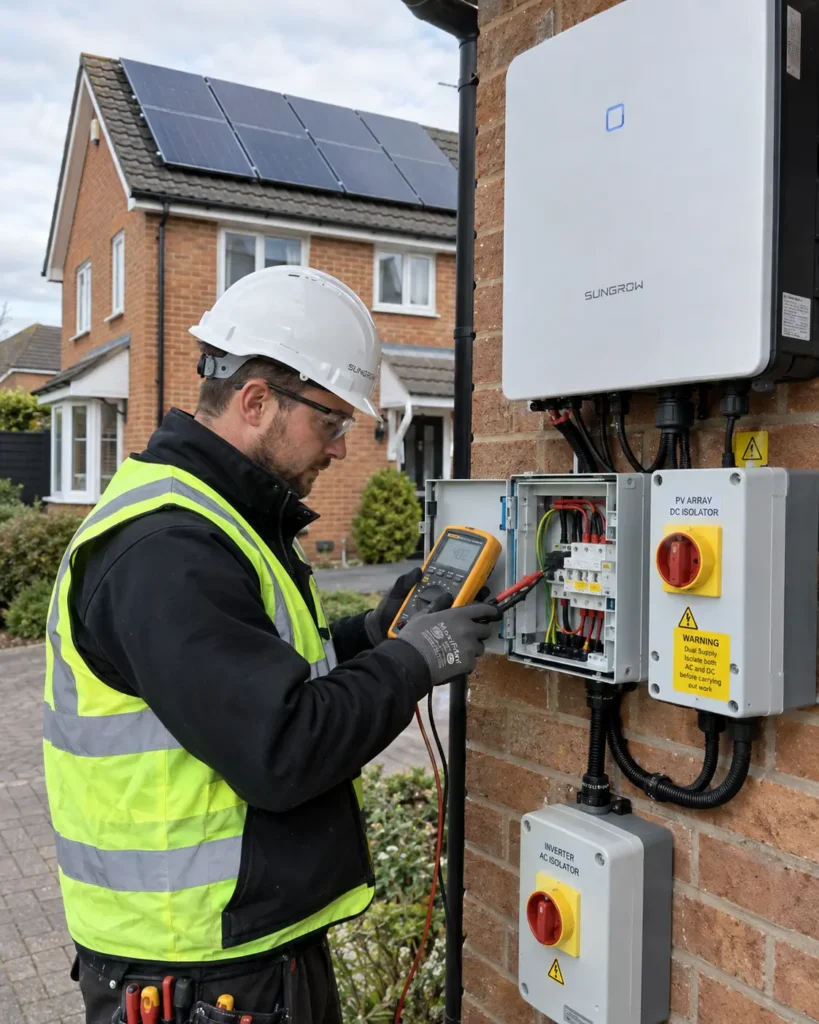
What is solar PV commissioning?
Commissioning is the point where an installed solar array moves from “physically fitted” to “tested, verified and ready for normal operation”.
The MCS solar PV installation standard says a system should be commissioned using a documented procedure to show that it is safe, installed to the standard and manufacturer requirements, and operating correctly against its design. It also references BS EN 62446-1 and the IET Code of Practice for Grid-connected Solar Photovoltaic Systems. MCS Certified
That makes commissioning different from the wider installation process. Mounting rails, panels and cable routes happen earlier. Commissioning focuses on verification: are the electrical values sensible, do isolators and protection work, does the inverter function properly, and has the system been documented?
For those earlier stages, see Get Free Quote’s solar panel installation process and step-by-step solar installation guide.
Solar PV commissioning process at a glance
| Stage | What is checked | Why it matters |
|---|---|---|
| Visual inspection | Array, cables, connectors, labels and equipment | Finds obvious installation or safety issues |
| DC testing | Voltage, current, polarity, insulation resistance and earth continuity where applicable | Confirms strings are wired correctly |
| AC testing | New AC circuit and protective measures | Confirms grid-side electrical work is safe |
| Functional checks | Inverter, isolators and monitoring | Confirms the system operates as designed |
| DNO compliance | G98, G99 or G100 route as applicable | Confirms the correct network-connection process |
| Handover | Certificates, test results, manuals and warranties | Gives the owner evidence and operating information |
1. Pre-commissioning visual inspection
Before live testing, the installer should inspect the system and compare it with the design.
This includes checking that modules, mounting equipment, cables, connectors, isolators and the inverter are correctly installed and suitably labelled. Cable routes should be secure and protected from foreseeable damage. Components should also match the design documentation.
The installer should confirm that the electrical arrangement matches the planned string configuration and inverter inputs. Batteries, optimisers, microinverters or export-limiting equipment must be treated as part of the overall system where fitted.
Visible defects should be corrected before the relevant electrical tests are completed.
2. DC-side solar PV commissioning tests
Solar panels produce direct current whenever they receive sufficient light, so the DC side needs a PV-specific test process.
The MCS model PV array test report includes fields for each string’s open-circuit voltage (Voc), short-circuit current (Isc), irradiance, polarity, array insulation resistance and earth continuity where fitted. It also records array-isolator and inverter functional checks. MCS Certified
Open-circuit voltage helps confirm that the expected number of modules are connected and that the string is behaving plausibly.
Short-circuit current provides another comparison between strings and expected performance under the available irradiance. Results need context because sunlight can change quickly.
Polarity testing confirms positive and negative conductors are correctly identified before connection to sensitive equipment.
Insulation-resistance testing checks whether live DC conductors are adequately isolated from earth and can reveal damaged cables, connector faults or insulation problems.
These tests require appropriate instruments and competence. Current NICEIC assessment requirements for solar PV work specifically identify relevant solar test equipment and access to the IET Code of Practice and MCS standard. NICEIC
Homeowners should not attempt live DC commissioning tests themselves.
3. AC-side tests and inverter checks
The AC circuit connecting the inverter to the property also needs inspection and testing under the relevant electrical rules. This work is normally recorded through the electrical certification for the installation.
Next comes functional commissioning. The installer checks that the inverter starts correctly, accepts the PV input, synchronises appropriately with the grid and reports normal operating status. Array and AC isolators should also operate correctly.
Monitoring should be configured at this stage. If the system uses an app or web portal, the owner should be shown how to view generation, recognise fault messages and distinguish a communications problem from a solar-generation fault.
4. G98, G99 and the DNO connection process
Solar PV connected in parallel with the public distribution network must follow the correct DNO procedure.
Under the MCS solar standard, G98 applies up to and including 16 A per phase, while G99 applies above 16 A per phase. The threshold uses the aggregated AC output of generators at the premises, so battery storage can affect which route applies. G100 is relevant where export is deliberately limited. MCS Certified
For many straightforward G98 single-premises installations, the system can be installed and commissioned before the installer submits the required installation information. ENA’s G98 procedure states that the DNO should receive that information no later than 28 days after commissioning. Energy Networks
G99 systems generally involve an application and DNO consent before connection and commissioning, although the exact process depends on the system configuration. ENA guidance also provides commissioning documentation for relevant G99 installations. Energy Networks
Ask the installer which route applies, whether permission is needed before work starts and what DNO evidence you will receive afterwards.
5. Commissioning certificates and homeowner handover
A complete handover is one of the clearest signs that commissioning has been finished.
For an MCS-certified system, the records should explain what was installed, how it was tested and how it should be operated. MCS commissioning templates include a PV System Verification Certificate and PV array test report. MCS Certified
Depending on the project, your pack should normally include commissioning and test records, an Electrical Installation Certificate, MCS certificate where applicable, DNO documentation, manufacturer manuals, warranty information, system design or schematic information, performance estimates and safe isolation or operating instructions.
MCS’s published solar PV requirements state that an MCS installation should be registered on the MCS Installation Database and its certificate generated no later than 10 working days after commissioning. MCS Certified
Do not confuse the MCS certificate with the complete commissioning pack. It does not replace the underlying test results, manuals, warranties and handover information.
6. Monitoring, generation and final checks
Commissioning does not prove that a roof will generate its predicted annual kilowatt-hours in one afternoon. Weather, irradiance, module temperature and shading change constantly.
Instead, the installer checks that the system operates sensibly under the available conditions and that monitoring starts recording generation. Keep the predicted annual generation with your commissioning records as a reference for longer-term performance.
If you are choosing equipment before installation, Get Free Quote’s best solar panels UK guide can help explain common panel specifications.
Before accepting handover, make sure you have the electrical and commissioning records, understand the DNO status, have the MCS certificate if promised, can access monitoring and know how to isolate the system safely.
If export payments are part of your plan, paperwork also matters commercially. Under the Smart Export Guarantee, qualifying generators need appropriate export metering and must demonstrate that the installation meets applicable certification requirements. See the GOV.UK Smart Export Guarantee guidance and Ofgem’s current SEG information. GOV.UK
Common commissioning problems
Recent discussions among UK solar owners repeatedly mention delays in receiving MCS certificates, DNO confirmations, schematics or electrical certificates after the physical installation has finished. These discussions are anecdotal, but they highlight practical questions homeowners commonly ask at handover. Reddit
Technical problems can also appear at commissioning, including reversed polarity, abnormal string readings, insulation faults, incorrect inverter settings, unconfigured monitoring or export limits that do not match the agreed DNO arrangement.
Prevent these issues by asking before contract signature for a written list of the documents you will receive and when the project will be treated as complete.
Get Your Free Air Source Heat Pump Quote
Find the right air source heat pump solution for your home. Tell us a few details and our team will help you explore suitable options at a competitive price.
Quick to complete. No obligation.
Get your quote
Enter your details below and one of our team will get back to you.
Frequently asked questions
Find clear answers to common questions comparing air source and ground source heat pumps, including efficiency, installation and running costs, winter performance, noise, land requirements and borehole depth.
It is the formal inspection, testing, configuration and documentation carried out when a solar PV installation is completed. Its purpose is to verify that the system is safe and operates in line with its design.
No. Installation covers the physical and electrical construction of the system. Commissioning happens at the end and verifies that the completed installation works correctly.
Typical PV tests include open-circuit voltage, short-circuit current, polarity, insulation resistance and earth continuity where applicable. Isolators and inverter operation are also checked. MCS Certified
Voc means open-circuit voltage. Installers measure it to help confirm that a PV string is connected as expected.
Isc means short-circuit current. It is measured under controlled test conditions and helps installers compare actual string behaviour with expected values.
The electrical output of solar panels changes with available sunlight. Recording irradiance gives useful context when assessing current readings.
The installer should investigate and correct the fault before completing the relevant verification and handing over the system.
MCS certification is not simply a legal permission to own solar panels. However, it is important where an installation has been sold as MCS-certified and is commonly used to demonstrate eligibility for schemes such as the Smart Export Guarantee. GOV.UK also recognises equivalent accredited certification for SEG purposes. GOV.UK
Published MCS solar requirements state that registration and generation of the MCS certificate should take place no later than 10 working days after commissioning. MCS Certified
No. An MCS certificate confirms registration of an eligible MCS installation. Commissioning records contain the technical inspection and test information used to verify the system.
G98 covers qualifying generation up to and including 16 A per phase. Installations exceeding that threshold use G99 procedures. The exact connection route can also depend on other generation or batteries at the property. MCS Certified
For an MCS installation, the contractor is responsible for the appropriate G98 or G99 notification process under the MCS solar PV standard. MCS Certified
It can. MCS notes that the 16 A-per-phase threshold considers the aggregated AC output of generators, including relevant battery generation equipment. MCS Certified
For the standard single-premises G98 procedure, ENA states that the installer must provide the installation information to the DNO within 28 days after commissioning. That is the submission deadline, not a guaranteed DNO response time. Energy Networks
For systems following the normal G99 connection process, DNO approval is generally obtained before connection and commissioning. The exact procedure depends on the installation type and connection route.
Useful records include commissioning test results, electrical certification, MCS and DNO paperwork where applicable, system information, manuals, warranty details, performance estimates and operating or isolation instructions.
Electrical work associated with the solar installation should be appropriately inspected, tested and certified. The relevant certification should form part of the project's electrical records.
Yes, although available irradiance affects some measured values. A competent installer interprets readings against the conditions present during testing rather than expecting full rated output.
You still need to meet your chosen supplier's SEG or export-tariff requirements. GOV.UK states that SEG applicants need qualifying generation, suitable export metering and acceptable evidence of installation certification. GOV.UK
Ask for the missing documents in writing and identify each item specifically. If the system was sold as MCS-certified, you can also check the appropriate MCS consumer and certification channels rather than relying only on verbal assurances.
Conclusion
The solar PV commissioning process is the quality-control stage that turns a finished installation into a properly tested and documented system.
A competent process checks the DC array, AC connection, inverter operation, isolation, monitoring and network-connection requirements. It also leaves the homeowner with a useful evidence pack.
When comparing solar quotations, look beyond panel wattage and headline price. Ask who handles commissioning, DNO paperwork, MCS registration, electrical certification, monitoring setup and final handover. Get Free Quote can help you compare suitable solar quotations before choosing a provider.


