
Solar Panel Output UK: How Much Electricity Do Panels Generate?
Check Your Eligibility for Boiler Upgrade Scheme (BUS)
Complete your details below to check your eligibility.
Thank you
We've received your details and will be in touch shortly.

Quick answer: how much electricity do solar panels generate in the UK?
A typical UK home solar installation of around 4–4.5kWp may generate roughly 3,000–4,000kWh per year, although output can vary significantly.
A well-positioned, unshaded roof in southern England may generate more electricity than the same system on a shaded or less favourable roof further north.
Solar output is normally estimated using the system capacity in kWp together with the property’s location, roof orientation, roof pitch and shading. MCS performance calculations use these site-specific factors rather than assuming every system of the same size produces identical results.
t daytime electricity demand and suitable roof space, because every kilowatt-hour used directly on site can replace electricity that would otherwise be bought from the grid. Exporting surplus electricity can add revenue, but self-consumption is normally the stronger value driver.
A farm solar project should be sized around actual demand rather than roof area alone. Roof condition, structural loading, three-phase supply, DNO export limits, seasonal demand, battery economics and tax treatment can all affect the result. In 2026, current commercial market guides commonly put mid-sized rooftop installations at roughly £750–£1,100 per kWp, depending on size and complexity. Only a site survey and detailed quotation can establish a reliable price.
Solar Panel Output UK: How Much Electricity Do Solar Panels Generate?
Solar panel output in the UK depends on much more than the wattage printed on the panel.
A typical domestic solar system may have a rated capacity of around 4–5 kilowatt peak (kWp), but its actual electricity generation changes throughout the day and year. Location, roof direction, roof angle, shading and weather all affect the final figure.
Energy Saving Trust says the average solar panel system is around 4.5kWp. Panels generate electricity from daylight rather than heat, so they continue working on cloudy days, although stronger sunshine generally means higher output.
For many UK homeowners, a reasonably well-positioned 4–4.5kWp system might generate roughly 3,000–4,000kWh of electricity in a year. However, that is only a broad planning figure. Your installer should calculate a property-specific estimate.
If you are considering solar, you can also compare home-improvement options with Get Free Quote before deciding which system suits your property.
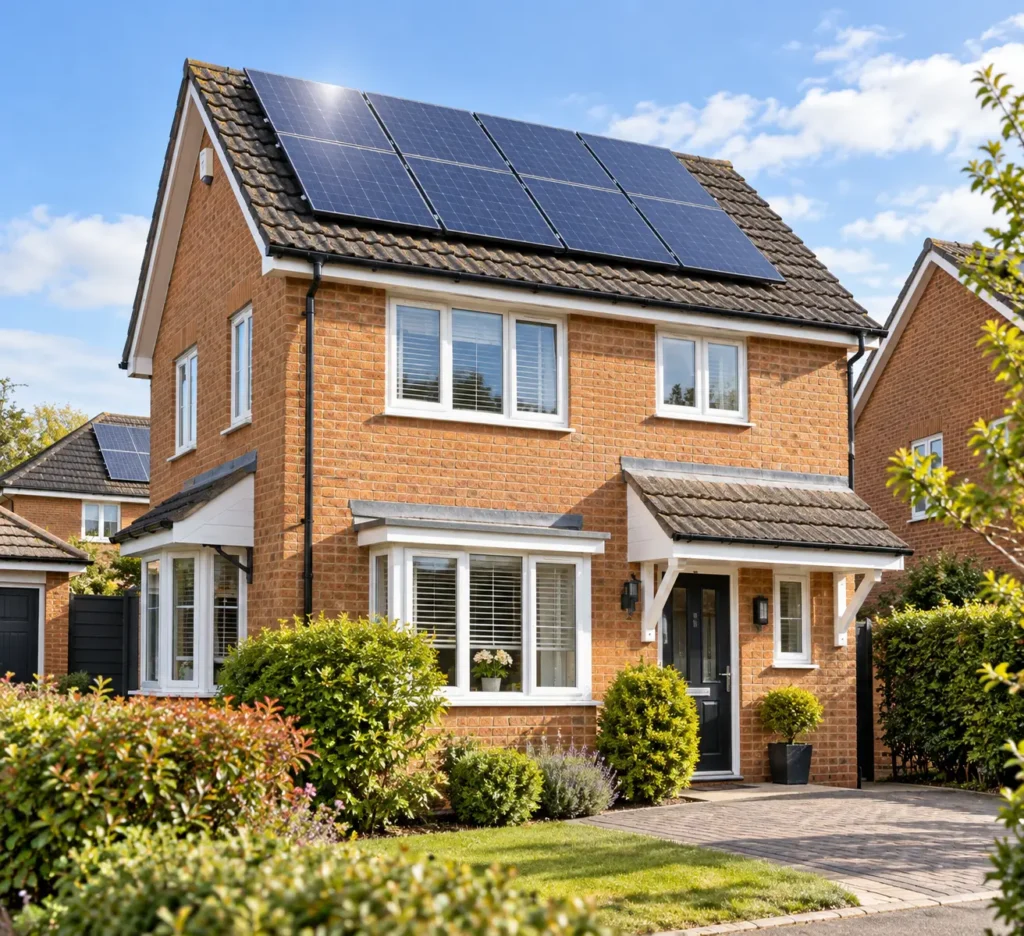
Typical solar panel output in the UK
There is no single output figure that applies to every UK home.
As a rough planning guide, reasonably well-sited systems may produce somewhere around 800–1,000kWh annually for every kWp of installed capacity. Regional conditions and shading can push actual generation outside this range, so it should not replace a site-specific calculation.
d on the panel.
A typical domestic solar system may have a rated capacity of around 4–5 kilowatt peak (kWp), but its actual electricity generation changes throughout the day and year. Location, roof direction, roof angle, shading and weather all affect the final figure.
Energy Saving Trust says the average solar panel system is around 4.5kWp. Panels generate electricity from daylight rather than heat, so they continue working on cloudy days, although stronger sunshine generally means higher output.
For many UK homeowners, a reasonably well-positioned 4–4.5kWp system might generate roughly 3,000–4,000kWh of electricity in a year. However, that is only a broad planning figure. Your installer should calculate a property-specific estimate.
If you are considering solar, you can also compare home-improvement options with Get Free Quote before deciding which system suits your property.
| System size | Approximate annual output* | Example number of 450W panels |
|---|---|---|
| 3.6kWp | 2,900–3,600kWh | 8 |
| 4.05kWp | 3,200–4,050kWh | 9 |
| 4.5kWp | 3,600–4,500kWh | 10 |
| 5.4kWp | 4,300–5,400kWh | 12 |
| 6.3kWp | 5,000–6,300kWh | 14 |
Real properties show why a range matters. An Energy Saving Trust case study near Coventry reports around 3,700kWh a year from a 4kW system. Another Energy Saving Trust example models a partially shaded, south-west-facing 4.5kWp system in north-west England at about 2,850kWh a year.
The lesson is simple: system capacity alone does not tell you annual generation.
kWp and kWh are not the same thing
Two measurements appear repeatedly in solar quotations.
kWp, or kilowatt peak, describes the maximum rated capacity of the solar array under standard test conditions.
kWh, or kilowatt-hour, measures the amount of electrical energy actually generated or consumed.
For example, ten 450W panels create a 4.5kWp array:
450W × 10 = 4,500W = 4.5kWp.
That does not mean the system continuously generates 4.5kW whenever daylight is available.
Its actual output moves constantly as sunlight, temperature and shading change.
If you are comparing current panel specifications, see the guide to the best solar panels in the UK for 2026.
How does solar panel output change throughout the year?
UK solar generation is heavily seasonal.
Longer days and stronger solar radiation mean spring and summer normally provide the majority of annual generation. Winter has shorter days, a lower sun angle and more periods of heavy cloud.
Panels still work during winter. They simply have much less solar energy available.
Energy Saving Trust confirms that solar cells do not require direct sunshine and can generate electricity on cloudy days. However, stronger sunshine produces more electricity.
This means homeowners should judge solar performance across months or an entire year rather than looking at one poor December day.
Generation can also differ substantially between one year and the next because UK weather varies.
What affects solar panel output?
Several factors interact.
| Factor | Effect on generation | What to check |
|---|---|---|
| System size | More installed kWp usually means more annual generation | Total panel wattage |
| Location | Solar irradiation varies across the UK | Property postcode |
| Roof direction | South-facing roofs usually maximise annual yield | Orientation |
| Roof pitch | Angle affects how directly sunlight reaches the modules | Roof inclination |
| Shading | Trees, buildings and chimneys can reduce generation | Shade assessment |
| Weather | Cloud reduces instantaneous output | Long-term annual estimate |
| Panel temperature | Very hot cells can become slightly less efficient | Ventilation and design |
| Inverter design | Can limit or influence usable AC output | Inverter specification |
These factors are why two neighbouring properties can produce different amounts of electricity from nominally similar solar arrays.
Does a solar roof have to face south?
No.
A south-facing roof usually provides strong annual generation in the UK, but east- and west-facing arrays can also perform well.
East-facing panels favour morning generation. West-facing panels shift more production into the afternoon and evening.
That can sometimes suit household electricity use better than an array focused entirely around midday.
North-facing roofs usually produce less annual electricity and need more careful assessment.
What is the best solar panel angle?
There is no universal angle for every property because location and roof direction also matter.
Typical pitched UK roofs often provide a workable angle without alteration. Flat roofs give installers more freedom to choose the panel tilt, although spacing, wind loading and row-to-row shading must also be considered.
If your property has a flat roof, see the guide to solar panel angles for flat roofs in the UK.
How is solar panel output calculated?
The most useful estimate is based on your property rather than a generic online average.
Under the MCS approach, annual output is calculated from the array’s installed capacity together with a location-, orientation- and inclination-specific yield figure and a shading factor. A simplified expression is:
Estimated annual output = system kWp × location/orientation/pitch yield × shade factor
The current MCS solar installation framework was updated in 2026. Its performance-estimation process is designed to give consumers a standardised annual generation forecast rather than a guaranteed production figure.
When comparing quotations, therefore, ask to see the assumptions behind the annual kWh figure.
Do not automatically choose the installer presenting the highest generation estimate.
A credible lower estimate based on realistic shading and roof measurements may be more useful than an optimistic forecast.
Energy Saving Trust also provides a solar energy calculator that considers property and household circumstances.
Why doesn’t a 450W solar panel always produce 450W?
A panel’s rated wattage comes from controlled standard test conditions.
Your roof rarely matches those laboratory conditions exactly.
Cloud, changing sun angle, high panel temperatures, partial shading and electrical losses affect instantaneous output.
There may also be times when an inverter limits the maximum AC power delivered by the system.
Seeing 300W from a nominally 450W panel therefore does not automatically mean something is wrong.
Peak output is also different from daily energy production. A system might briefly reach several kilowatts around midday, while the more useful figure for household economics is the number of kilowatt-hours produced across the whole day, month or year.
Does a battery increase solar panel output?
No. A battery does not make the panels generate more electricity.
It changes what happens after electricity has been generated.
Without storage, surplus electricity can flow to the grid when the house is producing more than it consumes. With a battery, some of that surplus can instead be stored for use later.
This may increase the proportion of your own solar electricity that you use at home.
If you export eligible electricity in Great Britain, the Smart Export Guarantee from Ofgem allows participating small-scale generators to receive payments from electricity suppliers. Suppliers set their own rates and contract terms.
Generation, self-consumption and financial savings should therefore be treated as three separate figures.
How can I tell whether my solar panels are generating properly?
Start with the monitoring information from your inverter, energy meter or solar app.
Compare generation over meaningful periods rather than one hour or one cloudy day.
Look for:
year-on-year generation trends
unusual drops compared with similar weather
inverter warnings or error codes
one roof section performing very differently from another
persistent generation well below the installer forecast.
Remember that an annual forecast is not a guarantee for every year. Weather alone can produce noticeable differences.
If performance remains unexpectedly low, check the original design assumptions, shading and equipment before assuming the panels themselves have failed.
What should an installer show you before you buy?
A good solar quotation should make its generation assumptions easy to understand.
Ask for the proposed system size in kWp, panel model and quantity, roof orientation, roof pitch, shading assessment, inverter specification and estimated annual generation in kWh.
The quote should also distinguish between electricity generated, electricity expected to be used in the home and electricity likely to be exported.
For an overview of what happens between survey and commissioning, read the solar panel installation process guide.
You can also review the main solar panel quote comparison service, which recommends comparing annual-generation assumptions alongside equipment, warranties and installation scope.
Get Your Free Air Source Heat Pump Quote
Find the right air source heat pump solution for your home. Tell us a few details and our team will help you explore suitable options at a competitive price.
Quick to complete. No obligation.
Get your quote
Enter your details below and one of our team will get back to you.
Frequently asked questions
Find clear answers to common questions comparing air source and ground source heat pumps, including efficiency, installation and running costs, winter performance, noise, land requirements and borehole depth.
It varies with panel wattage, season, location, roof direction and weather. A 450W panel will not continuously generate 450W throughout daylight hours.
A broad planning figure is roughly 3,200–4,000kWh per year for a reasonably well-sited system. Site-specific conditions can move output outside this range.
A rough planning range is around 4,000–5,000kWh annually. Your MCS estimate should provide a more appropriate property-specific figure.
Yes. Solar PV panels generate electricity from daylight and continue working under cloud, although output is lower than in strong sunshine.
Yes, but winter generation is normally much lower because days are shorter and the sun sits lower in the sky.
Late spring and summer generally provide the strongest generation, although the highest-output month varies with location and weather each year.
No. East- and west-facing roofs can still produce useful amounts of electricity. South-facing arrays generally maximise annual generation.
kWp means kilowatt peak. It describes the rated maximum capacity of the solar array under standard test conditions.
kWh means kilowatt-hour. It measures the actual amount of electrical energy generated or consumed over time.
No. Batteries store electricity that has already been generated. They may increase solar self-consumption but do not increase panel output.
Yes. Shade from trees, neighbouring buildings, chimneys or other objects can reduce generation. Its impact depends on the system design and timing of the shade.
Not necessarily. Solar panels need light rather than heat. High cell temperatures can slightly reduce electrical efficiency.
The kWp rating comes from standard test conditions. Real roofs experience changing sunlight, temperature, shading and electrical losses.
Eligible households in Great Britain may receive payments for exported electricity through Smart Export Guarantee tariffs offered by electricity suppliers.
They are forecasts rather than guarantees. A good estimate accounts for system size, postcode, roof direction, pitch and shading, but actual weather still affects yearly generation.
Compare longer-term generation with your original estimate and previous years. Persistent unexplained shortfalls or inverter errors may justify further investigation.
Efficiency mainly affects how much generating capacity can fit into a given roof area. For two arrays with the same installed kWp and otherwise identical conditions, panel efficiency alone does not mean one automatically produces substantially more annual electricity.
Solar panel output UK: the practical conclusion
For many UK homes, a 4–4.5kWp solar array can generate several thousand kilowatt-hours of electricity each year.
However, the headline system size is only the starting point.
Location, roof direction, pitch and shading determine how much electricity the system is likely to produce. Weather then affects the actual result from one day or year to the next.
The best way to compare solar proposals is therefore to look beyond panel wattage. Ask each installer for a transparent, property-specific annual generation estimate and check the assumptions behind it.
That gives you a far better basis for deciding how large your solar system should be and what you can realistically expect it to generate.


