
Flat Roof Solar Panel Cost UK: 2026 Price Guide
Check Your Eligibility for Boiler Upgrade Scheme (BUS)
Complete your details below to check your eligibility.
Thank you
We've received your details and will be in touch shortly.

Quick answer:
Quick answer: In 2026, expect a typical UK flat-roof solar installation to cost roughly £4,500–£7,500 for 3kWp, £6,000–£9,500 for around 4–4.5kWp and £7,500–£11,500 for approximately 5–6kWp. Flat roofs often need additional mounting hardware, ballast and engineering work. A ballasted installation also requires the roof structure to cope safely with both the PV array and the additional weight. Battery storage is separate and currently tends to cost about £5,000–£8,000. Your final quotation should be based on a roof survey rather than these indicative figures.
Flat Roof Solar Panel Cost UK: 2026 Prices, Mounting Costs and Payback
Solar panels on a flat roof typically cost around £6,000 to £9,500 for a 4–4.5kWp domestic system in the UK in 2026, although straightforward smaller installations can cost less and larger or structurally complex projects can exceed £10,000.
The panels themselves are not necessarily more expensive than those used on a pitched roof. The difference usually comes from the mounting system, ballast or mechanical fixings, structural calculations and any work needed to protect the roof membrane.
For context, the Energy Saving Trust’s solar panel guidance currently puts the average domestic solar installation at about £7,600 for a 4.5kWp system. Flat-roof installations can sit above or below that figure depending on roof access and the mounting design. Energy Saving Trust
If you are comparing your options, you can also read our guide to solar panels on a flat roof in the UK.
To find out what your own property could cost, compare solar quotes with Get Free Quote after the roof and proposed system have been properly assessed.
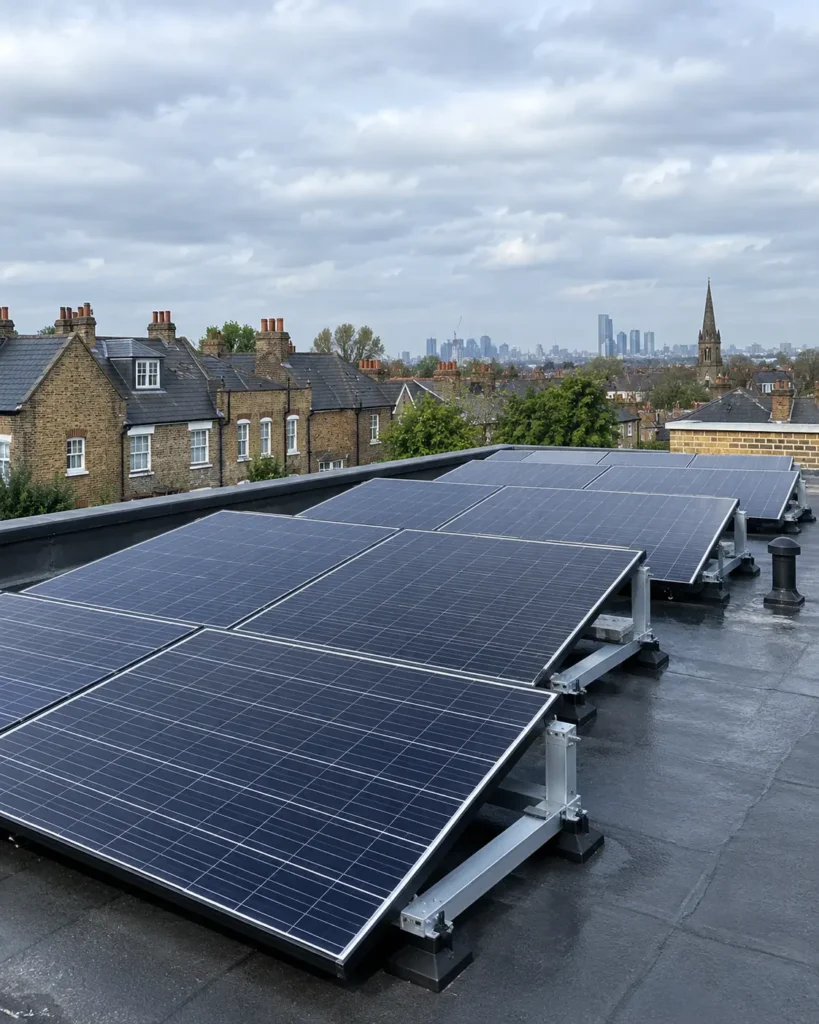
How much do flat roof solar panels cost in the UK?
Current market estimates vary because installers price the complete installation rather than the panels alone. Recent UK guides place a 4kWp flat-roof system at around £6,100–£9,000, while larger 5kWp installations commonly move towards £8,000–£10,500. solarbypostcode.co.uk
A practical budgeting range is:
| System size | Indicative 2026 installed cost | Typical application |
|---|---|---|
| Around 3kWp | £4,500–£7,500 | Small household, garage or extension |
| Around 4–4.5kWp | £6,000–£9,500 | Typical domestic installation |
| Around 5–6kWp | £7,500–£11,500+ | Larger household or higher electricity use |
These are indicative prices, not quotations. Roof condition, access, array layout and electrical work can materially change the final figure.
How much extra does flat-roof mounting cost?
A pitched-roof array normally attaches to rails fixed into the roof structure. On a flat roof, the installer needs a purpose-designed system that creates the required panel angle while resisting wind.
Current market estimates suggest this can add roughly £500–£1,500 compared with a straightforward pitched-roof installation, although complicated projects can cost more. SolarByPostcode
The actual mounting hardware is only part of that premium. The quotation may also include wind-loading calculations, protective layers beneath the mounting system, ballast, additional labour and structural engineering.
Why does the cost vary so much?
The biggest variable is usually not the solar panel brand. It is the roof.
A modern flat-roof extension with clear access and known construction may be relatively straightforward. An older roof with an unknown deck, ageing felt, difficult access or limited load-bearing capacity requires more investigation.
Important cost factors include:
- system size and number of panels
- ballasted or mechanically fixed mounting
- structural engineering requirements
- condition and age of the waterproof membrane
- roof height and access
- scaffolding or lifting equipment
- wind exposure
- panel layout and row spacing
- inverter specification
- consumer-unit or electrical upgrades
- optional battery storage.
That is why comparing headline prices alone can be misleading.
Ballasted or mechanically fixed: what changes the price?
Most domestic flat-roof installations use either ballast or mechanical fixings.
| Mounting method | How it works | Main consideration |
|---|---|---|
| Ballasted | Weighted mounting frames hold the array down without penetrating the roof | Avoids roof penetrations but adds weight and requires structural and wind-load assessment |
| Mechanically fixed | Mounts attach to the deck or structural elements | Can reduce ballast weight but penetrations must be correctly designed and weatherproofed |
The current MCS solar PV installation standard defines a flat roof as one below 10 degrees. For ballasted systems, it requires appropriate wind-resistance calculations, a compatible protection layer and consultation with a qualified structural engineer to establish that the roof can carry the PV system and ballast. Mechanically fixed systems can require condition surveys and pull-out testing. MCS Certified
This is why a cheap collection of panels and mounting trays should not be treated as equivalent to a designed installation.
For more detail on the physical work, see our guide to flat roof solar panel installation.
Will you need a structural survey?
For a ballasted MCS installation, structural capacity is a central part of the design rather than an optional extra. The combined weight of panels, frames and ballast must be considered alongside wind and other loads. MCS Certified
This matters particularly for timber flat roofs, older extensions and roofs where construction details are unknown.
A structural assessment can therefore add several hundred pounds to some projects. However, that is preferable to assuming a roof can safely carry a heavy array simply because it appears substantial.
Roof condition matters too. If the covering is approaching replacement, renewing it before installing solar can make financial sense. Otherwise, the array may later need removing and reinstalling when the roof is replaced.
Does the panel angle affect the cost?
Yes. Flat roofs give the designer more freedom over orientation, but tilt and spacing interact.
Many flat-roof systems use relatively shallow angles. A low-profile system reduces wind loading and allows rows to sit closer together. Increasing the tilt can improve the angle at which sunlight reaches the panels, but it may require greater spacing to prevent one row shading the next.
That can mean fitting fewer panels into the same roof area.
You can explore this separately in our guide to the best flat roof solar panel angle in the UK.
Panel efficiency also matters when roof space is restricted. Higher-output modules can produce more capacity from a limited usable area. Our comparison of the best solar panels in the UK for 2026 explains the specifications worth comparing.
Do you need planning permission?
The answer depends on where in the UK the property is located.
In England, the rules changed on 27 August 2026. Planning Portal currently states that flat-roof solar equipment on a house can generally remain permitted development where the highest part is no more than 600mm above the highest part of the roof, subject to other conditions. A transitional period runs until 27 August 2027. Additional restrictions apply to listed buildings, scheduled monuments and designated land. Planning Portal
In Wales, current government guidance says flat-roof panels should not sit within one metre of the roof edge or protrude more than one metre above the roof plane for the domestic permitted-development provisions described there. GOV.WALES
Scotland has its own permitted-development rules, while Northern Ireland advises householders to confirm requirements with the relevant planning office. Scottish Government
Always check the rules for the specific property before installation.
Is VAT charged on flat roof solar panels?
For qualifying residential installations in Great Britain, solar panels currently benefit from 0% VAT until 31 March 2027.
HMRC guidance includes photovoltaic panels and essential equipment within the eligible energy-saving materials. The temporary zero rate is scheduled to revert to the reduced rate after 31 March 2027 under the current rules. GOV.UK
You can check the latest position in the GOV.UK guidance on VAT for energy-saving products before accepting a quotation.
How much can flat roof solar save?
Your savings depend more on generation, electricity use and export arrangements than on whether the underlying roof is flat.
The Energy Saving Trust says a typical 4.5kWp domestic system occupies roughly 20–30m². Its current modelling gives general solar payback periods of around nine to twelve years across example locations in Great Britain when export payments are included. Those figures are based on July 2026 fuel prices. Energy Saving Trust
A flat-roof mounting premium can lengthen the payback period slightly. However, a flat roof can also allow the installer to choose a better orientation than the building itself would provide.
Surplus generation can qualify for payment through the Smart Export Guarantee explained by Ofgem, subject to the tariff provider’s eligibility requirements. Ofgem
Battery storage changes the calculation again. Energy Saving Trust currently estimates typical battery costs at about £5,000–£8,000. Energy Saving Trust
How to compare flat roof solar quotes
Do not compare quotations on total price alone.
Ask each installer to confirm the proposed system size, number and model of panels, inverter, mounting manufacturer, ballast or fixing method, structural assessment and expected annual generation.
Then ask how the design deals with wind loading and whether it affects your existing roof warranty.
You should also confirm whether scaffolding, DNO work, commissioning, monitoring equipment and warranties are included.
Most importantly, compare like with like. A £6,500 quote without structural assessment or clearly specified mounting equipment is not automatically better value than a £7,500 quote containing a properly engineered roof design.
Get Your Free Air Source Heat Pump Quote
Find the right air source heat pump solution for your home. Tell us a few details and our team will help you explore suitable options at a competitive price.
Quick to complete. No obligation.
Get your quote
Enter your details below and one of our team will get back to you.
Frequently asked questions
Find clear answers to common questions comparing air source and ground source heat pumps, including efficiency, installation and running costs, winter performance, noise, land requirements and borehole depth.
Often slightly. Flat roofs normally need specialist frames, ballast or mechanical fixings plus additional structural and wind-load assessment. The additional cost is commonly several hundred pounds and can exceed £1,000 on larger or more complicated systems. SolarByPostcode
A reasonable 2026 UK estimate is approximately £6,000–£9,000, although the final cost depends on mounting, access and structural requirements. solarbypostcode.co.uk
Current market estimates broadly place a 5kWp system at around £7,500–£10,500, before unusual structural or roofing work. solarbypostcode.co.uk
No. The roof must be structurally suitable, in adequate condition and capable of accepting the selected mounting method.
It should not when correctly designed. MCS requires a suitable protection or slip layer compatible with the waterproofing system and structural consideration of the additional ballast load. MCS Certified
For ballasted systems installed under the current MCS standard, a qualified structural engineer must be consulted to establish that the roof can withstand the PV array and ballast loads. MCS Certified
Mechanically fixed systems are possible. However, the fixings and waterproofing must be properly engineered. The MCS standard calls for condition assessment and, where appropriate, pull-out testing. MCS Certified
Many domestic mounting systems use relatively shallow angles such as 10–15 degrees because this limits wind loading and allows closer row spacing. The optimum design depends on location, roof dimensions and orientation.
Not necessarily. South-facing panels can maximise annual generation per panel, while an east-west layout may allow more modules on some flat roofs and spread electricity generation across more of the day.
Potentially. Shallower panels shed dirt less effectively. Energy Saving Trust notes that UK rainfall normally helps clean panels tilted at 15 degrees or more, while lower-angle systems may need more attention. Energy Saving Trust
Often not, but rules differ between England, Wales, Scotland and Northern Ireland. Listed buildings, conservation areas and other designated sites can require additional approval. Planning Portal
Qualifying residential solar installations in Great Britain currently receive 0% VAT until 31 March 2027 under the present rules. GOV.UK
There is no universal figure. Energy Saving Trust's general solar modelling currently indicates about nine to twelve years in example GB locations with export payments, but an additional flat-roof installation premium can affect that calculation. Energy Saving Trust
Energy Saving Trust currently gives a typical battery-storage cost of around £5,000–£8,000. Energy Saving Trust
If the covering is near the end of its useful life, doing the roofing work first can avoid paying to remove and reinstall the solar array later. A survey should establish the roof's condition before the system design is finalised.
Conclusion: what should you budget?
For most homeowners researching flat roof solar panel cost in the UK, a sensible initial budget is around £6,000–£9,500 for a typical 4–4.5kWp system in 2026, excluding battery storage and major roof repairs.
The final figure depends heavily on structural capacity, mounting design, access and roof condition.
Get the roof assessed before focusing on individual panel brands. Once you know what mounting system the property can safely support, you can compare system sizes, predicted generation and total installed prices on a meaningful basis.
If you are ready to investigate your property, compare quotations based on the complete engineered installation rather than the cheapest headline price.


