
Residential Solar Panel Installers UK: 2026 Guide
Check Your Eligibility for Boiler Upgrade Scheme (BUS)
Complete your details below to check your eligibility.
Thank you
We've received your details and will be in touch shortly.

Quick Answer: How Do You Choose a Residential Solar Panel Installer?
Choose a residential solar panel installer by checking active MCS certification, relevant electrical competence, insurance, consumer protection and a clear trading record. Then compare at least three itemised quotes using the same criteria: total system size in kWp, exact panel and inverter models, predicted annual generation, shading assumptions, scaffolding, electrical work, DNO responsibilities, warranties and aftercare.
Do not choose on price alone. A credible installer should survey the property, explain the design assumptions and provide realistic savings rather than guarantee a particular return. Also confirm what paperwork you will receive after commissioning, especially if you want to apply for Smart Export Guarantee payments.
Residential Solar Panel Installers: How to Choose the Right UK Installer in 2026
Choosing between residential solar panel installers is not simply a question of finding the lowest price. A good installer should assess your roof, electricity use, shading, future plans and electrical setup before recommending a system. They should also explain the proposed equipment, expected annual generation, warranties, grid-connection process and aftercare in writing.
Energy Saving Trust recommends obtaining at least three quotes from MCS-certified installers. Comparing properly specified quotes on the same basis helps expose unrealistic generation forecasts, missing costs and weak warranty terms. See the Energy Saving Trust rooftop solar installation guide for its current homeowner guidance.
This guide explains what to verify, what a strong quotation should contain and which questions to ask before signing.
Ready to explore your options? Get a free home-improvement quote and compare suitable providers without obligation.
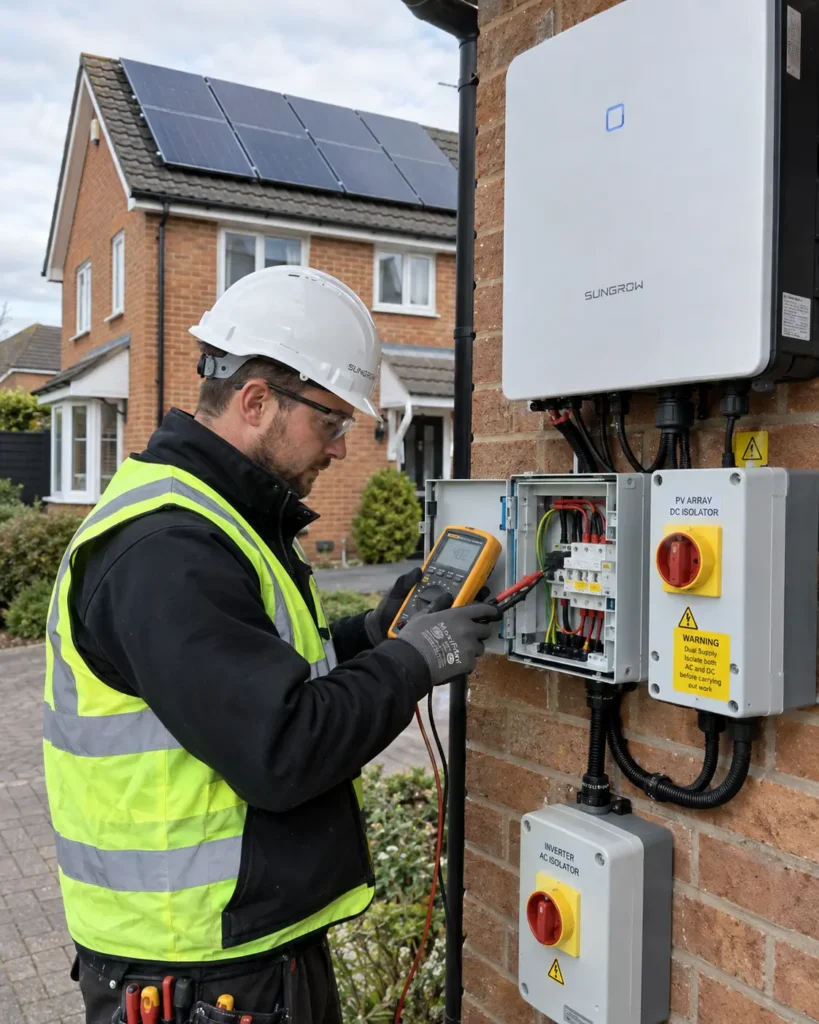
What Should Residential Solar Panel Installers Actually Do?
A residential installer should do more than fit panels to a roof. The job begins with assessing whether solar is suitable for your property and designing a system around your home.
Before the final design, the installer should consider roof orientation, pitch, shading, available area, roof condition and your electricity use.
The survey should also consider the consumer unit, inverter location, cable routes and future battery or EV-charger plans. See our solar panel installation survey guide for more detail.
The installer should then handle the agreed grid-connection work, installation, commissioning and handover. Our solar panel installation process guide covers that sequence in detail.
The Installer Checks That Matter Most
1. Verify MCS Certification
Energy Saving Trust recommends using installers certified by the Microgeneration Certification Scheme. MCS standards cover areas including the supply, design, installation, commissioning and handover of solar PV systems. The current solar PV installation standard, MIS 3002, applies to MCS contractors working on qualifying systems.
Do not rely on a logo alone. Verify the business against current MCS records and confirm its certification scope includes solar PV. You can also review the MCS Customer Commitment, which explains what customers should expect from certified installers.
MCS documentation can also matter when applying for export payments. Ofgem says installations up to 50kW normally need to demonstrate suitable certification for the Smart Export Guarantee, with an MCS certificate being a recognised route.
2. Check Consumer Protection Separately
Technical certification and consumer protection are related, but they are not identical.
Under the redeveloped MCS scheme being introduced during 2026, Consumer Code membership is no longer mandatory for every MCS-certified installer. Homeowners should therefore check an installer’s consumer-protection arrangements separately.
For example, RECC deposit and workmanship warranty protection requires its members to protect deposits and workmanship warranties. Ask what insurance-backed protection applies, who provides it and how long it lasts.
3. Check the Business Behind the Quote
Confirm that the company named on the quotation is the business you are contracting with. Check its trading history, contact details and insurance.
If work is subcontracted, make sure responsibility for the roof work, electrics, certification and aftercare is clear.
Residential Solar Installer Comparison Checklist
| Check | What good looks like | Warning sign |
|---|---|---|
| Certification | Active solar PV certification verified independently | Logo displayed but status not verified |
| Survey | Property-specific roof and electrical assessment | Final design based only on a phone call |
| Generation estimate | Written kWh estimate with shading and orientation assumptions | Guaranteed savings or vague “up to” claims |
| Quote | Itemised equipment, labour, scaffolding and responsibilities | One total with major exclusions unclear |
| Warranties | Product, inverter and workmanship cover explained separately | “25-year warranty” with no explanation |
| Aftercare | Named support route and monitoring handover | No clear contact after final payment |
What Should Be Included in a Solar Panel Quote?
A useful quotation should let you compare one proposal with another without guessing what is included.
The quote should show panel count, individual wattage, total array capacity in kilowatt peak (kWp), and exact panel and inverter models.
It should also include estimated annual generation in kilowatt-hours (kWh). Ask what roof orientation, pitch, shading and system losses were used. A higher forecast is not automatically better if the assumptions behind it are less realistic.
Check the full installation scope. Scaffolding, mounting, electrical work, monitoring, DNO administration and commissioning can affect the final price. Extras such as bird protection, optimisers, microinverters or batteries should be itemised.
Finally, separate the warranties. Panel product warranties, performance warranties, inverter warranties and workmanship warranties cover different risks. Ask who deals with a claim if the original installer stops trading.
If you are still comparing panel specifications, see our guide to the best solar panels for UK homes.
How Much Does Residential Solar Installation Cost in 2026?
Energy Saving Trust currently gives around £7,600 as an indicative cost for a typical 4.5kWp domestic solar PV system. Your quotation may be lower or higher depending on system size, roof access, scaffolding, panel and inverter choice, electrical work and whether battery storage is included.
Treat that as a benchmark rather than a guaranteed quotation. A property survey is needed for a reliable final specification.
Qualifying installations of solar panels in residential accommodation are currently zero-rated for VAT. HMRC says the temporary 0% VAT rate runs until 31 March 2027. Under current legislation, qualifying installations return to the reduced 5% rate from 1 April 2027. Read HMRC’s VAT guidance for energy-saving materials for the current rules.
Cost also needs to be judged against expected generation and household consumption. Energy Saving Trust’s current examples show solar payback varying by location and electricity-use pattern.
Can You Earn Money From Exported Solar Electricity?
In Great Britain, eligible households can receive payments for electricity exported through the Smart Export Guarantee (SEG).
Ofgem explains that SEG suppliers determine their own tariff rates, contract lengths and other terms. Your SEG provider does not have to be the company that supplies the electricity you buy. See Ofgem’s Smart Export Guarantee guidance for generators.
Before signing an installation contract, ask what certificates, commissioning information and metering arrangements you will receive.
Export income is not a fixed guaranteed return. Tariffs vary, as does the proportion of your solar generation that your home sends to the grid.
Seven Questions to Ask Before You Sign
Are you currently MCS certified for solar PV? Verify the answer independently.
What annual generation do you predict, and what assumptions did you use? Ask for the kWh figure in writing.
Exactly which panels and inverter are included? Request model numbers and datasheets.
What is excluded from this price? Check scaffolding, roof work, electrical upgrades and grid applications.
What warranties and insurance-backed protections apply? Separate product cover from workmanship protection.
Who handles DNO paperwork and commissioning? Responsibility should be explicit.
What happens if something goes wrong after installation? Ask about monitoring support, faults and warranty claims.
Local Installer or National Solar Company?
Neither is automatically better.
A local installer may offer direct access to the surveyor and installation team. A national company may have broader support capacity and more standardised processes.
Compare the proposed design, certification, contract, warranty arrangements and aftercare rather than the label.
Reviews can help, but read them critically. Recent comments about survey quality, communication, workmanship and problem resolution tell you more than a headline star rating alone.
Recent homeowner discussions also repeatedly raise practical comparison points such as whether scaffolding is included, how workmanship protection operates and what happens if an installer later stops trading. These are useful questions to resolve before signing rather than after installation.
What Happens After You Choose an Installer?
A final survey and design should come before installation.
In England, many conventional rooftop solar installations can fall within permitted-development rules when the relevant conditions are met. Restrictions can apply to listed buildings, conservation areas, flat-roof systems and other situations. Other UK nations operate their own planning regimes, so confirm the rules for your property. See the Planning Portal solar-panel guidance for England.
Energy Saving Trust says installation of a typical domestic rooftop system commonly takes around one to two days, although surveys, scaffolding, grid requirements and scheduling extend the total project timeline.
At handover, collect the documents promised in the contract and make sure you understand the monitoring system and basic fault reporting.
Get Your Free Air Source Heat Pump Quote
Find the right air source heat pump solution for your home. Tell us a few details and our team will help you explore suitable options at a competitive price.
Quick to complete. No obligation.
Get your quote
Enter your details below and one of our team will get back to you.
Frequently asked questions
Find clear answers to common questions comparing air source and ground source heat pumps, including efficiency, installation and running costs, winter performance, noise, land requirements and borehole depth.
Get at least three quotations. Energy Saving Trust recommends comparing at least three MCS-certified installers so you can compare pricing, equipment, assumptions and service.
MCS certification is widely recommended for domestic solar installations and is a recognised way to demonstrate suitable certification when applying for SEG payments. Equivalent certification may also satisfy SEG requirements.
Check the installer directly through MCS rather than relying on a certification logo shown in marketing material.
Not necessarily. Under the redeveloped MCS scheme, Consumer Code membership is no longer mandatory. Check RECC or other consumer-protection membership separately.
Look for system size, panel and inverter models, predicted annual generation, roof layout, scaffolding, electrical work, DNO responsibilities, commissioning, monitoring, warranties and exclusions.
Energy Saving Trust currently gives around £7,600 as an indicative cost for a typical 4.5kWp home system. Actual quotations vary by property and specification.
Not automatically. Compare equipment, predicted generation, installation scope, warranties, certification and aftercare alongside the total cost.
A workmanship warranty covers qualifying problems with the installation work rather than defects covered by the panel or inverter manufacturer's warranty.
It can protect specified warranty obligations if an installer ceases trading. Check the provider, duration, exclusions and policy documentation rather than assuming all guarantees offer identical cover.
Neither is automatically better. Compare the actual design, credentials, contract, installation arrangements and aftercare offered by each company.
A property-specific survey should take place before the final system design and specification. Roof condition, shading, electrics and cable routes can materially affect the installation.
Many conventional systems do not require a planning application, but restrictions can apply. Check the rules for your UK nation, property type and location before proceeding.
The physical installation of a typical rooftop system often takes around one to two days. The complete process takes longer because of surveys, design, scaffolding and grid procedures.
Often, yes. Tell the installer before the original design is finalised because inverter choice, electrical layout and grid arrangements can affect future battery compatibility.
The Distribution Network Operator manages the local electricity distribution network. Your solar installer should establish which grid-connection procedure applies and explain who handles it.
Eligible generators in Great Britain can apply for export payments through the Smart Export Guarantee. Rates and terms vary between SEG suppliers.
Qualifying installations currently benefit from 0% VAT until 31 March 2027. Under current rules, the rate changes to 5% from 1 April 2027.
Ask in advance about electrical documentation, commissioning records, equipment and workmanship warranties, monitoring instructions, applicable DNO paperwork and your MCS certificate where relevant.
Final Checklist: Choosing Residential Solar Panel Installers
The right installer should make the proposed system easier to understand, not harder.
Before committing, verify certification, insist on a property-specific survey, compare at least three itemised quotations and question savings claims that depend on unclear assumptions. Make sure the quotation identifies the equipment, installation scope, grid responsibilities, warranties and aftercare.
Do not automatically choose the cheapest proposal. Choose the quotation whose design, assumptions, scope and protections you can verify and understand.
When you are ready to compare options, use our solar panel quote comparison service to review suitable residential installation quotations.


