
Domestic Solar Panel Installation UK: 2026 Guide
Check Your Eligibility for Boiler Upgrade Scheme (BUS)
Complete your details below to check your eligibility.
Thank you
We've received your details and will be in touch shortly.

Quick answer: what should a domestic solar panel installation include?
A professional domestic solar panel installation should include a property and roof assessment, a system design based on your home and electricity use, the solar panels, mounting system, inverter, electrical protection, monitoring and any agreed battery storage.
The installer should also deal with the relevant Distribution Network Operator process, test and commission the system, and provide the necessary handover documents.
Most conventional rooftop systems can be installed physically in one or two days, although surveys, scaffolding, planning checks and grid requirements can extend the overall project. A typical 4.5kWp home system currently costs around £7,600, but actual quotations vary by roof, access, equipment and electrical work. Energy Saving Trust
Domestic Solar Panel Installation UK: Costs, Process and What to Check in 2026
A domestic solar panel installation can reduce the electricity you buy from the grid, but value depends on more than panel count. Roof condition, orientation, shading, household demand, inverter choice and system design all affect the result.
Energy Saving Trust currently puts the average domestic system at around 4.5kWp, using roughly 12 panels and 20–30m² of roof space, with an indicative installed cost of about £7,600. This guide explains what to check before accepting a quote, what installation involves and when batteries or export tariffs may improve the economics. Energy Saving Trust
Ready to compare options? Get Free Quote can help you compare domestic solar panel quotes without treating the cheapest headline price as the only deciding factor.
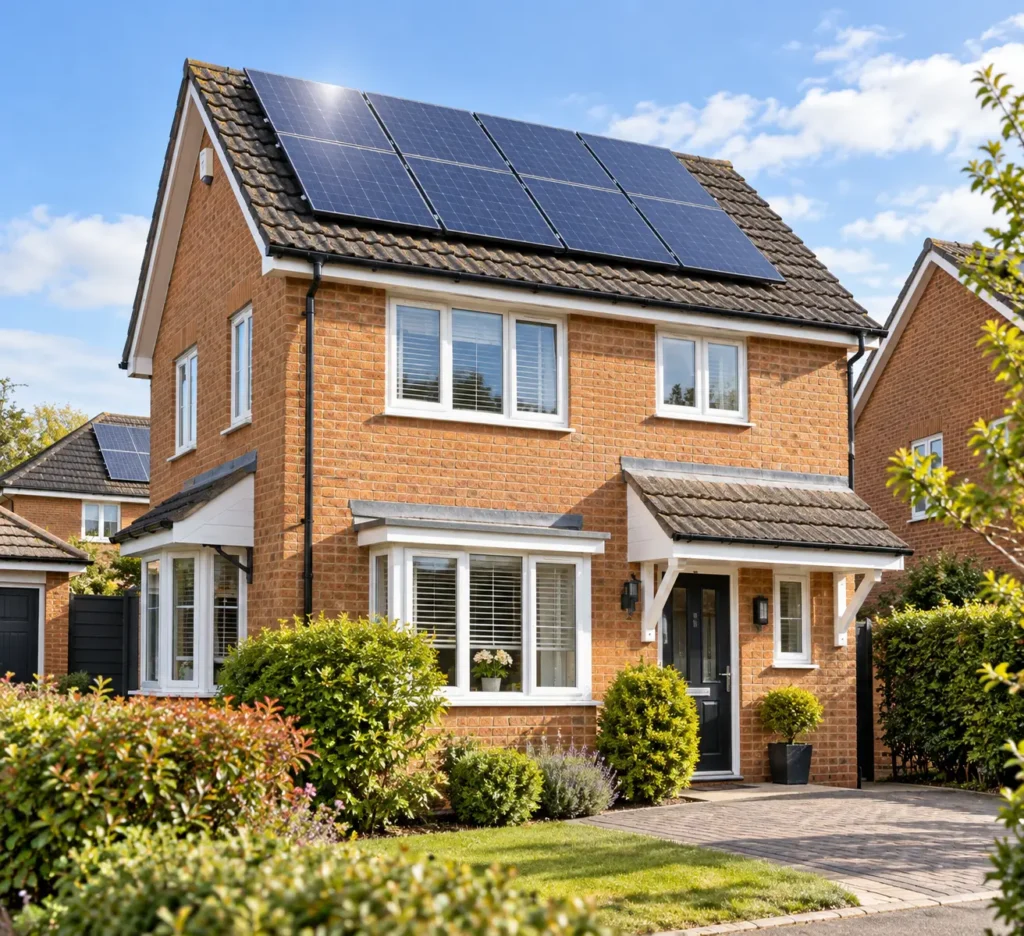
Domestic solar installation at a glance
| Item | Typical UK position |
|---|---|
| System size | Around 4.5kWp for an average home |
| Roof area | Roughly 20–30m² |
| Panel count | Around 12, depending on module size and output |
| Installed cost | Around £7,600 for a typical system |
| Physical installation | Often 1–2 days |
| Planning | Usually permitted development for conventional house rooftops, subject to restrictions |
| Grid connection | Installer should handle the relevant DNO procedure |
| Export income | Eligible Great Britain systems can use the Smart Export Guarantee |
| VAT | Qualifying residential solar installations are currently zero-rated until 31 March 2027 |
The cost, system-size and roof-space figures above come from current Energy Saving Trust solar guidance. SEG arrangements are governed by Ofgem, while the VAT position comes from HMRC. Energy Saving Trust
Is your home suitable for domestic solar panels?
Start with the roof, not the sales brochure. An unshaded south-facing roof generally gives the strongest annual output, but east- and west-facing roofs can still work well. Energy Saving Trust estimates that east- or west-facing systems may generate around 15–20% less than an equivalent south-facing system. Energy Saving Trust
Shading matters because a chimney, tree or neighbouring building can reduce generation for part of the day. A good survey should identify when and where shading occurs rather than assuming the whole roof performs equally.
Roof condition is just as important. Solar panels can remain in service for 25 years or more, so installing them over a roof covering close to replacement can create avoidable removal and refitting costs later. If you are uncertain, check whether you need a new roof before installing solar panels first. Energy Saving Trust similarly advises considering roof-covering renewal where needed. Energy Saving Trust
Your electricity use also influences the right design. A larger array is not automatically better if much of its output will be exported rather than used at home. Tell the installer about planned changes such as an EV, heat pump, home working or battery storage.
A thorough solar panel installation survey should turn these property details into a site-specific proposal rather than a generic package.
What does a domestic solar panel installation involve?
The installer should assess the property, confirm usable roof space, review shading, inspect the roof and check the electrical system. The final design should state the proposed panel model, total kWp, inverter, expected annual generation and its assumptions.
On installation day, safe roof access is normally provided with scaffolding. Mounting brackets and rails are attached to the roof structure, the panels are secured, and DC cabling runs to the inverter. The inverter converts the direct current produced by the panels into alternating current that household appliances can use. Energy Saving Trust
The installer then completes the electrical protection and connection work, commissions the system, configures monitoring and explains normal operation and faults.
The current MCS standard also requires an appropriate assessment of the building and sets requirements for grid-connection procedures and DNO notification. MCS Certified
For a more granular stage-by-stage explanation, use Get Free Quote’s solar panel installation process guide rather than duplicating every technical step here.
How much does domestic solar panel installation cost?
Energy Saving Trust currently gives around £7,600 as the indicative cost of a typical 4.5kWp domestic solar PV system. That is a useful benchmark, not a guaranteed quotation. Energy Saving Trust
Your price can move up or down depending on panel quantity, module specification, inverter choice, roof access, scaffolding, structural work, cable routes and whether the roof covering needs attention. Flat roofs and unusual roof materials can also require different mounting systems.
A battery is a separate cost decision. Energy Saving Trust currently places typical battery storage at around £5,000–£8,000, although capacity, inverter arrangement and installation complexity all matter. Energy Saving Trust
Qualifying solar panel installations in residential accommodation are currently zero-rated for VAT. HMRC states that this temporary zero rate runs until 31 March 2027, after which the reduced rate is scheduled to apply unless the rules change. Check HMRC’s current energy-saving materials VAT guidance. GOV.UK
What should you compare in solar panel quotes?
Do not compare quotes only by total price or panel wattage. Two systems with the same headline kWp can differ materially in design quality, equipment, warranties and expected generation.
| Quote item | What to check |
|---|---|
| System design | Panel layout, kWp, inverter and annual kWh estimate |
| Performance assumptions | Roof orientation, pitch, shading and system losses |
| Equipment | Exact panel and inverter models, plus monitoring |
| Access | Scaffolding and special roof access |
| Electrical work | Consumer-unit work, protection, cabling and isolators |
| Grid connection | Who handles G98/G99 and any export limitation |
| Certification | MCS status where specified and required documents |
| Warranties | Product, workmanship and insurance-backed protection |
| Battery | Capacity, usable storage, power rating and compatibility |
| Handover | Commissioning records, manuals, monitoring and support |
Which? and Energy Saving Trust both recommend obtaining at least three quotations and checking itemised specifications rather than relying on a headline price. Recent SolarUK discussions also show homeowners repeatedly asking whether scaffolding, DNO applications, warranties and battery specifications are actually included. Which?
If you may add a battery, EV charger or heat pump later, ask whether the inverter, consumer unit, cable routes and grid application leave room for it.
Planning permission, MCS and DNO requirements
Most conventional rooftop solar installations on houses in England can fall within permitted development, but conditions and exceptions apply. Listed buildings, protected locations, unusual mounting arrangements and properties with restricted development rights need extra checking. Planning rules differ across the UK, so confirm the position for your property rather than assuming the English rules apply everywhere. GOV.UK’s permitted-development guidance explains the English framework. GOV.UK
Grid connection is separate from planning. The 2026 MCS Solar PV Installation Standard requires MCS contractors to follow G98 for installations up to and including 16A per phase, G99 above that threshold and G100 where export is limited. It also places the relevant DNO notification responsibility on the MCS contractor. MCS Certified
After commissioning, eligible generators in Great Britain can apply for a Smart Export Guarantee tariff. Ofgem’s Smart Export Guarantee guidance confirms that participating suppliers set their own rates, contract lengths and terms, so export offers should be compared rather than assumed. Ofgem
Should you add a solar battery?
A battery can increase the amount of solar electricity you use yourself by storing surplus daytime generation for later. It can also be charged from the grid on cheaper time-of-use tariffs where the system and tariff support that strategy. Energy Saving Trust
A battery does not automatically produce the best return. Ask for separate figures showing the solar-only and solar-plus-battery economics.
If you are likely to add storage later, mention it during the original design. Compatible inverter choices, available wall or floor space and the DNO arrangement can make a later upgrade easier.
Is domestic solar panel installation worth it?
For a suitable property, solar can reduce grid electricity purchases for decades. Energy Saving Trust says panels should last 25 years or more, while an inverter may need replacement after roughly 12 years. Energy Saving Trust
Its current modelling gives payback periods of approximately nine years in London and Aberystwyth, 10–11 years in Manchester and 11–12 years in Stirling, depending on occupancy assumptions. Those examples include export payments and use July 2026 fuel prices, so they should not be treated as guarantees. Energy Saving Trust
The strongest installation is designed around the household rather than a generic package. Generation, self-consumption, export tariff, maintenance, future electricity demand and any finance costs all change the outcome.
Get Your Free Air Source Heat Pump Quote
Find the right air source heat pump solution for your home. Tell us a few details and our team will help you explore suitable options at a competitive price.
Quick to complete. No obligation.
Get your quote
Enter your details below and one of our team will get back to you.
Frequently asked questions
Find clear answers to common questions comparing air source and ground source heat pumps, including efficiency, installation and running costs, winter performance, noise, land requirements and borehole depth.
Energy Saving Trust currently estimates around £7,600 for a typical 4.5kWp system. Your actual quotation will depend on system size, equipment, roof access, scaffolding and any additional electrical or structural work. Energy Saving Trust
Energy Saving Trust uses roughly 12 panels for an average 4.5kWp system, occupying approximately 20–30m². The correct number depends on panel output, usable roof area and electricity demand. Energy Saving Trust
The physical installation commonly takes one or two days for a straightforward property. Surveying, scaffolding, design and grid procedures make the complete project longer. getfreequote.co.uk
Usually not for conventional rooftop panels on a house where permitted-development conditions are satisfied. Listed buildings, protected locations and unusual installations can have additional requirements, and rules vary between UK nations. GOV.UK
MCS certification provides a recognised framework covering system design, installation, commissioning and customer requirements. It is also relevant to many export-tariff and funding arrangements. MCS Certified
They are electricity-network connection procedures. Under the current MCS standard, G98 covers qualifying generation up to and including 16A per phase, while systems above that threshold follow G99 procedures. MCS Certified
No. Solar panels operate without battery storage. A battery may increase self-consumption, but whether it improves the financial result depends on its price, your electricity-use pattern and tariff.
Usually, yes. Planning for it when designing the original system can simplify future inverter, cabling, space and grid-connection requirements.
Yes. Photovoltaic panels generate electricity from daylight rather than heat, although output is lower when solar radiation is weaker. Energy Saving Trust
No. South-facing roofs generally maximise annual generation, but east- and west-facing arrays can still be practical. Energy Saving Trust estimates they may produce around 15–20% less than an equivalent south-facing array. Energy Saving Trust
If significant roof work is likely during the life of the solar system, completing it first can avoid paying to remove and reinstall panels later. A roof assessment should form part of the design process. MCS Certified
Eligible generators in Great Britain can receive payments through Smart Export Guarantee tariffs. Individual suppliers decide their rates and contractual terms. Ofgem
Qualifying installations in residential accommodation are currently zero-rated. The temporary 0% rate is scheduled to run until 31 March 2027. GOV.UK
Maintenance is generally modest. Energy Saving Trust says rainfall often keeps appropriately tilted panels clean, although dirt, nearby trees and system monitoring still need attention. Energy Saving Trust
For an MCS installation, the handover pack should include relevant certification, system information, manuals, test and commissioning data, warranty information and maintenance guidance.
Homeowner checklist before you sign
- Check the roof condition and whether repairs are likely within the system’s life.
- Compare at least three itemised quotations on the same basis.
- Ask for estimated annual generation in kWh and the assumptions behind it.
- Confirm certification, warranties, DNO responsibilities and handover documents.
- Decide whether a battery is justified now, later or not at all.
- Check planning, lease or freeholder restrictions where relevant.
- Compare export tariffs after commissioning instead of assuming your existing supplier is best.
- Keep certificates, warranties, manuals and design information for maintenance and any future house sale.
A domestic solar panel installation is a long-term home improvement, so the design and paperwork matter as much as the equipment. If the roof is suitable, the performance estimate is realistic and the quotation is complete, solar can provide useful electricity savings for many years.
When you are ready, compare solar panel installation quotes and judge each proposal on the complete specification, not simply its headline price.


