
Solar PV Installation UK: Costs & Requirements 2026
Check Your Eligibility for Boiler Upgrade Scheme (BUS)
Complete your details below to check your eligibility.
Thank you
We've received your details and will be in touch shortly.

Quick answer: what should you know before a solar PV installation in the UK?
A typical domestic solar PV project starts with a property assessment and site survey, followed by system design, any required Distribution Network Operator (DNO) checks, scaffolding, installation, electrical testing, commissioning and handover. The panels generate DC electricity, while an inverter converts it into AC electricity for your home. Many standard roof-mounted systems fall under permitted development, but rules differ across the UK and extra restrictions can apply to listed buildings, conservation areas, flats and unusual installations. Check that your quote states system size, expected annual generation, equipment models, warranties, DNO responsibilities and whether an MCS certificate will be provided.
Solar PV Installation UK: Costs, Requirements and What to Expect in 2026
If you are planning a solar PV installation in the UK, the biggest decisions happen before anyone puts a panel on the roof. A good project starts with roof suitability, realistic generation estimates, grid-connection checks and a specification that makes quotes easy to compare.
Solar PV can reduce the electricity you buy from the grid and may earn export payments for surplus power. However, system size, shading, roof condition, household use and tariff choice all affect the result. Energy Saving Trust currently puts the average cost of a home solar panel system at around £7,600.
If you are ready to compare options, Get Free Quote can help you review quotations before deciding whether to proceed.
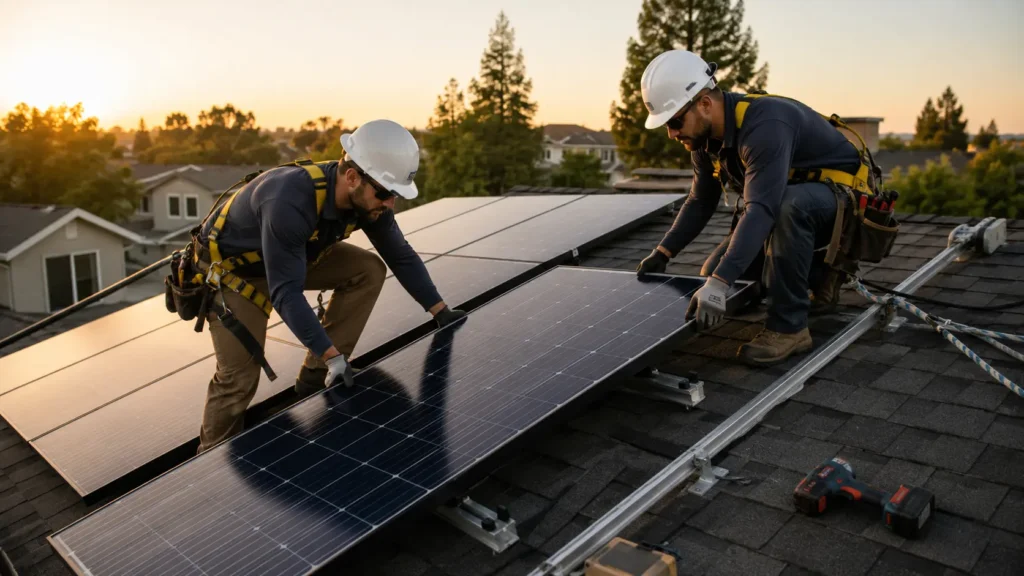
Solar PV installation UK: key points at a glance
| Question | What to check |
|---|---|
| Typical cost | Energy Saving Trust currently estimates around £7,600 for an average home solar panel system |
| Roof | Condition, usable area, pitch, orientation and shading |
| System design | Panel capacity in kWp, inverter specification and estimated annual generation |
| Grid connection | Whether G98 or G99 applies and who deals with the DNO |
| Certification | Installer credentials, MCS documentation where applicable and electrical certificates |
| Payback | Self-consumption, export tariff, location, electricity prices and total installed cost |
Is your home suitable for solar PV?
A south-facing roof with little shade is often ideal, but east- and west-facing roofs can also generate useful electricity. The key questions are whether there is enough unshaded roof area and whether the predicted generation suits your energy use. Energy Saving Trust confirms that shading, roof orientation and location all affect the result.
A survey should also check roof condition. Solar panels can remain in service for decades, so installing them on a roof likely to need major work soon can create avoidable removal and refitting costs. If the covering or structure is questionable, deal with that first. See our guide to solar panels and roof replacement.
The installer should review the consumer unit, cable routes, meter position and inverter location. If you may add a battery, EV charger or heat pump later, say so during design because it can influence equipment choices.
The Energy Saving Trust solar calculator can provide a useful independent estimate of likely system size, costs and savings.
How much does solar PV installation cost in the UK in 2026?
Energy Saving Trust currently gives an average home solar panel installation cost of around £7,600. That is a benchmark, not a quotation. Final prices depend on system size, equipment, roof access, scaffolding, electrical work and battery storage.
As of September 2026, qualifying installations of solar panels in residential accommodation are zero-rated for VAT until 31 March 2027. HMRC describes this as a temporary relief, so work completed later may be subject to the rules then in force.
Do not compare quotes on price alone. Ask each installer to show the kWp capacity, panel count, inverter, predicted annual generation and major inclusions. A cheaper system can be poor value if it is undersized or excludes necessary work.
A site survey should turn an indicative price into a property-specific proposal. Our solar panel installation survey guide explains what should be checked.
What size solar PV system should you install?
The best system is not automatically the one with the most panels. It should fit the usable roof area, stay within electrical and network constraints, and make sense for your electricity use.
Installers describe array size in kilowatt-peak, or kWp. Annual generation is measured in kilowatt-hours, or kWh. When comparing proposals, look at the assumptions behind the generation estimate, including location, roof direction, pitch, shading and system losses.
If one quote predicts much more output from a similar array, ask why. See our guide to solar panel output in the UK for more detail.
Planning permission, MCS and DNO requirements
Planning rules differ across the UK. In England, the permitted development rules for solar equipment were updated on 27 August 2026, with transitional arrangements to 27 August 2027. Wales and Scotland have their own rules. Listed buildings, conservation areas, flats, shared roofs and unusual installations need particular care.
For England, check the current Planning Portal solar guidance. Homeowners in Wales can use the Welsh Government solar planning guidance, while Scottish homeowners can check the Scottish Government permitted-development guidance.
Grid connection is separate. A solar PV system operates in parallel with the electricity network, so the local DNO must be dealt with under the applicable connection process. Energy Networks Association documents set out G98 requirements for fully type-tested microgenerators up to 16A per phase and G99 requirements for larger or otherwise applicable generation. Your installer should explain which route applies and whether prior approval is required.
MCS is also important for many domestic customers. Under the MCS solar PV standard, certified contractors register completed installations on the MCS Installation Database and provide an MCS certificate after commissioning. MCS handover guidance also covers system information, commissioning data, warranties and operating instructions.
What happens during a solar PV installation?
The usual sequence is assessment, survey, system design, grid checks, scaffolding, roof mounting, panel fitting, inverter and cabling work, testing, commissioning and handover.
Getfreequote.co.uk already has a detailed solar panel installation process guide, so there is no need to repeat every fixing and cable route here. For a typical home, on-site installation is often completed in around one to two days, while surveys, scaffolding, DNO work and scheduling make the total project longer.
Before handover, you should understand the monitoring system, isolation procedure and who to contact if a fault appears.
What should a solar PV quote include?
A strong quote makes it easy to compare like with like. Ask for a written proposal rather than relying on a verbal headline price.
| Quote item | What good detail looks like |
|---|---|
| System size | Total array capacity in kWp and panel count |
| Equipment | Exact panel, inverter and battery make/model where applicable |
| Generation estimate | Annual kWh estimate with roof, shading and loss assumptions |
| Work included | Scaffolding, mounting, cabling, electrical work and making good |
| Compliance | DNO responsibility, electrical certification and MCS paperwork where applicable |
| Warranties | Product, performance and workmanship terms |
| Price | Total price, payment stages, exclusions and validity period |
Be cautious if a proposal does not name the equipment, gives no generation assumptions or promises savings without showing how they were calculated. Getfreequote.co.uk’s existing solar quote page similarly recommends comparing equipment, generation assumptions, warranties and what the installer includes.
Solar batteries, export payments and payback
You do not need a battery to benefit from solar PV. Without one, your home uses solar electricity when available and exports unused generation. A battery can store some surplus for later, but the financial case depends on its cost, usable capacity, efficiency, warranty, tariff and your demand pattern. Energy Saving Trust’s 2026 analysis found that batteries can increase bill savings, although the added savings do not always recover the battery cost within its expected life.
In Great Britain, the Smart Export Guarantee guidance from Ofgem explains how eligible small-scale generators can receive payment for exported electricity. Ofgem notes that rates and contract terms vary by supplier, so compare tariffs rather than assuming your electricity supplier offers the best export deal.
Energy Saving Trust’s current examples, based on July 2026 fuel prices, show payback periods with export payments of roughly nine to twelve years across the UK locations it models, depending on location and occupancy. Treat these as illustrations, not guarantees. Your result depends on installed cost, generation, self-consumption, export rate and future electricity prices.
f grid work, access, roof repairs or switchgear are excluded.
If the farm is also planning vehicle electrification, consider how that future load could interact with solar and review Get Free Quote’s EV charger guidance. For project-specific questions, contact Get Free Quote before comparing proposals.
Get Your Free Air Source Heat Pump Quote
Find the right air source heat pump solution for your home. Tell us a few details and our team will help you explore suitable options at a competitive price.
Quick to complete. No obligation.
Get your quote
Enter your details below and one of our team will get back to you.
Frequently asked questions
Find clear answers to common questions comparing air source and ground source heat pumps, including efficiency, installation and running costs, winter performance, noise, land requirements and borehole depth.
Energy Saving Trust currently estimates around £7,600 for an average home solar panel system. Your actual quotation depends on system size, roof access, equipment, electrical work and whether you add a battery.
The physical installation of a typical domestic system often takes around one to two days. The full project takes longer because surveys, design, scaffolding and grid-connection work happen before installation.
Many standard domestic installations can use permitted development rights, but the rules vary across England, Wales, Scotland and Northern Ireland. Listed buildings, conservation areas and flats can require additional checks.
For an installation completed under the MCS scheme, the certified contractor registers the completed system and generates an MCS certificate. It forms part of the installation documentation you should retain.
G98 and G99 are technical connection requirements covering electricity-generating equipment connected to distribution networks. G98 covers fully type-tested microgenerators up to 16A per phase, while other installations may fall under G99.
Your installation must follow the applicable network-connection process. Depending on the system, this may involve notification or prior approval. A competent installer should explain and manage the appropriate route.
Yes. Solar PV panels still produce electricity from daylight on cloudy days, although output is normally lower than under strong direct sunlight.
No. South-facing roofs can perform well, but east- and west-facing roofs can also be suitable. Shading, pitch, available area and your household electricity-use pattern matter too.
If the roof is approaching major repair or replacement, dealing with it first may avoid paying to remove and reinstall the solar array later. The survey should assess roof condition before the design is finalised.
No. Solar PV works without a battery. A battery can increase the amount of generated electricity you use yourself, but whether it improves the financial return depends on its price, tariff and your electricity-use pattern.
Often, yes. However, compatibility with the inverter, electrical design, available space and grid-connection arrangements should be checked. Mention future battery plans when obtaining the original solar design.
The Smart Export Guarantee is the Great Britain scheme under which licensed electricity suppliers offer eligible small-scale generators payment for electricity exported to the grid. Rates and terms vary between suppliers.
There is no universal payback period. Current Energy Saving Trust examples using July 2026 fuel prices show roughly nine to twelve years across the locations modelled, depending on location and occupancy.
As of September 2026, qualifying installations of solar panels in residential accommodation are zero-rated for VAT until 31 March 2027. Check the rules applying when your work is carried out.
Yes, provided the roof is structurally suitable and an appropriate mounting design is used. Planning rules can also impose specific height, position or setback requirements, so the property should be assessed individually.
Final checks before you proceed
Before accepting a quote, confirm that the roof and electrical system have been assessed; the design states system size, equipment and expected generation; planning, DNO and certification responsibilities are clear; the quotation identifies inclusions and warranties; and any savings or payback figures are presented as estimates.
Solar PV is a long-term home improvement. The strongest proposal is the one you can understand and verify, not simply the one with the lowest upfront price or highest promised saving.
When you are ready, compare written quotations on the same basis and choose the specification that best fits your property and priorities.


