
Solar Panel Installers UK: Compare MCS Installers 2026
Check Your Eligibility for Boiler Upgrade Scheme (BUS)
Complete your details below to check your eligibility.
Thank you
We've received your details and will be in touch shortly.

Quick answer: how do I choose a solar panel installer in the UK?
Check that the company is currently MCS certified for Solar PV, then get at least three itemised quotations based on the same property information. Compare system size in kWp, panel and inverter models, estimated annual generation, scaffolding, electrical work, DNO responsibilities, warranties and aftercare. Do not judge value only by the headline price. A cheaper quote may exclude work another installer includes. Also check consumer-code membership, insurance, payment terms and recent customer feedback. Before signing, make sure the final design follows a proper survey rather than relying only on a desktop estimate.
Solar Panel Installers UK: How to Find and Compare MCS-Certified Installers in 2026
Choosing between solar panel installers in the UK is not simply a matter of finding the lowest quote. A good installer should assess your roof, electricity use, shading, electrical system and future plans before recommending a system. They should also explain the assumptions behind expected generation, savings and payback.
Energy Saving Trust recommends getting at least three quotations and looking for MCS-certified installers. Certification is an important starting point, but you should also compare equipment, workmanship cover, consumer protection, scaffolding, grid paperwork, payment terms and aftercare.
Get Free Quote is a UK comparison and introduction service rather than the installer itself. Its role is to help homeowners compare scope, prices, provider information, warranties and exclusions before deciding whether to proceed.
Ready to compare? Use the solar panel quote service to compare suitable options, or start from the Get Free Quote homepage if you are still researching.
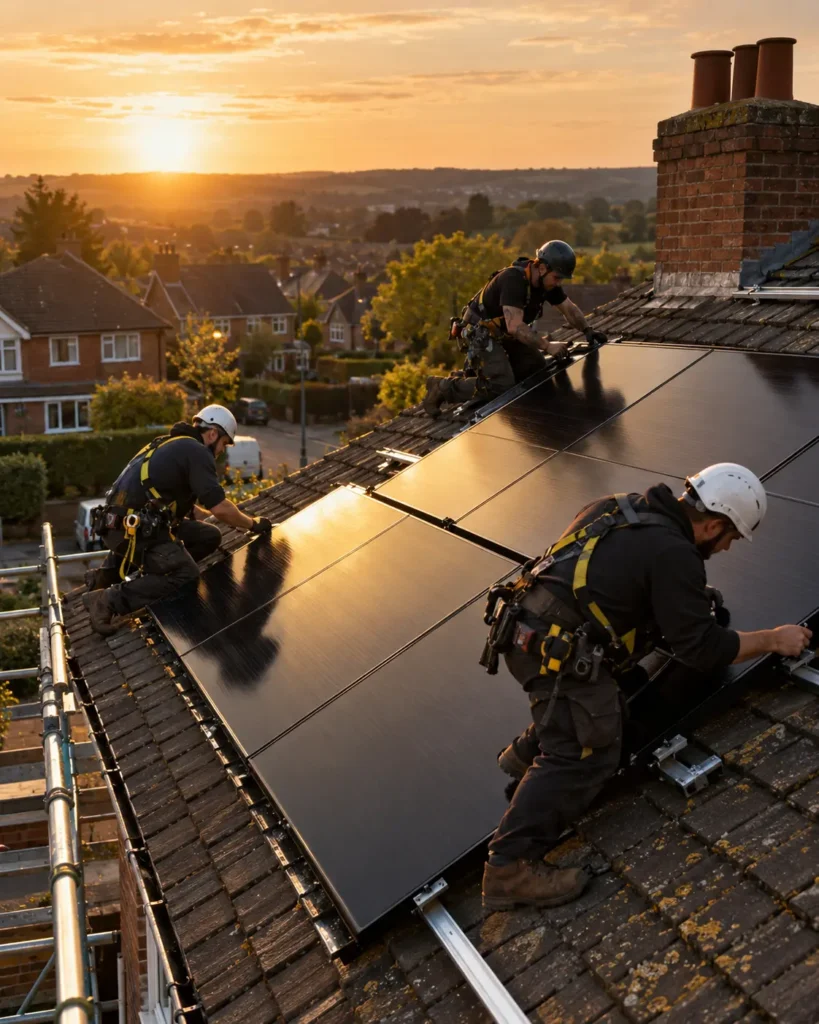
What should you compare between UK solar panel installers?
| Check | What to look for | Why it matters |
|---|---|---|
| MCS | Current Solar PV certification | Provides a recognised quality framework and can matter for export tariffs |
| Survey | Roof, shading, electrics and household use assessed | Supports a property-specific design |
| Equipment | Exact panels, inverter and battery | Lets you compare performance and warranties |
| Generation | Annual kWh estimate with assumptions | Helps you sense-check savings |
| Scope | Scaffolding, mounting, cabling and electrical work | Exposes important exclusions |
| Paperwork | DNO responsibility and handover documents | Reduces connection and admin problems |
| Protection | Product and workmanship warranties | Clarifies who covers faults |
| Aftercare | Monitoring and support process | Matters throughout the system's life |
Compare like for like. If one installer proposes ten panels and another fourteen, compare total kWp, annual generation and roof layout rather than price alone.
Visual suggestion: Create a downloadable “Solar Installer Quote Checklist” showing these eight checks on one page.
Check MCS certification before you sign
MCS is the UK’s recognised quality scheme for small-scale renewable technologies. Energy Saving Trust recommends looking for MCS-certified solar installers and directs homeowners towards the official MCS Find an Installer service.
Check the exact company name, current certification status and Solar PV scope. Do not rely only on a logo displayed on a brochure or website. Certification can change, so verify it close to the point of signing.
MCS certification should not replace normal due diligence. Review the quotation, workmanship protection, company identity, insurance and aftercare as well.
Check consumer protection too
The Renewable Energy Consumer Code consumer guide advises homeowners to check MCS certification and consumer-code membership before signing. Its guidance also warns about high-pressure selling and stresses the importance of clear deposit and payment terms.
For RECC members, deposits and workmanship warranties must have appropriate protection against the installer ceasing to trade. Ask what is protected, which provider supplies the protection, how long it lasts and what documents you will receive.
Local installer or national installer?
There is no automatic winner. The better fit depends on your property, specification, survey quality, price and the support offered.
| Installer type | Potential strengths | Points to check |
|---|---|---|
| Local or regional | Direct communication and local experience | Capacity, equipment range and long-term support |
| National | Standardised processes and broader support teams | Subcontracting, sales process and flexibility |
| Solar-and-battery specialist | Deeper storage and smart-tariff experience | Whether added complexity suits your home |
| Multi-service energy company | Easier EV, battery or heat-pump integration | Whether the solar design remains property-specific |
For a complex roof, heavy shading or a larger battery system, relevant experience with that type of project may matter more than company size.
What should a solar panel quote include?
A strong quotation should identify the panel model, number of panels, total system capacity in kWp, inverter, optional battery, roof layout and expected annual generation.
The installer should explain how it calculated that generation. Roof direction, pitch, shading, location and system losses all affect output. A larger forecast is not automatically a more credible forecast.
If you are comparing equipment as well as installers, the best solar panels UK guide can help you consider efficiency, warranties and available roof space without allowing brand choice to replace good system design.
Check practical installation costs
Confirm whether scaffolding is included. Also ask about roof mounting, cable routes, electrical upgrades, monitoring equipment, commissioning, making good and bird protection where relevant.
Recent discussions among UK solar buyers repeatedly raise similar questions: whether scaffolding is included, who handles grid paperwork, whether insurance-backed workmanship cover is provided and whether battery capacity has been matched to real household use.
The solar panel installation process guide explains what happens from survey and design through scaffolding, electrical work, commissioning and handover.
Confirm the survey and DNO responsibilities
A desktop estimate can help with early pricing. However, the final system should reflect a proper assessment of the roof and electrical system.
Review what a solar panel installation survey should cover before accepting a final specification.
Your installer should also explain which distribution-network process applies and who handles it. The route depends on the generating equipment, inverter arrangement, battery storage and export limits.
How much do solar panels cost in the UK in 2026?
Energy Saving Trust’s current guide gives around £7,600 as a typical installed cost for an average 4.5kWp domestic solar system. Treat that figure as a benchmark rather than a quotation. Roof access, system size, scaffolding, equipment choice, electrical work and battery storage can all change the final price.
Qualifying installed solar panels are currently zero-rated for VAT until 31 March 2027. Under HMRC’s published rules, the reduced 5% rate is due to apply from 1 April 2027. Read HMRC’s energy-saving materials VAT guidance
The useful question is therefore not simply, “Which installer is cheapest?” It is, “What complete system and installation scope am I receiving for this price?”
Visual suggestion: A graphic comparing headline quote price against total included scope could help readers spot misleadingly cheap quotations.
Will the installer help with export payments?
The Smart Export Guarantee explained by Ofgem enables eligible small-scale generators to receive payments for electricity exported to the grid.
Your SEG licensee does not have to be the same company that supplies your electricity. Ofgem advises generators to compare available export tariffs and their terms.
Ask the installer what documentation you will receive after commissioning and what you will need when applying for an export tariff.
A sensible savings estimate should also separate electricity expected to be used within the home from electricity expected to be exported. That makes the financial assumptions easier to check.
Solar installer red flags
Be cautious if a salesperson pressures you to sign immediately, offers a large “today only” discount, avoids giving equipment model numbers or refuses to provide a clear written scope.
RECC specifically identifies several pressure-selling practices homeowners should watch for, including inflated starting prices followed by discounts and incentives that depend on signing immediately.
Also question unusually optimistic generation or payback claims that do not show their assumptions. If an installer cannot explain shading losses, electricity-use assumptions, export prices or how a battery changes the calculation, the forecast is difficult to assess.
Payment terms matter too. Understand when deposits and stage payments become due, how they are protected and what happens if you cancel or the company stops trading.
What happens after you choose an installer?
The project normally moves through a detailed survey, final design, grid checks, scaffolding, installation, testing, commissioning and handover.
At handover, confirm that you receive the system specification, electrical documentation, relevant MCS paperwork, warranties, monitoring access and instructions for reporting faults.
A tidy installation matters, but paperwork and aftercare are part of the finished job too.
Which installer may suit your project?
For a straightforward pitched roof, focus on sensible sizing, a credible generation estimate, clear scope and dependable aftercare.
For a shaded or complex roof, ask how the design handles different roof faces and shading before accepting optimisers or microinverters as automatically necessary.
For a battery-heavy project, compare usable capacity, inverter compatibility, backup capability, warranty conditions and tariff strategy. The battery should be justified separately from the solar array.
For an EV owner, tell installers about present and future charging requirements. That allows the electrical design to consider higher household demand and possible solar-aware charging.
Get Your Free Air Source Heat Pump Quote
Find the right air source heat pump solution for your home. Tell us a few details and our team will help you explore suitable options at a competitive price.
Quick to complete. No obligation.
Get your quote
Enter your details below and one of our team will get back to you.
Frequently asked questions
Find clear answers to common questions comparing air source and ground source heat pumps, including efficiency, installation and running costs, winter performance, noise, land requirements and borehole depth.
MCS certification is the main UK quality-assurance framework for small-scale solar installations. Energy Saving Trust recommends using an MCS-certified installer, and certification can also be important when arranging export payments.
Energy Saving Trust recommends obtaining at least three quotes. Make sure they are sufficiently detailed to compare equipment, system size, generation estimates, warranties and installation scope.
Search the installer by company name or location using the official MCS Find an Installer service. Check that the certification is current and covers Solar PV.
Not necessarily. A lower price can reflect different equipment or exclusions such as scaffolding, electrical work, bird protection or paperwork. Compare the complete scope before deciding.
Usually you should establish clearly whether scaffolding is included. Roof height, access, extensions and conservatories can affect its cost.
Check panel product and performance warranties, inverter or battery warranties, the installer's workmanship warranty and any insurance-backed protection. They cover different risks.
Energy Saving Trust says the installation itself commonly takes around two days, although complex projects can take longer. Surveys, scaffolding and grid processes extend the overall project timeline.
A proper assessment is important because roof condition, orientation, pitch, shading, available area and mounting requirements influence the final design.
Yes, but compare total system capacity in kWp and predicted annual generation as well as the number of panels. Different panel models have different power ratings.
Sometimes. Compare the solar-only proposal with the solar-plus-battery version. Battery value depends on usable capacity, household consumption, tariffs, export rates and purchase price.
Qualifying installations are currently zero-rated until 31 March 2027. HMRC's current rules state that the reduced 5% rate will apply from 1 April 2027.
The Smart Export Guarantee is the framework through which participating electricity suppliers pay eligible small-scale generators for electricity exported to the grid.
No. Ofgem states that your chosen SEG licensee does not have to be your existing electricity supplier.
Be wary of pressure to sign immediately, large same-day discounts, unclear prices and claims of artificial scarcity. RECC specifically warns consumers about these types of sales practices.
Expect relevant system specifications, electrical paperwork, warranties, monitoring information and applicable MCS and grid-connection documentation. Ask the installer for a written handover-document checklist before work begins.
Final checklist before choosing a solar panel installer
Verify current MCS status. Get at least three itemised quotations. Compare the same assumptions. Check the exact equipment, generation estimate, scaffolding, electrical work, DNO responsibility, warranties, payment terms and aftercare.
Most importantly, make sure the final proposal follows a proper property survey.
A suitable installer should provide a well-designed, clearly documented system at a fair price and be able to explain why the proposal fits your property.
If you are ready to move from research to quotations, compare options through Get Free Quote and assess each proposal on its complete scope rather than headline price alone.


