
Best Value Solar Panels UK 2026: Buyer’s Guide
Check Your Eligibility for Boiler Upgrade Scheme (BUS)
Complete your details below to check your eligibility.
Thank you
We've received your details and will be in touch shortly.

Quick answer: what are the best value solar panels in the UK?
For a typical UK home with enough unshaded roof space, a mainstream N-type panel in roughly the 430–470W class is often the value sweet spot. JA Solar DeepBlue 4.0 Pro and Trina Solar Vertex S+ are strong examples because they combine useful power density with long performance warranties. JinkoSolar Tiger Neo is another credible option, although buyers should check the exact model because product-warranty terms can vary.
If roof area is tight, higher-efficiency models such as LONGi Hi-MO X10 or AIKO Neostar 2P can produce more power from the same space. The extra cost makes most sense when it allows a meaningfully larger solar array to fit on the usable roof. Manufacturer specifications currently put some of these higher-efficiency ranges above 24%. LONGi Solar
Best Value Solar Panels UK 2026: How to Get the Most for Your Money
The best value solar panels in the UK are not necessarily the cheapest panels or the models with the highest headline efficiency. For most homes, value comes from a well-priced, correctly designed system using reliable modern panels, a suitable inverter and realistic generation estimates.
In 2026, mainstream N-type panels from established manufacturers such as JA Solar, Trina Solar and JinkoSolar offer a strong balance of efficiency, warranty and cost. Higher-efficiency back-contact panels from LONGi or AIKO can be worth paying more for when roof space is limited.
This guide explains which panel families are worth shortlisting, how to compare value properly, typical UK installation costs and when a premium panel makes financial sense.
If you are ready to compare complete systems rather than panel prices alone, you can compare solar-panel quotations from suitable UK providers.
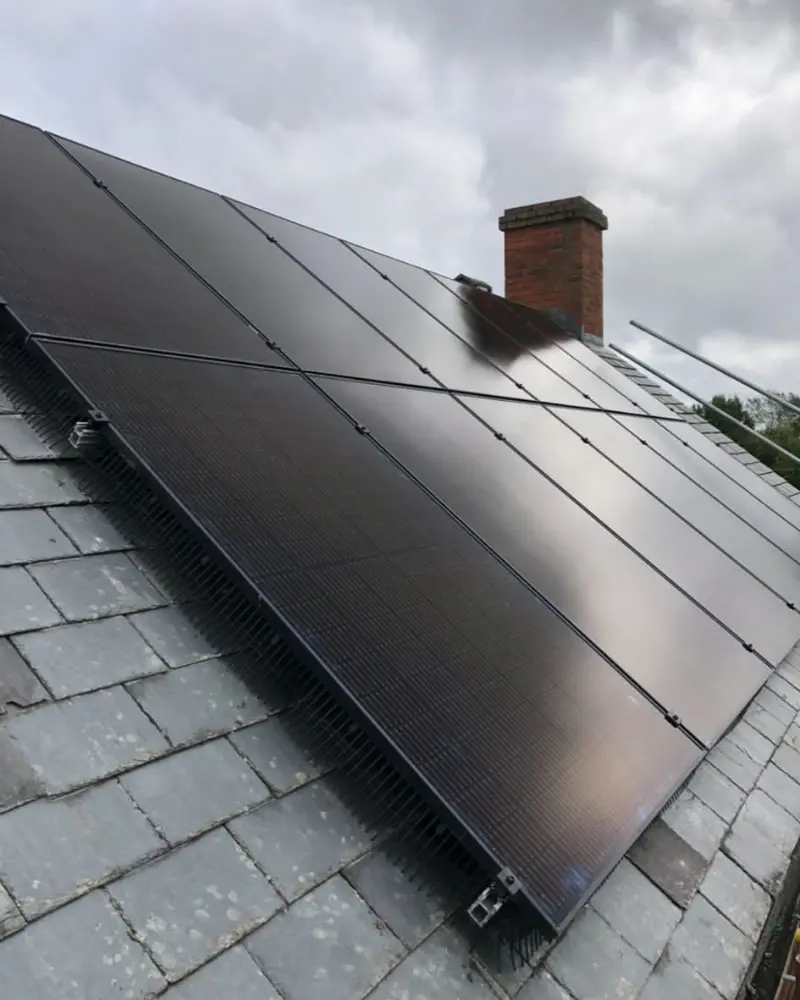
Best-value solar panels to shortlist in 2026
The comparison below uses current manufacturer specifications. It deliberately avoids panel-only retail prices because homeowners buy complete installed systems. The wholesale or online price of an individual module can be a poor guide to the final cost of solar on your roof.
| Panel family | Headline specification | Warranty position | Where the value case is strongest |
|---|---|---|---|
| JA Solar DeepBlue 4.0 Pro | JAM54D41 range reaches 455W and 22.8% efficiency | 15-year product and 30-year linear performance warranty on the cited residential variant | Standard roofs where the total installed quote is competitive |
| Trina Solar Vertex S+ | Current rooftop range reaches 460W and 23.0% efficiency | 25-year product and 30-year power warranty | Buyers wanting strong warranty cover without automatically moving to an ultra-premium product |
| JinkoSolar Tiger Neo 3.0 | Residential modules in the wider range reach up to 495W and 24.8% efficiency | 30-year linear power warranty; product terms vary by module | Quotes offering attractive installed £/kWp, provided the exact model is specified |
| LONGi Hi-MO X10 | Back-contact range reaches up to 24.8% efficiency | 30-year product/materials and power warranties on LONGi's cited European range | Small or awkward roofs where output per square metre matters |
| AIKO Neostar 2P | 450–485W and up to 24.3% efficiency | 15-year product warranty, extendable to 25 years, plus 30-year performance warranty | Space-constrained roofs where higher power density has real value |
These figures are not a simple ranking. Availability, model specifications and warranty terms can change. Ask the installer to put the full model number on the quotation rather than listing only a manufacturer.
JA Solar DeepBlue 4.0 Pro
JA Solar’s JAM54D41 range reaches 455W and 22.8% module efficiency. The cited version carries a 30-year linear output warranty and a 15-year product warranty. JA Solar
That product-warranty term is shorter than some competitors, but it does not automatically make the panel poor value. If a complete JA Solar system costs materially less while delivering comparable predicted generation, the lifetime economics can still be attractive.
Trina Solar Vertex S+
Trina’s current Vertex S+ residential range reaches 460W and 23.0% efficiency. Trina states a 25-year product warranty and 30-year power warranty for the range. Trinasolar
That combination deserves attention when two quotations are close in price. You gain comparatively long product cover without necessarily needing the highest-efficiency panel on the market.
JinkoSolar Tiger Neo
Tiger Neo 3.0 uses JinkoSolar’s N-type TOPCon technology. The wider residential range reaches 495W and 24.8% module efficiency. Jinko’s published warranty documentation also shows that warranty terms vary between product variants. Jinko Solar
A quotation saying only “Jinko 450W panels” therefore needs more detail. Request the model number, datasheet and applicable warranty documents.
LONGi Hi-MO X10 and AIKO Neostar
LONGi’s Hi-MO X10 and AIKO’s Neostar ranges become particularly interesting when usable roof area limits system size. Both manufacturers offer current back-contact products with efficiency above 24% on selected models. Longi
If that extra efficiency allows another 0.5–1kWp of solar to fit on your roof, paying more may be rational. If you can already accommodate your target system size with cheaper modules, the financial benefit may be much smaller.
When is a premium solar panel worth paying for?
Premium efficiency matters most when roof space is scarce, roof geometry restricts the layout or you expect electricity demand to increase through an EV, heat pump or other electrification.
Ask an installer to produce two layouts: one using a good mainstream panel and another using the premium option. Compare the extra installed cost against the extra annual kWh the higher-efficiency layout is expected to generate.
This exposes the real trade-off. A headline efficiency percentage is valuable only when it improves the system that actually fits your property.
What “best value” should mean on a solar quote
A useful solar comparison starts with the complete system.
| Compare this | Why it matters |
|---|---|
| Installed £/kWp | Makes different system sizes easier to compare |
| Estimated annual generation | Reflects orientation, pitch, shading, location and system losses |
| Exact panel and inverter models | Determines performance, compatibility, warranty and future support |
| Product and performance warranties | Separates defects cover from guaranteed long-term output |
| Export and self-consumption assumptions | These can materially change projected savings |
| Included work | Scaffolding, electrical upgrades, DNO work and monitoring alter the real installed price |
For a deeper look at generation assumptions, see the guide to solar-panel output in the UK.
How much do solar panels cost in the UK in 2026?
Energy Saving Trust currently gives an average home solar PV installation cost of around £7,600 and describes an average system as roughly 4.5kWp. The actual quotation depends on system size, roof access, equipment and the property itself. Energy Saving Trust
Qualifying installed solar panels currently benefit from 0% VAT until 31 March 2027 under the temporary VAT relief for energy-saving materials. HMRC states that solar panels fall within the qualifying technologies. GOV.UK
This is another reason to compare complete installed quotations rather than adding together online component prices.
The lowest quotation is not automatically the best value. A cheaper proposal may contain fewer panels, a smaller system or exclusions for scaffolding and electrical work.
How to choose the best-value solar system in six steps
- Establish usable roof area. If space is generous, mainstream modules may offer better value than premium high-efficiency panels.
- Compare kWp, not merely panel count. Ten 450W panels provide 4.5kWp; ten 400W panels provide 4kWp.
- Request a property-specific generation forecast. Check its assumptions for orientation, pitch, shading and location.
- Require exact equipment models. The brand name alone is not enough.
- Separate product and performance warranties. They protect against different risks.
- Compare two or three complete quotations on the same basis.
MCS’s current solar PV installation standard covers the supply, design, installation, commissioning and handover requirements applying to MCS-certified contractors. MCS Certified
For the practical stages after survey and design, see the solar-panel installation process guide.
Does a battery make solar better value?
Sometimes, but not automatically.
A battery can increase self-consumption by storing surplus solar electricity for later use. It may also work with time-of-use tariffs. However, the battery adds its own purchase cost, usable-capacity limits, efficiency losses and warranty considerations.
Energy Saving Trust advises that solar savings depend partly on how much generated electricity you use yourself and whether you receive export payments. Energy Saving Trust
Ofgem’s Smart Export Guarantee allows eligible solar PV generators to receive payment for exported electricity. Suppliers set their individual tariff rates and terms, so export income should not be assumed without checking the tariff. Ofgem
For UK weather concerns, the guide to solar panels for cloudy weather explains why daylight, shading and system design matter. Solar PV can generate electricity on cloudy days, although output varies with available light. Energy Saving Trust
How long can solar panels take to pay back?
Energy Saving Trust’s current examples, using July 2026 fuel prices and export payments, show indicative payback periods of around nine years in London, 10–11 years in Manchester and 11–12 years in Stirling, depending on household occupancy. Energy Saving Trust
These figures are examples rather than guaranteed returns. Installation cost, generation, electricity prices, export rates, shading and the proportion of solar electricity used at home all affect the calculation.
This is why saving a few pounds on each module is not the same as improving lifetime value.
Get Your Free Air Source Heat Pump Quote
Find the right air source heat pump solution for your home. Tell us a few details and our team will help you explore suitable options at a competitive price.
Quick to complete. No obligation.
Get your quote
Enter your details below and one of our team will get back to you.
Frequently asked questions
Find clear answers to common questions comparing air source and ground source heat pumps, including efficiency, installation and running costs, winter performance, noise, land requirements and borehole depth.
For many normal-sized roofs, mainstream N-type panels from manufacturers such as JA Solar, Trina Solar and JinkoSolar are sensible starting points. Compare complete installed costs and generation forecasts rather than choosing by brand alone.
No. Higher efficiency mainly helps you generate more power from limited roof area. On a large roof, a cheaper panel with slightly lower efficiency may deliver a better financial return.
Yes. Modern residential modules around 22–23% efficiency can provide strong performance. Several mainstream current products sit in this range. JA Solar
They can be. Around 430–460W is common among current residential ranges, but dimensions, voltage, roof layout and inverter compatibility also matter.
Its DeepBlue 4.0 Pro residential range combines efficiency up to 22.8% on the cited model with a long linear performance warranty. Whether it represents good value depends on the complete installed quotation. JA Solar
Yes. The current Vertex S+ rooftop range reaches 23.0% efficiency and carries 25-year product and 30-year power warranties, making it a useful comparison option. Trinasolar
They may be where roof space is restricted. LONGi's Hi-MO X10 range offers very high power density, so the relevant question is whether it lets your installer fit significantly more total system capacity. Longi
AIKO's Neostar 2P range reaches up to 24.3% efficiency in its cited specification, making it especially relevant to space-constrained layouts. AIKO Website
Both matter. Product warranties cover eligible defects for a stated period, while performance warranties specify minimum retained power output over time. Do not treat them as interchangeable.
Energy Saving Trust currently estimates around £7,600 for an average domestic solar installation, although actual quotations vary substantially by property and specification. Energy Saving Trust
Yes. Solar PV cells use daylight and can generate on cloudy days, although output is normally lower than in strong sunlight. Energy Saving Trust
No. Solar works without a battery. Storage can increase self-consumption, but whether it improves financial value depends on battery cost, electricity use, tariffs and export arrangements.
Eligible systems in Great Britain may receive export payments through a Smart Export Guarantee tariff. Suppliers set their own rates and terms. Ofgem
Cost per watt is useful, but installed £/kWp and expected annual generation are usually more meaningful for homeowners because they account for more of the complete system.
Comparing at least two or three properly itemised proposals is sensible. Energy Saving Trust also recommends speaking to at least three certified installers when considering renewable technologies.
Final recommendation
For most UK homeowners, start by obtaining prices for a good mainstream N-type system using manufacturers such as JA Solar, Trina Solar or JinkoSolar.
If roof space is limited, compare the additional price of higher-efficiency LONGi or AIKO panels against the extra system capacity they allow you to install.
Then compare the whole quotation: system size, predicted generation, inverter, warranties, scaffolding, electrical work, MCS certification and export assumptions.
The best value solar panels are therefore the panels that help create the strongest complete system for your property at a sensible lifetime cost—not simply the modules with the lowest purchase price or highest efficiency.
To compare property-specific options, visit Get Free Quote and request no-obligation quotations based on your roof, electricity use and priorities.


