
Solar Panel Installation Companies UK: Compare Installers 2026
Check Your Eligibility for Boiler Upgrade Scheme (BUS)
Complete your details below to check your eligibility.
Thank you
We've received your details and will be in touch shortly.

Quick answer:
The safest way to compare solar panel installation companies is to start with MCS-certified installers and obtain at least three detailed quotes. Compare the same system size in kWp, exact panel and inverter models, annual generation estimate, scaffolding and electrical work, DNO responsibilities, workmanship cover, product warranties and aftercare. Do not choose on price alone. A cheaper quote can represent good value, but only if the design, equipment and protections are equivalent. Before paying a deposit, verify the installer’s current certification and consumer-code membership independently rather than relying on logos in a brochure. Energy Saving Trust and RECC both recommend comparing three quotations.
Solar Panel Installation Companies UK: How to Compare Installers in 2026
Choosing between solar panel installation companies is about more than finding the lowest price. A good installer should assess your roof, electricity use and future plans, design a suitable system, explain the expected generation honestly, handle the relevant grid-connection steps and provide clear protection if something goes wrong.
For UK homeowners, the most useful comparison points are MCS certification, consumer-code membership, survey quality, equipment specification, workmanship protection, aftercare and the assumptions behind any savings forecast. Price matters, but only when you are comparing like-for-like systems.
This guide explains what to check before signing a contract, what a credible solar quote should contain and how to compare local and national installers without being distracted by headline discounts or unusually optimistic payback claims.
Ready to compare options? Get Free Quote helps homeowners compare suitable businesses, quotations, warranties and timescales without an obligation to proceed. The service researches providers and helps customers compare written quotations before deciding whether to connect with a chosen business.
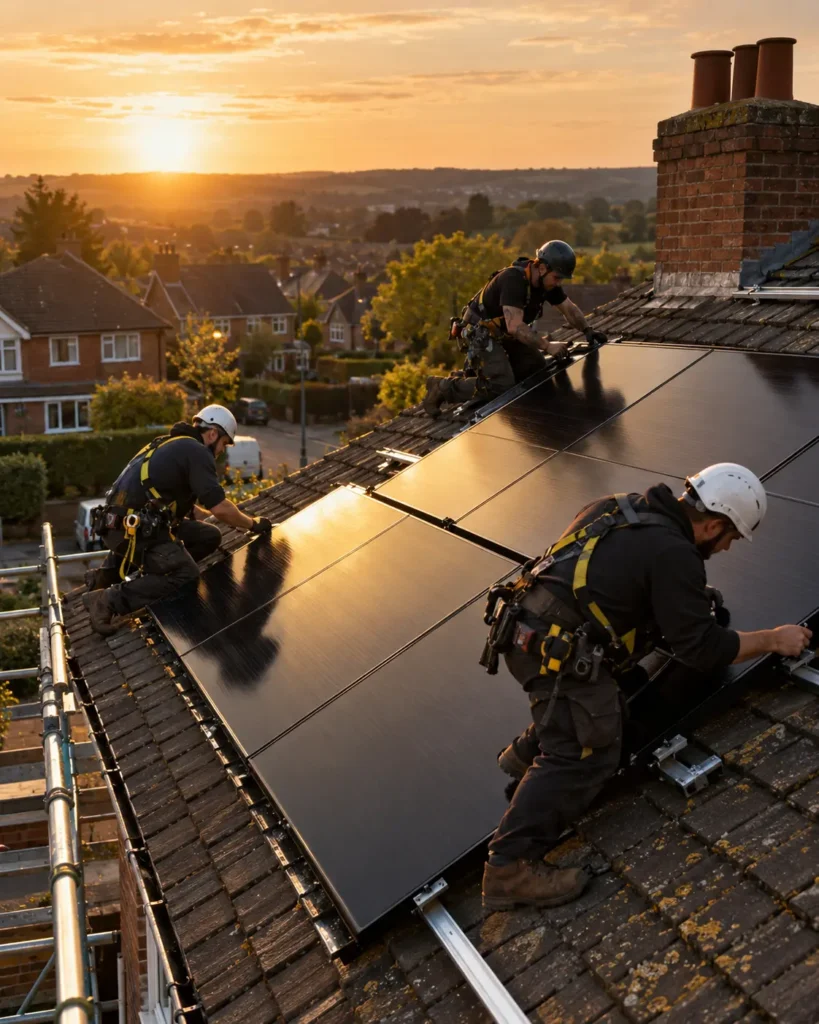
What should you look for in a solar installation company?
Start with MCS certification
For a typical domestic installation, MCS is one of the most important checks. MCS-certified contractors must work to scheme requirements covering design, installation, commissioning and handover. In-scope installations must also be registered by raising an MCS certificate.
An MCS certificate is also important if you want to access the Smart Export Guarantee (SEG). Ofgem says generators must demonstrate that their installation is suitably certified; for installations up to 50kW, an MCS certificate or equivalent is normally used.
Check the contractor independently through the MCS installer directory. Do not assume that wording such as “installed to MCS standards” means the company currently holds certification for solar PV.
Check the consumer-protection route
Technical competence and consumer protection are related but different. Look for membership of an approved consumer code such as RECC or HIES, then verify membership on the scheme operator’s own website.
The Renewable Energy Consumer Code consumer guidance recommends obtaining at least three quotations and checking MCS certification. It also warns against pressure-selling techniques and says consumers should receive clear system-performance information before signing.
For RECC members specifically, a deposit should not exceed 25% of the contract price, and deposits and applicable advance payments must have protection against the member becoming insolvent or ceasing to trade.
Solar installer comparison: local, national or comparison service?
| Route | Potential strengths | Points to check |
|---|---|---|
| Local solar installer | Local knowledge, direct contact, potentially simpler aftercare | Current MCS scope, capacity, financial protection, response times |
| National installation company | Wider coverage, standardised processes, finance or tariff integration | Who actually installs the system, subcontracting, regional aftercare |
| Quote-comparison service | Faster way to compare several suitable providers | How installers are selected, what information is shared, whether quotes are genuinely like-for-like |
There is no automatic winner. A strong local installer can provide excellent service, while a national company may offer more standardised processes and wider support.
The important question is who is contractually responsible for the survey, system design, installation, certification, warranties and post-installation service.
Get Free Quote states clearly that its solar service is a comparison and introduction service rather than the manufacturer or installer. Its solar page also recommends comparing system size, equipment, generation assumptions, installation scope and warranties.
How to compare solar panel quotes properly
Solar quotes can look similar while describing materially different systems. Compare the technical scope before comparing the total price.
| Check | What a useful quote should show | Why it matters |
|---|---|---|
| System size | Total capacity in kWp and panel count | Lets you compare systems on the same basis |
| Equipment | Exact panel, inverter and battery make/model | Determines performance, compatibility and warranty |
| Generation | Estimated annual kWh plus assumptions | Makes optimistic forecasts easier to spot |
| Roof works | Mounting system, scaffolding and any exclusions | Prevents surprise extras |
| Electrical works | Consumer-unit upgrades, cabling, isolators and monitoring | Clarifies the full installed scope |
| Grid connection | Who handles G98/G99 and any export limitation | Avoids delays and unclear responsibility |
| Protection | Workmanship cover, insurance-backed protection and product warranties | Shows what happens if equipment fails or the installer ceases trading |
| Final price | VAT treatment, payment stages and optional extras | Allows a genuine like-for-like comparison |
A useful proposal should also show panel layout, shading assumptions and expected system losses. A higher annual-generation estimate is not automatically better. It may simply use more optimistic assumptions.
If you are still comparing equipment, use the Get Free Quote guide to the best solar panels in the UK to assess the products separately from the installation company.
What should happen during the solar survey?
A proper survey turns a generic estimate into a property-specific design. The installer should assess roof dimensions, orientation, pitch, shading, roof condition, access, cable routes, inverter location and the existing electrical installation.
Your electricity consumption matters too. A system should not be sized from roof area alone. The designer should consider when you use electricity, whether you expect to add an EV or heat pump and whether battery storage could increase your self-consumption.
Ask what could cause the design or price to change after the survey. That simple question can expose vague provisional pricing before you sign.
The solar panel installation survey guide explains the property checks homeowners should expect before installation.
How much should solar panel installation cost in the UK?
Energy Saving Trust currently estimates that a typical 4.5kWp domestic solar PV system costs around £7,600 to install. Prices vary with system size, roof access, scaffolding, panel and inverter choice, electrical work, battery storage and whether the roof needs attention.
That £7,600 figure is a benchmark, not a guaranteed quotation. A cheaper proposal may omit work included elsewhere, while a more expensive quotation may include a larger array, premium equipment or more complex access.
The Energy Saving Trust solar calculator can provide a property-specific starting estimate before you speak to installation companies.
In Great Britain, qualifying residential solar-panel installations currently benefit from 0% VAT until 31 March 2027. Northern Ireland has different rules, so installers should apply the VAT treatment relevant to the property.
Contracts, warranties and consumer protection
Before signing, separate four different promises that can become blurred together in sales material:
Panel product warranty: covers defects in the module.
Panel performance warranty: covers a stated level of output over time.
Inverter or battery warranty: applies separately to those components.
Workmanship or installation warranty: covers the installer’s work.
Then ask what happens if the installation company stops trading. Insurance-backed protection can be valuable because a long workmanship guarantee from a company that no longer exists may otherwise be difficult to enforce.
RECC requires its members to protect deposits and workmanship warranties against installer failure, subject to the applicable policy and scheme terms. HIES also describes deposit protection, insurance-backed guarantees and dispute-resolution arrangements for installations registered through its accredited installers.
Read exclusions as carefully as the headline warranty length. Check whether labour, replacement equipment, access or scaffolding costs are covered.
What happens after you choose an installer?
The installer should finalise the design, establish whether planning permission is required, handle or clearly allocate the Distribution Network Operator process, arrange installation, commission the system and provide the final documentation.
Many conventional domestic rooftop systems in England can fall within permitted-development rules where the relevant conditions are satisfied. Listed buildings, conservation restrictions and unusual designs can require additional checks, and planning systems differ across the UK.
For grid connection, G98 and G99 procedures depend on the generating equipment and capacity. Energy Networks Association guidance shows that a low-voltage single-phase generating unit with registered capacity up to 16A per phase—3.68kW at 230V—can fall within G98. Other configurations may follow G99 procedures.
At handover, MCS guidance expects documentation covering items such as the MCS certificate, warranties, performance estimate, manuals, commissioning information and maintenance guidance.
A practical seven-step way to choose a solar panel installation company
Shortlist verified installers. Check MCS certification and consumer-code membership independently.
Get at least three written quotes. Energy Saving Trust and RECC both recommend comparing multiple quotations.
Make the systems comparable. Match kWp, panel count, inverter type, battery capacity and included works.
Interrogate the generation estimate. Ask what orientation, shading, losses and usage assumptions underpin it.
Check the contract and protections. Understand deposits, cancellation terms, workmanship cover and insurance-backed protection.
Confirm responsibilities. Get planning, Building Regulations, DNO, scaffolding, certification and handover responsibilities in writing.
Choose on total value, not headline price. Consider design quality, realistic forecasting, protection and aftercare alongside cost.
Before signing, use the solar panel installation checklist to make sure important details have not been overlooked.
Get Your Free Air Source Heat Pump Quote
Find the right air source heat pump solution for your home. Tell us a few details and our team will help you explore suitable options at a competitive price.
Quick to complete. No obligation.
Get your quote
Enter your details below and one of our team will get back to you.
Frequently asked questions
Find clear answers to common questions comparing air source and ground source heat pumps, including efficiency, installation and running costs, winter performance, noise, land requirements and borehole depth.
Start by checking that the contractor is currently MCS certified for solar PV. Then verify its consumer-code membership, business identity, warranties and independent customer feedback. Obtain several written quotations rather than relying on one sales presentation.
For most domestic solar systems, MCS certification is the usual route. Ofgem says installations up to 50kW generally demonstrate suitable certification through an MCS certificate or equivalent.
Aim for at least three. Energy Saving Trust and RECC both recommend getting three quotations so you can compare price, equipment, system design and protection rather than accepting the first offer.
Energy Saving Trust currently puts a typical 4.5kWp domestic system at around £7,600. Your final price can change because of system size, roof access, scaffolding, electrical work, batteries and equipment specification.
Not automatically. First check whether the quotes cover the same system size, exact equipment, scaffolding, electrical work, warranties, certification and DNO work. A cheap quote is only cheaper if the scope is genuinely comparable.
Look for system capacity in kWp, panel count, panel and inverter models, proposed layout, predicted annual generation, scaffolding, mounting, electrical works, monitoring, DNO responsibilities, warranties, payment stages and the total installed price.
Neither is inherently better. Compare the actual company’s credentials, survey quality, system design, aftercare, subcontracting arrangements and consumer protection. Local availability can help with support, while larger businesses may offer more standardised processes.
The installation company will commonly handle the relevant notification or application, but this should be confirmed in writing. The route depends on the generating equipment and whether G98 or G99 procedures apply.
Many conventional domestic rooftop systems can be installed under permitted-development rights, subject to conditions. Listed buildings, conservation areas, stand-alone arrays and unusual installations can require additional checks. Planning rules also differ between UK nations.
Check the panel product warranty, panel performance warranty, inverter warranty, battery warranty where applicable, and the installer’s workmanship warranty. Also establish whether any workmanship guarantee has insurance-backed protection.
Payment terms depend on the contract and consumer scheme. RECC specifically states that its members should not take more than 25% of the contract price as a deposit and requires relevant deposit protection.
The physical installation of many domestic systems can be completed in roughly one to three days, although surveys, scaffolding, system design and DNO processes make the overall project longer. Get Free Quote gives one to three days as a typical domestic installation period.
Eligible generators in Great Britain can apply for a Smart Export Guarantee tariff. Participating suppliers determine their own rates and contract terms, and Ofgem recommends comparing tariffs.
For an MCS installation, the handover pack should include documentation such as the MCS certificate, performance estimate, warranty details, equipment information, commissioning records, operating information and maintenance guidance.
The answer depends on your contract and protection scheme. Insurance-backed workmanship protection can provide cover when an installer can no longer honour its guarantee. Check that any required policy has actually been registered and read its conditions before relying on it.
Conclusion
The right solar panel installation company for your home is not necessarily the biggest, cheapest or the one advertising the longest headline warranty.
Look instead for a credible property-specific design, current certification, transparent pricing, realistic generation assumptions and clear responsibility from survey through to aftercare.
Verify credentials independently, compare at least three genuinely like-for-like quotations and keep important promises in writing.
If you want help narrowing the field, you can compare solar panel installation quotes and review prices, equipment, warranties, scope and timescales before deciding whether to proceed.


