
Solar Panel Installation Service UK: Costs & What’s Included
Check Your Eligibility for Boiler Upgrade Scheme (BUS)
Complete your details below to check your eligibility.
Thank you
We've received your details and will be in touch shortly.

Quick answer:
A professional solar panel installation service should normally include a property assessment, roof and electrical survey, system design, generation estimate, quotation, grid-connection checks, scaffolding where required, solar panels, inverter, mounting equipment, electrical work, testing, commissioning, monitoring setup and handover documents. Energy Saving Trust currently puts an average UK home system at about 4.5kWp and around £7,600 to install, although individual quotes vary. Compare the complete specification rather than the headline price, and check certification, warranties, assumptions, exclusions and aftercare before committing.
Solar Panel Installation Service UK: What’s Included, Costs and How to Choose
Choosing a solar panel installation service is about much more than finding someone to put panels on your roof. A good service should assess whether solar suits your property, design the system around your electricity use, explain expected generation, manage relevant grid-connection paperwork, install and commission the equipment safely, and leave you with the documents and support you need afterwards.
UK homeowners often receive quotations that look similar but include different panels, inverter sizes, scaffolding, warranties, battery options and savings assumptions. This guide explains what a professional service should include, how much a typical installation may cost, what to check before signing, and how to compare installers fairly.
For the fitting sequence itself, see our detailed solar panel installation process guide.
Get a free quote: If you already know you want solar, use Get Free Quote to compare suitable installation options for your property.
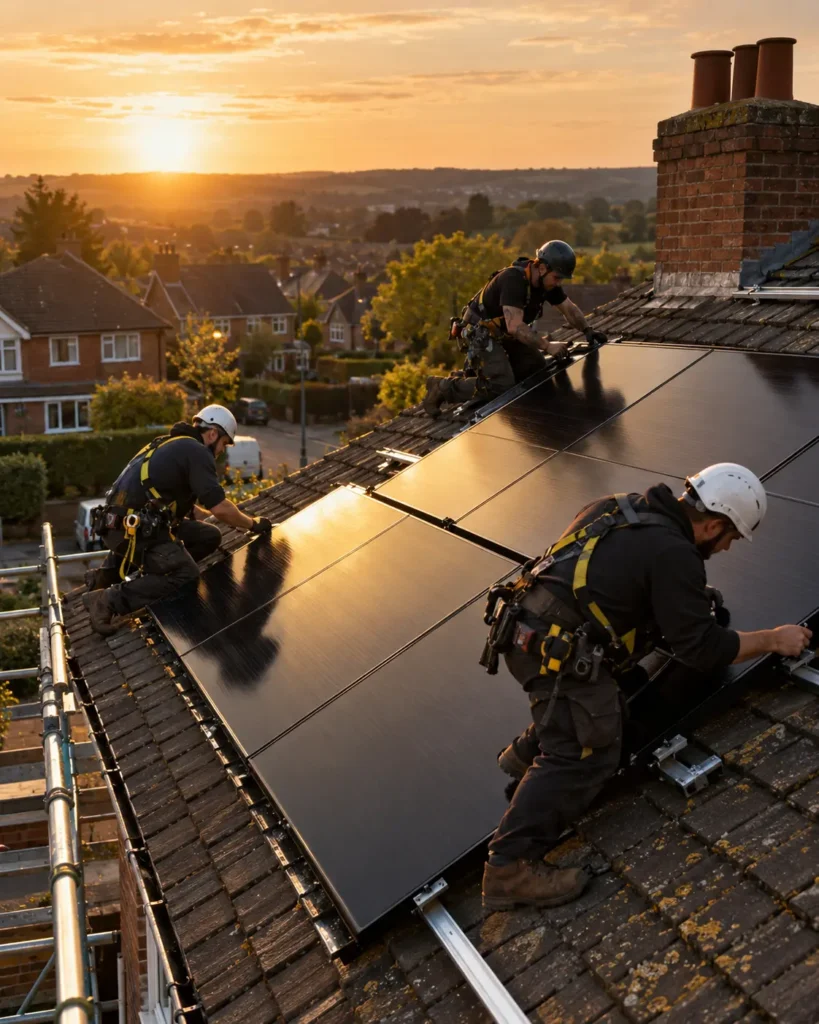
What should a solar panel installation service include?
A complete service should take you from initial assessment to a working, documented system. The exact scope varies, so never assume every quotation includes the same work.
| Stage | What a good service should cover | What to check |
|---|---|---|
| Assessment | Electricity use, roof space, shading and goals | Is the proposal tailored to your home? |
| Survey and design | Roof condition, layout, electrical checks and system sizing | Is there a property-specific generation estimate? |
| Preparation | Scaffolding, access, grid checks and scheduling | Are these included in the price? |
| Installation | Mounting, panels, inverter, cabling and protection | Are exact products specified? |
| Commissioning | Electrical tests, system setup and monitoring | Will the installer demonstrate the system? |
| Handover | Certificates, warranties, manuals and grid paperwork | What documents arrive, and when? |
| Aftercare | Fault support and warranty process | Who handles problems later? |
The important question is whether the company is selling a complete service rather than an attractive equipment bundle with important items left outside the quote.
How much does a solar panel installation service cost in the UK?
According to Energy Saving Trust’s current solar-panel guidance, an average home solar system is around 4.5kWp and costs about £7,600 to install. Treat that as a national reference point, not a guaranteed quotation.
Your cost depends on system size, panel and inverter specification, roof access, scaffolding, mounting system, electrical work, battery storage and unusual site requirements. A straightforward pitched roof can cost less to work on than a roof with several elevations, dormers or difficult access.
Qualifying installations of solar panels in residential accommodation are currently zero-rated for VAT until 31 March 2027. HMRC says they are scheduled to return to the reduced 5% rate from 1 April 2027. Read HMRC’s VAT guidance for energy-saving materials
A good quotation should make it possible to understand why the price is what it is. If one quote is much cheaper, compare scope before assuming it represents better value.
What should be included in a solar panel quote?
The best quotes are specific. They should identify the panel manufacturer and model, number of panels, total array capacity in kWp, inverter make and rating, roof layout, estimated annual generation, scaffolding, mounting equipment, electrical work, monitoring, warranties and DNO work.
If a battery is included, compare usable battery capacity and inverter capability rather than only the advertised storage figure.
Also check whether roof repairs, consumer-unit upgrades, trenching, long cable runs or other work will cost extra.
A site survey matters because an online estimate cannot fully assess roof condition, shading, access or the existing electrical installation. Read our solar panel installation survey guide before accepting a final design.
How should you compare solar panel installers?
Start with the complete proposal, not the panel brand or headline price.
Check the design assumptions
Ask how the annual generation figure was calculated. Roof direction, pitch, shading and location all affect output. A higher estimate is not automatically better if the assumptions are optimistic.
For more context, see our guide to solar panel output in the UK.
Check current certification
Where an installer offers an MCS-certified installation, verify its current solar PV certification independently rather than relying on a logo on a quotation. You can use the MCS installer search.
Certification is not a substitute for comparing the design, company history, quotation and aftercare, but it is an important part of checking what you are buying.
Compare warranties properly
Separate the panel product warranty, panel performance warranty, inverter warranty and installer workmanship warranty. They cover different things.
Ask who handles a claim if equipment fails. A long manufacturer warranty is more useful when you also know who will diagnose the problem and manage the claim.
Check inclusions and exclusions
Scaffolding, bird protection, DNO applications, monitoring hardware and electrical upgrades can materially change the total cost. Make sure exclusions are written down.
Recent UK solar discussions show that homeowners frequently struggle to compare quotes precisely because installers include different combinations of scaffolding, grid applications, warranties and battery equipment.
Compare aftercare
Find out who you contact if monitoring stops, an inverter reports a fault or generation appears lower than expected. Clear aftercare can be more valuable than small differences between similar panel specifications.
If you are still comparing products, our best solar panels UK 2026 guide explains the product side separately.
MCS, DNO and Smart Export Guarantee: what matters?
The Distribution Network Operator, or DNO, manages the local electricity network. Your installer should determine which connection process applies to the proposed system and explain who will submit the paperwork.
Do not assume a larger panel array automatically means a particular DNO route. The connection assessment depends on the generating equipment and configuration, including inverter capacity and, where relevant, batteries or export limitation.
After commissioning, you may be able to apply for a Smart Export Guarantee (SEG) tariff and receive payment for eligible electricity exported to the grid. Ofgem confirms that solar PV is an eligible SEG technology where the scheme requirements are met. It also advises generators to shop around because suppliers determine their own rates and contract terms. See Ofgem’s Smart Export Guarantee guidance
Is your home suitable for solar panels?
A good service should be willing to tell you when a proposed layout needs changing.
Roof area, orientation, pitch, shading and condition all matter. South-facing roofs often give strong annual generation, but east- and west-facing roofs can also produce useful electricity.
The roof should also be in suitable condition. If major repairs are likely soon, dealing with them before solar can avoid the cost and disruption of removing and reinstalling panels later.
Planning rules depend on the property and UK nation. In England, rooftop solar on homes can fall within permitted development rights when the relevant conditions are met. Listed buildings, protected sites and unusual installations require extra care. Check the government’s permitted-development guidance
Should you add a solar battery?
A battery can increase the amount of solar electricity you use yourself by storing surplus generation for later, but it also increases the upfront cost.
Consider your evening electricity use, tariff, battery capacity, inverter power, expected solar surplus and whether you may add an EV or heat pump later.
Ask the installer to show the financial case for the battery separately from the solar array. That makes it easier to see whether storage improves the overall proposition rather than simply increasing the project price.
If you may add storage later, tell the designer now. Equipment choice and system architecture can affect how straightforward a future upgrade will be.
What should happen after the installation?
Commissioning and handover are part of the service.
Before the project closes, you should understand how to view generation, recognise a fault and contact the installer for support. You should also receive the relevant system information, warranties and certification.
If you plan to apply for export payments, confirm what documentation your chosen SEG supplier requires. Ofgem says eligible exported electricity must be metered and installations must meet the applicable eligibility and certification conditions.
Keep the final quotation, invoice, system design, warranties, certificates and commissioning information together. These documents may be useful for warranty claims, future electrical work or when selling the property.
How to choose the right solar panel installation service
Use a simple decision process:
Confirm suitability. Start with your roof, electricity use and future plans.
Compare several detailed quotes. Compare the same scope, not just total price.
Verify certification and company details. Check current credentials independently.
Challenge the generation estimate. Ask what assumptions sit behind it.
Check every inclusion and exclusion. Focus on scaffolding, grid paperwork and electrical work.
Understand the warranties. Know who provides them and who handles claims.
Assess aftercare. Make sure there is a clear route for technical support.
Choose on whole-project value. The cheapest quote is not necessarily the lowest-cost system over its working life.
Get Your Free Air Source Heat Pump Quote
Find the right air source heat pump solution for your home. Tell us a few details and our team will help you explore suitable options at a competitive price.
Quick to complete. No obligation.
Get your quote
Enter your details below and one of our team will get back to you.
Frequently asked questions
Find clear answers to common questions comparing air source and ground source heat pumps, including efficiency, installation and running costs, winter performance, noise, land requirements and borehole depth.
A full service normally covers assessment, survey, system design, equipment supply, scaffolding where needed, mounting, electrical installation, commissioning, certification, monitoring setup and handover. Check your quotation because inclusions vary between installers.
Energy Saving Trust currently gives an average figure of around £7,600 for a 4.5kWp home solar system. Your actual price will depend on system size, roof complexity, equipment and any battery or additional electrical work.
The physical installation of a typical domestic system often takes around one or two days. Surveying, design, scaffolding, DNO requirements and scheduling mean the complete project normally takes longer.
Sometimes, but never assume it is. Check whether scaffolding, access equipment and removal are explicitly included in the written quotation.
MCS is the common certification route used for UK domestic solar. If an MCS-certified installation is being offered, verify the contractor’s current status directly. Ofgem requires appropriate certification for SEG eligibility, with specific rules depending on installation size.
In England, many conventional domestic rooftop installations can qualify as permitted development when the relevant conditions are met. Different rules or additional restrictions can apply to listed buildings, protected areas and properties elsewhere in the UK.
A Distribution Network Operator manages the local electricity distribution network. Solar installations connected to the grid must comply with the relevant connection requirements.
G98 and G99 are engineering requirements governing the connection of generation equipment to electricity distribution networks. The correct route depends on the generating equipment and connection configuration, so the installer should assess this for the proposed system.
Yes. Solar panels and battery storage can be designed together. This can make it easier to coordinate inverter choice, cabling, monitoring and grid-connection requirements.
Often, yes. Tell the solar designer about your future plans because the original inverter, electrical design and available installation space can affect the cost and complexity of adding storage later.
Yes. Solar PV panels generate electricity from daylight, although output is lower in dull conditions than in strong sunshine. Energy Saving Trust confirms that solar panels continue to work on cloudy days.
It depends on your electricity use, available roof area, panel wattage and design goals. A professional proposal should specify the number of panels and expected annual generation rather than using a generic house-size estimate.
Check the panel product warranty, performance warranty, inverter warranty and installer workmanship warranty separately. Also ask who manages claims if a product develops a fault.
If significant roof repairs are likely soon, completing them first can be sensible. Otherwise, panels may later need to be removed and reinstalled to allow roofing work.
Eligible households in Great Britain can apply to a Smart Export Guarantee supplier. Exported electricity must be appropriately metered and the installation must meet the supplier and scheme eligibility requirements.
Compare system capacity, exact equipment, annual-generation assumptions, scaffolding, electrical work, DNO responsibilities, warranties, battery specification, certification and aftercare. Compare like for like rather than choosing on total price alone.
Conclusion
A solar panel installation service should provide more than panels and labour. The real value lies in accurate assessment, sensible design, clear performance assumptions, competent installation, proper commissioning, complete paperwork and dependable aftercare.
Use current UK cost benchmarks as a starting point, then compare quotations line by line. Check what is included, whether the proposed system suits your electricity use and roof, how generation has been calculated, and what happens if you need support later.
When you are ready, compare solar installation quotations through Get Free Quote and focus on service, specification and long-term support rather than simply the lowest headline price.


