
Domestic Solar Panel Cost UK 2026: Prices, Savings & Payback
Check Your Eligibility for Boiler Upgrade Scheme (BUS)
Complete your details below to check your eligibility.
Thank you
We've received your details and will be in touch shortly.

Quick answer: how much do domestic solar panels cost?
A typical domestic solar panel installation in the UK costs around £7,600 for a 4.5kWp system, according to Energy Saving Trust’s current solar guidance. As a practical planning range, many standard rooftop systems cost around £6,500–£9,000 before optional battery storage. Smaller systems can cost less, while larger arrays, premium equipment, complicated roofs or extra electrical work can take the price beyond £10,000. A 5kWh home battery costs around £4,600 on average, although battery prices vary widely. Your final quotation should be based on a property survey and system design rather than panel count alone.
Domestic Solar Panel Cost UK 2026: Prices, Savings and What You Should Pay
For most UK homeowners, a professionally installed rooftop solar PV system costs roughly £6,500–£9,000. Energy Saving Trust currently uses about £7,600 as the typical cost of a 4.5kWp domestic system.
That headline figure is only a starting point. Your price depends on system size, inverter choice, scaffolding and roof access, electrical work, mounting, warranties and battery storage. This guide explains those costs, likely savings and how to compare quotations on a like-for-like basis.
Thinking about solar? Use Get Free Quote to compare your options, and ask installers to show the system size, expected annual generation, equipment specification and complete installed price.
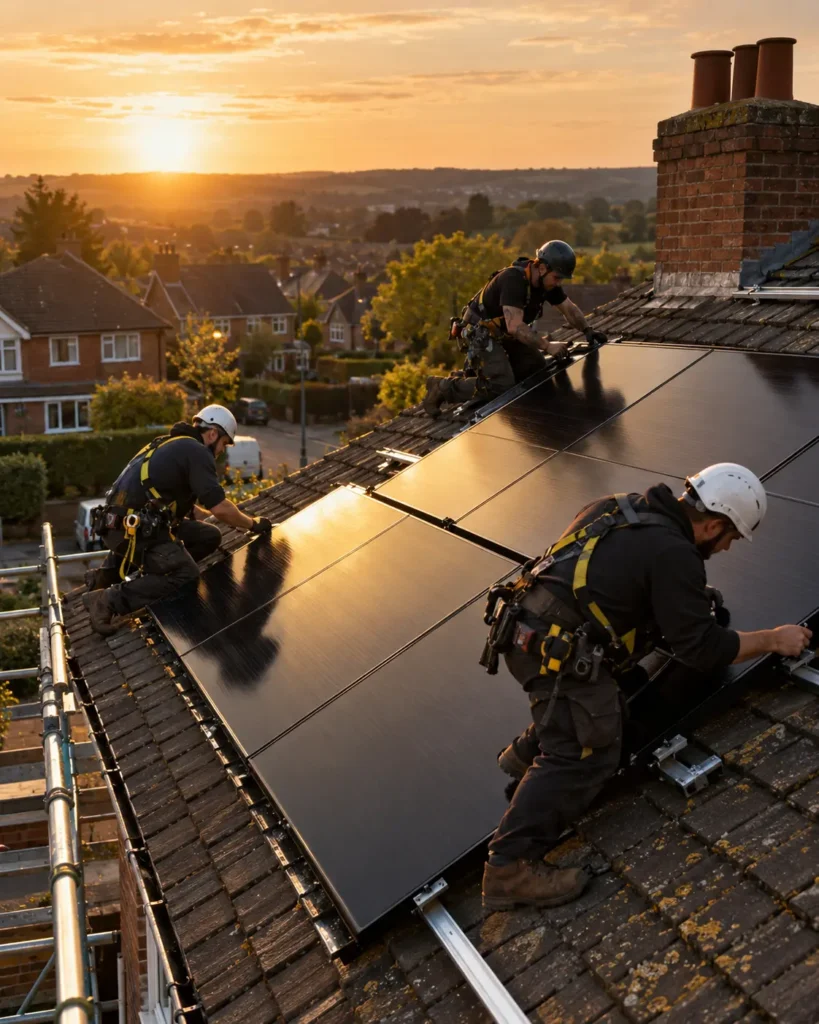
Typical domestic solar panel prices in 2026
There is no single correct price for every house. System size is measured in kilowatt-peak (kWp), the combined rated output of the panels under standard test conditions. The table below is a budgeting guide rather than a quotation.
| Approximate system size | Typical number of panels | Indicative installed price | Common fit |
|---|---|---|---|
| 2–3kWp | Around 5–8 | £4,000–£6,500 | Smaller homes or limited roof space |
| 4–5kWp | Around 9–12 | £6,500–£9,000 | Many typical UK family homes |
| 5–6kWp+ | Around 12–15+ | £8,000–£10,000+ | Larger homes or higher electricity use |
Energy Saving Trust’s current benchmark is about £7,600 for a 4.5kWp system. Recent UK market guides also place a typical three-bedroom installation broadly within the £6,500–£9,000 range.
The cheapest system is not automatically the best value. A larger array can make sense if you have suitable roof space and useful electricity demand. Higher-efficiency panels may be worth considering where roof area is restricted.
For the wider survey and installation process, see the domestic solar panel installation guide.
What is included in a domestic solar installation price?
A complete quotation should cover more than the panels themselves. Typical items include:
Solar PV modules
An inverter
Roof mounting equipment
Cables, isolators and electrical components
Scaffolding or access equipment
Installation labour
System design and performance estimates
Commissioning, testing and handover
Monitoring equipment or an app
Grid notification or application where required
Certification and warranty documentation
Scope matters. One installer may include scaffolding or monitoring while another treats them as extras. Comparing only the total price can therefore be misleading.
Use the solar panel installation quote guide to check specifications, exclusions, warranties and expected generation before accepting an offer.
What affects domestic solar panel cost?
1. System size and panel output
More panels usually increase the total price, although larger systems can cost less per kWp because some installation costs are fixed.
Size the array around usable roof space, current electricity consumption and likely future demand. If you plan to buy an EV or install a heat pump, tell the installer before the design is finalised.
2. Roof shape, height and access
A simple pitched roof is usually cheaper to work on than a high, split or awkward roof. Dormers, chimneys and several roof faces can increase design and labour time.
Flat roofs need a different mounting arrangement and may require ballast or structural checks. If this applies to your property, see the flat-roof solar panel cost guide.
3. Panel, inverter and optimiser choice
Premium panels usually cost more and can be useful when roof space is limited.
Inverter choice also affects price. A conventional string inverter is often cheaper than microinverters or optimiser-based systems. More advanced equipment may be useful on shaded roofs or arrays spread across different orientations.
4. Scaffolding and electrical upgrades
Scaffolding costs vary by property. Some houses may also need consumer-unit work, new cable routes or other electrical upgrades.
A good quotation identifies those costs before work begins rather than relying on a low headline price followed by additions later.
5. Roof condition
Solar panels are a long-term installation. If the roof covering is already approaching the end of its useful life, repairing or replacing it first can avoid the cost of removing and refitting the array later.
How much does solar battery storage add?
Battery storage is optional. Energy Saving Trust says a 5kWh battery costs around £4,600, while battery systems more generally can range from about £1,500 to £10,000 depending on capacity and specification.
A battery stores surplus generation for use later. It can also work with a time-of-use electricity tariff, allowing the battery to charge from the grid during cheaper periods.
However, a battery does not automatically improve the financial return from solar. Compare a solar-only quotation with a solar-plus-battery quotation and ask for the payback assumptions separately. Installing both together may reduce duplicated labour and integration costs.
How much can domestic solar panels save?
Your savings depend mainly on how much electricity the system generates, how much you use yourself and what you receive for exported electricity.
Energy Saving Trust’s current examples show payback periods of about nine years in London, around 10–11 years in Manchester and up to around 11–12 years in Stirling, depending on household occupancy. These figures include export payments and use fuel prices from July 2026.
Your result may differ because orientation, shading, location, electricity prices and usage patterns all matter. The generation forecast deserves as much attention as the purchase price. The solar panel output guide explains the main variables.
You may also earn money for surplus electricity through the Smart Export Guarantee (SEG). Ofgem explains that eligible small-scale generators can receive payments from SEG suppliers for electricity exported to the grid. Suppliers set their own rates, contract lengths and other terms. Read Ofgem’s Smart Export Guarantee guidance
VAT, grants and financial support in 2026
Installed domestic solar panels currently qualify for 0% VAT across the UK. HMRC’s published schedule shows the zero rate applying to solar panels until 31 March 2027, after which the treatment is scheduled to change unless policy changes again. Check the current GOV.UK VAT guidance
There is no universal cash grant available to every homeowner simply for purchasing solar. Support depends on location and eligibility.
In England, the Warm Homes: Local Grant supports eligible low-income households in privately owned homes with EPC ratings from D to G. Government figures show solar PV has been one of the most common measures installed through the programme. The wider Warm Homes Plan also includes support for low-income households and plans for low- and zero-interest finance for home upgrades. Read the Warm Homes Plan
Because schemes can change, confirm current government or local-authority eligibility before including financial support in your budget.
How to compare domestic solar panel quotes
Start by comparing the proposed system rather than simply looking at the total price. Ask each installer to provide:
Total system size in kWp.
Number, make and model of panels.
Inverter or microinverter specification.
Expected annual generation in kWh.
Assumptions for shading and roof orientation.
Full installed price and every exclusion.
Panel, inverter and workmanship warranties.
Whether scaffolding and electrical work are included.
Whether certification and grid paperwork are included.
Separate figures for solar-only and solar-plus-battery options.
MCS’s current solar PV standard covers the design, installation, commissioning and handover requirements for systems installed by MCS contractors. See the current MCS solar PV installation standard
Get Your Free Air Source Heat Pump Quote
Find the right air source heat pump solution for your home. Tell us a few details and our team will help you explore suitable options at a competitive price.
Quick to complete. No obligation.
Get your quote
Enter your details below and one of our team will get back to you.
Frequently asked questions
Find clear answers to common questions comparing air source and ground source heat pumps, including efficiency, installation and running costs, winter performance, noise, land requirements and borehole depth.
Energy Saving Trust currently gives an average figure of around £7,600 for a 4.5kWp system. Actual quotations depend on the property and specification.
A typical 4kW-class domestic system will often fall somewhere around £6,500–£8,000, although roof complexity, panel choice and electrical work can move the price higher or lower.
Many domestic systems use roughly 9–12 modern panels, but the correct number depends on panel wattage, available roof area and your electricity use.
Not necessarily. £10,000 may be high for a straightforward smaller system but reasonable for a larger array, premium equipment or a difficult installation. Always compare the system specification.
Often, but not always. Ask installers to state clearly whether scaffolding and access equipment are included in the quoted price.
Energy Saving Trust currently estimates around £4,600 for a 5kWh battery, although systems can range from approximately £1,500 to £10,000.
It can be. Installing both during the same project may reduce duplicated labour and integration costs.
Yes. Installed solar panels currently qualify for 0% VAT, with HMRC’s present schedule showing that treatment through 31 March 2027.
There is no single grant available to every homeowner. Assistance depends on location and eligibility, including schemes under the Warm Homes Plan.
Energy Saving Trust examples currently range from roughly nine to 12 years, depending on location and household usage.
Yes. Eligible households can receive export payments through the Smart Export Guarantee, although suppliers set their own tariffs and conditions.
Differences can come from system size, panel and inverter specifications, roof access, scaffolding, electrical work, warranties and battery storage.
They can be because flat roofs may require specialist frames, ballast or structural consideration. The final difference depends on the property.
Not on price alone. Compare system size, equipment, annual generation estimates, warranties, exclusions and installer credentials.
MCS certification is important for many homeowners because it provides a recognised installation framework and may be relevant to export-payment and consumer-protection requirements. Check the specific requirements of your chosen SEG supplier and installation arrangement.
Is domestic solar worth the cost?
Solar can make financial sense when the roof is suitable, the system is correctly sized and the household can use a meaningful share of the electricity generated.
Treat the current £7,600 average as a useful benchmark rather than a target price. A strong proposal should show exactly what you are buying, how much electricity the system is expected to generate and which assumptions sit behind the savings calculation.
If two quotations are thousands of pounds apart, compare equipment, system size, warranties, scaffolding, electrical work and generation forecasts line by line before deciding.
When you are ready, compare solar installation options with Get Free Quote and request a survey-based price for your property.


